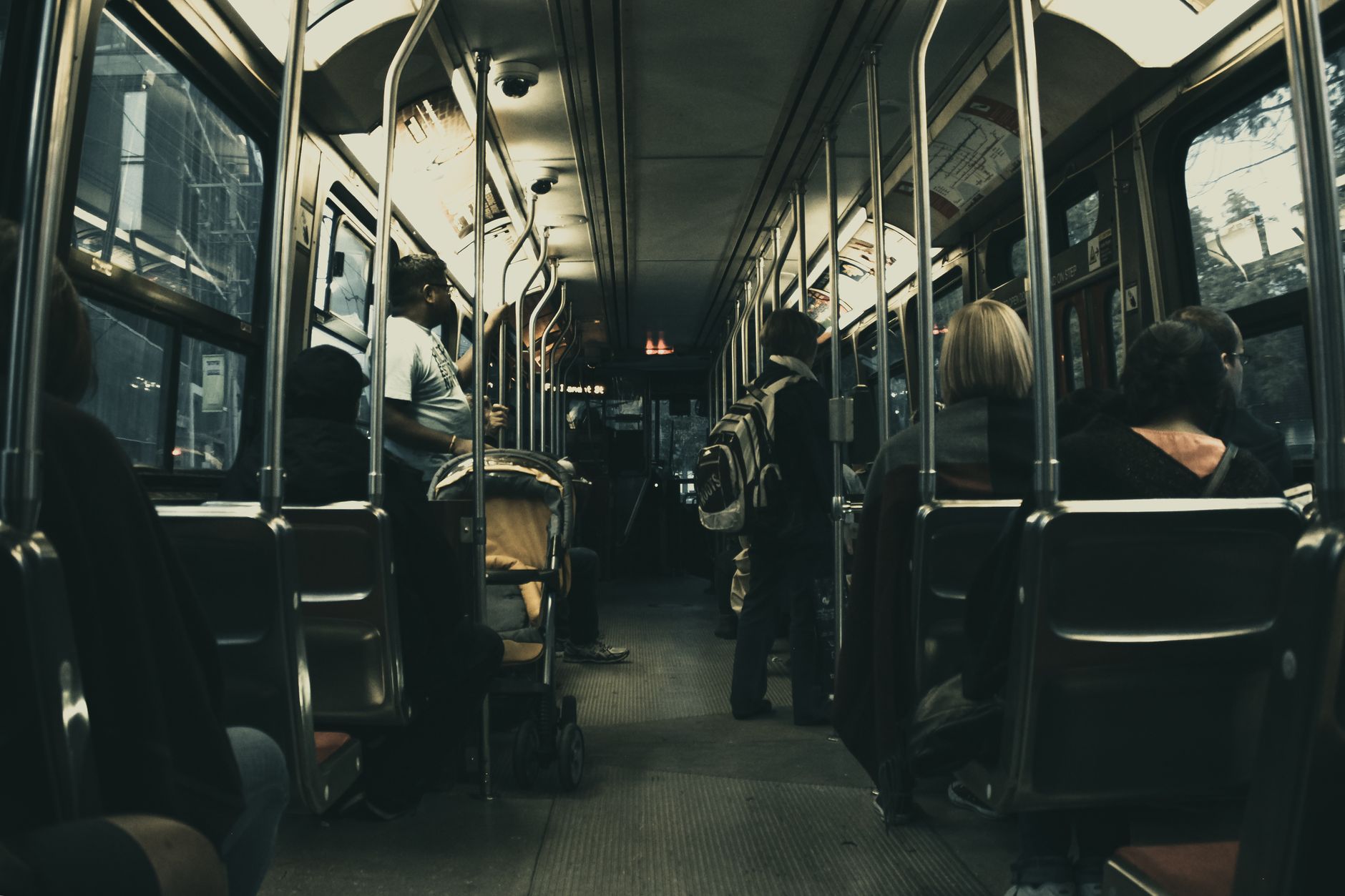
The Girl Who Gave Up Her Seat
I found out Michael Halloran died on a Tuesday morning in March, standing in my own kitchen in Millbrook, Ohio, with a coffee mug halfway to my mouth and my phone buzzing on the counter. His grandson Patrick texted me before the obituary even ran. He went easy, Em. In his sleep, at the house. He would have wanted you to hear it from us first.
I set the mug down and I did not cry right away. I just stood there in the kitchen that used to be my mother’s kitchen, in the house that Michael Halloran quietly helped us keep, and I thought about a yellow raincoat with a patch sewn on three times, and a city bus, and a morning seventeen years ago that I have never told all the way through to anyone. Not my husband. Not my own kids, who are six and four now and already asking why Grandma Sarah has a framed photo on her hallway wall of an old man with a cane standing next to a little girl in braids.
So I am going to tell it now, all of it, the way it actually happened, because a story like this deserves more than the version that gets picked apart and half-remembered at a funeral reception with paper plates of ham sandwiches. It deserves the whole thing, from a cold Tuesday in October when I was seven years old, holding my backpack against my chest like it might protect me from the world, to the box that arrived at my house four days ago with Michael Halloran’s handwriting on the outside of it for the very last time.
The Bus
I was seven years old the morning everything started, and it was my first time riding the Route 78 bus alone.
My mother, Sarah, had gotten a new job at Millbrook Regional Hospital eight months earlier, in the cafeteria kitchen, plating breakfast trays for patients who couldn’t get down to eat. Her shift started at 6:45, which meant she couldn’t walk me the six blocks to Lindale Elementary anymore, not if she wanted to keep the job, and we needed the job. My father, David Torres, had died two years before that, on the floor of the Halloran Tool and Die plant on a Thursday afternoon in April, his heart stopping between one stamping run and the next before the paramedics could get to him. He had worked there for eleven years. He liked the men on his line. He used to come home smelling like machine oil and tell me that a good day was one where nothing broke, and I did not understand until I was much older how much that sentence meant, coming from a man who worked with his hands for a living.
After he died, my mother took whatever hours she could find, and the hospital cafeteria job was the one that came with health insurance, so she took it even though it meant a 6:18 a.m. bus stop with her seven-year-old daughter in a yellow raincoat.
That raincoat had a patch near the left pocket. It had been mended three times by then, the stitching a little different each time because my mother wasn’t much of a seamstress and she’d learned as she went, and the thread scratched against my wrist whenever I moved my arm a certain way. I didn’t care. It was my coat. My father had picked it out at the church rummage sale the fall before he died, out of a box of donated coats that the ladies from Millbrook First Methodist put out every September, and I loved it because he had loved it, and because yellow was, in his words, “a color you can find your kid in a crowd.”
That morning my mother knelt down in front of me at the bus stop and gripped my shoulders the way she did when she was trying very hard not to fall apart in front of me.
“You get off right after the pedestrian bridge,” she said. “Count five stops. Don’t talk to anyone. Sit close to the driver.”
“Yes, Mom,” I said. I remember trying to sound older than I was, because I could see how much this cost her, sending me off alone on a public bus at seven years old, and I wanted to make it easier on her the only way a seven-year-old knows how, which is to pretend you are not scared.
She kissed my forehead, smoothed down the sleeve of that yellow raincoat, and stepped back onto the curb with the kind of smile mothers wear when they are holding something heavy behind their teeth.
I climbed on and took a seat near the front, by the window, and I held my backpack against my chest the whole ride, counting stops under my breath like she’d taught me.
One. Two. Three.
By the fourth stop the bus had filled up with the early crowd: shift workers half asleep against the windows, a nurse in blue scrubs holding a paper coffee cup like it was the only thing keeping her upright, a heavyset woman with two grocery bags wedged between her feet, a teenager in a hoodie with his phone six inches from his face. Nobody talked. Nobody looked at anybody. That’s just how the early bus was.
Then, at the fifth stop, an old man got on.
He didn’t look like anybody important. A gray wool coat, a simple blue scarf wound twice around his neck, a wooden cane that tapped softly against the rubber floor mat as he climbed the two steps up. His hands shook slightly around the handrail. His breathing was thin and effortful, like each step up onto that bus cost him something he didn’t have much more of.
There was an empty seat near the front marked for elderly and disabled riders, and a teenager was sitting in it with his eyes locked on his phone screen, and he did not move, and nobody around him moved either, and the old man had to grab the pole in the center aisle just as the driver hit the gas and the bus lurched forward. His cane slipped sideways on the wet floor mat. His whole body tilted, just for a second, and I heard the nurse across the aisle suck in a breath like she was about to jump up.
I froze in my seat.
My mother’s voice was in my head. Sit close to the driver. Don’t talk to anyone. That seat was my safety, the thing she had told me to hold onto, and every part of the plan she’d drilled into me at 6:18 that morning said stay put.
But I was looking at his hands. The way they shook around that pole, white-knuckled, and the way he was trying so hard not to let anyone see how much effort it was taking just to stand there. And I looked around at a bus full of grown adults, every single one of them finding somewhere else to look.
I don’t know exactly what made me stand up. I’ve thought about it for seventeen years and I still don’t have a better answer than the one I gave him that morning, which I’ll get to. But something in me decided that being a little bit afraid mattered less than a stranger falling down in front of a bus full of people who wouldn’t catch him.
I stood up.
“Sir,” I said, “you can sit here. It’s closer to the door.”
He looked at me the way you’d look at something you didn’t expect to find on an ordinary Tuesday. Like I’d handed him something rare.
“Are you sure?” he asked.
“Yes,” I said. “I can hold on.”
He lowered himself into my seat slowly, one hand braced on the seat back, his breath coming out in a long shudder of relief once he was down. As he settled in, his fingers brushed against the sleeve of my raincoat, right over the patch my mother had stitched three times, and I saw something move across his face.
It wasn’t surprise. I know what surprise looks like on a person. This was something quieter and older than that. Recognition, though I had no idea yet what he was recognizing.
“Thank you,” he said, and his voice had gone soft. “What’s your name?”
“Emily,” I told him. “My mom calls me Em when she’s tired.”
He smiled, just barely. “I’m Michael. You can call me Mr. Michael.”
“My grandma says I should be respectful to older people,” I said. “So. Mr. Michael.”
He laughed at that, a short real laugh, like it surprised him coming out of his own chest, like it had been a long time since something had gotten a laugh out of him that easily.
I didn’t notice the two men in the back of the bus at first. I noticed them later, when I looked back to check the stop count out the rear window, the way my mother taught me. Two men in black jackets, standing near the back doors instead of sitting, even though there were open seats. One held a phone loosely down at his side, not looking at it. The other one was watching everything: the patch on my sleeve, my scuffed school shoes, the little green Lindale Elementary emblem on the strap of my backpack, the way my lips moved silently as I counted the stops.
I didn’t know yet that they worked for Mr. Michael. I didn’t know yet that they’d been told, in no uncertain terms by his own sons, that he was not to ride that bus without them anywhere in sight, not after the surgery he’d had five months earlier, not with his heart the way it was.
At 6:31 the bus rolled past the sign for Lindale Elementary, still eight minutes from my stop, because my mother had me riding to the district’s before-school breakfast program instead, the one that opened at 6:45 for kids whose parents worked the early shift. At 6:33 I whispered “five” under my breath and reached up for the yellow cord.
“Are you riding alone?” Mr. Michael asked me.
“Yes,” I said. “My mom works early. We practiced. I know what to do.”
“And you weren’t afraid to give up your seat?”
I thought about that question longer than a seven-year-old usually thinks about anything. I remember feeling like it deserved a true answer and not just a polite one.
“A little,” I said. “But you needed it more.”
He looked down at his own shaking hands for a second, and when he looked back up his eyes had filled faster than he could get ahead of, and he turned his face a little toward the window like he didn’t want me to see it happen. I didn’t understand it then. I understand it now, after everything, better than almost anything else in this story.
The bus slowed at my stop. I stepped down onto the sidewalk, then turned around once before the doors folded shut.
“Get there safe, Mr. Michael!” I called out.
The doors closed. The bus pulled away down Route 78 toward downtown Millbrook, and I walked the half block to the breakfast program without thinking much more about it, because I was seven, and at seven a kind old man on a bus is a nice thing that happened, not the first page of the rest of your life.
I didn’t see what happened in the back of that bus after I got off. I only found out years later, from one of the two men in black jackets himself, a quiet man named Denny Vance who became something like family to us before it was over. He told me that after the doors closed behind me, he leaned toward his partner and said, low enough that Mr. Michael wouldn’t hear it over the engine: “Find out who that girl is.”
The Car Outside Our Building
Four days later, on a Saturday, a black sedan I didn’t recognize parked across from our apartment building on Kessler Street, and a man in a gray suit knocked on our door and asked for my mother by name.
My mother answered the door with a dish towel still in her hand and that particular tightness in her shoulders that single mothers get when a stranger in a good suit shows up unannounced, because in her experience strangers in good suits usually meant bad news, a lawyer, a collector, something taken away rather than given.
The man introduced himself as Aaron Whitcomb, and he said he worked for Michael Halloran.
My mother went very still when she heard that name. Everyone in Millbrook knew the Halloran name, the way you know the name of the river that runs through your town or the water tower with your school colors painted on it. Halloran Tool and Die had been the largest employer in Millbrook for three generations, ever since Michael’s grandfather opened the original stamping shop in 1938. My father had worked there. Half the fathers and mothers on our street had worked there, or still did.
“Is something wrong?” my mother asked.
“No, ma’am,” Aaron said. “Quite the opposite. Mr. Halloran would like to thank your daughter in person, if that’s something you’d be willing to allow. He’d also like a few minutes of your time, if you have it.”
My mother let him in, mostly out of the particular helplessness of a woman who does not know how to say no to a man who says her late husband’s employer wants to say thank you. I remember sitting at our kitchen table while Aaron explained, gently and without much detail at first, that Mr. Halloran had suffered a serious cardiac event five months earlier, a triple bypass that had nearly killed him on the table, and that his doctors and his own sons had more or less forced him, over his considerable objections, into a slow, deliberate program of getting back out into ordinary life. Short walks. Errands he used to do himself. And, against everyone’s better judgment, short rides on the public bus that used to run past the old plant, because he had ridden that route as a young man learning the business from the floor up, and something about it steadied him.
“He doesn’t usually talk to strangers on the bus,” Aaron said. “He mostly just rides and looks out the window. What your daughter did that morning is the first time in five months any of us have seen him laugh.”
My mother looked over at me, sitting there in my socks with my knees pulled up to my chest, listening to a grown man in a suit tell her that her daughter had made a stranger’s heart happier just by standing up.
“He’d like to invite you both to the house next Sunday,” Aaron said. “No obligation. Just a thank-you. He was very insistent that I make clear there’s nothing expected in return.”
My mother said yes before she’d fully decided to, the way you sometimes agree to things that some part of you already knows are going to matter.
The Coat Closet
The Halloran house sat on four acres at the edge of town, an old brick farmhouse that had been added onto twice, with a wraparound porch and a kitchen big enough to feed a wedding. It was less grand than I’d built it up to be in my head all week, and somehow that made it feel more real.
Michael Halloran met us at the door himself, leaning on the same wooden cane, wearing a cardigan instead of the gray coat, and he looked smaller and older in his own home than he had on the bus, the way people sometimes do once you see them outside the version of themselves they show the world.
“Emily Torres,” he said, like he’d been practicing my whole name. “Come in. I have something I want to show you.”
He led us not to a sitting room but out the back door, across the yard, to a converted garage that had been fitted out with clothing racks, cardboard bins, and a long folding table with a sewing machine set up at one end. Dozens of coats hung along the racks, all sizes, all colors, some clearly new and some clearly secondhand and lovingly patched.
“This was my wife’s project,” he told me, running his hand along a row of little kids’ coats. “Eleanor. She started it thirty-one years ago at the church, before it outgrew the church basement and moved out here. Every September and October, she and a group of volunteers would collect coats, mend what needed mending, and hand them out to any family in Millbrook who needed one. No questions asked. No forms to fill out. You just came and took what you needed and left with your dignity intact. That mattered to her more than almost anything.”
He picked up the sleeve of my yellow raincoat, the one I was still wearing, and turned it gently to show my mother and me the patch.
“Three stitches, reinforced at the corners so it doesn’t tear out again,” he said. “That’s Eleanor’s method. She taught it to every volunteer who ever sat at that table. I would know that stitch pattern in my sleep. I nearly did, the moment your hand brushed mine on that bus.”
My mother’s hand went to her mouth. She told me later, years later, that she’d gotten that coat for me from a box at the fall rummage sale at Millbrook First Methodist, the same year my father died, not knowing it had come out of a program that a dying woman named Eleanor Halloran had built with her own hands and then handed off to volunteers to keep running after she was gone.
“Eleanor passed five years ago,” Michael said. “Cancer. I kept the closet open because I couldn’t bring myself to close it, but I stopped coming out here myself. Couldn’t stand to. Then a girl on a bus gave up her seat to an old man she’d never met, wearing a coat with my wife’s stitching in the sleeve, and told me I needed it more than she did.” His voice caught on that last part. “I hadn’t cried since the funeral. I cried on that bus in front of a busload of strangers because a seven-year-old reminded me what my wife spent thirty years trying to teach this town, which is that kindness doesn’t check your resume first.”
Then he told us the rest, the part that changed everything for my mother and me in a way the coat closet story alone never could have.
“I know your husband’s name,” he said to my mother, gently, watching her face. “David Torres. Eleven years on the line, floor two, badge number 4471. I know it because I make it my business to know the names of the men who built this company alongside my father and me, even the ones I never got to shake hands with as often as I should have.”
My mother went white.
“I was in the hospital myself the week he died,” Michael said. “Recovering from the same surgery Aaron mentioned. I didn’t hear about David’s passing until I was already home, weeks later, and by then the moment to reach out properly had passed, and I let it pass, and that is one of the real regrets of my life. I should have been at that funeral. I should have made sure his family was taken care of the moment it happened, not stumbled into it seventeen months later because his daughter happened to give up her bus seat to a stranger who turned out to be her father’s employer.”
He looked at me for a long moment.
“You didn’t know any of that when you stood up for me,” he said. “You just saw an old man about to fall. That’s the part I can’t get over. You weren’t repaying a debt. You didn’t know there was one. You were just being decent, the way decent people are when nobody’s watching to give them credit for it.”
What Came After
I wish I could tell you the story ends there, with an apology and a coat closet and everybody understanding each other. But that Sunday afternoon was really just the beginning of something that lasted the rest of Michael Halloran’s life, and I want to tell it honestly, without making it sound like a check got written and that was that, because it was never about a check, even though there were checks, plenty of them, and I won’t pretend otherwise.
Within a month, my mother was offered a position in the benefits office at Halloran Tool and Die, full time, with insurance that covered more than the hospital’s plan ever had, at a wage that let her leave the 6:18 a.m. bus stop behind for good. Michael was careful about how it was offered. He didn’t want it to look like charity, and my mother, who has more pride than anyone I’ve ever known, would not have accepted charity if he’d offered it outright. Instead, the plant’s longtime benefits coordinator was retiring that spring, and my mother, it turned out, had a knack for the work and the patience for it that the job needed, and she got it on the strength of an interview like anybody else would have, even if Michael Halloran was the one who made sure she knew the opening existed.
He also set up something he called an education account for me, administered through the company rather than through him personally, the same kind of account other longtime employees’ children had access to if they qualified, except mine had a little extra sitting in it that I didn’t understand the size of until I was filling out my own college paperwork at seventeen and saw the balance.
But honestly, if you’d asked me at ten years old, or thirteen, or sixteen, what Michael Halloran meant to me, I wouldn’t have started with any of that. I’d have told you about Sunday dinners at the farmhouse, which became a standing thing within a year, my mother and me driving out most weeks unless something got in the way. I’d have told you he taught me to play chess at that same folding table in the coat closet garage, badly at first because his hands shook too much to reliably move the pieces where he meant to, and how he made me promise never to let him win, and how I never did, not once, not even after his hands got worse.
I’d have told you about the year I broke my arm falling off my bike on Kessler Street and he showed up at the emergency room before my mother’s shift even ended, because Aaron had called him the second the school nurse called my mother, and he sat with me in a plastic chair in the ER hallway telling me terrible jokes about doctors until I stopped crying.
I’d have told you he came to every school choir concert I was ever in, sitting in the third row on the aisle in a folding chair because his cane made the regular auditorium seats hard to get out of, and that he clapped louder than any other parent or grandparent in that gymnasium, every single time, even the years I was mostly background noise in a group of thirty off-key eight-year-olds.
I’d have told you he was, in every way that matters, the grandfather I did not otherwise have, my father’s parents having passed before I was born and my mother’s father having been out of the picture since before I could remember. Michael Halloran filled a space in my life I didn’t fully understand was empty until he filled it.
He never once, in seventeen years, tried to be my father. He was careful about that in a way I only came to appreciate as an adult. He talked about my father often, actually, made a point of it, kept a photo of David Torres from the plant’s employee wall in his own study, told me stories about running into my dad on the floor, about a joke my father apparently told at every safety meeting for a decade about a foreman who couldn’t find his own hard hat. Michael gave me back pieces of a father I was too young to have kept much of on my own, and he never once tried to replace what I’d lost. He just refused to let me lose more than I already had.
The Whisper in the Back of the Bus
I have to tell you now what actually happened in the back of that bus, on that first morning, after I stepped off and the doors closed behind me, because it’s the one piece of this story I didn’t have for a long time either.
Denny Vance, the quieter of the two men in black jackets, told me the truth about it on the day of Michael’s funeral, standing outside the church in the cold with his hands shoved in his coat pockets, the way men who are uncomfortable with grief often stand.
“When you got off that bus,” Denny said, “the boss just sat there a second, staring out the window at you walking away. And I leaned over to Aaron and said, ‘Find out who that girl is.’ That’s it. That’s the whole big whispered secret you probably built up in your head for years.” He almost smiled. “We weren’t planning anything sinister, Em. We were two guys whose whole job at that point was keeping an eighty-one-year-old man with a bad heart from getting hurt, and we’d just watched a seven-year-old do something for him that the two of us, with our earpieces and our protocols, hadn’t managed to do in five months, which was make him feel like a person again instead of a patient. We wanted to know who you were so we could say thank you properly. That’s all it ever was.”
I laughed when he told me that, because I’d spent years half-expecting some more dramatic explanation, and the real one was so much smaller and so much better than anything I’d imagined. Two tired men doing their jobs, quietly moved by the same thing that moved their boss, and neither one of them able to say so out loud on a crowded bus at 6:33 in the morning.
Losing Him
Michael Halloran lived to see me graduate from Millbrook High, sitting in that same folding chair he brought to every concert, clapping loud enough that I could pick his voice out of the crowd when they called my name. He lived to see me finish nursing school at Ohio State, four years after that, in a program I chose partly because of a hospital cafeteria job that started this whole story and partly because I wanted, in some way I couldn’t fully explain even to myself, to spend my working life the way he’d spent his last years, quietly making sure people were taken care of. He lived to walk me halfway down the aisle at my wedding, my mother on the other side, because he insisted a girl ought to have two people walking her in if her father couldn’t be one of them, and nobody in that church argued with him about it.
He met my daughter. He held her twice before his hands got too unsteady to trust with a baby, and he cried both times, unashamed of it by then in a way he hadn’t been on that bus seventeen years earlier.
His heart, the same one that had frightened his sons into hiring Denny and Aaron in the first place, finally gave out in his sleep at eighty-eight, in the farmhouse, in his own bed, four days before that box arrived at my door.
The box was waiting on my porch on a Wednesday afternoon when I picked my son up from preschool. Inside, wrapped in tissue paper that still smelled faintly of the cedar closet he kept it in, was a coat. A woman’s wool coat, gray, with a small mended patch at the left cuff, stitched three times, reinforced at the corners the way Eleanor Halloran taught every volunteer who ever sat at that folding table.
There was a note in Michael’s handwriting, shakier than it had been even a year earlier but still unmistakably his.
Em,
This was Eleanor’s coat. She mended it herself, the winter before she passed, using the same stitch she taught me to recognize on your sleeve on a bus I almost didn’t get on that morning. My sons think I’m sentimental for keeping it this long. I think a man’s allowed to be sentimental about the two people who taught him what it means to be looked after by someone who didn’t have to bother.
Keep the coat closet running. Teach your kids the stitch. And if you ever see somebody struggling to hold on while everybody else looks away, stand up. You already know it’s the right call. You knew it when you were seven, before anybody explained to you why it mattered.
Love, Mr. Michael.
I still run the coat closet out at the farmhouse every September, in the same converted garage, at the same folding table, and my mother comes most Saturdays to help sort donations even though she could easily be enjoying a quiet retirement instead. Denny still stops by sometimes, retired now himself, and he always makes a point of checking whoever’s working the sewing machine that day, joking that he’s inspecting for Eleanor’s stitch.
Last September, a woman came in with her granddaughter, maybe seven years old, looking for a coat before the weather turned. I found a yellow one in the bin, patched once already at the pocket, and I sat down at that table and reinforced the seam myself, three stitches, corners tucked, the way I was taught by a man who learned it from his wife.
I didn’t tell the little girl the whole story. She was too young for all of it, the same way I was too young, that Tuesday morning on Route 78, to understand what standing up for a stranger was going to cost me in the best possible way, or what it was going to give back a hundred times over. I just handed her the coat and told her it would keep her warm, and that if she ever saw somebody who needed her seat more than she did, she should give it up without thinking twice, because you never really know who you’re helping, or what they might spend the rest of their life trying to give back.
She put the coat on right there in the garage, patch and all, and ran back out into the yard to find her grandmother, and for a second, watching that yellow coat move across the grass toward the fall sunlight, I could have sworn I heard somebody laughing behind me, low and real, like it had been a long time since something had gotten a laugh out of him that easily.
It hadn’t. Not since a girl in a yellow raincoat gave up her seat on a bus and asked for nothing at all in return.