The Box My Husband’s Mother Threw Away
My mother-in-law Delphinia put my daughter’s ashes out at the curb with the trash while I was nine hours into a double shift at the hospital. When I asked her why, she looked at me the way she looks at a water ring on her good tablecloth and said, “You need to move on. It is not healthy keeping a box like that.” I am thirty seven years old. I live on Cedar Street in Winfield, Kansas. My daughter lived four days, two years ago, and that box was the only place I had left to keep her.
A trash truck was already two houses down when my neighbor Ansley Boze looked twice at what she saw sticking half out of our bin and pulled it out with her own two hands before the arm on that truck ever reached our curb. I did not know any of this yet. I was forty minutes from the end of my shift, drawing blood from a man with veins like wet string, when my phone buzzed against my hip with a text that made me set the tray down, walk straight to my charge nurse, and tell her I needed to leave right now and would explain later. She did not ask me twice. She has known me six years. She knew the look on my face was not a look I wear over nothing.
I drove home from Cowley Memorial in a kind of silence I do not have words for, the radio off, my hands doing the driving without any help from the rest of me. When I turned onto Cedar Street I saw Ansley sitting on my front step in her garden clogs with her little terrier’s leash looped twice around her wrist, and in her lap, held the way you would hold something that might still be warm, was a small cedar box the size of a loaf of bread. My husband Merrick built that box himself, in his shop out behind the garage, the week we came home from Wichita without our daughter, because he needed his hands to do something and there was nothing else in the world they knew how to do. He sanded it smooth as river glass and rubbed it with oil until the grain came up gold, and he never once talked about what it cost him to build it, and I never once asked, because some things a person does for you are better left as a kindness you simply accept.
Inside that box is not very much, and it is everything I have. A knit cap the size of my closed fist, made by a volunteer at the hospital who sits in a chair by a donation bin and knits caps for babies she will never meet. A plastic hospital bracelet with our last name printed wrong, an extra letter dropped in, that I have never had reprinted because it is the only proof in the world that she was admitted, that she existed on a chart, that a hospital somewhere has a record with her name misspelled and her weight and the time she was born. A single photograph, the only one we have, of three hands, mine and Merrick’s and one so small it does not look real until you have held one that size yourself. A footprint card, the ink a little smudged on the left foot because the nurse who took it was crying too and her hand was not as steady as she wanted it to be. And underneath all of that, wrapped in the folded blue baby blanket my own mother crocheted before we even knew if we were having a girl, a small plastic bag inside a smaller wooden urn no bigger than a coffee mug, which is what is left, in this world, of four days that were the center of my whole life before they were the center of my whole grief.
I am telling you what was in that box because I want you to understand exactly what a woman put out with a broken shop light and a bag of yard clippings, and exactly what she meant when she told me, standing in my own kitchen not two hours later, that it was not healthy for me to keep it.
I need to back up, because you cannot understand how a woman ends up sitting on her own front step holding her dead daughter’s ashes in a stranger’s borrowed evening light without understanding what the two years before it looked like, and what kind of family I married into to get there.
I grew up thirty miles from here, in a house with more brothers than bedrooms, and I met Merrick Tate at the Cowley County Fair the summer I was twenty six, standing in line for a corn dog behind a man who was arguing, patiently and at some length, with a carnival worker about whether a ring toss was rigged. It was rigged. He knew it was rigged. He argued anyway because he does not like to let a small unfairness pass unremarked, even one that costs him three dollars and a stuffed bear he did not want. I married that man two years later in the yard of the house on Cedar Street that his grandfather built, under a cottonwood tree that is older than the town’s oldest church, and we have been married nine years this coming October. He works line crew for the rural electric cooperative, the kind of job that means he is gone three or four days at a stretch whenever a storm takes down wire somewhere in this end of the state, and the kind of job that means when he is home, he is fully, entirely home, in a way I have never once taken for granted.
We tried four years for a baby before we ever saw two lines on a test, and I will not walk you through every one of those years because grief that long deserves its own telling and this is not that story. What matters is that when it finally happened, it happened the way everything worth having happens to people like us, quietly, on an ordinary Tuesday, with no fanfare and no warning of what was coming after. I carried her thirty weeks before my body decided it was done carrying her, and she was born ten weeks early on a Thursday night at a hospital in Wichita, because our hospital here in Winfield is not built for what a baby that small needs. She weighed two pounds eleven ounces. Her heart, the doctors told us within the first hour, was missing a piece of itself that a heart needs to do its work, a defect so severe that the surgery that might have helped a stronger baby was never going to be an option for one as small as she was.
She lived four days. I am not going to describe those four days to you in the kind of detail some people might want, because those four days do not belong to strangers, and because the parts of them worth keeping are not the parts a story needs to be dramatic. What I will tell you is that on the fourth night, a nurse who had cared for her since the first hour, a woman I still write a Christmas card to every year, asked us gently if we wanted to hold her without any of the wires and monitors, just for a while, just the three of us. We said yes. And that is how she died, in my arms, with Merrick’s hand on my shoulder and hers, without pain, in a dim room in Wichita, at forty minutes past two in the morning, in more peace than I had any right to expect for a night that broke something in me that has never fully gone back together.
We drove home to Winfield two days later with an infant car seat still strapped in the back of Merrick’s truck because neither one of us could bring ourselves to take it out yet, and a nursery down the hall from our bedroom that had a crib in it and a mobile of soft felt stars and no baby to put in either one. I could not walk past that room for the better part of a month. Then one Saturday I did walk into it, and instead of packing it away in boxes the way some people might expect a woman to do, I did the opposite. I kept it. Not as a nursery anymore, but as the one room in the house where I did not have to pretend, for anyone, that I was fine. Merrick built a low shelf along the far wall out of the same cedar as the box, and on it we set the box itself, the framed photograph, a small rocking chair that had belonged to my grandmother, and a single houseplant that has somehow, against every instinct I have for keeping things alive, thrived in that room for two years. On hard days, and there are still hard days, I sit in that chair with the box in my lap. On the anniversary, I carry it out to the cottonwood tree in the backyard and sit under it until the light changes, because that tree was there the day I married her father, and it feels like the right kind of witness.
That room, and that box, were never a secret in this family. Everyone who has ever sat in my kitchen knows what is down that hall. What almost no one in this family has ever fully accepted is that I was allowed to keep it there.
Delphinia Tate has had a key to this house since the week Merrick and I moved into it, nine years ago, a housewarming gift she gave herself and never once offered to return, and for most of those nine years I let that be a small, ordinary friction instead of the fight it probably should have been. She let herself in to leave a casserole, to water a plant while we were traveling, to drop off a package that had been delivered to her house by mistake, and I told myself, the way I imagine a lot of women tell themselves, that a mother-in-law with a key was simply the price of marrying a good man from a close family. I mentioned it to Merrick more than once over the years, carefully, the way you mention a thing you do not want to turn into a bigger argument than it is. He always said the same thing. She means well. She just likes to feel useful. I believed him, mostly, because for nine years the worst that key ever produced was a rearranged spice cabinet and a Tupperware of chicken and rice I did not ask for.
Delphinia is the kind of woman who irons pillowcases and believes, without ever quite saying it out loud, that a well-run house is a kind of moral achievement. She raised Merrick and his sister alone after their father left, on a schoolteacher’s salary, in a house that was always spotless no matter what else was falling apart around it, and I understand, in the part of me that tries to be fair to her even now, that a woman who survives that kind of decade learns to believe composure is the same thing as strength. What she has never understood, in two years of trying, is that my grief was never a lack of composure. It was the one honest thing I had left.
From the very first month, she had opinions about how I was doing it wrong. She thought the memorial service should have been smaller, more private, less likely to draw sympathy she considered excessive from people who barely knew us. She thought I went back to work too soon, and then, four months later, she thought I had stayed home too long. She would come by on a Sunday, glance down the hall toward that closed door, and say something like, “You know, some time away from that room might do you good,” in the particular voice she uses when she has already decided something is a fact and is only waiting for the rest of us to catch up. Twice, over two years, she used almost exactly the same words she used to me in my kitchen that day. Once at Thanksgiving, quietly, while I was pulling a pie from the oven and could not walk away from her. Once at church, in the parking lot, where she could keep her own voice low and pleasant while she told me it was time I let myself heal. I never fully told Merrick how many times, because I did not want to make him choose between us over words, and because some part of me, the part raised to keep peace in a house with more brothers than bedrooms, kept hoping she would simply stop on her own.
She did not stop. She escalated, and she waited for the one window in nine years when nobody would be home to see her do it.
The window came the second week of June. Merrick’s cousin’s family, five of them, were driving in from Nebraska for the Tate family reunion at the Cowley County fairgrounds, the kind of gathering this family has held every other summer for as long as anyone can remember, and with our own house being the only one on that side of the family with a real spare room, it had been decided, mostly by Delphinia, that the cousins would stay with us for three nights. At the same time, one of the other phlebotomists at Cowley Memorial went out on sudden medical leave, and I picked up her shifts on top of my own, three twelve hour days back to back, the kind of stretch where you come home and fall asleep still wearing your shoes. Merrick’s crew got called out the same week to help restring line in Barber County after a storm tore through, four days away, staying in a motel with spotty cell service and a schedule that had him up before dawn and asleep before I ever got a call returned.
Delphinia had, by her own account later, decided that the spare room simply could not stay the way it was with out-of-town family sleeping in it. She has told me since that she meant to be helpful. She has told me she thought a fresh coat of paint, a cleared shelf, and a room that looked like a guest room instead of what she called, more than once, a shrine, would spare the visiting cousins any awkwardness and spare me, in her words, the embarrassment of strangers seeing how I had chosen to grieve. She let herself in on the Thursday morning of that week with the key she had never given back, while I was already at the hospital starting the second of my three doubles, and while Merrick was six hours away restringing a line he could not leave to answer a phone. She cleared the shelf. She took down the photograph, the rocking chair, the houseplant, and set them in the hallway. And then, because to her eye a small unmarked wooden box sitting where a lamp or a stack of towels belonged was simply one more piece of clutter standing between that room and the guest room she had decided it needed to become, she carried it out with an armload of other things she judged fit to throw away, a cracked lampshade, a box of baby clothes she assumed I no longer wanted, a broken shop light from Merrick’s garage, and she set all of it at the curb for the Thursday morning pickup, the same way she has set out trash at her own house every week of her life.
I did not know one single thing about any of it. I spent that Thursday on my feet from six in the morning until past two in the afternoon, drawing blood, running samples, doing the small unglamorous work that keeps a rural hospital running, thinking about nothing more urgent than whether I would have the energy to shower before my next shift started. Cedar Street was thirty minutes away and a whole life away from where my body was standing.
Ansley Boze has lived across the street from us for eleven years, in the pale yellow house with the porch swing, and she is one of the few people in this town who has never once made me feel like my grief needed managing. She taught fourth grade at the elementary school for thirty two years before she retired, and she has the particular gift some teachers have of noticing children and grown adults alike without seeming to be watching at all. She has seen me, more than once over the past two years, carry that same cedar box out to the cottonwood tree in our backyard and sit under it for an hour with my knees pulled up to my chest, and she has never once come over to ask about it, because she told me once, early on, that grief a person is tending is not the same as grief a person needs rescued from, and she meant to let me tend mine in peace. She knew exactly what that box was, and exactly what it meant, the moment she saw a corner of pale cedar wood sticking up out of a garbage bag at the edge of our bin.
She was walking her terrier past our house that Thursday morning, the way she does most mornings before the heat sets in, when she noticed our bins were already at the curb, hours earlier than we usually set them out, because Delphinia had rolled them down herself before she left for her own errands. Ansley told me later she almost did not look twice. It was the shape of it that stopped her, a corner of pale wood at an angle no lampshade or broken light fixture would sit at, tucked between a bag of yard clippings and that shop light with its cord still coiled around it. She walked closer. She recognized the grain of that cedar the way you recognize a friend’s handwriting, because she had stood at her own kitchen window more than once and watched Merrick sand that very box in his garage two years ago, and she had watched me carry it out to that tree enough times that its shape was simply known to her, the way a neighbor’s car or a neighbor’s dog is known.
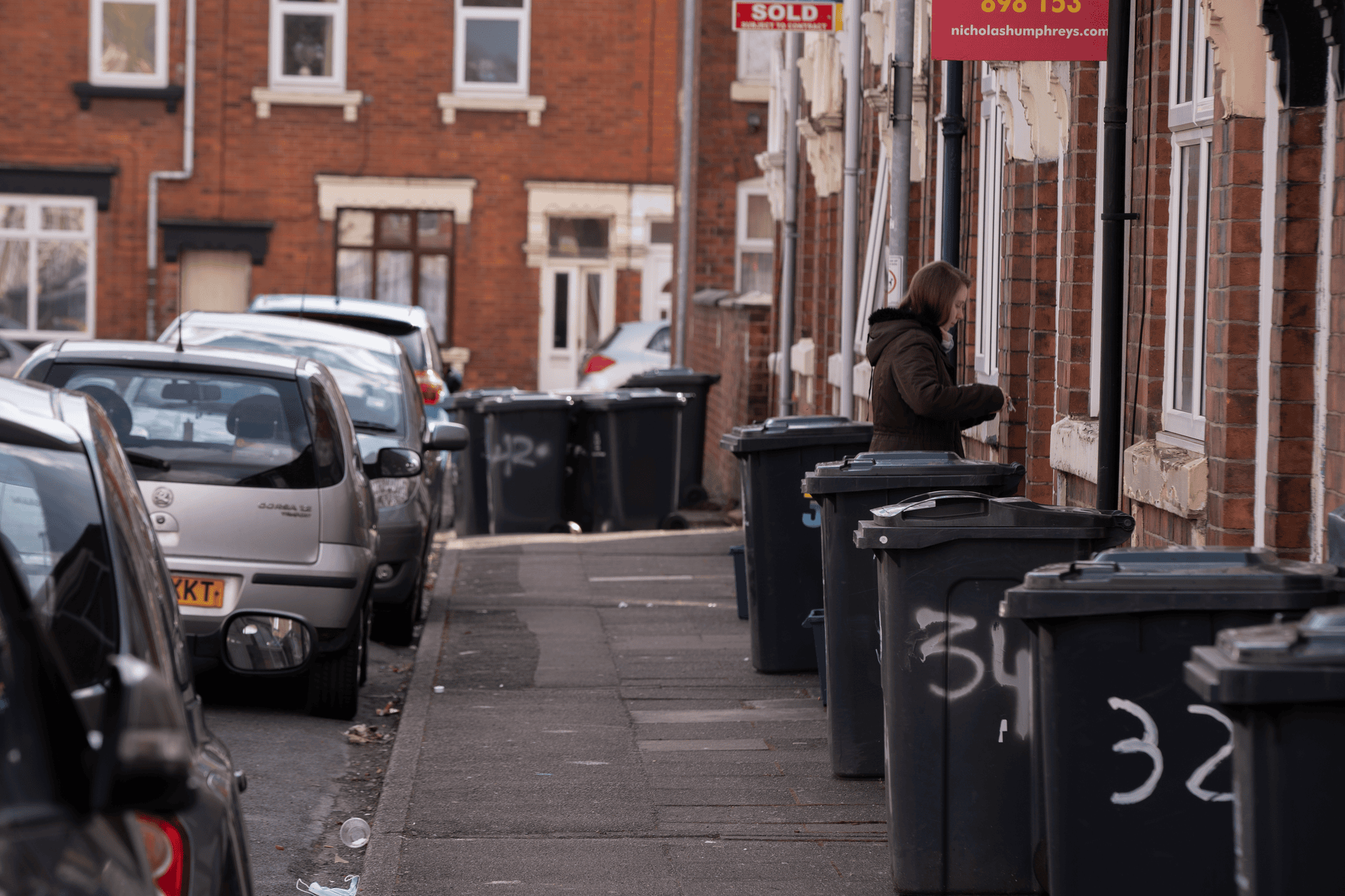
She was still standing there working out what she was looking at when she heard the truck two houses down. Cowley County runs its Thursday route early on our street, and Ansley told me the arm on that truck was already lifting the bin two doors up when she reached into ours, pulled the whole bag up by its top, and set it down flat on the grass rather than risk trying to dig the box out with the truck bearing down. She told me she did not think about it, exactly. She said her body simply moved before the rest of her had finished deciding, the way yours does when a child steps toward a road. She waved the driver on with her free hand, told him it was fine, everything he needed was still at the curb, and stood there on our lawn with a bag of garbage at her feet and her dog’s leash wound twice around her wrist while the truck rolled past and lifted our other bin without incident, none the wiser that it had come within two houses and perhaps ninety seconds of taking the only physical thing left of my daughter to a landfill outside Arkansas City.
She sat right down on the grass and went through that bag by hand until she found the box, and then she carried it inside her own house and set it on her kitchen table while she tried to decide what to do next, because she did not yet know whether I had done this myself, in some private moment of trying to move forward that was none of her business, or whether something else entirely had happened. She has since told me she almost did not text me at all that morning, out of respect for whatever choice she thought I might have made. What changed her mind was walking back outside twenty minutes later and finding the rest of what had come out of that room, the photograph frame with a hairline crack from being tossed in with the garbage, the rocking chair set out on the curb strip itself as if for anyone driving by to take, and the box of baby clothes I had, in fact, still very much wanted. No woman clearing out her own daughter’s memory, Ansley said, throws out the chair her grandmother rocked in along with it. Someone else had made this decision, and made it while I was nowhere near home to stop it.
She texted me at ten past eleven that morning. I still have the message. It says only, Novie, please call me when you get a break, it’s important, I have something of yours. I called her from the break room forty minutes later, between patients, and by the time she finished telling me what she had found sitting in that bin, I had already told my charge nurse I was leaving.
I do not remember most of the drive home. I remember pulling into my own driveway and seeing Ansley on my front step, the box in her lap, her dog asleep at her feet in the shade, and I remember getting out of my car and walking toward her without any memory of closing the car door. She stood up and held it out to me with both hands, the way you would hand someone something alive, and she said, “It’s all here. I checked. I didn’t open the little bag inside, I didn’t think that was mine to do, but it’s all here.” I sat down on my own front step and held that box against my chest and I do not know how long I sat there before I was able to say anything at all, and Ansley sat beside me the whole time and did not say one word she did not need to say, because some people understand that the kindest thing you can do for a person in that moment is simply not leave.
It was Ansley, gently, who told me she thought Delphinia’s car had been in our driveway earlier that morning. It was Ansley who told me about the photograph frame and the rocking chair and the box of baby clothes still sitting curbside, all of it now carried back onto my own lawn by her own two hands while she waited for me. I understood, sitting on that step with the box in my lap, exactly what had happened and exactly who had done it, before I ever walked back inside my own house.
Delphinia’s car pulled into my driveway a little after four that afternoon. She came back, she told me later, because she had left a can of paint in my garage that morning and wanted to retrieve it before the weekend, and because some part of her, I think, wanted to see the finished guest room and be thanked for it. She got out of her car with a bag from the hardware store in one hand, saw me sitting on my own front step with the cedar box in my lap and Ansley’s dog still lying in the shade beside me, and I watched her face do the thing faces do when a person realizes, all at once, that the story they had been telling themselves does not match the room they have just walked into.
I asked her, as evenly as I have ever asked anything in my life, whether she had put this box out with the trash. She did not deny it. I want to be fair to her and say that much, because she has never once, through everything that came after, tried to claim it was an accident or that she had not known what was inside it. What she said instead, standing in my own driveway with a can of paint still swinging from her hand, was, “I did it for you, Novie. You need to move on. It is not healthy keeping a box like that.” She said it the second time slower than the first, the way you repeat something to a person you believe simply has not understood you yet, and I understood, hearing it that second time in full daylight instead of in memory, that she believed every word of it. She was not cruel by accident. She had decided, over two years of careful, private judgment, that my grief had gone on long enough to embarrass this family, and she had finally found a week with nobody home to stop her from fixing it herself.
I did not raise my voice. I want you to know that, because I have thought since about what I might have said if I had let myself shout, and I am glad, on reflection, that I did not give her that. What I told her instead was that she did not get to decide what was healthy for me to keep, that the box in my lap was not clutter and never had been, that a photograph frame does not end up cracked and a rocking chair does not end up on a curb strip by accident when a person is being careful with what belongs to someone else, and that the only reason I was holding my daughter right now instead of standing at a landfill fence with nothing left to hold was that a neighbor who is not even blood to this family loved me enough to look twice at a garbage bag. I told her the key she had carried in her purse for nine years was done. I told her that if she ever wanted to see the inside of my home again, she would knock on the door like anyone else, and wait for someone to answer it.
She tried, in the moment, to tell me I was being dramatic, that she had only meant to help, that a grown woman ought to be able to put a box like that somewhere less prominent without accusing her own family of cruelty. I told her that a grown woman gets to decide for herself what less prominent means in her own house, and that the day she decided for me, without asking, was the day she stopped being welcome to decide anything in this house at all. She left without the can of paint. I have not given it back to her, and I do not intend to.
Merrick got the call from me forty minutes later, standing outside a motel room in Barber County with a plate of gas station food going cold in his hand, and Ansley has told me since that even secondhand, over the phone, three hundred miles away, she could hear something in his voice change in the first ten seconds of that call. He did not finish his shift that day. He told his foreman what had happened, in about as many words as I have just told you, and the man who has known Merrick eleven years told him to go, that line could wait, that this could not. He drove back that same night, six hours, arriving at nearly one in the morning to find me still sitting up at the kitchen table with the box between us and Ansley’s casserole dish, the one she had brought over that evening so I would not have to think about supper, still half full on the counter.
I will not pretend the days after that were simple. Merrick sat with his own mother two days later, alone, at her kitchen table, and told me afterward only the shape of what was said, because some of what passes between a man and the mother who raised him alone is not mine to repeat in full. What I know is that he told her the key was gone for good, that any visit to our house from now on would happen because we invited her, not because she let herself in, and that the next time she had an opinion about how I grieved, she would keep it inside her own house the way she expected the rest of us to keep our feelings inside ours. I know that he told her, in words I do trust him to have used because I have heard him use them with me, that she had not helped me move on. She had simply proven, in the clearest way she ever could have, exactly why I needed that room in the first place.
Delphinia has not fully apologized, not in the way some stories like to end, with tears at a kitchen table and everyone forgiven by the final page. What she has done, in the weeks since, is stop saying the words move on to my face, and start, once or twice, asking Merrick real questions about how I am doing instead of announcing to him what she has decided I must be feeling. She sent, through Merrick, a card the week after, three lines long, that said she was sorry for what the moment had cost me, though she still believes, and told him she still believes, that she meant well. I do not know yet what to do with a person who can hold both of those things at once, sorry for the cost and certain of her own good intentions, and I am not in a hurry to decide. Love does not require me to hand her a key back before she understands, fully, what she took was never a box.
The room is different now. Merrick and I repainted it together the following weekend, a soft green instead of the pale yellow it had been, and he built a second shelf, taller and set with a small brass lock on the glass front, not because we expect to need it again but because some doors are worth being able to close properly. The photograph sits behind that glass now, the crack in its frame replaced with new glass Merrick cut himself. My grandmother’s rocking chair sits exactly where it always did. And in the backyard, under the cottonwood tree that watched me marry Merrick nine years ago, we planted a small dogwood the week after, a tree with roots too deep and too public to ever be mistaken for clutter by anyone standing in our yard, ours to tend for as long as this house is ours.
Ansley and I have coffee on her porch most Saturday mornings now, which we did not do before, and I have told her more than once that I do not know how to properly thank a woman for ninety seconds of paying attention that another person would have let pass by. She always waves it off the same way. She tells me she did not save anything. She tells me she only looked twice at something that did not look right, the way she spent thirty two years learning to look twice at children who did not look right either, and that the saving part, the part where a small wooden box did not end up buried under a county’s worth of garbage outside Arkansas City, that part was mine and Merrick’s and nobody else’s, built two years before she ever crossed that street to hand it back to me.
I still carry that box out to the cottonwood tree on hard days. I sit in my grandmother’s chair some evenings with it in my lap and I do not explain that to anyone anymore, because I no longer owe an explanation to a single person for how I choose to keep what is left of four days that changed the whole shape of my life. My daughter lived four days. I have grieved her for two years and I expect, honestly, to grieve her in some quiet corner of myself for the rest of however many years I am given, and I have stopped waiting for anyone’s permission to call that healthy. It is not a box of clutter sitting behind a locked glass shelf in a green room at the end of my hall. It is the only room in this house where love and grief have never once had to explain themselves to each other, and as long as I live on Cedar Street, it will stay exactly that, and it will stay exactly mine.
This story is a dramatization. Names, characters, and details are invented, and any resemblance to real people or events is coincidental.