
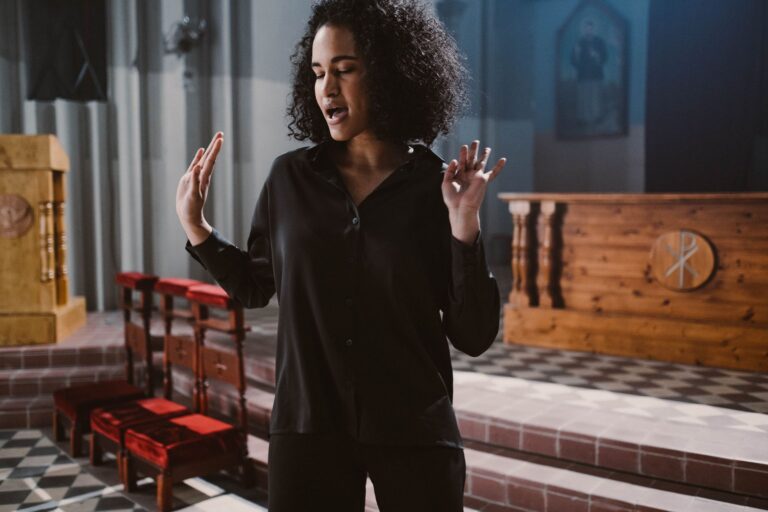
My name is Zephyrine, I am thirty-one years old, and I have spent the last six years of my life running the youth choir at New Bethel Missionary Baptist Church here in Greenwood, Mississippi, on money nobody in that church ever gave me. I want to tell you exactly how I lost that ministry in front of forty people on a Tuesday night in March, and exactly how I got it back, because the getting it back is the part that still makes me put my hand over my mouth when I think about it too fast.
But I have to start with the losing, because the losing is where the truth was hiding the whole time. It had been hiding in plain sight, in a folder in a church office nobody thought to open, for six years.
The finance committee meeting was open to the whole congregation that month, which was not unusual. Twice a year New Bethel does what our new finance chair, a man named Wendon Hollibaugh, called “full transparency,” which meant anybody who wanted to sit through two hours of line items in the fellowship hall under the buzzing fluorescent lights could come and watch him read the church’s money out loud like a court reporter. I went because I always went. I sat in my usual folding chair, third row back, with my choir folder still in my lap because I had come straight from Tuesday rehearsal, forty-eight minutes late already, my good church shoes still smelling like the gravel lot behind the annex where I park so the kids can have the spaces close to the door.
Wendon Hollibaugh is not a cruel-looking man. I want to be fair about that, because it would be easy to tell you he had a mean face and let you build a villain out of your own imagination, and that would not be honest. He is maybe forty-five, trim, wears a tie to church business meetings when nobody else does, and he moved to Greenwood two years ago to run the regional branch of a bank on Howard Street. He joined New Bethel with his wife and became finance chair inside of a year because, and I heard the deacons say this themselves, admiringly, “the man actually knows how to read a balance sheet.” Before Wendon, our books were kept the old way, in a green ledger and a shoebox of receipts and a treasurer’s memory, and it worked, mostly, the way a lot of things in a small Delta church work, on trust and casseroles and nobody wanting to embarrass anybody. Wendon came in with spreadsheets. He color-coded things. For the first year I thought, honestly, that the church needed him.
By the time he got to my line, the room had already watched him trim two other ministries that year, the same flat, reasonable voice both times. He had cut the mission trip’s line in half in January, calling it “duplicative with what the district association already funds,” and in February he had eliminated the small stipend the church used to pay a retired schoolteacher to run Vacation Bible School crafts, saying volunteers should volunteer, that was the word he used, “should.” Nobody had fought him on either one, partly because he was usually right about the math, and partly because there is a particular kind of quiet that settles over a small church when a newcomer arrives who is better with numbers than anyone who has been there thirty years. You start to doubt your own instincts around a man like that. You start to wonder if the thing you always believed was ministry was actually just inefficiency wearing a choir robe.
He got down the list that Tuesday night, reading dollar figures off a laptop connected to a little portable projector propped on a music stand, the numbers thrown up crooked on the fellowship hall’s cinder block wall. Building fund. Utilities. Pastor’s discretionary. Missions. Ushers’ uniforms. And then, “Youth Choir Ministry,” and under it, in red, a zero.
He didn’t even look up at first. He said, “This is a line I’m proposing we eliminate going into the new fiscal year,” the same flat voice he’d used for every other line, like it was nothing, like it was a magazine subscription nobody read anymore. Then he did look up, and he looked right at me, because everybody in that room knew whose line it was, and he said the sentence I have turned over in my hands every day since. He said, “With respect to Miss Zephyrine’s dedication, I think we all know this has become more of a hobby than a funded ministry, and this board has a responsibility to stop carrying line items nobody’s accounting for.”
A hobby.
I want you to understand what six years looks like before I tell you what it felt like to hear that word out loud, in front of my pastor, in front of Deacon Rooks, in front of the mothers of the church in their good hats even though it was a Tuesday, in front of half the choir’s own parents, sitting in folding chairs eating pound cake off paper plates.
I grew up in that choir loft. Not this choir, the grown choir, the Voices of Zion, up behind the pulpit where I stood next to my grandmother every Sunday of my childhood in a Delta town where the cotton still grows right up to the edge of the parking lots and the heat sits on you like a hand from May to October. My grandmother raised me after my mother passed when I was nine, in a shotgun house two streets off Grand Boulevard under those big old oaks, and church was not a place we went, it was the shape our whole week was built around. Wednesday night Bible study. Thursday choir rehearsal. Friday she’d have me help her iron the choir robes for Sunday, and she taught me, standing at that ironing board, that the robe you press for somebody else is a kind of prayer too, even if nobody ever sees your name on it.
Get a new story in your inbox every morning.
Facebook doesn’t show you every story we post. Our free newsletter does. Join 2,500+ readers.
The youth choir back then was strong. Twenty-some kids, a real director, a piano that stayed in tune. But church youth choirs are fragile things, more fragile than anybody who hasn’t run one understands, because they run entirely on one or two adults who are willing to give up every Tuesday and Thursday evening of their lives for free, year after year, for children who are not their own, and when that adult burns out or moves or dies, the whole thing can go from twenty kids to nothing inside of eighteen months. That is exactly what happened at New Bethel. The director before me, a wonderful woman I loved, had a falling out with the old music ministry over instrumentation, contemporary praise songs versus the traditional hymns, the kind of church fight that sounds small from outside and splits families from inside, and she left, and she took most of the choir’s momentum with her. By the time I was twenty-five, the New Bethel youth choir was down to two children singing “This Little Light of Mine” a cappella on fifth Sundays because there was nobody left to accompany them and nobody left to recruit anybody new.
I was twenty-five. I was working as a teacher’s aide at the elementary school on Grand Boulevard, making not quite enough money to call comfortable, still living two streets over from where I grew up, and I remember standing in the back of that near-empty sanctuary on a fifth Sunday watching those two children sing by themselves and feeling something in my chest that I can only describe as my grandmother’s hand on the back of my neck, the way she used to steer me when I was small and about to walk somewhere I shouldn’t. She had passed three years before that, but I heard her plain as anything. Somebody has to.
Deacon Rooks is the one who ordained the whole thing, though he’d tell you God did, and he wouldn’t be wrong either. He had known my grandmother fifty years, served as a deacon at New Bethel since before I was born, and he was the one who found me in the fellowship hall after that fifth Sunday, still in my choir robe from grown choir, wiping my eyes over a cup of church coffee, and he said, “Baby, you got something in you that wants to fix this. I can see it on you.” I told him I didn’t have the training, I wasn’t a music director, I’d never led anything. He said, “You don’t need training to love children in tune. The rest you’ll learn.” He was the church’s financial secretary back then, kept the books himself in that green ledger, and he told me the church could put fifty dollars a month in a youth choir line, no more, times were tight, the roof fund was eating everything. Fifty dollars a month does not buy robes. It does not buy sheet music, or gas for the van, or entry fees for the state youth choir festival in Jackson, or a keyboard when the old one finally died in the middle of a Christmas cantata rehearsal with a sound like something dying inside it.
So I did what I imagine a lot of women in small churches all over this country have quietly done for a hundred years, and I never once thought of it as remarkable while I was doing it. I paid the difference. Robes off a wholesale website, forty dollars each, twenty-four of them by the time the choir grew back, out of my own paycheck, a few at a time, whenever I could. Gas for the fifteen-passenger church van on festival Saturdays, because Deacon Rooks would hand me the little discretionary fifty and it covered maybe a third of the tank. Sheet music. A folding table for the fellowship hall snack spread after rehearsal, because hungry children do not sing well and I was not going to let a child leave my rehearsal hungry on my watch. Entry fees for the Mississippi Baptist State Youth Choir Festival in Jackson, sixty dollars a head, twenty-two children the year we finally had twenty-two children. A used keyboard I found through a music teacher friend in Grenada, four hundred dollars I put on a card and paid off six months at a time.
Deacon Rooks would ask me, every single year around budget time, to turn in my receipts so the church could reimburse me at least partway. And every single year I told him no, or I’d hand him a folder and then tell him to keep the money in the general fund, put it toward something the roof needed, or the widows’ ministry, or whatever else was short that quarter. I was not trying to be a martyr about it. I want to be honest with you, because false modesty is its own kind of pride and I don’t want any part of it. I told myself, and I believed it, that a church struggling to keep its lights on did not need to be handing fifty-year-old widows’ grocery money to a woman with a steady paycheck and no children of her own to feed. I told myself the choir line reading zero every year was just arithmetic. I did not understand, not until much later, that it was also a kind of hiding, that somewhere in the middle of doing right by my church I had also stopped letting anybody see me at all.
There is a verse my grandmother had taped inside her Bible, Matthew chapter six, about not letting your left hand know what your right hand is doing, about giving in secret so that your reward is not the applause of men but something that comes from a deeper place entirely. I lived inside that verse for six years without ever once feeling like I was suffering for it. I loved those children. That is the plain truth underneath everything else I am telling you. I loved teaching a shy alto how to find her note without me giving it to her. I loved the sound of twenty-two children finding a four-part harmony for the first time, that moment when a room full of noise suddenly resolves into something that sounds like it was always supposed to exist. I would have paid twice what I paid.
Antwon is the reason I would have paid three times what I paid, and if you take nothing else from this story, take him.
He came to me at twelve years old, the September his father died. His daddy drove a gravel truck for a company out of Indianola, and on a rainy Tuesday in October the truck went off the shoulder on Highway 82 outside of Itta Bena, and that was that. Antwon’s grandmother, who raised him after, brought him to New Bethel three Sundays running and he did not say a single word to another human being inside that building for a month. He sat in the back pew with his arms folded so tight across his own chest it looked like he was trying to hold himself together with them. His grandmother asked me, after service one Sunday, if the choir might do him some good, “since he used to sing around the house before,” and I looked at that boy and I saw exactly what I had been at nine years old in a house that had gone suddenly and permanently quiet, and I told her yes before I’d even thought it through.
He would not sing the first six weeks. He would come to rehearsal and stand in the tenor section and move his mouth and no sound would come out, and I let him. I never once called on him by name to sing a solo line, never once put him on the spot in front of the others. I just kept a chair for him and kept expecting him and kept driving past his grandmother’s porch on Tuesday afternoons on my way to the church, slowing down long enough to holler out the window that rehearsal started at six and we’d save him a spot. Six weeks of that. On the seventh week, in the middle of “His Eye Is on the Sparrow,” I heard one thin, cracked, off-pitch voice come up out of the tenor section, and I did not turn around, and I did not stop the song, and I let that boy find his own way back into the world of speaking without an audience watching him do it.
Antwon is eighteen now. He sings tenor lead. He got a partial choral scholarship this spring to Mississippi Valley State University, forty minutes from here, and when the letter came he drove straight to the school where I work and stood in the front office in his work boots, still in his shift clothes from the tire shop, and cried in a way I have honestly never seen a grown young man cry, not sad crying, the other kind, the kind that comes out of a place that’s been waiting six years for permission.
That is what a zero on a budget line was standing in for. I want you to sit with that arithmetic a moment the way I have had to sit with it. Twenty-two children, most years. A boy who did not speak for six weeks and now sings a scholarship tenor line at a university choir. And a printed page, projected crooked on a cinder block wall on a Tuesday night, that said, in red, zero dollars, next to the word hobby.
I did not argue with Wendon Hollibaugh that night. I want to tell you I stood up with some righteous fire and set that room straight, because that is how these stories are supposed to go, but that is not what happened. What happened is I sat very still in my folding chair with my choir folder in my lap, and I felt my face doing the thing my grandmother used to call “holding your dignity like a full cup,” walking carefully so nothing spills, and I said, when the chair asked if I had anything to add, “No sir, I trust the committee to do what’s best for the church.” I heard Antwon, three rows back, start to rise up out of his seat, and I found his eyes and gave the smallest shake of my head I could manage, because that boy has had enough people fight loud battles over him in his life and I was not about to let this be one more thing he had to carry out of that room.
I drove home that night the long way, down Grand Boulevard under the oaks, and I will tell you I cried like I had not cried since I was nine years old in that quiet house. Not over the money. I want to be plain about that. I have never once cared about the money for its own sake. I cried because a man who did not know me, who had never once come to a Thursday rehearsal or watched twenty-two children find a harmony or driven past a grieving boy’s porch to holler out a window, had stood up in front of my whole church family and called six years of my life a hobby, and worse than that, nobody in that room, not one soul, had stood up to correct him. Not because they didn’t love me. Because none of them knew the truth either. I had made sure of that myself, for six straight years, one folder of unclaimed receipts at a time.
For about four days I seriously considered walking away from that choir altogether, and I am not proud to tell you that, but this story does not work if I pretend the thought never crossed my mind. I thought, if this is what it earns you, being called a hobby in front of everybody who matters to you, maybe it is not worth doing anymore. I did not sing at all that week, not even the little bit of humming I do over dishes, and a woman who has stopped humming over her own dishes is a woman who needs to pay attention to herself.
I went to the school on Grand Boulevard those four days and did my job, helped second graders sound out their spelling words, ate my lunch alone in my car in the parking lot with the radio off, and drove home each afternoon a different way than usual so I would not pass the church at all. I told myself I was protecting my own heart. What I was really doing, I understand now, was letting one man’s ignorance finish a job my own silence had started six years earlier. I had spent six years making sure nobody could see what that ministry cost me, and it turns out a thing nobody can see is also a thing nobody can defend. I had built my own disappearing act one quiet folder at a time, and Wendon Hollibaugh had simply been the first person cruel enough, or maybe just careless enough, to read the empty space out loud.
Deacon Rooks came to my house on a Saturday morning, unannounced, carrying a banker’s box that had clearly sat in a closet a long time, dust on the lid, and he set it on my grandmother’s old kitchen table without a word and lifted the lid.
Inside were six years of my own receipts. Every folder I had ever handed him at budget time and told him to put toward the roof or the widows’ fund instead of reimbursing me, every single one, kept, dated, initialed in his own careful hand in the corner of each page. He had never thrown a single one away. “I kept telling myself,” he said, sitting down slow across from me the way a man in his eighties sits down, like the chair might not still be there when he gets to it, “that a day might come when this church needed to see what it actually costs to run a ministry on love alone. I did not think it would be this particular day, or that ugly a word, but here we are.”
We sat at that table two hours. He had added it up himself, in pencil, on a legal pad, years before Wendon Hollibaugh ever moved to Greenwood, just out of an old bookkeeper’s habit of wanting a column to have a total. Thirty-four thousand, one hundred and sixty dollars, across six years, out of my own paycheck, into robes and gas and festival fees and one dead keyboard and one summer where I put a busted transmission on the church van on a credit card because there was no other way to get twenty-two children to the state festival in Jackson and back.
“This was never yours to be ashamed of,” Deacon Rooks told me. “You’ve had it backwards this whole time, thinking hiding it was humility. Hiding it just meant nobody could defend you when the day came somebody needed defending. The Lord blesses secret giving, baby, but He also built a church out of people who are supposed to bear one another’s burdens, and you cannot let people bear a burden they don’t know exists.”
The next business meeting was the annual one, first Tuesday in April, the one where the whole congregation votes on the coming year’s budget, and it happened to fall on the same night as something already on the calendar, Antwon’s send-off Sunday, moved that year to a Tuesday because of a scheduling mix-up with the college’s orientation dates, where he was set to give a testimony before he left for Mississippi Valley State. Wendon Hollibaugh stood up first, on schedule, with a stack of printed budget pages he had made copies of himself at the bank’s office and brought to hand out to the whole congregation, his own idea of transparency, so that everybody could see in black and white, he said, “exactly where this church’s resources are and are not being stewarded well.” He held up the youth choir line as his example. He read the zero out loud a second time, in front of a fuller room than the March meeting, parents and grandparents and the whole choir sitting up front in their robes for Antwon’s send-off, and he said, “In six years, not one receipt. Not one accounting. I am not questioning anyone’s heart, I am questioning whether this board has been a responsible steward of the trust this congregation places in it.”
Deacon Rooks stood up before the pastor could even call on him, which nobody had seen him do in longer than most of the room had been alive, and he said he would like the floor, and he opened that banker’s box right there on the table in front of God and New Bethel and Wendon Hollibaugh.
“I can tell you exactly where it went,” he said, “since I’ve got six years of it right here, in receipts she handed me herself and told me to spend on the roof instead. Thirty-four thousand, one hundred and sixty dollars, out of the paycheck of a woman who works as a teacher’s aide making forty-one thousand dollars a year. Robes. Gas. A busted transmission on the church van she put on her own credit card in July of the year before last so twenty-two of our children could get to Jackson and back for the state festival. This zero,” and he tapped the projected page, “does not mean nothing happened. It means she paid for everything herself and never once let this church see the bill.”
The room went the particular kind of quiet that isn’t empty, the kind where you can hear the box fan in the corner of the fellowship hall and forty people all holding the same breath at once.
Then Antwon stood up, out of his choir robe, on schedule for his own turn to speak, and he did not give the send-off speech I know he had written and practiced, because I had heard him practicing it in the church van on the way to a rehearsal two weeks before. He put that paper down on his folding chair and he talked instead about a rainy Tuesday on Highway 82, and a month of not speaking, and a woman who slowed her car down every single Tuesday afternoon that fall to holler out the window at a boy on his grandmother’s porch that rehearsal started at six and he had a chair waiting, and about the seventh week, and “His Eye Is on the Sparrow,” and the sound of his own voice coming back to him in a room where nobody turned around to stare. “That zero on the wall,” he said, and his voice cracked the way it used to crack before it found its register, “that zero is the reason I have a voice at all. I am not going to let anybody stand in this church and call the reason I can talk again a hobby.”
I will not pretend the whole room did not come apart a little after that. One of the mothers of the church, in her good hat even though it was only a Tuesday, stood up on her own and started talking about her own granddaughter, who had been failing the eighth grade and failing at home too before that choir gave her somewhere to be three afternoons a week and something to be proud of on a Sunday. Another parent stood. Our pastor did not even try to regain order for a full minute, just stood there at the podium with his hand over his mouth, and when he finally spoke his voice was not steady either.
What happened next is the part I still have trouble believing even though I was sitting right there in it. The congregation did not just restore the line. Our pastor made a motion, right from the floor, breaking every rule of order that meeting had ever followed, to establish a permanent Youth Choir Ministry Fund, funded above and beyond the old fifty-dollar allowance, with a standing policy that every dime spent by a ministry leader gets reimbursed within thirty days, no exceptions, no quiet folders handed back with instructions to spend it elsewhere. Somebody in the back called out a dollar figure to start the fund that night, cash, right there, and by the time the plate came back around it had more than tripled what Wendon Hollibaugh had zeroed out three weeks before.
I want to tell you about Wendon Hollibaugh’s face, because I think it matters, and because this is not a story where the man who wronged me needs to be destroyed for the story to mean anything. He looked, more than anything, like a man who had built his whole understanding of stewardship around what could be measured, and had just been handed proof that some of the most faithful stewardship in that building had been happening exactly where his spreadsheet could not see it. He asked to speak again, and our pastor let him, and he did not make excuses. He said he owed me an apology in front of the same room he had made his accusation in, that fairness required it, and he gave one, plainly, without hiding behind his title. He said he had mistaken silence for absence, and that it was the worst mistake a man in his position could make, because the church runs on exactly the kind of giving a balance sheet cannot see. He asked, and I believed him when he asked it, whether he could personally help set up the new reimbursement policy properly, the paperwork, the accounting, so that no one after me would ever again feel like the only faithful choice was to disappear.
I told him yes. I meant it. My grandmother did not raise me to hold a grudge like it was something precious, and Deacon Rooks did not open that banker’s box to win an argument, he opened it so the truth could do what truth is supposed to do in a church, which is set something right and then get out of the way so grace can move in behind it.
The choir is twenty-six children now, the biggest it has ever been. We have a real budget line with an actual number attached to it that gets spent and gets reimbursed inside thirty days, robes ordered new this spring for the first time since I started, a working keyboard, a church van with a transmission that is, as of this writing, entirely paid for by the church that owns it. Antwon left for Mississippi Valley State three weeks after that meeting, and he came back the first weekend he could to sit in on a Thursday rehearsal, not to sing, just to sit in the back and listen, the way I imagine he’ll do for the rest of his life whenever he can manage it.
The first Sunday after the vote, we sang “His Eye Is on the Sparrow” again, the same song that brought Antwon’s voice back to him five years before, because I wanted it to be the first thing that new keyboard ever played in front of the congregation. Twenty-six children in robes that fit right and did not come from a wholesale website I’d bookmarked and saved toward for months. Deacon Rooks sat in his usual pew near the front, in his eighties, in a suit that has been pressed the same way for as long as I have known him, and when the choir hit the bridge he had both hands up off his cane, palms open, the way the old deacons of this church have always worshipped, without a bit of self-consciousness about it. Our pastor did not preach a sermon that could compete with what that room already knew, so he kept his message short and let the choir close the service instead, which almost never happens at New Bethel, and which felt exactly right.
Afterward, in the fellowship hall, over the same pound cake that gets served after every business meeting and every Sunday both, Wendon Hollibaugh found me by the coffee urn and asked, a little stiffly, whether he could sponsor the choir’s van insurance out of his own pocket that year, separate from the church budget entirely, “not to make up for anything,” he said, “just because I’d like to be part of it now, if that’s something you’d let me do.” I told him that was exactly the kind of giving my grandmother taught me to recognize, the kind that does not announce itself, and that yes, he could.
I still think about that word sometimes, hobby, the way you think about a bruise you keep pressing on to see if it still hurts. It does, a little, when I let myself sit in it too long. But I think more often now about what Deacon Rooks said to me at my grandmother’s kitchen table, about hiding your giving being a kind of humility that can turn, without you ever meaning it to, into a kind of disappearing. I do not hide the cost of this ministry anymore. When a new choir parent asks me what it takes to keep twenty-six children in robes and rehearsal and festival fees, I tell them the real number, the whole number, because I have learned that the truth of what love costs is not a thing to be ashamed of. It is a thing your church, your family, your whole town, deserves to be allowed to help carry.
Six years ago I stood in the back of a near-empty sanctuary and heard my grandmother’s voice tell me somebody has to. I still believe that. I have just learned, the hard way, in front of forty folding chairs and a projector throwing numbers crooked on a cinder block wall, that somebody has to includes letting the people around you see what it actually costs you to be that somebody. That is not pride. That is just letting the whole body of the church do what a body is built to do, which is carry its own weight together, in the light, where everyone can finally see.
This story is a dramatization. Names, characters, and details are invented, and any resemblance to real people or events is coincidental.