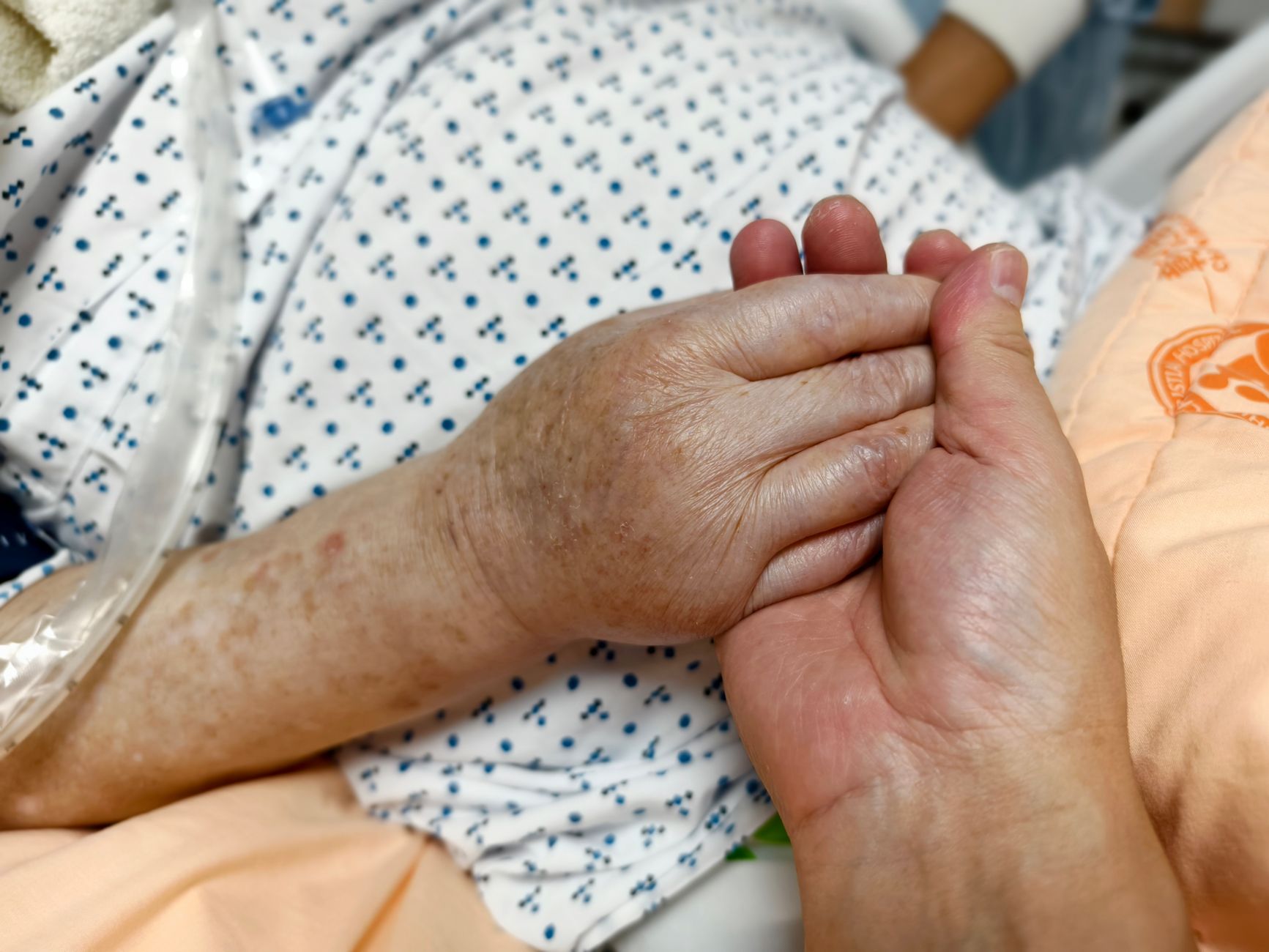
The Bracelet They Cut From My Wrist
My brother Renard stood in the doorway of our father’s ICU room in Bolivar, Missouri, and told the charge nurse to cut the plastic bracelet off my wrist, the one that let me stay past visiting hours, while our father lay ten feet away with a nasal cannula taped to his cheek and no way of knowing what his own son was doing to his only daughter.
She did it with the same blue-handled trauma scissors they use to cut gauze off a wound. One snip. It took about four seconds, and I remember counting them, because counting was the only thing left for my hands to do. The two halves of the bracelet fell onto the tile by my shoe, my name and Dad’s patient number still printed on them in that faded thermal ink, and Renard looked at me the way you look at somebody you’ve already decided isn’t family anymore.
He had a lawyer standing next to him in a gray suit that had never once touched a barn, and a folder of papers, and behind them, in the hallway, our sister Adaline Beth stood with her arms crossed and her eyes on the floor, because Adaline Beth has never once in her life been able to watch what she helps do.
I want to tell you the whole of it, because it did not start in that doorway, and it did not end there either. It started three days earlier in a cattle chute at six forty-five in the morning, and it very nearly ended with my father signing away his own voice while he was too weak to lift his head off the pillow. But it did not end that way, because a night nurse named Marlin had been in that room at four in the morning when nobody else was, and she had heard him say something with her own two ears that Renard’s lawyer never counted on anybody writing down.
Let me back up and do this right.
My name is Cordy. I am forty-five years old, and I have lived my whole life within eleven miles of the Polk County line, on the same two hundred and ten acres of fescue pasture and hardwood timber my father has run cattle on since before I was born. Bolivar is a town of about eleven thousand people if you count the university crowd, one courthouse square with a limestone bandstand in the middle of it, more churches than stoplights, and a livestock sale barn that still fills up every Wednesday the way it has for sixty years. I never left. I got my cosmetology license out of the vo-tech in Springfield when I was twenty and came straight home and opened a two-chair salon on the square, and I have been cutting the hair of half this county ever since, in between calving season and canning tomatoes and, for the last six years, being the one who drives out to the home place every single morning before my first appointment to make sure my father is still upright and ornery and hasn’t done something a seventy-four-year-old man with a bad hip has no business doing alone.
Renard is forty-nine. He left for Springfield at nineteen and never really came back, not the way that counts. He sells commercial insurance now, does well enough at it, drives a truck nicer than anything on our road, and shows up at Thanksgiving and sometimes at branding time if it’s convenient. Adaline Beth is forty-one, married to a good enough man named after his own father, living over in Ozark with two kids in travel ball, and she calls Dad on Sundays and means it, mostly, but she has spent her whole life letting Renard do her thinking for her, the way a lot of youngest children do when the oldest one never lets the room forget he’s the oldest.
I don’t say any of that to make myself out a saint. I say it so you understand why, six years ago, when our mother was dying of the cancer that took eleven months to do it, and somebody had to sign the DNR forms and talk to the hospice nurse and make the calls nobody wants to make, it was me standing in that room, and it was me my father turned to afterward, in the truck in the church parking lot the day we buried her, and said, “Cordy, I want you to be the one. If it ever comes to me, I mean. Not your brother.” He didn’t explain it that day. He didn’t have to. Two years before that, Renard had sold forty head off Dad’s herd at the fall sale, the year Dad’s hip surgery had him laid up and unable to haul them himself, and Renard had told him the check was twenty-two thousand and some change, and it took Dad the better part of a year to find out, from the sale barn’s own books, that it had been thirty-one. Renard never gave a real answer for the difference. He called it a misunderstanding about commission. Dad called it what it was, once, quietly, to me alone in the machine shed, and never brought it up to Renard’s face again, the way men of his generation swallow a thing rather than let it split a family clean in two. But he remembered it. And six years ago he drove himself to a lawyer’s office on the square, a man who has done half this county’s wills for thirty years, and signed a durable healthcare power of attorney naming me, and only me, as his agent, and he told me where the copy was kept and never mentioned it again either, the way he does with things that are already settled in his mind.
I didn’t think about that paper for six years. You don’t, until you do.
It was the second week of October when it happened. We were weaning calves that week, which on our place means five, six days of running cattle through the chute, sorting, vaccinating, tagging, the kind of physical work that a man Dad’s age has no business doing at a dead run but has never once let anybody tell him he’s too old for. I was supposed to be out there with him by seven that morning, but I had a six-thirty color appointment I couldn’t move, a bride getting married that Saturday, and I told him to wait on me before he started running them through alone. He didn’t wait. He never has, not once in seventy-four years, and I knew that when I said it, and I have replayed that six-thirty appointment in my head more times than I can count since.
I got out to the home place at six forty-five, thirty-five minutes behind, and I saw the four-wheeler sitting empty by the loading chute with the gate still swung open, and I knew before I was even out of my own truck. He was down in the dirt beside the chute, on his side, one boot still hung up in the bottom rail like he’d tried to catch himself on the way down. His lips were the wrong color. I have cut hair in this town for twenty-five years and I have held a lot of hands at a lot of funerals, and I knew what I was looking at before I ever got my knees in the mud beside him.
I called 911 with cattle bawling behind me the whole time because nobody had shut the gate, and I did compressions on my own father in the dirt of a cattle chute until the Bolivar ambulance got there, which felt like an hour and was, they told me later, six minutes. I rode in the back. I held the hand that wasn’t in the paramedic’s way and I said the only thing I could think to say, which was, “I’m here, Daddy, I’m right here, don’t you dare,” over and over, the whole way in.
They took him to Polk Regional, and from there, because his heart had thrown a clot into a main artery and his blood pressure had crashed twice in the ambulance bay, they moved him straight up to the ICU. A cardiologist named for our county opened him up that same afternoon, three vessels bypassed, and told me if I had been forty minutes later instead of thirty-five we would be planning a funeral instead of a vigil. I have thought about that math more than I have thought about almost anything else in my life.
The ICU at Polk Regional runs a policy I did not know existed until that first night, and I am grateful for it every day since, because it is the only reason any of what came next has a paper trail at all. For a patient in critical condition with no reliable way to communicate his own wishes, the unit lets one person, the documented healthcare agent, wear what they call a care-partner bracelet. It is nothing fancy, a plain teal band with a barcode, but it means you are not bound by the two-visitors, thirty-minutes-an-hour rule everybody else lives under. It means you can sleep in the recliner by the bed. It means, in plain terms, that the hospital has looked at your paperwork and decided you are the one who gets to stay.
They put that bracelet on my wrist the first night, after the charge nurse pulled up my father’s file and found the healthcare power of attorney scanned into it from years back, my name printed clean on page two. I did not think of it as anything but practical that night. I think of it very differently now.
Renard got there at nine the next morning, having driven down from Springfield, and Adaline Beth came in from Ozark that same afternoon. I will say this plainly and fairly: they were shaken. Renard sat with his head in his hands in the family waiting room for the better part of an hour before he could make himself go in. Adaline Beth cried in the hallway with her forehead against the cinderblock wall. Whatever came later, I do not believe either one of them wanted our father to die, and I want that on the record before I tell you the rest, because it would be easy for you to hear this story and decide they were monsters from the first minute, and that is not the truth, and Dad would not want me telling it that way.
What is also true is that by the second day, in the family room down the hall, with Dad sedated and on a ventilator and unable to hear a word of it, Renard started talking about “what happens next,” and I do not mean what happens next medically. I mean the farm. I mean the herd, and the equipment line of credit Dad still carried at the co-op, and a phrase Renard used twice that I have not been able to shake since, which was “getting ahead of this before it gets complicated.” Adaline Beth mostly looked at her hands while he talked. I told him I wasn’t discussing any of it while our father was on a ventilator ten feet away, and I meant it as the end of the conversation. It was not the end of the conversation. It was the beginning of one that took three more days to come to a head, mostly at night, when I wasn’t there to hear it.
I want to tell you about Marlin now, because everything that happened after hangs on her.
Marlin worked nights in that ICU, seven at night to seven in the morning, four nights a week, and by the second night of my father’s stay I had learned her whole rhythm without either of us saying much about it. She was somewhere in her fifties, gray coming in at her temples that she’d stopped fighting, with the particular quiet efficiency of somebody who has done this job long enough that nothing rattles her hands even when it rattles everything else. She was the one who taught me how to work the ice chips into Dad’s mouth on a little pink sponge stick before he was strong enough to drink. She was the one who noticed, on the second night, that I hadn’t eaten since the morning it happened, and who came back from her break with half a turkey sandwich from the cafeteria she said she “wasn’t going to finish anyway,” and set it on the tray table without a word, and walked back out. Small kindnesses. The kind that don’t cost anything and mean everything at four in the morning in a room that smells like antiseptic and fear.
By the third night, Dad’s sedation had been backed down as the doctors weaned him toward extubation, and he was drifting in and out, more awake than not, though still groggy and slurring when he tried to talk. I had gone home for four hours that night on Marlin’s own insistence, because she told me, not unkindly, that I was going to end up in the bed next to him if I didn’t sleep in an actual bed at least once that week. I was not there in the small hours of that morning. I have had to build the rest of it from what Marlin told me and from what she wrote down, because I was thirty-five minutes away in my own bed, sleeping the first real sleep I’d had in three days.
At around four in the morning, Dad woke enough to know where he was, which the nurses call a lucid window, a stretch of real clarity that sometimes opens up between doses as a patient starts to come off heavy sedation, before it closes again. Marlin was doing vitals. He caught her wrist, she told me later, not hard, just enough to hold her there, and he said, clear as she’d heard him say anything in three days, “Is my girl here. Cordy.”
Marlin told him I’d gone home to sleep and would be back by seven, and he nodded, and then he said something else, unprompted, that she has told me she will remember for the rest of her career, because it is not common for a patient to say a thing like that clearly enough to repeat, and it is not common for a nurse to have the good sense to write it down word for word the second she stepped back out to her station, which is exactly what Marlin did.
He said, “Cordy’s got the paper. She knows what I want. Don’t let Renard near my checkbook again, and don’t let him near my machines either. He’ll tell you he’s helping. He helped himself to my cattle money once already.” Then he asked for water, and Marlin gave him ice on the pink sponge, and within twenty minutes he had drifted back down into sleep, and by seven, when I walked back in with his house shoes and a clean undershirt, he did not remember saying any of it, and neither of us knew yet what it would mean.
Marlin charted it. Not as gossip, not as a favor to me. She charted it the way she is trained and required to chart any lucid, spontaneous statement a critical patient makes about his own care and his own wishes, timestamped, quoted as close to word for word as she could manage, filed in the nursing notes the same way she’d have charted his blood pressure or his oxygen saturation. It sat there in his medical record for exactly nine hours before anybody but her and God knew it existed.
Renard and Adaline Beth arrived together the next morning, a little before ten, and this time they did not come alone. The man in the gray suit introduced himself as an attorney out of Springfield, one none of us had ever laid eyes on, one who had never done a single day of work for our family before that morning, and he was carrying a leather folder that he set on the rolling tray table at the foot of Dad’s bed like it was the most natural thing in the world to conduct legal business six inches from a man who’d had open-heart surgery four days earlier.
The document inside that folder was titled, in plain language I did not fully understand until later, a revocation and re-designation of healthcare agent. It named Renard as the new sole agent, with Adaline Beth as backup. Attached to it was a notarized statement, signed two days before by a notary in Springfield, swearing that our father had told Renard, “by telephone,” that he wished to make this change, given his concerns about my “capacity to make hard decisions under pressure.”
I want you to sit with that phrase the way I had to sit with it. My capacity to make hard decisions under pressure. I had done chest compressions on my own father in the dirt of a cattle chute four days before. I had not left that hospital for seventy-two hours except to shower and to sleep the four hours Marlin ordered me to take. And somewhere in that same window, my brother had gotten a notary in another county to swear to a phone call none of us could verify ever happened, at a time when Dad, by every chart entry from every nurse on that floor, had been too sedated to reliably operate a telephone, let alone dictate legal instructions over one.
The charge nurse that morning was a capable young woman named for the shift lead, and she did what any charge nurse would do faced with a notarized legal document and a family member insisting it be honored immediately. She hesitated. A notarized paper looks official. It is designed to look official. She said she’d need to loop in the hospital’s risk management office before anything could be actioned, and Renard, who had clearly expected friction, produced his second piece of leverage on the spot.
He told her that if I was not, in fact, the recognized agent going forward, then I had no more standing in that unit than any other visitor, and that the “care-partner bracelet” on my wrist, the one that let me stay past hours, sleep in the recliner, be present for rounds, was a courtesy extended on the basis of paperwork that was actively being challenged, and he wanted it removed while the matter was reviewed, so that, in his words, “nobody’s got an unfair advantage in the room while this gets sorted.”
That is the moment you already know. The charge nurse, caught between a family dispute and a document with an official seal on it, made the call that hospitals so often make when nobody wants to be the one who guessed wrong: she erred toward the paper in front of her rather than the paperwork already on file, and she asked me, gently, almost apologetically, to hold out my wrist, and Renard’s lawyer stood there watching with his hands folded like it was a closing on a house instead of the last hours my father had left with a voice of his own.
I held out my arm. I don’t know why I did it so calmly. I think some part of me had already decided that fighting it in that hallway, in front of my sedated father, was not the fight that mattered, and that the fight that mattered was going to happen somewhere else. She cut it clean. Snip. Four seconds. The two halves fell by my shoe.
Renard looked at me and said, “This isn’t personal, Cordy. It’s just cleaner this way while it’s being sorted out.” And I remember thinking, with a kind of cold clarity I have never felt before or since, that I had never in my life heard four words used more dishonestly in a row than “it’s just cleaner this way.”
Adaline Beth would not look at me. She looked at the floor, at her own shoes, at the vinyl tile with my bracelet’s broken halves on it, everywhere but at my face, which told me more than anything Renard said that whole morning.
I did not raise my voice. I want that understood, because it would have been easy, standing outside my own father’s door with a cut bracelet in my hand, to come apart. What I did instead was go find Marlin, who had stayed two hours past the end of her overnight shift because she had a feeling, she told me later, that she should not leave that floor yet, and I told her what had just happened, and I watched her face change from tired to something else entirely.
She did not ask my permission for what she did next, and she did not need it. She walked straight into that room, past the lawyer, past Renard, and she asked, in a voice pitched exactly the way you’d expect from somebody who has spent thirty years in ICUs learning how to command a room without ever raising it, for the charge nurse and the hospital’s on-call risk manager to meet her at the nurses’ station in five minutes, because she had information relevant to the document under review, and she had charted it nine hours earlier, and it was already sitting in the permanent medical record for anyone with the clearance to read it.
The risk manager was a woman who had been called in from home, still in a cardigan she’d clearly thrown on over pajamas, and she pulled the chart up on the workstation right there at the desk while Renard and his lawyer stood a few feet off looking like men who had walked into a room expecting a formality and found a courtroom instead. Marlin read the entry out loud, the timestamp, the quote, word for word as she’d written it at four seventeen that morning: Cordy’s got the paper. She knows what I want. Don’t let Renard near my checkbook again, and don’t let him near my machines either. He’ll tell you he’s helping. He helped himself to my cattle money once already.
The risk manager read it twice, silently, on the screen, and then she looked up at the lawyer and asked him a single question, which was what time, exactly, the notarized phone conversation was alleged to have taken place. He named a time the afternoon before. She pulled up the medication administration record on the same screen, the sedation dosing, the nursing assessment notes from that exact hour, all of it timestamped by machines that do not lie and do not have a stake in who inherits what, and every one of them showed a man who had been, at that hour, assessed as minimally responsive, unable to reliably answer orientation questions, four hours out from his last dose of a sedative that does not leave a person capable of a clear-headed phone call about legal paperwork, let alone one he would never place himself, on a unit with no cordless phones at the bedside to begin with.
“There’s no phone in that room a patient could have used,” the risk manager said, quietly, mostly to herself. “There’s a call button and a bedside monitor. That’s it.”
I watched Renard’s face when she said it. I watched him understand, in real time, that the story he had built, and paid a lawyer and a notary to dress up official, had a hole in it big enough to walk a bull through, and that the hole had been sitting in his own father’s chart nine hours before he’d ever unzipped that leather folder.
He tried anyway. I will give him that much, that he did not fold quiet. He said the note could be Marlin’s word against a signed notarized statement, that nurses “misheard things all the time” in the middle of the night, that this was exactly the kind of “one person’s account” his lawyer had warned him a family dispute could turn into. He said it loud enough that a resident three doors down stuck her head out to see what was happening. And Marlin, who has been doing this job since before Renard had his first insurance license, looked him dead in the eye and said, calm as anything, “I’ve been a critical care nurse for thirty-one years, sir. I don’t chart things I didn’t hear. And I will say the same thing under oath, in front of anybody, at any time, because it’s already written down, and it was written down nine hours before you walked in here with a folder.”
The risk manager did not need anything more than that. She told the lawyer, professionally and without a hint of apology, that the hospital would not be acting on the revocation while there was a documented, timestamped contradiction in the medical record regarding the patient’s capacity and stated wishes at the alleged time of the phone call, and that any further action would need to go through the county probate court, with the existing durable power of attorney remaining in full effect in the meantime. She looked at the broken bracelet still sitting on the counter where the charge nurse had set it, and she picked up the desk phone herself and told someone on the other end to cut a new one and bring it right up.
Renard’s lawyer, to his credit, seemed to understand exactly what had just happened and did not waste any more of anyone’s morning. He folded his papers back into the leather case without another word and left, and I have never seen him again, and I hope I never do.
Renard did not leave so quietly. He turned on Marlin in that hallway, told her she had no business inserting herself into a family’s private affairs, that she’d “made an enemy” she didn’t understand the reach of, that he had friends on the hospital board and would make sure this cost her. I watched her take every bit of that without her face moving, and when he was done, she said the only thing I have ever heard her say with any real edge in her voice at all: “Sir, I took an oath a long time before your father had this heart attack, and it wasn’t to you. Go home.”
He left. Adaline Beth did not leave with him. She stood in that hallway for a long moment after he’d gone, and then she came and sat down next to me on the same wood-look bench I’d spent three nights on, and she cried, and this time she looked at me while she did it. She told me she had never once believed I would do our father wrong. She told me she went along with the document because Renard had told her it was only a formality, a way to “make things fair” since I was already the one with all the power, his word, power, like being the one who does the calling and the sitting and the crying alone in a cattle chute at dawn is a prize somebody hands out instead of a weight somebody carries. She told me she was sorry, and I believed her, and I will tell you honestly that I have let her back into my life since, slowly, carefully, the way you let anybody back in who was weak rather than cruel. Renard, I have not.
They walked me in to see Dad an hour later, a fresh teal bracelet on my wrist, the barcode still shiny, and he was more awake than he’d been in days, off the last of the heavy sedation, breathing well on his own with just a little oxygen through the cannula. He didn’t know yet what had happened. Marlin and I had agreed, without much discussion, that it could wait until he had the strength to hear it properly, and it was two more days before I told him the whole of it, sitting on the edge of his bed with his good hand in both of mine.
He was quiet a long time after I finished. Then he said, in a voice still rough from the ventilator tube but entirely his own, entirely clear, “Get Renard on the phone. I want to say it myself, so there’s no confusion about whose voice it was.”
I did not want to. I did it anyway, because it was his voice to use, not mine to spend for him. Renard answered on the second ring, and Dad, propped up on two pillows with an IV still taped to the back of his hand, said the only thing he needed to say. “Son, I know what you tried to do while I couldn’t talk for myself. I want you to hear me say, with my own mouth, working fine, that Cordy is my person. She always has been. That’s not new, and it’s not because of any heart attack. If you ever try that again, in any hospital, at any age I am, I will make sure there is nothing left for a lawyer to argue about, because I will have already given it all to the daughter who does the counting instead of the daughter who gets counted on.” Then he said, “I love you. That’s still true too. But I meant what I just said,” and he handed the phone back to me and closed his eyes, worn clean out, and I sat there and watched my seventy-four-year-old father sleep like a man who had just set something down he’d been carrying since a fall sale six years back.
Dad spent eleven more days in that hospital and three weeks after that in a rehabilitation facility in Springfield, building his strength back up one hallway lap at a time, cussing at the walker the whole way, which the therapists told me was a very good sign. He is home now, on the same two hundred and ten acres, and while I have hired a young man from over toward Fair Grove to do the heavy chute work, Dad still walks out most mornings in his coat to look the cattle over himself, because some things a man does not hand off just because his heart tried to quit on him once.
Marlin and I are friends now, plain and simple, the kind of friendship that starts in the worst week of your life and outlasts it. She came out to the farm the first Sunday Dad was home, off the clock, in her own truck, and I made her a plate of the fried chicken my mother used to make, and Dad shook her hand for a long time and could not get a single word out, which for a man who’d just told his own son off over the telephone is saying something. She still checks on him. Not because anybody’s paying her to. Because she is the kind of woman who cannot walk away from a thing she has already decided to care about, and I think that is the whole difference between her and my brother, right there, in one sentence.
I think about that broken bracelet more than I probably should. I kept both halves. They sit in a little dish on my dresser now, next to my grandmother’s thimble, two pieces of plastic with my own name printed on them in fading thermal ink, cut off my wrist by a woman who was only doing what she was told, on the say-so of a man who had convinced himself that cutting me out of a room was the same thing as cutting me out of a family.
It isn’t. It never was. You can cut a bracelet off a wrist in four seconds. You cannot cut six years of six a.m. drives out to the home place off a life, and you cannot cut a night nurse’s plain, stubborn honesty out of a permanent medical record just because it is inconvenient to the story you brought a lawyer to tell.
My father gave me that power of attorney six years ago in a church parking lot, and my brother tried to take it back in an ICU hallway while Dad couldn’t lift his head off the pillow, and it took a woman none of us had ever met before that week, working a shift nobody was paying her to work late, to make sure the truth got written down before the lie ever had the chance to get signed.
I do not know what Renard tells people now about that week. I know what I know, which is that I still drive out to the home place every morning before my first appointment, and my father is still there, ornery and upright, waiting on his coffee, and the bracelet on my wrist these days is nothing more than the one I wear to church on Sundays. I don’t need the teal one anymore. I never really did. What I needed was for the truth to hold, just once, when it mattered, in front of the people who wanted it to bend.
It held. Because a woman named Marlin decided, at four seventeen in the morning, that some things are worth writing down exactly the way you heard them, even when nobody is watching, and especially when somebody, someday, might try to say they never happened at all.
This story is a dramatization. Names, characters, and details are invented, and any resemblance to real people or events is coincidental.