The Seat My Stepbrother Saved Me
I was refilling Charmaine’s wineglass without being asked, a cooking show playing low on the flat screen behind her, forty minutes into what I still believed was a friendly Sunday dinner, when she set down her fork and told me, in the gentlest voice I have ever heard someone use to gut a person, exactly where I stood in this family.
“Sweetheart, I know this is hard to hear,” she said, and she reached across my father’s new glass dining table and patted my hand like I was a child who had dropped an ice cream cone, “but immediate family is the people building a future together. You’ll always be a lovely piece of Sherman’s past. I just don’t think you’re part of what we’re building now.”
The cooking show host was demonstrating how to properly sear a scallop. My father was in the kitchen getting more ice. I sat there with the wine bottle still in my hand and I smiled, because that is what you do, that is what I had been raised to do, and I said something like “Of course, I understand,” even though I understood nothing, even though every word of it had landed somewhere behind my sternum and stayed there.
That was four months before the wedding. I want to start there because I think people hear a story like mine and assume the daughter must have done something, must have been difficult, must have given this woman a reason. I did not. I brought a casserole to that dinner. I complimented her tablecloth. I had spent eleven months trying very hard to be exactly the kind of stepdaughter who does not cause trouble, because my father had already lost enough, and I did not want to be one more thing he had to manage.
My name is Dinah Redding. I am forty-one years old. I grew up in a town in southern Missouri you have probably never heard of, on a road with more cattle gates than street signs, in a house two miles from the feed store my father has run since before I was born. Redding Feed and Seed still has his name painted over the door in letters my mother chose. My mother’s name was Lucinda. She died three years ago this past spring, of the kind of cancer that takes eighteen months to finish what it starts, and for most of those eighteen months I drove four hours each way every other weekend to sit with her, because my own life, my job, my son, my falling-apart marriage, could only be paused for so long at a time.
I tell you all of that so you understand what kind of year it was before Charmaine ever walked into it. My mother was gone. My marriage ended eight months after the funeral, not dramatically, just the slow kind of ending where two people finally admit the thing they had been too tired to say out loud. My son Eli was seven and asking, every night for a while, whether people who die can still hear you if you talk to them before bed. I told him yes. I was not sure it was true. I needed it to be true as much as he did.
So when my father called me on a Tuesday night, fourteen months after we buried my mother, and told me in a voice I had not heard him use since before her diagnosis, light, almost shy, that he had met someone at a line dancing class the VFW hall started running on Thursday nights, I was glad. I want that on the record, because everything that came after might make it sound like I resented my father finding love again. I did not. I sat in my kitchen with the phone against my ear and I cried, quietly, so he would not hear it in my voice, because it was the first time in over a year that my father had sounded like himself.
Her name is Charmaine Ashworth. She is fifty-eight, divorced, and she moved to our part of the county from Springfield to be closer to her sister. She has two grown children. Her daughter, Tansy, lives out in Colorado and I have met her exactly twice. Her son, Milo, is twenty-seven, and he is the reason I am telling you any of this at all, because without Milo, I would not have been at my father’s wedding. I would have found out about it the same way everyone else in town found out, from a photograph on Facebook, and I would have spent the rest of my life pretending that did not break something in me.
The first six months, I liked her. I want to be honest about that too. Charmaine was warm in company, the kind of woman who remembers everyone’s coffee order and asks real questions and laughs loud enough that a room relaxes around her. She brought a pie to the first dinner I had with the two of them, an actual homemade pie, and she asked me about Eli’s soccer season like she meant it. My father lit up around her in a way I had not seen since before my mother got sick, and I told myself that was the whole point, that my job now was simply to want his happiness more than I wanted anything of my own.
It was small things at first. The kind of things I told myself I was imagining, because a woman alone, freshly divorced, freshly motherless, learns not to trust her own read on a room. Charmaine would refer to “our family dinners” and somehow the guest list would be her, my father, Milo, and whichever of Milo’s friends happened to be in town, and I would find out about them after the fact, in a group text where I had been added late, if at all. She redecorated the house my mother had lived in for thirty-one years within four months of moving her things in, and when I mentioned, gently, that the kitchen curtains had been my mother’s, sewn by her own hands the year I was born, Charmaine told me she had donated them to the church rummage sale because they “didn’t really go with the new backsplash.” My father did not notice things like that. He is a good man, but grief had made him soft-focus about a great many details, and Charmaine filled the space around him with a confidence that looked, from the outside, exactly like competence.
I told myself I was being a good daughter by staying quiet. I told myself that eleven times, probably, in eleven different ways, over that first year. I was wrong every time, but I did not know that yet.
The dinner where she told me where I stood was the first time she said anything to my face instead of around me. We were four months out from the wedding by then, a date they had picked for the second Saturday in October, at an orchard barn outside of town called Millbrook that my mother had actually loved, that my parents had gone to for the fall festival every year of my childhood, which is its own kind of small cruelty I did not fully register until much later. I had asked, that night, in the most casual voice I could manage, whether Eli and I should plan to fly in the Thursday before or the Friday, since we lived six hours away by car and I would need to book time off work.
That is when she set down her fork.
I did not argue with her that night. I want you to understand that about me, because I think it is the part of this story people struggle with the most. I am not a woman who makes scenes. I grew up in a house where you did not raise your voice at the dinner table, where disagreements got settled quietly, later, in private, if they got settled at all. So I sat there with Charmaine’s hand on top of mine and I said, “Of course, I understand,” and I finished my wine, and I helped clear the table, and I drove the four hours home with the radio off the whole way because I could not stand the sound of anyone’s voice but my own thoughts, going in circles, telling me I must have misheard her, must have misunderstood, must be making something out of nothing the way grief makes you do.
I had not misunderstood anything. Three weeks later, the invitations went out. Cream card stock, my father’s new address embossed at the top, an illustration of the Millbrook orchard in bloom. Milo got one. Tansy got one, all the way out in Colorado. My father’s sister, my Aunt Renata’s replacement in this story, got one, along with her whole family. I did not get one. Neither did Eli.
My father called me the week the invitations went out and talked for twenty minutes about seating charts and whether the caterer could do a version of my mother’s green bean casserole for the family-style dinner, and never once mentioned that I would not be at any table at all, because as far as he knew, I already had my invitation. I understand now that he believed that. I did not understand it then. Then, I just sat on the phone and made the right sounds in the right places and hung up and sat on my kitchen floor with my back against the cabinets until Eli found me and asked if I was sick.
I told him I was fine. I have gotten very good, this past year, at telling people I am fine.
I want to explain the vulnerable place I was standing in that fall, because it matters to what happened next. I was forty-one, divorced eight months, raising a nine-year-old alone on a dental hygienist’s salary in a rented duplex two states from where I grew up. My mother, the one person who would have marched into that dining room and said something, was gone. My marriage was gone. And now, it seemed, my father’s family, the only whole family I had left, had quietly decided there was not a seat in it for me. I did not have the strength that fall to fight for a place at a table. I barely had the strength to get Eli to school on time. So I did what I have always done when the ground gives out from under me. I got small. I got quiet. I told myself a version of the story where I understood, where it made a kind of sense, where a woman planning her second wedding at fifty-eight years old was entitled to a small and simple day, and if that day did not have room for her fiancé’s adult daughter, well, that was not really about me. I almost believed it. I am ashamed, now, of how close I came to believing it.
What I did not know, that whole fall, was that Milo had started keeping a list of his own.
Milo Ashworth is not the villain of this story, and I want that clear from the start, because a story like mine can make people assume every person on the other side of the aisle is cut from the same cloth. Milo is twenty-seven, works as an EMT two counties over, and the first time I met him, at that same early dinner where I still liked his mother, he spent forty-five minutes on the back porch teaching my son how to properly whittle a stick with a pocketknife while their parents laughed at something inside. He was kind to Eli in a way that had nothing to do with performance, nothing to do with being watched. He asked me real questions too, about my job, about the divorce, without the practiced warmth his mother turned on like a porch light for company. By the time that October wedding rolled around, Milo and I had become something neither of us had a name for yet. Not quite friends. Something more like allies, two people who had ended up, through no fault of their own, standing on the same side of a family that did not entirely know what to do with either of us.
He noticed things I thought I was hiding well. He noticed I stopped coming to Sunday dinners the same month the invitations went out. He noticed that when his mother talked about the wedding at the kitchen table, my name never came up, not once, not even in the logistics, and he started asking her about it directly, in a way I never had the standing or the nerve to do myself.
He told me all of this later, in pieces, over the weeks after the wedding, when we were finally able to sit somewhere quiet and go back over the whole thing. He said he asked his mother, straight out, three weeks before the wedding, whether Dinah and her boy were coming. He said Charmaine told him I had “a lot going on” and had “decided it was best to sit this one out,” and that she said it so smoothly, so sadly, shaking her head like she was sorry for me, that for one whole week he believed her. He believed I had chosen not to come to my own father’s wedding.
It was my father who cracked it open for him, without meaning to. Two weeks before the wedding, at the feed store, my father mentioned to Milo, in passing, while they were loading fifty-pound bags of scratch feed into a truck bed, that he wished Dinah’s flight schedule had worked out different, that he hated the idea of missing having his daughter there but understood how hard it was for a single mother to get away with a kid in school. My father believed I had been invited and had declined because of the cost and the timing. That was the story Charmaine had told him. That was the story she had told Milo, a completely different story, one where I had chosen to stay home. Two lies, built to fit two different audiences, and neither of them anywhere close to the truth, which was that I had never been invited at all.
Milo told me later that he stood in the bed of that truck holding a fifty-pound bag of feed and felt something in his chest go cold and still, the way you feel right before you understand you are about to do something you cannot take back.
He did not confront his mother. He is smarter than that, or maybe just more strategic than I would have been at twenty-seven. He came to see me instead, drove three hours on a Sunday without telling either of our parents, and sat across from me at my kitchen table while Eli was at a friend’s birthday party, and he told me everything he had put together. I remember exactly where I was standing when he said it, at my own sink, my hands still wet from washing a coffee cup, and I had to set the cup down before I dropped it.
“She told your dad you couldn’t come,” Milo said. “She told me you didn’t want to. Dinah, I don’t think either of those things is true.”
I did not cry in front of him that day. I want to say I was too proud, but the truth is I was too stunned. Eleven months of trying to be small, of trying to be gracious, of telling myself I understood, and it had all been built on a lie a woman I had tried to trust told two different people to keep the door shut on both sides at once.
Milo asked me a question that afternoon that I have thought about every day since. He asked, “If you had a seat, would you come?”
I told him the truth. I told him I did not know if I had it in me anymore, that something in me had already started making peace with being on the outside of my own father’s new life, that grief does that to you, it teaches you to expect less so it hurts less when less is what you get. Milo listened to all of it, nodded, and did not argue with me. He just asked for my flight preferences, and my current address, and Eli’s full name for the ticket, and he told me not to say anything to my father, not yet, because he did not want Charmaine to have any warning at all.
I did not fully believe he would go through with it until the boarding pass showed up on my phone nine days later, a text with no message attached, just a screenshot of a confirmation for a Friday afternoon flight into Springfield, one adult, one child, and underneath it, a second text that said only: There’s a seat with your name on it. I made sure of it myself. Come home, Dinah.
I sat on my bathroom floor that night, phone in my hand, and I cried the way I had not let myself cry since the week my mother died. Not because of the ticket. Because someone had looked at me, at the shape of the hole I had quietly folded myself into, and decided I did not belong there.
I still almost did not go. I want to be honest about that too. I spent four days telling myself it would humiliate my father, that it would blow up a wedding that was not mine to blow up, that showing up uninvited made me the difficult one after all, exactly the thing I had spent a year trying not to be. It was Eli, in the end, who tipped me over. He came into my room the Wednesday night before the flight, saw the suitcase half packed on my bed, and asked if we were going to see Grandpa Sherman get married. I told him I was not sure. He said, in the very direct way nine-year-olds say true things, “Grandma Lucinda would want us to go.” I do not know how he understood that when I could not. But he was right, and something in me finally let go of the year of trying to make myself small enough to disappear.
We flew out on the Friday before the wedding. Milo picked us up at the airport himself, in his own truck, and did not say much on the drive except that he had a room booked for us at a motel outside of town, paid for on his own card, and that his mother had no idea any of it was happening. He told me the seating chart already had our names on it, in a spot he had quietly added the week before, at the end of the family table nearest the head, close enough that there was no version of the day where my father would not see us the second he turned around.
The wedding was Saturday, four in the afternoon, under the big oak that stands at the center of the Millbrook orchard, exactly where I remembered standing as a girl at the fall festival with my mother’s hand in mine. I stood at the edge of the gravel lot in the dress I had packed hoping I would find a reason to wear it, Eli’s hand in mine now instead of hers, and I watched the last of the guests filing toward the rows of white folding chairs, and I made myself walk forward before I could talk myself out of it a second time.
I did not walk down the aisle. I am not that kind of woman, and this was never that kind of moment. I came in from the side, along the tree line, while the string quartet was still tuning and the guests were still finding their seats, and I slipped into the chair Milo had saved, at the end of the family row, with Eli beside me, close enough that when my father walked out from behind the barn in his good gray suit, the one he had worn to my mother’s funeral only three years before because he said he did not see the point in owning two, the first thing his eyes landed on, before the officiant, before Charmaine, before anyone, was me.
He stopped walking. I watched it happen in real time, the exact second his whole face changed, confusion first, and then something that looked almost like fear, like he was doing frantic math in his head, and then his eyes went wet and he mouthed my name across thirty feet of orchard grass, and I understood, watching him, that Milo had been right. My father had not known. Whatever version of this story he had been told, it had never once included the truth that his daughter had not been invited to his own wedding.
Charmaine noticed him stop, and she noticed where he was looking, and I watched her face do something I will remember for the rest of my life. It was not shock. It was recognition. A woman who has told a careful lie knows, in her body, the exact moment it comes apart.
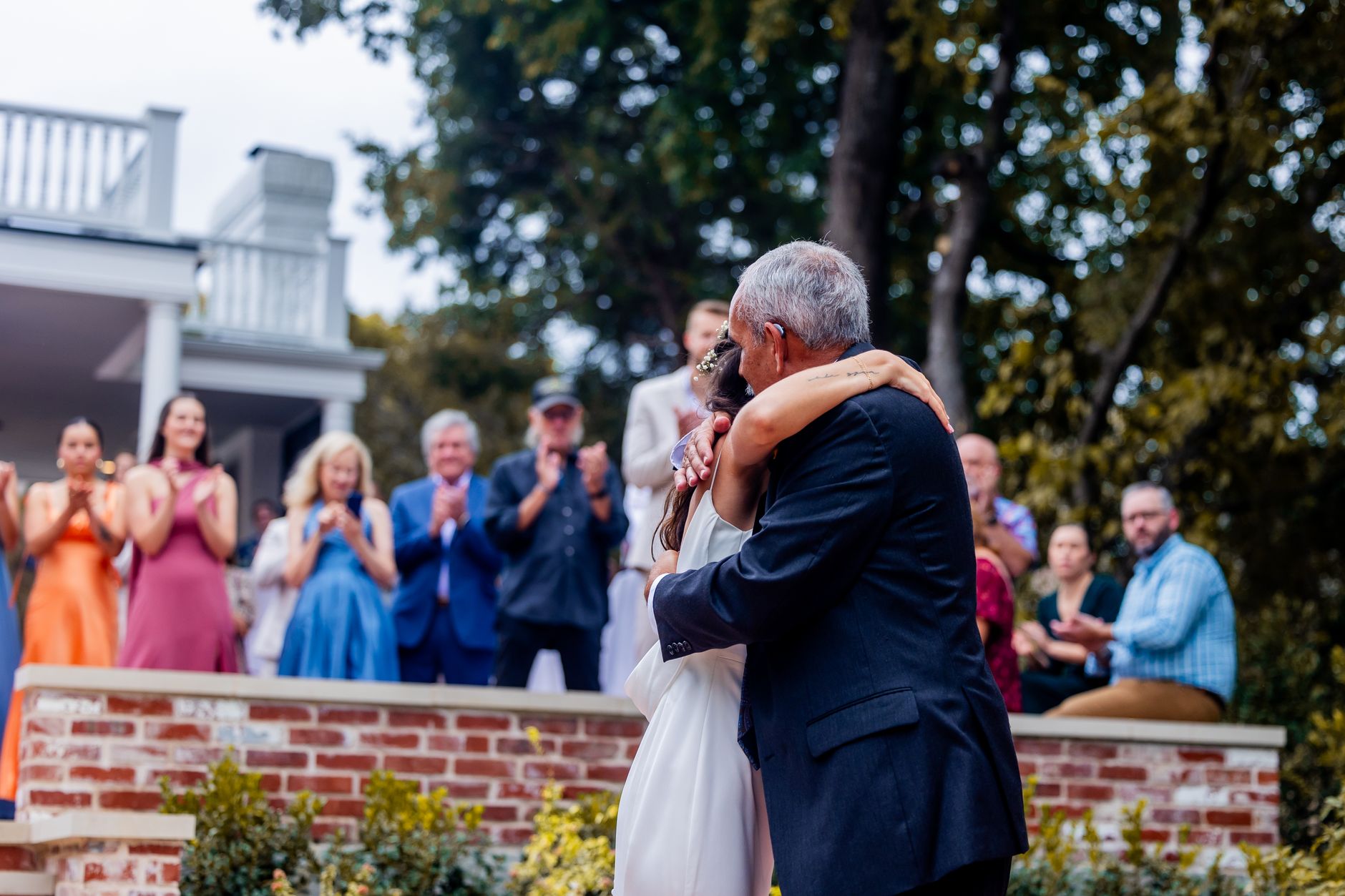
My father broke from his place at the front of that aisle, in front of a hundred and forty guests, in front of the officiant who did not know what to do with his hands, and he walked straight to the family row and pulled me up out of my chair and held onto me so hard I felt his shoulders shaking. He said my name three times. He said, “You’re here, you’re here, you came,” like he had been waiting for it without knowing he was waiting.
“Of course I came,” I told him, because in that moment, standing in that dress under that oak tree, I finally understood that I had wanted to come the whole time. It had never been a question of whether I wanted my father to have his day. It had only ever been a question of whether there was room in it for me too.
He held onto my shoulders and looked at me and asked, right there, loud enough for the front rows to hear, “Why didn’t you fly in with us? Why did you have to come alone?” He had truly believed, until that exact second, that I had chosen a cheaper flight, a later arrival, a quieter entrance. I watched the question land on him fresh, and I watched him turn, slowly, toward Charmaine, standing in her ivory dress at the top of the aisle with her bouquet starting to shake in her hands.
I am not going to pretend the next twenty minutes were graceful. They were not. My father asked Charmaine, in front of everyone, why his daughter had not received an invitation. Charmaine tried, for about thirty seconds, to say the word “misunderstanding” in four different ways, and none of them held. It was Milo, standing up from his own seat in the front row where he had been waiting the whole ceremony for exactly this moment, who finally said the thing none of the rest of us had the nerve to say out loud.
“You told me she didn’t want to come,” Milo said to his mother, his voice carrying clean across the orchard in a way that told me he had rehearsed it, at least in his head, more than once. “And you told Sherman she couldn’t come. They’re not the same lie, Mom. You told two different stories so neither of them would ever check with the other one.”
The silence after that lasted longer than any silence I have ever stood inside of. My father did not shout. That is not who he is. He looked at Charmaine for a long moment, the whole orchard watching, and asked her one question, quiet enough that I had to lean in to catch it: “Why would you do that to my girl?”
Charmaine did not answer him with a lie that time. I think she understood there was no lie left that would survive the day. What she said instead, in a smaller voice than I had ever heard her use, was the truest thing she had said to me in eleven months. “Because as long as she’s in the room, Sherman, I’m always going to be the second one. I wanted one day where I got to be the whole family. Just one day.”
I understood her, in that moment, more than I wanted to. I understood the fear underneath the cruelty, the fear of a woman who had married a man still grieving his first wife, who had watched him keep her curtains and her recipe and her daughter close, and had decided, somewhere along the way, that the only path to feeling like enough was to make sure there was less of everyone else in the room. It did not excuse what she did. It explained it. There is a difference, and standing in that orchard I finally understood I could hold both of those things at once.
My father did not call off the wedding. I want to be honest about that, because I know some people reading this will want the satisfying ending where the whole day burns down around her. That is not what happened, and I do not think it would have been the right ending even if it had been offered to me. What happened instead was smaller and, I think, better. My father asked the officiant to wait five minutes. He walked back to where Eli and I were standing, and he asked us both to stand up front with him for the ceremony, not in the wedding party, just close, just visible, just there. And when it came time for the vows, before the ring, before any of the words the officiant had printed on his little card, my father said something that was not in the program.
He said he wanted to speak first, if everyone would allow him a moment. He talked about my mother, briefly, honestly, the way a man talks about someone he loved for thirty-four years and buried three years ago, and he said that loving Charmaine had never once meant loving Lucinda less, and that if this family was going to survive being blended, it had to be built the way you build anything that lasts, out in the open, with nothing hidden and no one left off a list. Then he turned to Charmaine, in front of everyone, and told her that he would marry her, that he still wanted to, but that his daughter would be at every table for the rest of his life, at every holiday, every wedding, every ordinary Sunday, and that if that was ever a problem again, it would be the last time.
Charmaine cried through most of the rest of the ceremony. I do not think it was performance. I think, for the first time in a year, she was being asked to actually reckon with what she had done instead of managing around it, and it broke something open in her that had been sealed tight since her own first marriage fell apart years before mine ever started.
The reception that night was not perfect. I will not tell you it was. Charmaine and I did not hug and cry and become friends by the end of the evening. What we did was smaller, and truer. She came and found me near the dessert table, once the dancing had started and most of the guests were three drinks in and not paying close attention, and she told me she was sorry, in a voice with none of the smoothness she usually kept it in. She said she had been so afraid of disappearing into a marriage that already had a ghost in it, that she had made herself the villain trying to avoid becoming the afterthought. I told her I understood being afraid of disappearing. I did not tell her it was all right, because it was not, not yet. But I told her I was glad my father was happy, and that I hoped we could figure out, slowly, what this family was actually going to look like now that it had all its members finally in the same room.
Milo found me an hour later, out by the same oak tree, away from the noise, and he did not say much. He just sat down next to me in the grass, still in his rented suit, and handed me a plate of my father’s version of my mother’s green bean casserole, which the caterer had gotten almost exactly right, and said, “I told you there was a seat with your name on it.” I laughed, for the first time all day, and told him I would never be able to repay him for what he did. He said I already had, just by getting on the plane.
It has been eight months since that wedding. Things are not perfect between Charmaine and me, and I have stopped expecting them to be, because some things take longer than a good speech under an oak tree to actually heal. But she calls before every family dinner now, herself, not through my father, and my name is always on the list before the invitations even get ordered. Eli spends every other weekend learning how to whittle from his uncle Milo, who insists on the title even though nothing on paper makes it official, and who tells anyone who asks that he has a sister now, the kind you choose, which he says is the only kind that actually counts.
My father kept my mother’s curtain pattern. I do not know if he asked Charmaine to sew a new set or if she offered on her own, but they hang in the kitchen at Redding Feed and Seed now, in the little back office where my father still keeps his coffee, and every time I see them I think about a man who never stopped making room for everyone he loved, even when the people around him were not always brave enough to do the same.
I think about Milo, too, and the fact that he was twenty-seven years old and chose, without being asked, to tell the truth to the two adults in his life who had the most power over him. I think about what it means that the person who saved my seat at that wedding was not the man who loved me my whole life, but a young man I had known for less than a year, who simply looked at an empty chair and decided it was wrong.
I do not know exactly what to call Milo. Stepbrother is the word on paper, if it is any word at all. But when Eli asks who is coming to Thanksgiving this year, I tell him Grandpa Sherman, Charmaine, and Uncle Milo, and I do not stumble over any of it anymore. Some families are built the slow, ordinary way, from the day you are born. Mine got rebuilt in an orchard, in about twenty minutes, by a young man who could not stand watching an empty chair sit at a table that had plenty of room.
This story is a dramatization. Names, characters, and details are invented, and any resemblance to real people or events is coincidental.