The Report Cards He Kept
Six weeks after my father’s funeral, I stood at the door of his workshop with the spare key in my hand, and I still could not make myself turn it.
The pole barn sat forty feet behind the house he’d lived in alone for the last eleven years, out past the clothesline posts nobody used anymore, its tin roof gone the color of a nickel left out in the rain. I had put off this building longer than any other room in his life. The house I could do. I had already boxed up his flannel shirts, his reading glasses, the recliner with the worn patch shaped like him. The workshop was different. The workshop was where my father actually lived, if I was honest about it, more than he ever lived in any room with people in it, and some part of me was afraid that walking in there and finding nothing of myself in it would only confirm what I had believed for forty-six years.
That my father, Elmer Radke, loved his small engines more than he loved his own children.
I want to be fair to him before I tell you what I found, because it would be easy to make him sound cruel and he was never cruel. Not once in my life did my father raise his voice at me. He never missed a rent payment, never missed a meal, never laid a hand on either of us in anger. What he did was quieter than any of that, and harder to explain to people who did not grow up inside it. He simply did not ask. He did not ask how school was. He did not ask what I was reading, or who I was sitting with at lunch, or whether the boy who walked me home in ninth grade meant anything. He answered when spoken to, in short, complete sentences, and then he went back to whatever engine was open on his bench, and the conversation was over whether I was finished having it or not.
My mother, Fawn, died of cancer when I was eight years old. I don’t remember much about the year itself, the way you don’t remember the exact moment a bone sets, only that it hurt and then one day it didn’t hurt the same way anymore. What I do remember is my father standing at her graveside in a suit that didn’t fit him, dry-eyed, holding my hand and my brother Denton’s hand at the same time, one on each side of him like a man trying to keep two doors from blowing open in a storm. He never remarried. He never even, as far as either of us ever knew, went on a single date in the thirty-nine years after that. He raised us. He fed us. He drove us to school when the bus broke down and sat through exactly one parent-teacher conference per year, the mandatory one, arms crossed, saying almost nothing.
And in between all of that, he built the reputation that outlived him in Millhaven, Kansas: the man who could fix anything with a motor in it. Radke Small Engine sat behind our house for forty years. Farmers brought him tillers and chainsaws and the mowers their fathers had owned before them, and he fixed every single one like it mattered, like the machine itself had feelings that could be hurt by sloppy work. I used to stand in the doorway of that shop as a girl and watch him bent over some stranger’s carburetor with more patience and more visible tenderness than he ever once showed to me, and I told myself, somewhere around eleven years old, that this was simply the truth of my father. He had a certain amount of care in him, and he spent it all on machines, because machines were easier than people, and I was a person, and so I got what was left over.
What was left over did not feel like very much.
I think about the science fair most, when I think about the years before I stopped asking him for anything. I was in fifth grade. I had built a model of hillside erosion out of a cut-open milk carton, real dirt, a garden hose I wasn’t supposed to use, and about six hours of work spread over two weekends at the kitchen table while my father sat six feet away rebuilding a Briggs and Stratton carburetor and did not once look over to see what I was doing. The night before the fair I asked him if he would come. He didn’t look up from the parts spread out on a rag in front of him. He said, “Maybe. Depends on the shop.” I remember exactly how that word maybe sat in my chest, heavy and useless, like a stone somebody hands you and calls a gift.
He did not come. I won second place, a blue-and-white ribbon that said HONORABLE MENTION, and I stood in the gymnasium at Millhaven Elementary holding it and looking at the door for a man who was, at that exact hour, forty feet from our own kitchen with his head under the hood of a 1974 riding mower that belonged to a man named Milford Traxler who did not even live on our road.
I carried that night for a long time. I carried it into middle school, when I made honor roll five semesters running and never once told him, because what was the point of telling a man who would say “good” without looking up and go back to his bench. I carried it into high school band, where I played clarinet in a section of four girls who mostly could not read music, and where, sophomore year, I stopped even putting the concert dates on the refrigerator calendar, because putting them there and watching them go unmarked hurt worse than not putting them there at all. I carried it all the way to my own wedding, when he walked me down the aisle of the Millhaven Methodist church in a rented suit, silent the entire length of it, and gripped my hand so hard at the top of the aisle that it left a faint red mark I noticed later in the photographs, and then let go, and sat down, and never said one word to me about how I looked or how proud he was or anything at all, not that day and not in the thirty years of marriage that followed it.
I confronted him about it exactly once, the summer I was seventeen, home from a friend’s house at midnight to find him still awake in the kitchen with a carburetor spread across newspaper on the table, because even at midnight the shop followed him indoors. I don’t remember what set me off that particular night, only that something in me finally cracked open, and I stood in the doorway in my church shoes and asked him, straight out, whether he even cared what happened to me, whether any of it, the honor roll, the band, any of it, had ever once mattered to him at all. He didn’t answer right away. He set down the small screwdriver he was holding, very carefully, the way he set down every tool, and he looked at me for what felt like a full minute without saying anything. Then he said, “Go to bed, Marilee. It’s late.” That was the entire conversation. I went to bed. I cried into my pillow so my brother wouldn’t hear me through the wall, and I told myself something that night that I would go on believing for twenty-nine more years, that the truth had finally come out of him in the only unguarded moment I ever caught him in, and the truth was silence.
I did not know then that the small screwdriver he set down so carefully belonged to a carburetor for a mower owned by a widow three roads over who could not otherwise afford to have her lawn cut that summer, and that he stayed up past midnight on jobs like that more often than either of his children ever noticed, because charging her would have embarrassed her and not charging her meant working for free after supper, alone, in the dark, on top of everything else he never said out loud either.
By the time I was in my thirties I had made a kind of peace with him that was not peace so much as distance dressed up to look like peace. I called him on Sundays. I sent Christmas cards signed by my kids in their own handwriting, hoping that might reach some part of him a grown daughter’s voice couldn’t. I visited twice a year, drove the four hours from Wichita with my husband Barrett and our two children, and watched my father shake my son’s hand like he was closing a business deal and hand my daughter a peppermint from the dish by the register at the hardware store where he still worked three mornings a week even at seventy-nine. He was kind to my children in his own clipped way. He was never once, not for a single visit that I can remember, warm to me.
My brother Denton had an easier time of it, or at least it looked that way from where I stood. Denton stayed in Millhaven. Denton became a diesel mechanic and spent Saturday mornings in that same pole barn, elbow to elbow with our father, the two of them speaking almost entirely in the language of torque specs and gasket sizes, a language I never learned and was never taught and, if I am honest, never tried very hard to learn either, because I had decided by then that the workshop was his world and not mine, and I had built a whole life on the outside of it instead. Denton would tell me, on the phone sometimes, “Dad’s fine, Dad’s Dad,” in a voice that made it clear he’d made his own peace with our father a long time before I had, or maybe never needed to, because he’d found the door into that quiet man and I never had.
My father died on a Tuesday in April, alone, in his recliner, of a heart that simply stopped working sometime in the night. Denton found him the next morning when he came by to help with a mower deck that needed welding, and he called me at 7:40 in the morning, and I remember every single detail of standing in my kitchen in Wichita in my bathrobe with the phone against my ear and the coffee maker still gurgling behind me, and I remember that the first thing I felt, before the grief, before anything else, was a strange, ashamed relief that I would not have to keep trying anymore.
I am not proud of that. I tell you because it is true, and because it is the only way what happened next will make any sense at all.
The funeral was small, the way funerals are in towns like Millhaven. The pastor who buried my mother thirty-nine years earlier had long since retired, but his successor had known my father from the hardware store counter and said a few honest words about a man who fixed things other people had given up on. A dozen farmers came in clean shirts, men whose names I half remembered from childhood, men who shook my hand and said things like “your daddy kept my combine running through three harvests he had no business keeping alive” and “he never once charged me full price and never once told me that.” I stood there receiving these small tributes to a man’s generosity with strangers’ machines and felt something curdle in me that I did not have a name for yet. Denton cried at the graveside. I did not. I told myself it was because I had already done my crying for this man, years and years of it, quietly, on my own, long before he ever stopped breathing.
We split the estate the way you do in a family like ours, without much fighting because there wasn’t much to fight over. Denton took the truck and the tools he already half owned by proximity. I took the house to sell, the modest bank account, and, because nobody else wanted the job and somebody had to do it, the workshop.
I told myself I took the workshop because it was the practical thing to do, that Denton had spent enough Saturdays of his life in that building and deserved to be spared one more cleanout. The truth, which took me six weeks to admit even to myself, was that some stubborn, wounded part of me wanted to stand in the one room my father had truly loved and see, finally, with my own eyes, that there was nothing of me in it. I think I wanted the proof. I think forty-six years of maybe had worn a shape into me, and I needed the shape confirmed before I could let it go.
That is why it took me six weeks to turn the key.
When I finally did, the shop smelled the way it had smelled my whole life, cut oil and sawdust and the particular metal tang of a space heater that had run every winter since 1981. The workbench ran the length of the back wall, scarred and burned in a dozen places, every hand tool hung on a pegboard in an outline my father had drawn himself so he’d always know if something was missing. I stood in the doorway for a long time before I made myself walk to that bench, and when I finally opened the first drawer, expecting drill bits, I found drill bits. The second drawer held exactly what you’d expect, sandpaper sorted by grit into coffee cans with the labels still legible in his blocky printing.
It was the third drawer, the bottom one, the one that had always stuck a little and needed a firm tug to open, that would not come open at all.
I got down on my knees on the concrete and pulled harder, and felt something shift and catch on the inside, metal against metal, a sound that was not a stuck drawer but a lock. I found the little brass padlock fitted into a bracket screwed to the drawer’s inside face, small enough that I’d never have noticed it if the drawer had opened the way every other drawer in that shop opened. It took me another twenty minutes, and a coffee can full of loose keys my father had apparently saved for exactly this kind of afternoon, before I found the one that fit. It was on his own ring, the one Denton had handed back to me after the funeral home returned his personal effects, a small brass key with a strip of masking tape wound around the bow, and on the tape, in pencil, faded almost to nothing but still legible if you tilted it toward the light, one letter.
M.
My name is Marilee.
My hands were not steady when I finally got that drawer open, and what I found inside was not what I expected, not tools, not spare parts, not anything belonging to the world of engines and torque specs that had swallowed my father whole. It was a box. A cedar box, roughly the size of a bread loaf, with dovetail joints cut clean and tight along every corner, the kind of joinery you only get from someone who has practiced a skill for years without ever once mentioning it to the people he practiced it for. I turned it over without thinking, the way you turn over anything new in your hands, and on the underside, burned into the wood with what must have been his old woodburning pen, were two letters.
M.R.
He had built this box for me. At some point, in hours I never knew about, in a life I thought I understood completely, my father had sat at this same bench and burned my initials into a piece of cedar he’d cut and joined and sanded by hand, and he had never told me, and he had never given it to me, and it had sat locked in the bottom drawer of his workbench for however many years, waiting for a day he apparently never intended to see.
I sat down on the concrete floor of that shop in my father’s chair, the box in my lap, and I opened it.
The first thing I saw was a report card. Not the top one on a loose pile, but the first one in a stack that had been organized, sorted, and rubber-banded by grade, kindergarten through twelfth, in order, the rubber bands themselves brittle with age and snapping the moment I touched them. My kindergarten report card. Mrs. Iversen’s handwriting, forty-eight years old, telling my parents that Marilee shares well and is learning her letters ahead of pace. I had never seen this piece of paper in my adult life. I had no memory of my father ever holding it, reading it, reacting to it in any way at all, and yet here it was, in his workshop, in a box he built with my initials burned into the bottom, forty-eight years later.
I went through them one at a time, sitting on that cold floor for what must have been three hours, and every single one told me something I had spent my whole life certain my father never knew.
Fourth grade, all A’s, and in the margin, in pencil, in his blocky printing gone soft with age: Told Ulyana. She said tell Marilee yourself. I said I would when I figured out how to say it right.
Seventh grade, a C in gym class and A’s in everything else, and beside the C, underlined twice: Doesn’t matter one bit. She reads more than any kid in that whole school. Ask the librarian, she’ll tell you the same.
Ninth grade, the first semester I ever got a note home for talking too much in class, and beneath the teacher’s comment, in handwriting that looked almost amused: Good. Her mother talked plenty too. Glad some of that made it through.
I had to stop reading for a while after that one. I sat with my back against the leg of his workbench and cried in a way I had not cried at his funeral, in a way I had not let myself cry in years, because for the first time in my life I understood that my father had not simply endured my childhood from a distance. He had watched every single piece of it. He had read every report card I ever brought home, at some point when I wasn’t looking, in enough detail to argue with a gym teacher in the privacy of his own margin notes, and then he had folded each one and filed it in order in a box he built for exactly this purpose, and he had never once told me any of it, because somewhere in the thirty-nine years since my mother died, my father had lost, or maybe never had, the ability to say a true thing about his own heart directly to the person it belonged to.
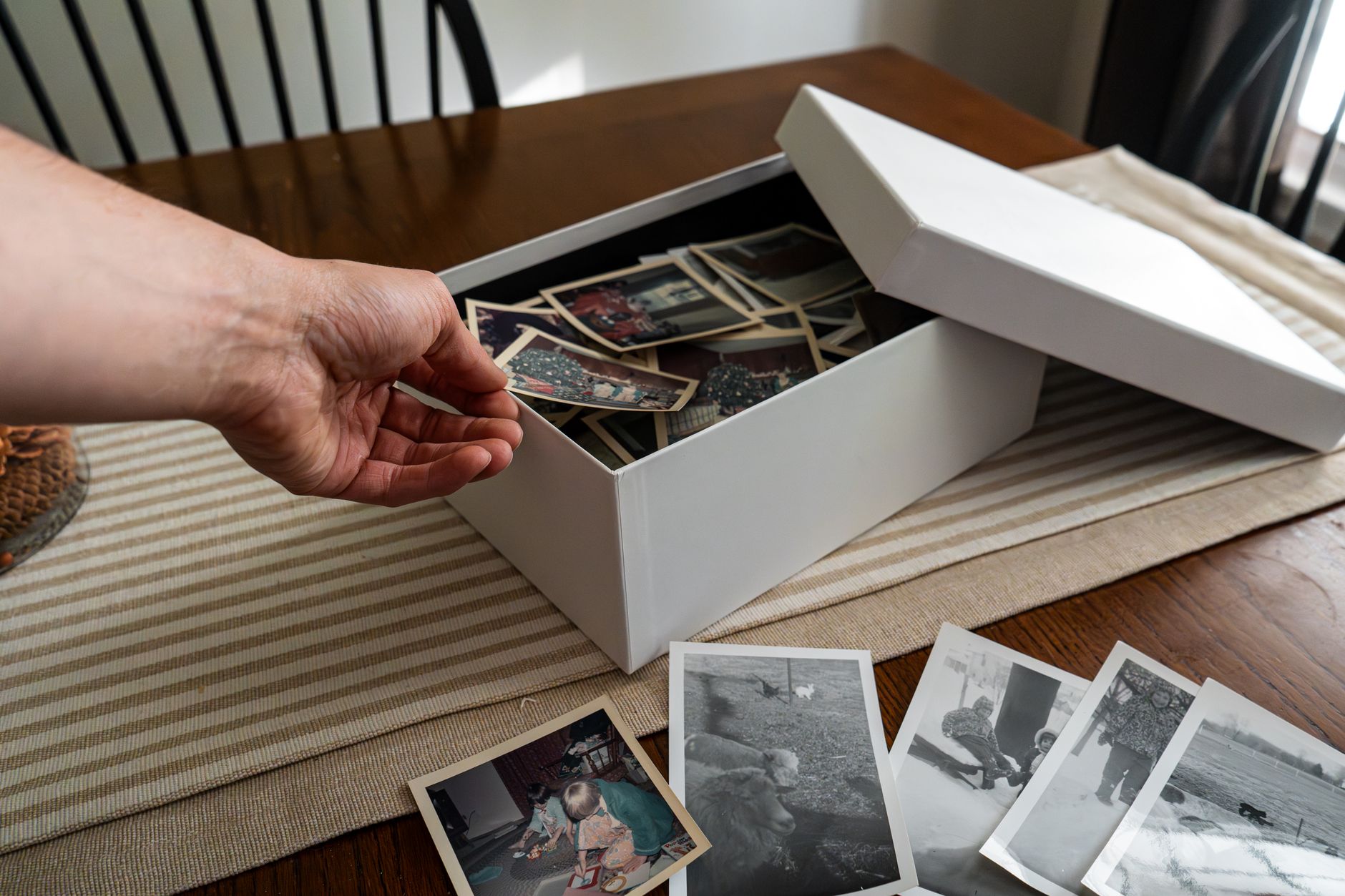
Beneath the report cards were the photographs. Every school picture I had ever brought home, every single year, kindergarten through senior portrait, in a stack as thick as a deck of cards, each one worn soft at the corners in a way that new photographs never are, the particular kind of wear that only comes from being taken out, looked at, and put back, over and over, for years. One photograph, my fourth grade picture, the year of the report card about my mother, was worn almost translucent at one corner, the emulsion gone thin and pale from what could only have been a thumb pressed against it, again and again, more times than I will ever be able to count.
Tucked between the photographs was a small braided friendship bracelet, the kind of thing an eight-year-old makes with embroidery floss and too much patience, the colors long faded to the same dull gray, and beneath it, a birthday card I had mailed him from Girl Scout camp the summer I was nine, my own crooked handwriting on the front announcing HAPPY BERTHDAY DAD, misspelled and unashamed, the inside blank except for a crayon drawing of the two of us standing in front of the shop. I had made him that bracelet in a cabin craft session and mailed him that card from a pay phone line at camp, certain neither one would matter to a man who barely looked up from his workbench, and he had kept both of them for thirty-eight years in a locked drawer with my initials burned into the lid of the box that held them.
There was a newspaper clipping from the Millhaven Gazette, brittle and yellow, a photograph of me at twelve years old holding a blue ribbon at the county 4-H fair for a rabbit-hutch design I’d built in shop class, a class I only took because the home economics section was full. I remembered that ribbon. I did not remember any adult from my family being at that fair at all, and I had spent thirty-four years assuming none of them had been. The clipping had been cut out with scissors along a careful, deliberate line, no ragged edges, the kind of cutting a man does when he intends to keep something.
And near the bottom of the box, folded once, was a program from a spring band concert, Millhaven High School, my sophomore year, the year I had stopped putting concert dates on the refrigerator because watching them go unmarked hurt too much to keep doing. My name was in the clarinet section, third row, tucked between two girls I barely remembered now. On the back of the program, in pencil, in handwriting shakier than the report card notes, my father had written eleven words that undid something in me that had been tight for over thirty years.
Stood by the gym doors. Left before the last song. Didn’t want her to see me like that.
I called my Aunt Ulyana that same afternoon, still sitting on the concrete floor of the shop with cedar shavings from some other project stuck to the knees of my jeans, and I asked her, before I had even said hello properly, whether she had known any of this. She was quiet on the line for a moment, and then she told me something I have turned over in my mind every day since.
She told me my father called her almost every Sunday night for thirty years, not to talk about himself, but to ask her what she thought I might be doing, what she thought I might need, whether she thought I was doing all right out there in Wichita with my own kids and my own life. She told me he never once wrote any of it down and mailed it to me because he had tried once, when I graduated high school, sitting at the kitchen table with a blank card in front of him for the better part of an hour, and had finally admitted to her over the phone that he did not trust his own hand to say it right, that he was afraid whatever came out would sound smaller than what he actually meant, and that a card that fell short felt worse to him than no card at all. She told me he came to the band concert because I had, without meaning to, once mentioned the date to him in passing, and that he had stood by the gym doors in the dark because the last time he had cried in public was at my mother’s graveside holding my hand, and he had promised himself that day he would never again let his children watch him fall apart, not even over something as small, and as large, as hearing his daughter play a clarinet solo he had waited three years to hear.
“He wasn’t cold, honey,” Ulyana said to me, and I could hear that she was crying too, forty years his sister and still learning things about him the same afternoon I was. “He was terrified. He buried your mother and made up his mind right there in that cemetery that he was never going to hand either of you kids something he couldn’t finish. A feeling he couldn’t finish saying out loud. A promise he might not keep. He decided the only thing he could give you that he was sure of was that shop roof staying over your head and that supper being on the table every single night, and he did that, every day, for thirty-nine years, and he never once believed it was enough, and he never figured out, not once in his whole life, how to tell you it was the only way he knew how to say I love you without breaking his own word.”
I sat with that for a long time after we hung up. I thought about the science fair, the maybe that had sat in my chest like a stone for thirty-six years, and I understood, finally, that maybe had not been indifference. It had been a man who could not promise anything he was not certain he could deliver, standing over a stranger’s carburetor because a stranger’s carburetor was a problem he knew for certain he could fix, while his own daughter’s disappointment was a problem he was terrified he would only make worse by trying.
Denton came out to the shop that evening after I called him, sat down on an overturned bucket across from me, and looked through the box himself for the first time. He found, tucked into a side pocket I hadn’t noticed, a smaller coffee can, the kind our father used for sorting hardware, except this one held no screws or washers. It held a single enamel pin, gold with a small red star, the kind they gave out at Millhaven Elementary for a student’s first time making the honor roll. Mine. Kept, according to a strip of masking tape stuck to the can’s side in my father’s printing, by the vise, where I see it every day. Denton, who I had always believed had the easier relationship with our father, sat on that bucket and cried harder than he had at the funeral, because it turned out he had his own version of this same discovery waiting for him in a different drawer, a set of his childhood report cards and his own first welding certificate, filed with the same careful hand, the same silent devotion, and he had simply never gone looking for it the way I finally had, because he had never needed to doubt that our father loved him in the first place.
I do not think my father was a good communicator. I will never be able to tell you that he was, and I am not going to pretend the years of maybe and the empty seats and the concerts I stopped announcing didn’t cost me something real, because they did, and I spent a very long time being angry about it, and that anger was not foolish or dramatic or something I should be embarrassed about now. It was earned. A child does not know, cannot know, that the silence across the dinner table is a man rationing every ounce of feeling he has left after burying his wife, terrified that if he lets one more drop of it out into the world unguarded, he will lose the ability to hold the rest of it together at all. A child only knows that her father did not come.
But I know now that he was there in every way he trusted himself to be there. I know that my father read every report card I ever brought home and argued with my teachers in the privacy of a pencil margin because that felt safer to him than arguing with them, or with me, out loud. I know that he stood in the dark by a gymnasium door and heard every note of a clarinet solo I thought no one but my band teacher ever noticed, and that he left before I could see his face, not because he didn’t care what was on it, but because he cared so much he could not risk me seeing what it cost him. I know that he called his sister every Sunday night for thirty years to ask about a daughter he did not know how to ask about directly, and that he kept a single gold pin in a coffee can by his vise so that some ordinary Tuesday, elbow-deep in somebody else’s lawnmower, he would look up and see proof that his daughter was smart and good and worth being proud of, even on the days he could not find a way to tell her so.
I brought the cedar box home to Wichita. It sits on the mantel in my living room now, where my own children and, someday, my own grandchildren will ask me what it is, and I will tell them the truth, which is that it is the box my father built with my initials burned into the bottom, and that it took me forty-six years and one locked drawer to understand what he had been trying, in the only language he ever fully trusted, to say to me the entire time.
I showed it to my daughter, Josephine, the week after I brought it home, laid every report card out across my own kitchen table the way he must have laid them out across his, and watched her go quiet the way I had gone quiet on that concrete floor. She is twenty-two now, the age I was when I decided my father simply did not have it in him to be proud of me, and she sat with that enamel honor roll pin turned over in her palm for a long time before she said the thing that finally let the last of my anger go. She said, “Mom, he kept a can labeled ‘by the vise, where I see it every day.’ That’s not a man who didn’t notice you. That’s a man who built his whole day around noticing you and never figured out how to say so.”
I drove out to the cemetery before I went home that week, past my mother’s headstone to the newer one beside it, and I did not say anything grand. I sat on the grass in my church shoes, the same ones, more or less, that I had been wearing the night I asked him if any of it mattered, and I told him I had found the box. I told him about the bracelet and the birthday card and the pin in the coffee can, and I told him I was sorry it took me a locked drawer and thirty-eight years to hear him, and that I heard him now, every word of it, all the way through.
Before I left the shop that last evening, I went back to the workbench one more time. I found a stub of pencil in the drawer where the box had been, and on the last blank page of that band concert program, beneath his eleven words, I wrote eleven of my own, and I left the program in the drawer where I’d found it, because some conversations, I have decided, are meant to stay exactly where they were finally, finally spoken.
I heard the whole thing, Dad. I stayed for the last song too.
Then I turned off the space heater that had run every winter since 1981, and for the first time in six weeks, I locked the shop behind me without a single ounce of dread in my chest, only the strange, settled quiet of a daughter who finally knows, all the way down, that she was loved.
This story is a dramatization. Names, characters, and details are invented, and any resemblance to real people or events is coincidental.