
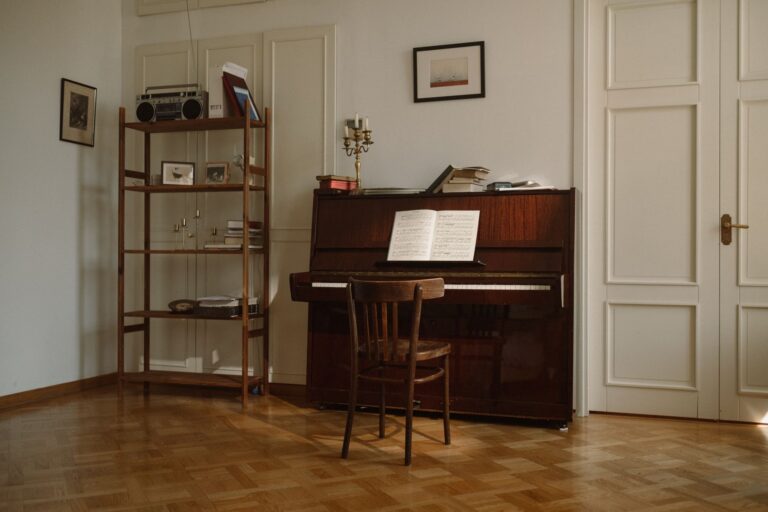
My son-in-law sold my granddaughter’s piano to pay off a gambling debt.
I was gone eight days, visiting my sister in Ponca City for her fortieth wedding anniversary, and when I came home there was a rectangle of clean carpet in my daughter’s front room where an upright piano had stood for four years. Nothing else. No note. No new furniture pushed into the gap to make the room look less bare. Just four dents pressed into the carpet fibers and a silence in that room I had not heard since before my granddaughter Lavinia learned to play “Amazing Grace” with both hands.
I want you to understand what that piano was before I tell you what happened to it.
My name is Hattie Voth. I am sixty-two years old, and I have lived within twelve miles of Thistle Grove, Kansas, my entire life. It is the kind of town where the grain elevator throws its shadow clear across Main Street by four in the afternoon, where the Casey’s is the only place open past nine, and where the ladies at First Baptist can tell whose truck is whose by the sound of the engine alone. I buried my husband six years ago. He ran the parts counter at the implement dealer for thirty years and never once raised his voice at me in thirty-nine years of marriage, which I have come to understand, watching the world since, is rarer than anyone tells you when you are young. I have lived on his pension and what I earn doing alterations out of my sewing room ever since, and it is not much, but it is mine, and I have never once been late on a bill in my life. I say that not to brag on myself. I say it because it matters to what comes next.
Four years ago, at Vacation Bible School, I watched my granddaughter Lavinia sit down at the old scratched-up upright in the fellowship hall of First Baptist and pick out a hymn by ear, both hands, without a single soul having taught her a note. She was nine years old. I stood in the fellowship hall doorway with a paper cup of red Kool-Aid going warm in my hand, and I knew, the way you know a change in weather before the sky ever tells you, that this child needed a piano of her own.
Her parents could not afford one. I am not going to spend this story explaining every reason why, and I am not going to sit here and pretend it was only about money, because even then there were things about my son-in-law, Kessa, that made a household feel tighter than his paycheck alone should have made it. But that is getting ahead of myself. The point, back then, was simpler than all of that. A little girl had a gift and no instrument to grow it on, and I was her grandmother, and I had two hands and a sewing machine and forty years left, God willing, to figure out how to help.
So I walked into Corer’s Music and Repair on the square in Thistle Grove and I asked the owner, a heavyset man with reading glasses pushed up into thinning gray hair, whether a woman my age, on my income, could take a piano home a payment at a time. I remember exactly how he looked at me. Not with pity, which I would not have tolerated, but with the particular patience of a man who has spent thirty years watching what music does to people and has decided it is worth being patient for.
“Mrs. Voth,” he said, “I will hold that piano for you as long as it takes.”
It took me four years.
Forty dollars a month, sometimes fifty when the alteration work was good that season, prom dresses taken in and wedding gowns let out and Carhartt jackets patched at the elbow for men who would rather pay a neighbor than order online. I walked every payment into that shop by hand. I do not trust the mail with money I have worked that hard for, and besides, I liked the walk, past the hardware store and the diner with the flag out front, past the bench where the retired men sit and argue about wheat prices like it is still 1974. I kept every receipt in an old Whitman’s Sampler candy tin on the shelf in my closet, rubber-banded in order by date, because that is the kind of woman I have always been. Forty-eight receipts by the time I was done. I finished paying that piano off on the fourteenth of March. Mr. Corer did not charge me a dime of interest across four years, and when I laid down that last payment, he came out from behind the counter and shook my hand like I had accomplished something worth shaking a hand over.
I had.
I did not want the piano in my own little house. I wanted it in my daughter’s front room, where Lavinia practiced every afternoon, where her mother could hear her through the kitchen doorway while she cooked supper, where I could sit on the porch swing on Sunday afternoons after church and listen through the screen door with my eyes closed while my granddaughter worked her way through a hymn or a movie theme or, more and more that last year, something she had started writing herself. That piano was never furniture to me. It was four years of Saturday mornings hunched over a sewing machine. It was a promise made to a nine-year-old girl in a fellowship hall, kept in full, by an old woman who does not make promises she cannot finish.
I need to tell you a little about Kessa now, because you will need it later, and because I have spent a lot of quiet hours since this happened wondering how much of it I saw and simply chose, the way families do, not to look at straight on.
Kessa married my daughter nine years ago in the fellowship hall of that same church, and for a long while he was, by every measure I had, a decent husband. He worked at the co-op grain elevator, steady hours, a uniform shirt with his name stitched over the pocket. He coached Lavinia’s tee-ball team the summer she was six, badly, but with more patience than I expected from him. There were good years in that house, and I do not want to pretend there were not, because it makes what happened harder to understand, not easier.
But somewhere along the way, small things started not adding up. A truck payment that went two months late even though he had not lost his job. A weekend he told my daughter he was working overtime out at the elevator, and I happened to drive past the elevator on my way home from Wednesday choir practice at nine at night and it was dark as a tomb, no trucks, no lights, nothing. He borrowed two hundred dollars from me once, cash, for what he called “car trouble,” and paid me back three weeks later in twenties that still had the crease of a bank strap on them, which struck me as odd at the time and which I filed away, the way you file away a lot of small odd things about people you love, because pulling the thread feels like an accusation you are not ready to make.
He missed Lavinia’s spring recital at the county arts building that same year, the first one he had ever missed, and told her afterward he’d had “car trouble,” the same excuse, and I remember watching my granddaughter’s face fold in on itself for just a second before she smoothed it back out, the way a nine-year-old should never have to learn to do.
I did not know the word for any of it then. I know it now. But I am getting ahead of myself again, and this story deserves to be told the way it happened to me, which is to say, slowly, and then all at once.
In late June, my sister called from Ponca City, Oklahoma, about two and a half hours south of us, to tell me she and her husband were finally throwing themselves the fortieth anniversary party their children had been promising for three years and never delivering, and would I please come stay the week and help her get the church hall decorated, because she trusted my hands with a glue gun more than she trusted her own daughters’. I said yes before she finished the sentence. Eight days, I told my daughter. Lavinia has piano practice every afternoon at four, I told her, same as always, and I will call you Sunday night to hear how the hymn is coming along.
I left on a Tuesday morning with a suitcase and a sheet cake recipe and no earthly idea that anything in my world was about to come apart at the seams.
Get a new story in your inbox every morning.
Facebook doesn’t show you every story we post. Our free newsletter does. Join 2,500+ readers.
I came home on a Wednesday, eight days later, tired from the drive, smelling like somebody else’s church basement, looking forward to nothing more than my own bed and the sound of my granddaughter practicing scales through a screen door. My daughter had asked me to stop by her place first to drop off a dish I had borrowed for the anniversary cake. I pulled into her driveway a little after four in the afternoon, and Lavinia’s practice time came and went in total silence.
That silence is what I noticed before I noticed anything else. Forty-five minutes past four and no scales drifting out through that screen door. I let myself in through the side door the way I always do, calling out, and I walked into the front room, and I stood there for a long moment not understanding what I was looking at, the way you stand in a parking lot searching for a car that is not where you left it, certain the fault must be in your own memory rather than in the world.
The piano was gone.
Not moved. Gone. Four dented squares in the carpet where the legs had sat for four years. No new furniture pulled in to cover the gap. Just an empty rectangle of wall with a faint clean outline where the piano’s shadow had kept the paint from fading same as the rest of the room, and a silence so complete I could hear the refrigerator humming two rooms away.
My daughter came around the corner from the kitchen with a dish towel in her hands and a face I had never once seen her wear in thirty-four years of being her mother. She would not look at me straight on. She looked somewhere over my left shoulder, at the empty wall, at anything but my eyes.
“Where is the piano,” I said. It did not come out as a question. It came out flat, the way a door sounds when it shuts on its own weight.
“It, ah.” She twisted the dish towel. “Kessa said the soundboard was warped from the heat this summer. He said a mover was coming to take it in for repair while I was at work, so it wouldn’t be sitting here all cracked and out of tune.”
“Repair where.”
“He didn’t say exactly. Somewhere out of town. He handles that kind of thing.”
I have known my daughter her entire life, and I know precisely what her voice sounds like when she is repeating a sentence she does not believe herself. I heard it that afternoon, plain as the elevator whistle at noon.
I found Lavinia upstairs a few minutes later, face down on her bed, thirteen years old and crying into a pillow the way you cry when you are too old to be babied about it but too young not to need to be anyway.
“Daddy said it needed fixing,” she said into the pillow, not lifting her head. “He said it would be back before I even noticed.”
She had noticed. That is the thing about a gift somebody spent four years earning for you, note by note. You notice the exact second it is gone.
I did not raise my voice that afternoon, not to my daughter, not to Lavinia. I have found, at sixty-two, that raising my voice mostly serves my own feelings and does very little for the truth. Instead I drove the fifteen minutes home, went into my closet, and took the Whitman’s Sampler tin down off the shelf.
Forty-eight receipts. Every one with my name on it. Every one dated, in Mr. Corer’s own handwriting, forty dollars, or fifty, paid in full, balance remaining, all the way down to the last one that read, in his careful accountant’s script, BALANCE: PAID IN FULL, and underneath it, in pen, God bless you, Mrs. Voth.
I put the tin in my handbag and I drove straight to Corer’s Music and Repair, because if there was one man in this county who would know the truth about where that piano had actually gone, it was the man who had sold it to me a payment at a time.
Mr. Corer was behind the counter when I walked in, same reading glasses, a little grayer than four years before. His face changed the moment I asked him about the repair.
“Nobody brought a piano in for a warped soundboard, Mrs. Voth,” he said. “Not from your daughter’s address, not from anybody’s, not this summer. I would remember. That was your piano. I’d know it in a dark room.”
I asked him if it was possible somebody had taken it to a different shop.
“There isn’t one closer than Danwell’s, two counties over,” he said. “And I’d want to know why anybody would drive that far when I’m sitting right here.” He took his glasses off and set them on the counter, which I had come to understand, across four years of visits, was the thing he did when he was about to say something he had been chewing on. “Hattie, I don’t like to speak on family business. But you paid for that instrument with your own two hands, every dollar of it, and I have got forty-eight receipts in my own file cabinet that say so. If somebody sold that piano out from under you, I want to know about it same as you do.”
I want to tell you that from there the truth came easily. It did not.
I went back to my daughter’s house that evening and I told her, gently as I knew how, that Mr. Corer had no record of any repair, that nobody had brought a warped piano to the only music shop in Thistle Grove, and that I would like to know, plainly, where her husband had actually taken it.
She sat down at her own kitchen table like her legs had simply stopped agreeing to hold her up. “He wouldn’t lie to me about something like that,” she said, but she said it the way you say a thing you are trying to convince yourself of more than the person across the table.
Kessa came home a little after seven that evening, and I was still sitting at that kitchen table when he walked in, tin bag from the co-op still in his hand, and something in his face went tight the second he saw me there.
I did not ease into it. I am too old and too tired for easing into things.
“Where is my granddaughter’s piano, Kessa.”
He set the bag down slow, and for a second I thought he was going to try the repair story on me too, but something in my face must have told him I had already been to Corer’s, because he did not bother.
“It’s a piece of furniture, Hattie,” he said, flat, not a shred of shame in it. “I needed real money and it was just sitting there collecting dust. I’ll get it back eventually.”
I have turned that sentence over in my mind more times than I can count in the weeks since. It’s a piece of furniture. Four years of Saturday mornings with a needle and thread. Forty-eight receipts in a candy tin. A nine-year-old’s first hymn played by ear in a church fellowship hall. To him, in the moment he needed it least to matter, it was a piece of furniture he was owed the right to sell.
My daughter’s face when he said it is a thing I will carry a long while.
“What debt,” I asked him. “What did you need real money for.”
He would not answer me straight, not that night, and I did not push harder, because I could see my daughter sitting there absorbing every word like a woman watching her house catch fire from the inside, room by room, and I did not think either of us had the strength that evening to go looking for the rest of it.
We found the rest of it two days later, and it was worse than either of us had let ourselves imagine.
My daughter called me Friday afternoon, her voice doing something I had not heard from her since she was a little girl who’d broken something of mine by accident and was working up the courage to confess it.
“Mom,” she said. “I need you to come over. I found something in the garage.”
She had gone out to the garage looking for a jumper cable, of all ordinary things, and behind a shelf of paint cans that had not been moved in years, she found a shoebox pushed back into the dark, taped shut, the tape old and yellowed at the edges like it had been sealed a long time ago and reopened and resealed more than once since.
Inside that shoebox were pawn tickets. Eleven of them, going back nearly three years. A set of golf clubs that had supposedly been “loaned to a buddy.” A chainsaw my son-in-law had told my daughter was “getting sharpened.” A gold class ring. And near the bottom, folded twice, a ticket from a pawnshop in the next county over, dated two years back, description line reading, in a stranger’s handwriting: MEN’S GOLD POCKET WATCH, ENGRAVED CASE, SURNAME VOTH.
Our family name. My husband’s own pocket watch, engraved on the back panel from the day his father gave it to him on his twenty-first birthday, the watch I had reported missing two years ago after what I believed, at the time, was a break-in at my own house while Kessa was over one Saturday helping me move a bureau. I remember the sheriff’s deputy walking through my house that day, noting a jimmied window latch on the back porch that I had always found a little strange, given nothing else in the house had been touched, not my jewelry box, not the cash in my kitchen drawer, nothing but that one watch off my dresser.
I sat down on an overturned bucket in my daughter’s garage and I could not, for a moment, make my mouth form words.
My son-in-law had not been robbed alongside me two years earlier. He had taken that watch himself, staged that window latch to point somewhere other than at him, and pawned my dead husband’s pocket watch for cash while comforting me, that same week, over losing it.
I am a woman of faith, and I want to tell you that in that moment I found something graceful and forgiving in myself. I did not. What I found, sitting on an overturned bucket in my daughter’s garage with a shoebox of other people’s stolen history in my lap, was a cold, clear anger I had not felt since the week I buried my husband.
But anger does not get a piano back, and it does not get a pocket watch back either. Paperwork does.
The pawn tickets in that box were old, most of them long past redemption, the items surely resold years ago and gone for good, which was its own separate grief I had to set aside to deal with later. But the piano was new, days old, not weeks, and my daughter, going through Kessa’s laptop that same Friday night with a resolve I had never seen in her before, found what we needed. A message thread on an online marketplace app, dated the Tuesday I had left for Ponca City, a listing titled “UPRIGHT PIANO, MOVING, MUST SELL TODAY,” photographs of my granddaughter’s piano taken right there in that front room, and a buyer, a young couple two counties over named Everdale, agreeing to meet that same afternoon with cash in hand for twelve hundred dollars, a fraction, I would learn later from Mr. Corer, of what that instrument was actually worth.
Twelve hundred dollars. I asked my daughter, quietly, if she knew what debt that amount corresponded to, and she told me, her voice barely above a whisper, that she had found text messages too, from a man Kessa never referred to by more than a first initial, about a card game that ran most Thursday nights out of the back of a shop in the next county, and a running number that had climbed, over the better part of a year, well past what either of us wanted to say out loud in that garage.
I did not sleep that Friday night. I sat up with that tin of receipts on my kitchen table until the sky started going gray, and somewhere around four in the morning I decided what I was going to do about it.
Saturday morning, I called Deputy Caldfield, whose family I have known since he was a boy delivering the county paper on a bicycle two sizes too big for him. I did not call him to arrest anyone, not that morning. I called him because a piano legally purchased and paid for by one person, receipted forty-eight times over four years in that person’s own name, is not community property belonging to whoever happens to live in the house it sits in, and I wanted somebody wearing a badge sitting beside me when I went to explain that to a family of strangers who had, through no fault of their own, bought stolen goods in good faith.
Deputy Caldfield met me at my daughter’s house Saturday at nine in the morning, looked over the forty-eight receipts in the tin, looked over the marketplace messages on the laptop, and told me plainly that what my son-in-law had done had a name, and the name was theft, because you cannot sell what was never yours to begin with, no matter whose front room it was sitting in.
We drove out to the Dunwoods’ place together that afternoon, my daughter, the deputy, and me, the tin of receipts on my lap the whole way like it was something alive I needed to keep both hands on.
The Dunwoods were a young couple, maybe thirty, with a little girl of their own who had been taking lessons at the elementary school and begging for a piano of her own for over a year. Mrs. Everdale answered the door, saw a sheriff’s deputy standing on her porch, and went pale as a bedsheet before anybody said a single word.
I want to tell you plainly, because it is the part of this story I hold onto most: those people did nothing wrong. They saw a listing, they paid a fair price for what they believed was a fair sale, and the piano was already sitting in their own front room with their daughter’s sheet music propped open on the stand when we arrived. When I laid those forty-eight receipts out across their kitchen table and explained, as calmly as I could manage, what had actually happened, Mrs. Everdale put her hand over her mouth, and her husband said, without a single second of hesitation, “Take it. Please. Take it home.”
I would not let them simply lose twelve hundred dollars over my son-in-law’s sin. That did not sit right with me, not as a Christian and not as the kind of woman my mother raised. Mr. Corer, when I called him that evening and told him the whole of it, offered on the spot to credit the Dunwoods’ little girl a piano of her own from his shop, discounted deep enough that between what the ladies at First Baptist quietly folded into an envelope after Sunday service, once word had traveled the way it does in a town this size, and what Mr. Corer was willing to absorb himself, the Dunwoods came out whole, and their daughter got a piano of her own besides. Small towns fail people plenty of ways. This was not one of those times.
Two men from church helped load Lavinia’s piano back into a borrowed trailer that same Saturday evening, and I rode home behind it with my hazards on the whole fifteen miles, the way you’d escort something precious, because I suppose that is exactly what I was doing.
That still left the matter of my husband’s watch, and the matter of my son-in-law.
Monday morning I drove the two counties over to Danwell Pawn and Music with the old ticket from the shoebox in hand, half expecting to be told the watch had been sold off years ago, gone the way of the golf clubs and the chainsaw. But small pawnshops, it turns out, are more sentimental businesses than people give them credit for. The owner, a soft-spoken man who had run that counter for twenty-some years, pulled a ledger and told me that engraved items sometimes sat in his back safe longer than the standard redemption period, because engraved things are harder to resell to a stranger, and a gold watch with another man’s initials on it is not the kind of item that moves quick off a shelf. It was still there. I paid what the ticket said, glad to pay it, and I held my husband’s watch in my two hands in a stranger’s shop two counties from home and I cried in a way I had not let myself cry since the week we buried him.
As for Kessa, the truth came out in full over the following two weeks, in pieces, the way truth about a person you loved tends to come out. Nearly a year of debt to that Thursday card game. A payday loan he had taken against his own truck title that my daughter had never once seen the paperwork for. Eleven pawned items belonging to people who trusted him, three of them belonging to me.
My daughter did not throw him out that same week, and I will not pretend she did, because that is not always how these things go in real families, and I have stopped expecting my own life to move at the pace of a story with a tidy bow on it. What she did was this: she opened her own bank account, the first one in nine years of marriage that carried only her name. She sat him down with Deputy Caldfield present, not to press charges, though she made clear that door stayed open, but to lay out, in writing, what restitution would look like and what would happen if it did not come. Kessa moved into his brother’s spare room that same week, agreed, in writing, to a Gamblers Anonymous meeting at the VFW hall every Tuesday night, and started paying my daughter back, slow, the way I paid off that piano, a little every month, because it turns out some debts really can only be settled that way. Whether that marriage survives the year, I could not honestly tell you, and I have made my peace with not knowing, because that decision belongs to my daughter and not to me.
What I can tell you is what happened three Sundays later, at the church potluck out behind First Baptist, tables of fried chicken and green bean casserole set up under the pole barn the men built the year Lavinia was born. Pastor Dancombe asked, near the end of the meal, if anybody had something to share, the way he sometimes does, and my granddaughter stood up from the folding table, walked into the fellowship hall, and came back out pushing that same scratched-up old upright, the very one she had first touched at nine years old, out onto the gravel where somebody had set up a little platform of hay bales for exactly this kind of thing.
She did not play “Amazing Grace” this time. She played something she had written herself over those two hard weeks, and I could not tell you the name of it, because she has not given it one yet, but I can tell you what it sounded like. It sounded like a piano that had been carried home.
I sat under that pole barn with Deputy Caldfield’s mother on one side of me and my daughter on the other, Lavinia’s own piano waiting for her back at the house, and I thought about forty-eight receipts in a candy tin, and about a man behind a counter who told a widow he would hold something for her as long as it took, and about how some things in this life really can be paid off, in full, note by note, if you are simply stubborn enough and patient enough and honest enough to keep showing up with what you have.
Nobody sells what was never theirs to sell. Not a piano. Not a watch. Not a promise I made to a nine-year-old girl in a fellowship hall four years ago, the promise that I have now kept twice.
This story is a dramatization. Names, characters, and details are invented, and any resemblance to real people or events is coincidental.