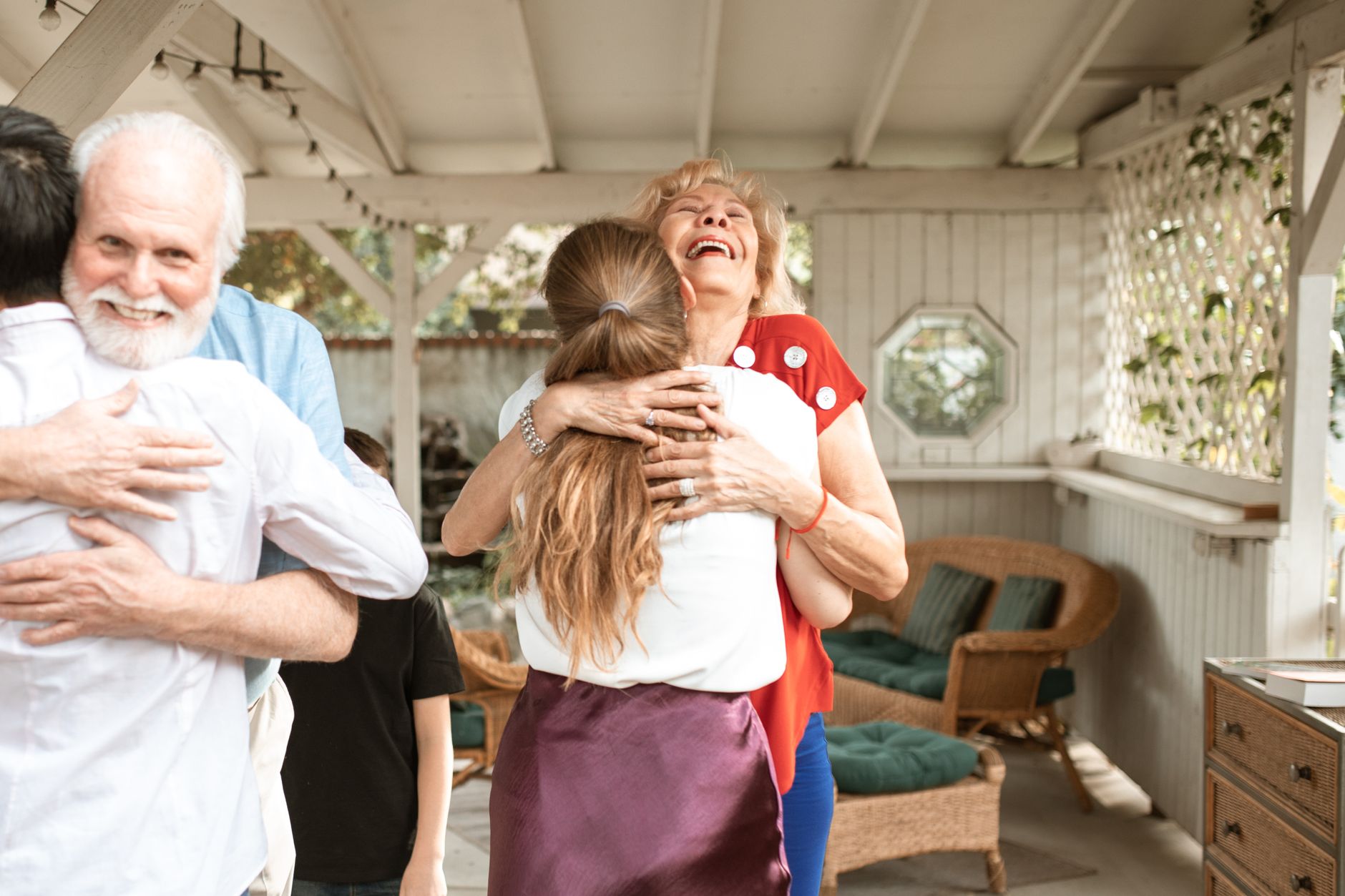
The Night My Daughter Came Home
The knock came at twenty past nine on a Tuesday in February, and I almost did not answer it.
I want to be honest about that, because the whole rest of this story turns on it. I was in my robe with a cold cup of tea going skin on the top, and the weather man had spent the whole evening warning about ice on the county roads, and when I heard those three knocks I assumed it was the wind throwing a branch against the storm door again. I am sixty-three years old and I live alone in the house where I raised my children, and a knock that late does not usually mean anything good. So I sat there another moment. I told myself it was nothing.
Then I heard the smaller sound under the knock. A child, fussing. Tired the way only a little one gets tired, where the crying is not about anything except being awake too long in the cold.
I knew that sound. I had not heard it in six years, but a grandmother does not forget it.
I crossed the front room faster than my knees wanted me to, and I pulled back the curtain on the door, and there she was. My daughter. Maren. Standing on my porch under the yellow bug light I never replaced, with frost in her hair and two suitcases on the boards beside her and a child gripping each of her hands. A boy of about five. A girl who could not have been more than three, the one who had been fussing, with her face pressed into her mother’s coat.
Six years. That is how long it had been since Maren had spoken to me. Six Christmases with no card. Six birthdays with no call. I had sent things the first two years, gifts that came back marked return to sender in handwriting I knew was hers, and then I had stopped sending things because I could not keep paying the post office to break my own heart. I did not know my granddaughter’s name. I want you to sit with that for a second, because I had to. I did not know the name of the little girl crying on my porch, and she was mine.
I opened the door.
The cold came in around her. Maren looked up at me, and her face did a thing I had not seen on it since she was a girl, since long before the silence, a kind of collapse, like a building deciding all at once that it could not hold its own weight anymore.
“Mom,” she said. That was all. Just the one word, the word she had not let herself use about me in six years, and her voice broke clean in half on it.
I should tell you what I had imagined, all those years, about this moment. Because I had imagined it. You do not get cut off by your own child and not imagine the day she comes back. I had a whole speech. I had built it and polished it and added to it at two in the morning more times than I will admit. In the speech I was calm and terribly dignified and I said something that made her understand exactly what she had done to me, something that landed, and then I decided, slowly, whether she had earned her way back in. In the speech I held the door half open and made her stand in the cold a while first. I had earned that, I told myself. After six years I had earned the right to make her wait.
I want to tell you I gave that speech. I did not give that speech.
What I did was look at the little girl with her face in her mother’s coat, the one I did not have a name for, and I heard myself say, “Get them inside before they freeze.”
And I stepped back to let them pass.
That was the decision. It happened in less time than it takes to read it. Six years of rehearsed dignity, and when the moment came I traded all of it for getting two cold children out of the wind, and I have never once regretted it, though it cost me more than I expected before the night was over.
I want to be clear about the cost, because I think people hear a story like this and they think forgiveness is the easy warm part at the end, the hug, the kettle on. It is not. The hug is the cheap part. The cost comes after, when you have to decide what you are going to do with everything you were owed.
The boy was Theo. The girl was June. June, like the month, like the warm middle of the year, and I had not known. Maren said the names quietly as she peeled their coats off in my front room, the way you introduce people who already know each other, and I had to turn toward the kitchen so she would not see my face when I learned my granddaughter’s name from her mother’s mouth at twenty-five past nine on a Tuesday in February.
I made cocoa. I do not know why that is the thing the body knows to do, but it is. I put milk in a pan and I found the cocoa tin that had been in the same cupboard since these children’s mother was their age, and I made cocoa for two little strangers who were the most familiar people in the world, and I let the making of it give me something to do with my hands while my chest tried to decide whether to come apart.
The cocoa tin is worth a word, because it is the kind of thing that undid me. It is a dented red tin with a picture of a girl in a bonnet on the side, and Maren used to stand on a chair to reach it when she was six, and I had not opened it in years, and when I pried the lid up the smell came out of it and the smell was her whole childhood, every snow day, every fever, every bad dream walked off in the kitchen at midnight. I stood there with the lid in my hand and the years just folded up on each other, six and thirty all at once, and I had to set the tin down and grip the counter and breathe before I could spoon a single thing out of it. I do not think Maren saw. She had her own hands full of children. But that tin knew her before the silence did, and it did not hold any of the silence against her, and I thought, standing there, that maybe a tin had more sense than I had given myself credit for.
Theo drank his sitting very straight at my kitchen table, watching me the careful way children watch an adult they have heard about but never met. I wondered what he had heard. I wondered if I was a villain in some story he had been told, the grandmother who did some terrible thing, and the not-knowing of it sat on me hard. June fell asleep against her mother before her cup was half gone, just dropped off mid-sip the way exhausted babies do, and Maren held her and did not drink her own cocoa at all, just held the warm mug against the child’s back like a small heater.
“Bill left,” she said finally. Bill was the husband. The one I had met exactly twice, at a wedding I was invited to like a distant cousin and a hospital waiting room where I was not allowed past the desk. “Three weeks ago. There’s a woman. There’s been a woman for a while, I think. And the house was in his name, his father’s money, and his lawyer was faster than I knew lawyers could be, and.” She stopped. “And I didn’t have anyone else, Mom. I drove eleven hours. I didn’t have anywhere else to take them.”
There it was. The thing I could have used, if I were the woman in my two a.m. speeches. You didn’t have anyone else. Not, I missed you. Not, I was wrong. You were the last door. I felt the old speech rise up in me, fully formed, the cruel clean version of it, and I felt how good it would feel to say it. That is the part nobody warns you about. How good cruelty feels when you have earned it. It sits right there at the back of the teeth, ready.
I looked at June asleep on her shoulder. I did not say it.
“You can have the back two rooms,” I said instead. “Theo can have your old room. We’ll sort the rest in the morning.”
Maren started to cry then, the silent kind, the kind that just runs down a face that is too tired to make any noise about it.
I did not comfort her. I want to be honest about that too, because this is not the story of a saint. I gave her a place to sleep and I gave her children cocoa and I did not yet have it in me to cross the kitchen and hold her. The body can do the right thing before the heart catches up. Sometimes that is all forgiveness is, at the start. The body going first.
Before they slept, I went to find sheets, and that errand turned into its own small reckoning. The linen closet still had Maren’s old twin sheets, the pale ones with the faded sailboats, washed and folded and stacked at the bottom where I had put them the year she left for the apartment with Bill. I had kept them. I had kept a grown married woman’s childhood sheets for six years of silence, folded in the dark, and I had never once asked myself why, and now I knew why, because I was carrying them down the hall to make up a bed for her son. I put the sailboat sheets on the bed in her old room and I tucked the corners the way I taught her to tuck them, and Theo watched me from the doorway with his careful eyes and finally asked, in the small flat voice of a child who has decided to risk a question, whether I was the grandma his mom cried about sometimes. I said I supposed I was. He thought about that. Then he said, “She didn’t tell me you were nice,” and he climbed into the sailboat sheets and was asleep in about ninety seconds, and I sat on the edge of that bed in the dark a good while longer than I needed to.
They slept. I did not. I sat up in the recliner in the front room the way I used to when one of the kids had a fever, listening to a house that had small breathing in it again for the first time in years, and I let myself feel all of it. The joy of it, which was enormous and which I did not trust. And under the joy, the thing I had carried for six years, which was a single question I had never been able to put down.
Why.
That was the whole of it. Not even what did I do. Just, why. Why a daughter I had carried and fed and stayed up with and loved past all reason had looked at me one autumn and decided to wall me out of her life with no explanation that ever made sense to me. There had been a fight, the last time we spoke, but the fight had been small. It had been about nothing, about a comment I made at a dinner about her finishing school, a comment I would take back a thousand times over if I could, but it had been small, and the punishment had been six years long, and the size of the two had never matched. I had spent six years trying to make a small thing explain a vast silence and never once managing it.
I got my answer two days later. Not in a dramatic scene. At the sink, doing dishes, while Theo built something out of blocks on the floor behind us.
Maren was drying. She had been quiet all morning, and then she said, to the window, not to me, “It wasn’t about what you said at the dinner.”
I kept my hands in the water. I had learned, raising her, that she would tell you the true thing only if you did not turn around and look at it.
“I know that wasn’t it,” she said. “I let you think it was, because it was easier. It was a thing I could point at.” She set a plate down. “I left because I was ashamed, Mom. And being near you made the shame worse, because you kept being. Kind. You kept calling and being decent about it and every time you did it I felt it more, and I couldn’t. I couldn’t be looked at. So I made it your fault. I took the smallest thing you ever did wrong and I made it the whole reason, because the whole reason was me and I could not stand to have you see me.”
I asked her, carefully, still not turning around, ashamed of what.
And she told me. I am not going to put the whole of it on this page, because some of it is hers and not mine to spend, but the shape of it was this: there had been a year, early on, when things went very wrong for her in a way she had hidden, money and worse than money, choices she was not proud of, and she had been certain, the way only the young and drowning are certain, that if I knew, I would stop loving her. She was so sure of that. She was so sure that my love had a bottom to it, a line past which it would not go, that rather than test it and find the line, she had cut the whole thing off clean. She had decided I would leave her, so she left me first. Six years, to avoid finding out whether I meant it.
“You thought I would stop,” I said. It was not a question.
“I thought everyone would stop,” she said. “You were just the one I couldn’t survive watching it happen with.”
I dried my hands. I turned around then. And here is the part I have thought about every day since, the thing I said, because I had been building toward the wrong speech for six years and the right one I did not know I had until it was already in the room.
I did not say it’s okay. Because it was not okay, and she would have known I was lying, and a lie would have proven her point, that my love was a thing that managed her instead of meeting her.
I did not say why didn’t you trust me, because the why was standing right in front of me, eleven hours of road still in her shoulders, and asking it would only have been me wanting credit.
What I said was, “There was never a bottom to it. I need you to hear that I am not saying that to be kind. I am saying it because it is a fact about the world that you got wrong, and you built six years on top of the wrong fact. There was never a line you could have crossed. There still isn’t. You went looking for the place where I would leave and there was no such place, and you spent six years guarding a door that was never going to close.”
She put down the dish towel and she came apart, finally, all the way, the way she had not let herself in front of me since she was small. And this time I did cross the kitchen. This time the body and the heart went together.
That was eleven months ago.
I will not pretend it has been simple since. Forgiveness is not an event, it is a tax you agree to keep paying. There were nights that first month when the old hurt came up the back of my throat unannounced, when she would do some small thoughtless thing, leave again for an afternoon without saying where, and the whole six years would slam back into me and I would have to go out to the garden and stand in the cold and remind myself, on purpose, with words, that I had chosen this. That forgiveness I had decided on once at a doorway was not a thing that stayed decided. It is a thing you decide again, smaller each time, until one day you notice you have not had to decide it in a while.
June calls me Gran now. She does not remember a time before me, which is its own strange grief, that the not-knowing went only one way, that she lost nothing and I lost three years of her, but I have stopped grieving it and started just having her. Theo told me last week that I am his best grown-up. Maren found work at the clinic in town and she is steady, and on Sundays she cooks and I am not allowed in the kitchen, which is its own kind of being forgiven.
People ask me, the few I have told, whether I was a fool to open the door that night. Whether she would have done the same for me. Whether the forgiveness was earned.
It was not earned. That is the thing I have learned and the thing I most want to leave you with. If it had been earned it would not have been forgiveness, it would have been a transaction, a thing she paid for and I handed over. I did not open the door because she deserved it. On the books she did not deserve it. I opened the door because she was mine and they were cold and because the love really did not have a bottom, and the only way to prove to her that it did not have a bottom was to spend some of it on a night when every ledger I kept said she had not earned a cent.
That is what it cost. It cost me the satisfaction of the speech. It cost me being right out loud. It cost me the clean dignity of the wronged, which is a more expensive thing to give up than people understand, because being wronged is a kind of wealth, and you have to decide to be poorer to give it back.
I gave it back. I would do it again tonight.
The bug light is still yellow over the porch. I keep meaning to change it. But some nights, when the children are asleep and the house is breathing the way a house should, I think about my daughter standing under that ugly yellow light with two suitcases and two babies and the word “Mom” breaking in her mouth, and I am so glad, so far past glad there is not a word for it, that I did not give the speech. That I let the body go first. That I opened the door.
There was never a bottom to it.
I just needed her to come close enough, one cold night, to find that out.
This story is a dramatization. Names, characters, and details are invented, and any resemblance to real people or events is coincidental.