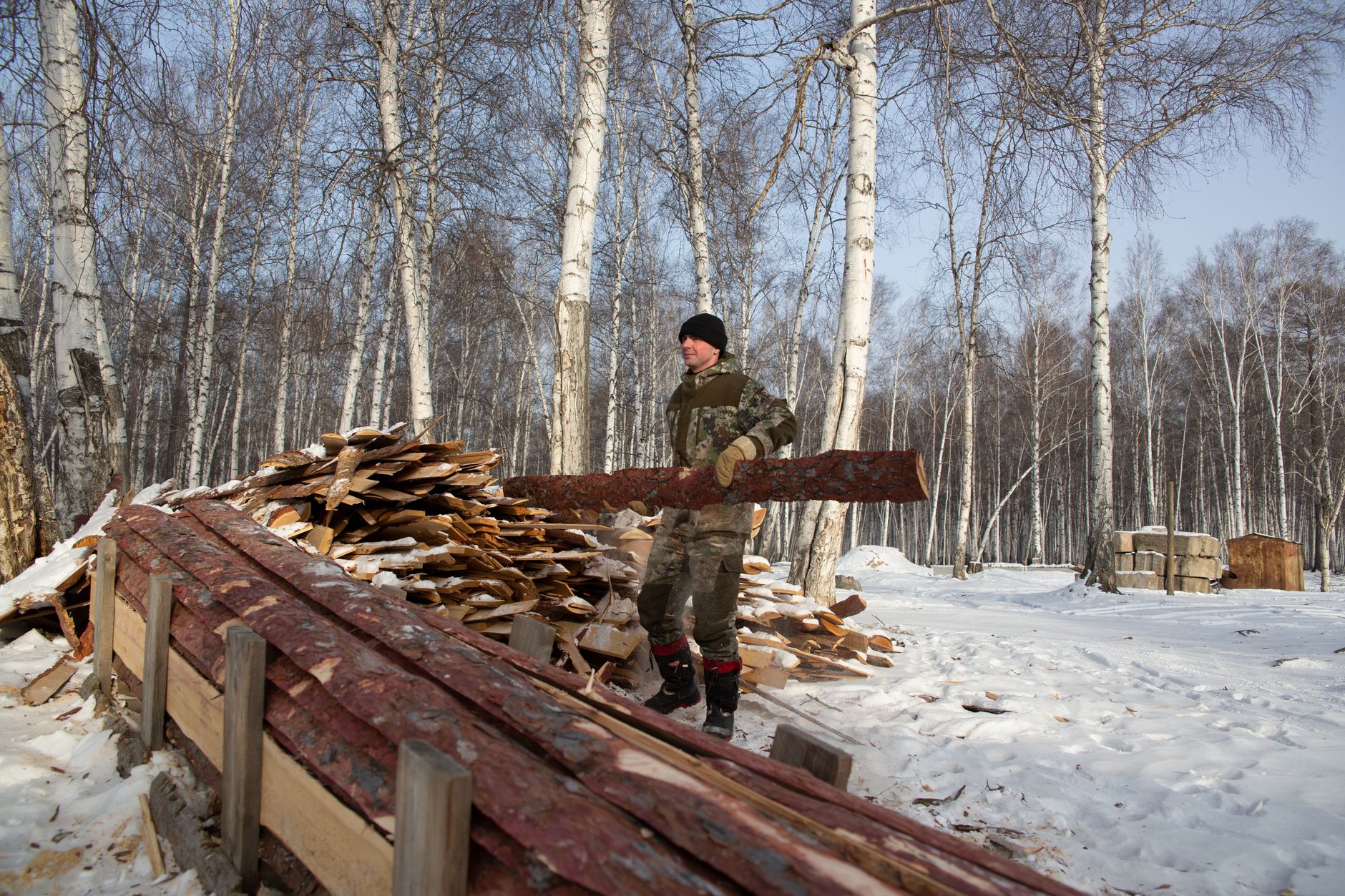
The Last Load of Firewood
I came home from the rehab center in Bangor on a Tuesday in October, three weeks before the doctors said I was ready and about six years before I said I was ready, and the first thing I saw pulling into my own dooryard was a sign. Not snow yet. Just the maples gone red on Katahdin’s shoulder and a cold snap riding down off Canada that everybody on Old Stream Road could feel in their knees before the radio ever said a word about it. Staked into the ground eight feet from my splitting block, driven in on an angle the way a man drives a sign in when he wants you to see it the second you turn off the road, was a real estate sign with a stranger’s phone number on it where mine should have been.
DENISE AUCOIN REALTY. FOR SALE. And under that, smaller, the word that did the real damage. MOTIVATED.
I want to tell you I got out of that truck calm. I did not. I have split wood on that block for better than forty years, ever since my father set it there with his own two hands, and there is not a soul in this town who has ever once heard me raise my voice over anything that wasn’t worth raising it over. I raised it that morning. My son Garrick was standing in my own yard next to a woman in a blazer that did not belong anywhere near a woodlot, and there was a U Haul idling on the road behind them with the ramp already half down, like they’d been waiting for me to be a little later than I turned out to be.
“Dad,” Garrick said, and put both hands up the way you do at a dog that might bite. “Dad, just hear me out before you say anything.”
“I’m going to say something,” I told him, “and it’s going to be that sign is coming out of my ground in about four seconds, and you’re going to be the one who pulls it.”
He didn’t move for it. That was the thing that told me how far this had already gone before I ever laid eyes on it. My own son, standing on my own land, and he didn’t move to pull a sign out of my dirt because some part of him had already decided the ground wasn’t fully mine to defend anymore.
My name is Alton. I am seventy-eight years old. I have lived in this house on Old Stream Road, three miles out of Millinocket proper with Katahdin sitting square in my kitchen window every clear morning, since I was nine days old. I worked forty-one years at the Great Northern Paper mill before it shut its gates for good, first on the green chain and then thirty of those years running the barker drum, and I split and delivered firewood, free of charge, to every widow and shut-in on this road every single winter since 1979. That is not a figure of speech. I have the tally sheets in a drawer in my kitchen, one line per cord, one column per name, going back forty-seven years, in my own hand and my father’s hand before mine. And on that Tuesday morning, my only son stood in my dooryard next to a real estate agent and told me, with what I will give him credit for believing was love, that I was too old to keep doing any of it.
To understand how I ended up standing in my own yard defending my own life to my own boy, you have to understand what that woodpile actually is. It is not a hobby of mine. It is not something I do to stay busy in my retirement, the way some men take up woodworking or bird feeders. It is the center pole of everything I have ever believed about what a man on this road owes the people around him, and it started before I was old enough to understand it, on a February night in 1958, the winter I turned ten.
There was a widow two houses down from us then named Vera Bouchard, whose husband had gone through the barker drum himself, the same drum I’d run three decades later, in an accident nobody in this town talks about even now. Vera kept a wood cookstove for heat because that was what a mill widow could afford, and that particular February the cold came down off Katahdin and sat on this valley for eleven straight days without breaking forty below at night, and Vera Bouchard ran out of dry wood on day nine. She was too proud to ask, the way a lot of the old French Canadian families along this road were too proud to ask for anything, and she nearly died of it. My father found her on the tenth morning, sitting up in a kitchen chair in three coats with her hands gone the wrong color, because he’d gotten a feeling and walked down to check on her before his shift. She lived. But my father never once, for the rest of his life, let a winter go by without walking the whole road himself in October, counting woodpiles with his own eyes, and quietly topping off anybody who was short.
He took me with him starting the winter I was twelve, handed me one end of a two-man saw before I was tall enough to keep it level, and told me something I have repeated to myself every October since. He said a road is not just people who happen to live near each other. He said a road is a promise, and the promise is that nobody on it freezes while somebody else on it has wood stacked to the eaves. I did not fully understand what he meant until I was a grown man myself, married, with a woodlot of my own out behind the house, and I found I could not walk past a neighbor’s low pile in October without hearing my father’s voice about it.
My wife Doris used to say I loved that road more than I loved my own recliner, and she was not wrong, though she also never once complained about the diesel bill on my old truck every fall, or the fact that our own basement sometimes ran a little lean by March because I’d given away a cord I’d meant to keep for us. Doris and I were married fifty-one years. She died six years ago this past spring, a stroke that took her in the kitchen on an ordinary Tuesday while she was shelling peas, and I was the one who found her, the same way my father found Vera Bouchard, except this time nobody lived. I will tell you plainly that the two winters after Doris died were the closest I have ever come to understanding what it must have felt like to sit in a kitchen chair in three coats with your hands going the wrong color, not from the cold in the air but from the cold that comes into a house when the person who filled it is gone.
What got me through those two winters was the wood. It was not a metaphor and it was not a coping strategy some counselor in Bangor suggested to me, though one did suggest something along those lines and I thanked her and went home and split three cords instead. It was the actual, physical fact of having somewhere to be at six in the morning and something that needed doing by hand, in the cold, for people who could not do it themselves. Estelle Ouellette, three houses down, has been getting a cord and a half from me every November since her husband Lucien died at the mill in 1991, the same drum, same mill, different decade, because that machine took more men off this road than I like to count. Estelle is eighty-four now and still makes me a dish of tourtiere every Christmas Eve in exchange, though I have told her a hundred times she owes me nothing. Merrow Doucette, my oldest friend on this earth, retired game warden, gets his own wood cut fine because Merrow is stubborn as a stump and can still swing a maul better than men half his age, but even Merrow lets me split the rounds too big for his shoulder anymore, because that is how two proud old men let each other help without either one having to say the word help out loud.
There are nine households on Old Stream Road that I have delivered wood to every winter for going on twenty years, some of them for closer to forty. Widows, mostly. A couple of shut-ins. One young family that lost their father in Afghanistan and has never once been billed for a stick of ash or birch since. I do not tell people this to be praised for it. I am telling you because you cannot understand what it cost me to stand in my own yard and hear my son call it a burden I was too old to carry, unless you understand it was never a burden. It was the only thing, after Doris died, that told me every morning I still had a reason to get up.
Which brings me back to that Tuesday in October, and the sign, and the U Haul with its ramp half down.
The trouble started the previous January, and I will own my part of it plainly, because a man my age who will not own his part of a mistake has no business asking anyone else to own theirs. I was out at the far end of my woodlot on a morning colder than it had any business being, hauling split rounds down to the truck on a sled I have used for thirty years, and I hit a patch of ice under a skin of fresh snow that I did not see because I was not looking hard enough, at seventy-seven years old, for a patch of ice I should have known better than to trust. I went down hard, and I broke my hip, and I lay in that woodlot for the better part of forty minutes before Merrow’s old dog Scout, who has a habit of wandering my property line, found me and set up a racket loud enough that Merrow came looking.
They flew me to Bangor. Hip replacement, a week in the hospital, and then five weeks in a rehab facility not four miles from where my son and his family live, because that was the closest bed available and because Garrick, understandably, wanted me near him. I want to be fair to my son here, because everything that happened after makes more sense once you understand what that January cost him too. Garrick was thirty-one years old when his mother died, sudden, in her own kitchen, with nobody there to catch her. He has told me since, more than once, that the worst part of losing her was not the loss itself but the not knowing, the fact that she was simply gone one afternoon in the ordinary middle of a Tuesday with no warning given to anyone. And now here was his father, five years later, lying in a snowy woodlot for forty minutes with a broken hip because nobody happened to be looking, and it is not hard for me to understand, looking back, that something in Garrick simply could not survive the idea of it happening to me the way it happened to her, quietly, with nobody there.
I did not understand it while I was lying in that rehab bed, though. What I understood was that my son started visiting me every evening after work with brochures.
Not brochures for a cane, or a better handrail, or one of those wood splitters on wheels that would have saved my hip and my dignity both. Brochures for an assisted living apartment complex in Bangor called Pine Ridge Commons, two bedroom units, on site nursing, a dining hall with a soup and salad bar, fourteen minutes from Garrick’s own front door. He would sit in the chair by my bed with his laptop open to floor plans and talk about square footage and emergency call cords in a voice that I could tell, even through the fog of the pain medication, had already made up its mind before he ever walked in the door.
I told him no. I told him plainly, more than once, in that rehab bed, that I was going home to Old Stream Road the day the doctors cleared me, and that I intended to keep splitting wood for that road for as many more winters as God saw fit to give me, with a cane if I had to and a walker if it came to that, but on my own land, in my own house, doing my own work. I thought that was the end of it. I have since learned that when my son believes he is protecting a person he loves from a mistake, he does not always hear the word no the way the rest of us hear it. He hears it as fear talking, or stubbornness talking, or grief talking, and he decides the kindest thing he can do is not listen to it.
What I did not know, lying in that bed telling my son no, was that he had already been to see a lawyer about the medical power of attorney I’d signed for him the day after my surgery, a document meant to let him make decisions about my care if I could not make them myself, and that a lawyer somewhere in Bangor had told him, in language broad enough to drive a U Haul through, that a man managing his father’s care and safety could reasonably be understood to be managing his father’s living situation too. I did not know he had already met Denise Aucoin, a realtor he’d found through a coworker, and walked her through my house while I was still learning to climb four stairs with a walker forty miles away. I did not know a sign was already ordered. I found all of that out the same morning I found the sign itself, standing in ground my own father had cleared with a team of horses in 1931.
“You can’t keep doing this, Dad,” Garrick said, in my dooryard, with Denise Aucoin standing close enough to hear every word and not nearly far enough away for my liking. “You lay in that woodlot for forty minutes. Forty minutes, and if Scout hadn’t been out that day, I don’t know what I’d have found when I finally drove up. I am not going to lose you the way I lost her. Alone, in the cold, with nobody there. I can’t do it again. I won’t survive it a second time.”
I want you to hear that line the way I heard it, because it is the whole hinge of this story. My son was not standing in my yard because he wanted my land, or my house, or whatever equity forty-one years at a paper mill and a lifetime of frugal living had put into a modest place on Old Stream Road, although I will tell you honestly that his own finances were not easy that year either, with two kids inching toward college and a job that had gone from steady to uncertain the way most jobs in this state have. Some small, ungenerous part of me wondered about that later, in a low moment, and I am not proud of having wondered it. But the truth, the whole truth, standing in that yard, was a grown man so afraid of losing his father the way he’d lost his mother that he had convinced himself the only loving thing left to do was take away the one thing keeping that father alive in every sense but the medical one.
“That wood is not what’s going to kill me, Garrick,” I told him. “Sitting in a recliner at Pine Ridge Commons with nothing to do but watch a soup line is what’s going to kill me. You want to save my life. Fine. Then help me carry it. Don’t ask me to set it down.”
He didn’t have an answer for that, not that morning. What he had instead was momentum, the kind that gets built up over five weeks of brochures and lawyers and a woman in a blazer who had already, I would learn, scheduled an open house for that coming Sunday, four days out, while I was technically still supposed to be in Bangor learning to climb stairs. I sent Denise Aucoin home. I told her, with more heat than I am generally in the habit of using with a stranger, that my house was not for sale, had never been for sale, and that if she left one more sign or one more lockbox anywhere on my property I would have Merrow, who still knows every game warden and sheriff’s deputy in three counties, come explain trespassing law to her personally. She left. The U Haul left with her, mostly empty, since it turned out Garrick had only loaded a handful of boxes from my back closet, old winter coats of Doris’s mostly, the kind of thing a son packs up when he has convinced himself the move is already decided and all that’s left is logistics.
Garrick stayed another hour, in my kitchen, arguing in the low, exhausted voice of a man who believes he is right and cannot understand why the person he loves won’t simply agree with him. He told me the open house was already scheduled and it would look bad to cancel it now. He told me Denise had a buyer already interested, a young family from away who wanted land and a woodlot, which struck me, even in my anger, as a bitter kind of irony I did not have the heart to point out to him that morning. He told me, finally, close to tears himself, that he did not know how else to keep me safe, and that every option he could think of that let me stay on Old Stream Road ended, in his mind, with another phone call like the one he’d gotten the day I fell, except the next time nobody would find me at all.
I did not have a good answer for him either. I only had my father’s voice, from sixty-eight years back, telling a boy not yet tall enough to hold a two-man saw level that a road is a promise. I told Garrick that promise was mine to keep or break, not his, and that he could either help me keep it or he could get out of my kitchen, but he did not get to break it for me out of love, because a promise broken out of love is still broken. He left angry. I let him leave angry, because I did not have the strength that day, three weeks out of a hip surgery, to chase a grown man down my own driveway and make him understand something it had taken his grandfather a whole life to teach me.
What I did not know, that Tuesday evening, sitting alone in my kitchen with a cane across my lap and forty-seven years of tally sheets in the drawer beside me, was that Merrow Doucette had been standing at the end of his own driveway that whole morning, close enough to see the sign go in and close enough to hear most of what got said, the way a man who has spent thirty years as a game warden learns to see everything on a road without ever seeming to be watching. And Merrow, unlike me, did not go home and sit quietly with his anger. Merrow got on the phone.
I found out later that he called Estelle Ouellette first, and Estelle called the Bouchard family, Vera’s grandniece, who still lives two towns over and still remembers the story of the winter her great aunt nearly froze. Estelle called the young widow with the Afghanistan husband, whose name is Colette, and Colette called two more houses, and by Wednesday evening there was not a household on Old Stream Road that did not know a realtor’s sign had gone up in my yard while I was still in a rehab bed forty miles away. I did not orchestrate any of it. I want to be honest that I did not even know it was happening, not fully, until Saturday morning, the day before Denise Aucoin’s open house was still, as far as I knew, scheduled to happen against my direct order that it not.
Sunday came in clear and cold, the kind of Maine October morning where the frost sits white on the grass until nearly nine and Katahdin looks close enough to touch. I woke early out of habit, the same six o’clock I have woken at since I was a boy on this road, and I made my coffee and stood at the kitchen window the way I have stood at it every morning of my adult life, looking out at the dooryard and the woodlot behind it, bracing myself, I will admit, for the sight of cars pulling in for a showing I had no power left to stop except by standing in the driveway myself with my cane.
What I saw instead, coming up Old Stream Road from both directions at once, was trucks.
Merrow’s truck first, with a cord of split birch already stacked and strapped in the bed. Behind him, Colette’s father in law’s flatbed, loaded with rounds not yet split. Behind that, three more trucks I recognized and two I did not, one from a family two roads over I’d delivered wood to only twice, years back, when their own woodlot flooded out. Estelle Ouellette rode in the cab of the third truck, eighty-four years old, wrapped in a coat that used to be Lucien’s, holding a covered dish on her lap the way she has held one every Christmas Eve for thirty years. By seven thirty there were eleven vehicles in and around my dooryard, and by eight there were people I had known my whole life and a few I barely knew standing in a loose crowd around my splitting block, next to the hole in the ground where a real estate sign had been staked four days earlier, unloading wood.
Denise Aucoin arrived at nine, on schedule, for her open house, and found she could not get her car past the trucks, and could not have shown a single room of my house even if she’d managed it, because the dooryard she’d planned to photograph as a charming rustic entrance was full of split wood and neighbors and Estelle Ouellette’s tourtiere going cold on a folding table somebody had carried out from my own garage.
Garrick pulled in a few minutes behind her. I watched him get out of his truck slow, the way a man moves when he is trying to understand a scene that does not match the one he built in his head, and I watched him find his mother’s coat on Estelle’s shoulders before he found me, and I watched something in his face come apart a little at the sight of it.
Estelle went to him first. I did not ask her to. I did not know, until it was already happening, that she intended to say anything at all, but Estelle Ouellette has never in my knowledge waited for permission to say a true thing to somebody who needed to hear it.
“Your father drove a cord and a half of wood to my door every November for thirty-four years, Garrick,” she said, standing close enough that he had to look at her and could not look past her. “The winter Lucien died, I did not know how I was going to heat that house through Christmas on a mill widow’s pension, and your father came up my driveway on the second of December, the same as he had the year before, and the same as he did every year after, and he never once made me feel like I was being given charity. He made me feel like I was being kept on a list of people who mattered. I am eighty-four years old, and I would rather freeze in that house than watch it get taken from a man who spent his whole life making sure nobody on this road ever had to.”
Garrick did not answer her, not right away. He looked past Estelle at the dooryard full of trucks and neighbors and cut wood, at Colette holding her little girl’s hand near the splitting block, at Merrow standing with his arms crossed the way a game warden stands when he is making sure a scene stays civil, and I watched my son do the math that I had not been able to make him do in a kitchen four days earlier. I watched him understand, all at once, the actual size and shape of what he had been about to sell, which was never really a house. It was a position on a road that could not be replaced by any amount of square footage at Pine Ridge Commons, because it was not built out of drywall and equity. It was built out of forty-seven years of tally sheets and a promise his own grandfather had made before either of us was born.
“I thought I was the only one who was supposed to be keeping him safe,” Garrick said, finally, to Estelle, though I think he was really saying it to the whole dooryard. “I didn’t know all of this was still here. I didn’t know how much of it there still was.”
“It was never going to stop being here,” Estelle told him. “It was only ever going to stop if you took it away from him.”
I will tell you plainly that my son cried in my dooryard that morning, in front of Denise Aucoin and Merrow Doucette and Estelle Ouellette and a dozen neighbors he had known his whole life and half forgotten, because a man who moves away from a small town for work has a way of forgetting how much of that town he is still standing on, even from a distance. He walked over to me, finally, past the wood and the folding table with the tourtiere going cold on it, and he did not say much. He did not have to. He put his hand flat on the splitting block, the same block his grandfather set in that ground, the same block I had told him four days earlier was coming out of the yard, and he said, “I don’t want to be the one who breaks the promise, Dad. Tell me how to help you keep it instead.”
Denise Aucoin pulled the listing that same afternoon, standing in my kitchen with a form Garrick asked her to bring back, apologizing in a way I could tell was more relief than obligation, because I do not think she had ever wanted to sell a dying man’s road out from under him either. She told us, before she left, that she’d grown up two towns over herself, and that her own grandmother had been on somebody’s wood list once, back before Denise was born, and that she had not let herself think too hard about that fact until she was standing in a dooryard full of people who remembered exactly what it meant.
What we built after that, over the following weeks, was not exactly the arrangement I’d had before my fall, and I want to be honest that it is better. Merrow and I sat down with Garrick and worked out a rotation, six of the younger men on the road, Colette’s father in law chief among them, who split and haul the heavier rounds now while I do the fine splitting and the kindling and the part of the work that matters most to me, which is still driving each load up each driveway myself and setting it stacked the way I’ve always set it, because an old man delivering his own wood is a different thing entirely to a widow on a cold morning than a stranger’s truck backing in unannounced. Garrick bought me, over my strong initial objection, a hydraulic splitter mounted on a trailer hitch, which I will admit now has saved my shoulder more than my pride wants to confess. He drives up from Bangor most Saturdays through the fall, and it is Garrick’s own son, my grandson Wyatt, fourteen years old and gone through a growth spurt this past year that put him near my own height, who asked me, the second Saturday in a row he came along, if I would show him how to read a round of maple before he split it, the way his great grandfather once showed a boy not tall enough yet to hold a saw level.
I taught him. I stood behind him in the cold with my hand light on his shoulder the way my father’s hand was once light on mine, and I told him what my father told me, that a road is not just people who happen to live near each other, that a road is a promise, and that the whole of a man’s life, if he is fortunate, gets measured less by what he built for himself than by what he kept warm for everybody else.
It is October again as I write this, a year almost to the week since a sign went into my ground at an angle meant to make sure I saw it first thing. There is no sign there now. There is a splitting block, older than I am by a decade, and a stack of tally sheets in my kitchen drawer with one new line added for this season, the forty-eighth line in a column my father started before I was tall enough to understand what it meant. Estelle Ouellette will get her cord and a half again this November, and I expect, same as every year, a dish of tourtiere in return that I will tell her, same as every year, she owes me nothing for. “You keep splitting wood for this whole road at your age, Alton,” she told me last week on her porch, “and I am going to have to live to a hundred just to make sure somebody’s still around to thank you for it.” Merrow still swings a maul better than men half his age, and still lets me split what’s too big for his shoulder, so that we can each go on pretending the other one is the one being helped.
And my son, who once stood in my dooryard and told me, out of a fear I understand now better than I understood it then, that I was too old to keep any of this going, drives up most Saturdays with his boy in the truck beside him, and helps me load a road’s worth of winter, one cord at a time, into the back of the same old truck my father once drove down this same road with a team of horses pulling behind it. He has never once, since that October morning, brought up Pine Ridge Commons again. I think he finally understands what I could not find the words to make him understand in a hospital bed forty miles from home, which is that there is more than one way for an old man to freeze to death in a warm room, and that the wood I split every winter was never really about the cold outside my window. It was about making sure that as long as I am able to lift a maul, nobody on this road, including me, ever has to sit alone in three coats and wonder if anybody is coming.
This story is a dramatization. Names, characters, and details are invented, and any resemblance to real people or events is coincidental.