
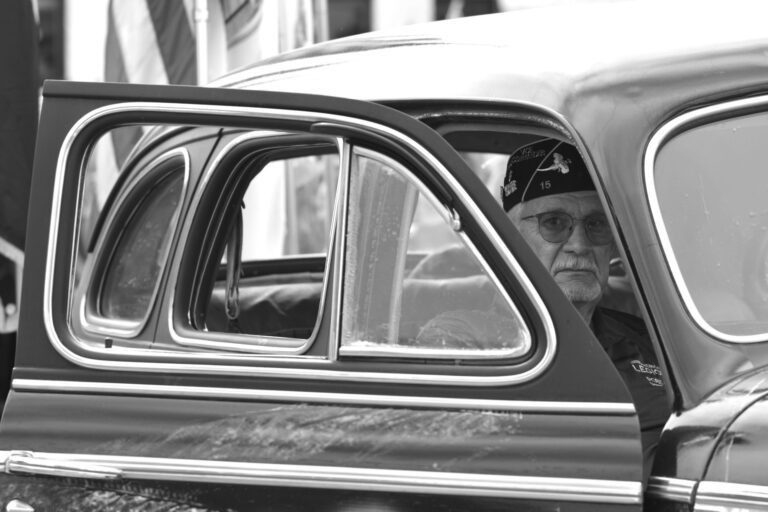
The first time I stood up in front of that room, I was not trying to save anything. I was seventy-one years old, eleven months a widower, and I only walked into the American Legion hall on a Tuesday because my daughter Verna had told me, in that patient voice she uses when she has already decided how a thing is going to go, that I could not keep sitting in the recliner watching the driveway like the mailman was going to bring Loretta back.
She did not say it that way. Verna is gentler than her mother was. What she said was, “Daddy, they do a karaoke night down at the Legion on Tuesdays. Cyrus goes. Just go sit. You do not have to sing.”
I had no intention of singing. I want that on the record before I tell you the rest of it, because what happened after was not a plan. I am not a man who plans his way into being loved. I was a man who fixed transmissions for thirty-eight years and came home to the same woman every night and did not know, until she was gone, how much of my own weight she had been carrying without ever letting me feel it.
Loretta passed in August. Congestive heart failure, the doctor said, though what I saw was a slow leaving, a lamp turned down a little more each week until one morning the wick was just cold. I had held her hand in that hospital bed and I had promised her a lot of things a man promises when he is scared, and one of them, God help me, was that I would not turn into one of those old men who lets the house go dark around him.
I broke that promise for eleven months. I want to be honest about that too. I let it go dark. I ate cereal for supper. I stopped going to church because everybody there wanted to hug me and I could not stand the softness of it. I let Loretta’s houseplants die on the sill because watering them felt like pretending she was coming back to fuss at me about it. Verna would come by on Sundays and find me in the recliner with the TV on mute and she would not say anything, she would just start washing dishes I had not run, and I would hear her crying a little at the sink and pretend I did not.
There is a particular kind of quiet that gets into a house after somebody leaves it, and I do not think a person can understand it until it has been in their own walls. It is not the absence of noise. It is the presence of the noise that should be there and is not. The kitchen timer Loretta set for her cornbread and never for anything else. The way she hummed without knowing she was doing it while she folded towels, always the same three notes, never a whole song, just three notes over and over like a bird that only knew the start of its call. The screen door she never let latch quiet because she said a house should announce its comings and goings. All of that noise went out of my house in one August afternoon and left behind a silence so loud I would sometimes turn the television up just to have something to fight against. I did not eat at the table for eleven months. I could not. Two chairs and one of them pulled out a little where she always left it. I ate standing at the counter, cereal, over the sink, like a man robbing his own kitchen.
I tell you this not to make you sad for me but so you understand exactly how far down in the recliner I was when Verna came for me. I was not sad. Sad is a thing that moves. I was still. I had gone still all the way through, the way water goes still under ice, and I had made my peace with staying that way until I quietly went out like the lamp I have already told you about. A man can decide that without ever saying it. I had decided it. And I would have kept my decision, too, if my daughter had been the kind to let me.
So when she brought up the Legion, I said yes mostly to make the crying stop.
Our town is called Ganns Mill, and if you have not heard of it, that is the whole point of it. We are a heartland town of maybe nine hundred people, a grain elevator, two churches, a Casey’s, and a stretch of two-lane that people take to get somewhere else. The American Legion Post 214 sits at the end of Depot Street in a low brick building that my father helped lay block for in 1961. He came home from Korea and helped build the place where the men who came home could go, and I grew up thinking of it as the biggest building in the world, though it is not, it is one room and a kitchen and a bar and a flag out front that Dwight raises every morning whether anybody is coming or not.
By the winter I am telling you about, though, almost nobody was coming.
That is the part you have to understand before the karaoke, before any of it. Post 214 was dying. Not dramatically. Just the ordinary American way a thing dies, which is that the old men who built it kept dying and the young ones kept leaving and the ones in the middle kept meaning to come by and never did. When I was a boy that hall was packed for the fish fry, packed for the turkey shoot, packed for the dances where I first saw Loretta in a yellow dress standing by the jukebox pretending she did not see me looking. By the time Verna dropped me off that first Tuesday, there were maybe six people inside, and the man running the karaoke machine, Lou, was singing to five of them because the sixth was asleep.
Get a new story in your inbox every morning.
Facebook doesn’t show you every story we post. Our free newsletter does. Join 2,500+ readers.
Lou. I have to tell you about Lou, because Lou is half of this story and he would be sore if I left him out, and Lou has been sore at me at least once a week for the better part of my life.
Lou is the post commander, and he has been the post commander for so long that I do not think there was ever an election, I think the job just fused to him. He served in Vietnam, came home to a town that did not want to hear about it, opened a small engine repair shop two doors down from my transmission garage, and spent the next forty years being the most stubborn man in three counties. Lou and I have argued about everything. We argued about carburetors. We argued about who had the right to the good parking spot behind the diner. We argued, once, memorably, for six weeks about whether a 1972 Chevy pickup came standard with a certain color of interior, and neither of us gave an inch, and we did not speak until the funeral of a man we both loved brought us back to the same pew.
But Lou called me the week after Loretta’s funeral. Just called, said nothing much, said the weather, said the Cardinals were going to break our hearts again, and did not hang up for forty minutes. That is Lou. He would rather cut off his own hand than say a soft word, so he keeps you on the phone for forty minutes talking about baseball so you know you are not alone. I did not know it then, but Lou had already lost the post in his mind. He was watching his father’s building empty out one folding chair at a time, and he had the same look I had, the look of a man tending a lamp that is going out.
So there we were, that first Tuesday. Six people. Lou behind the bar looking like a man at a wake. And me in the corner with a cup of coffee I did not want, having promised myself I would sit for one hour and then call Verna to come get me.
The karaoke machine was Cyrus’s doing. Cyrus is younger, maybe fifty, drives the propane truck, and he had this idea that the way to bring people back was to give them a reason to make fools of themselves in public. He had bought the machine off the internet and hooked it to two speakers that made everything sound like it was coming from the bottom of a well. And Cyrus, bless him, would sing anything. He sang that first night with his whole chest, terrible, off by half a step the entire time, and I watched the six people not caring, and something in me loosened just a little.
Then Cyrus came over and put the book in my lap.
“Odell,” he said. “You gotta pick one.”
“I do not gotta do anything,” I said.
“Loretta used to say you had a voice on you,” he said.
And that stopped me. Because it was true, and because I did not know he knew it. When Loretta and I were courting I used to sing to her. One song, mostly. I was not good, I want to be clear, I was never good, but there was one song I could carry well enough that she would close her eyes when I did it, and I sang it at our wedding, and I sang it to her in the kitchen on our anniversary every single year for forty-four years, and I sang it once, quiet, in that hospital room, when I thought she was already gone, and her hand had squeezed mine.
The song is “Unchained Melody.” The old one. “Oh, my love, my darling, I’ve hungered for your touch.”
I have never once sung it right. I cannot hit the high part where the man’s voice goes up and breaks your heart. I get up there and my voice cracks like a boy’s and I have to bring it back down, and Loretta used to laugh, not at me, with me, she used to laugh and put her forehead against mine and say, “You never can get that part, can you,” and I never could, and it was ours, that failure was ours, the cracking was the thing she loved.
So when Cyrus said her name, I do not fully know what came over me. I told him no. I told him no twice more. And then Lou, from behind the bar, without looking up, said, “Leave the man be, Cyrus. Not everybody’s got the nerve.”
Now. Lou knew exactly what he was doing. Forty years of arguing with a man teaches you which button to push. Lou pushed it.
I put down my coffee and I walked up to the front of that empty room and I told Cyrus to cue up “Unchained Melody,” and I stood there under the one good light with the flag behind me and my dead wife’s name still hanging in the air, and I sang it to six people, one of them asleep, in the worst voice you have ever heard.
And I cracked on the high part.
Of course I did. I got up to “I need your love” and my voice went to pieces right where it always goes to pieces, and for one second I stood there mortified, seventy-one years old and about to cry in front of Lou, of all the men on earth, in front of Lou.
But here is what happened. The room went quiet. Not embarrassed quiet. The other kind. Dwight, who had raised the flag that morning and every morning for nine years, took off his cap. The man who had been asleep woke up and did not know why his eyes were wet. And Lou, behind the bar, put down the glass he was drying and looked at me, and I looked at him, and neither of us said one single word, because we did not have to, because every man in that room had lost something and here was a broken old voice saying out loud the thing they had all been carrying in silence.
I finished the song. My voice cracked again on the last line, worse the second time. Cyrus started clapping and then everybody was clapping, six people clapping like sixty, and I went and sat back down in my corner and I put my face in my hands and I let myself cry for the first time since the funeral, and nobody looked away and nobody made it soft, they just let me have it, which is the only mercy that ever helped me.
I figured that was that. A strange Tuesday. I told Verna about it in the car and she cried too, of course, Verna cries at long-distance commercials.
But the next Tuesday, there were eleven people.
I did not think anything of it. Cyrus put the book in my lap again and I waved him off and Lou said, again, not looking up, “Not everybody’s got the nerve,” and I got up and did it again, cracked on the high part again, and this time when I finished, a woman I did not know, who I later learned was Dwight’s sister visiting from two towns over, came up and took both my hands and said, “My husband could not carry a tune either. Thank you.” And she did not say for what. She did not have to.
The Tuesday after that, there were twenty.
I want to try to explain how it grew, because I have thought about it a lot, and I do not think it grew because I was good. I have made that clear, I hope. I was bad. I am still bad. If you came to Ganns Mill tonight and stood in the back of Post 214 you would hear an old man mangle “Unchained Melody” and crack on the high part every single time without fail. That is not why they came.
They came because of the crack.
Word got around. You know how it goes in a small town, it goes faster than anything. The story that went around was this: there is an old man down at the Legion who lost his wife, and every Tuesday he gets up and sings their song, and he never can hit the high note, and it is the most beautiful thing anybody ever heard. That was the story. And people started coming to see if it was true, and it was true, and then they started bringing their own grief with them, because it turned out the whole town was full of people carrying lamps that were going out and nobody had given them a room to do it in.
I remember one Tuesday in that stretch, must have been late April, when a man came in the back that none of us knew. Big fellow, work boots, hands like a man who does something hard for a living, and he stood in the very back by the door the whole night with his cap in his hands and did not sit and did not sing and did not talk to anybody. I noticed him because he never once took his eyes off the front. When I got up and did the song and cracked on the high part like I always do, I saw him from the corner of my eye put his fist up against his mouth and just stand there. Afterward Cyrus tried to hand him the book and he shook his head and left, and I figured that was the end of it. But he came back the next week, and the week after, and by the fifth week he sat down, and by the sixth he told Cyrus, quiet, that he had lost his boy overseas three years back and had not been able to say the word out loud to another living soul, and that something about watching an old man fail the same note every week and not be ashamed of it had loosened the thing in his chest. His name was Dwight’s nephew, come to find out, which is how small the world gets in a town like Ganns Mill. He sang the next week. Terrible. Cried the whole way through some old country number nobody could name. And the room caught him the way it had caught me, held him up, let him have it, and did not make it soft.
That is how it went, every week, somebody new carrying something in under their arm.
By spring we had to put out more chairs.
By summer, we were standing room only.
I am not exaggerating for the story. Ask anyone in Ganns Mill. By July of that year you could not get into Post 214 on a Tuesday night unless you came early. Lou had to prop the back door open and set up folding chairs in the gravel lot, and people would stand out there in the warm dark listening through the open door. Cyrus’s terrible speakers finally died and a man from the next town over, who ran a music store, drove down and installed a real system for free, and would not take a dime, and said only, “My mother passed in March. I heard about the singing.” That is how it went. Every good thing that happened to that post came in carried under somebody’s arm along with their grief.
And the post came back to life. This is the part Verna says I always undersell, so I am going to try to say it plain. The karaoke night did not just fill the room on Tuesdays. It refilled the whole post. People who came for the singing stayed for the fish fry. The fish fry came back. The turkey shoot came back. A young couple whose grandfather had built the place with my father asked if they could hold their wedding reception in the hall, and Lou said yes, and cried during the toast, and would deny it to this day. Membership, which had been down to fewer than thirty names, more than half of them dead men Lou could not bring himself to cross off, climbed back over a hundred. The roof got fixed. The flag Dwight raised every morning finally had people underneath it again.
Lou and I never talked about any of it. That is not our way. But one night late in the summer, after everyone had gone, I was helping him stack chairs, and he stopped, and he looked around at that full-again room, and he said, “My old man built this place so we’d have somewhere to come home to.”
I said, “I know it. My old man laid the block.”
And Lou said, “It was going. I want you to know it was all the way gone, Odell. Another year.” He stacked a chair. “You know what you did.”
I did not, though. I still do not, not really. I did not do anything but crack on a high note. But I have come to believe that a town does not need a great voice. A town needs one honest one. A town needs to see one old fool stand up under the good light and love somebody who is not there anymore, out loud, badly, without hiding, and once it sees that it remembers it is allowed to do the same, and then everybody comes home.
Now I have to tell you about the night it turned, because everything I have told you so far was just the current under the water. The thing that made this more than a nice story about an old man singing happened on one specific Tuesday in the fall, almost exactly a year after Loretta passed, in front of the fullest house that hall had ever seen, and I did not see it coming, and it is the reason I am telling you any of this at all.
It was the anniversary Tuesday, though I had told no one that. I had not said out loud that it was a year. I did not want the softness. But Verna knew, and I think Lou knew, because Lou knows everything he pretends not to, and the place was more crowded that night than I had ever seen it. Standing room in the lot. Cyrus had strung some lights. Somebody had brought a sheet cake for no reason anybody would admit to.
I got up to sing. And I want you to understand, by this point it was a ritual. The room would go quiet the second Cyrus cued the opening. People who had heard me do it fifty times would still go quiet, because it was not about the surprise anymore, it was about the promise, the promise that a broken man would get up and try the impossible note one more time and fail it one more time and it would be all right, it would all be all right, that was the promise the whole town came to hear kept.
I started to sing.
And this time, I did not sing alone.
I got to the first line, “Oh, my love, my darling,” and I heard it, low at first, from the back of the room. A few voices. Then more. By the time I got to “I’ve hungered for your touch,” the whole room was singing it with me, three hundred people, in the hall and out in the gravel lot in the dark, every one of them who had ever lost somebody, which was every one of them, singing my dead wife’s song back to me in the room my father built, and I stood there under the good light and I could not sing at all anymore because I was weeping, and it did not matter, because they had it, they carried it, they carried me the way Loretta used to carry me without letting me feel the weight.
And we got to the high part.
Three hundred people, and I braced myself, because I always crack, and I did not want to be the one to break it, and I opened my mouth to try the note.
I will tell you what happened at that note in a moment, because it is the whole reason for this story, but I need you to know first that everything up to it was true. The dying post. The six people. The forty years of arguing with Lou. The plants I let die on Loretta’s windowsill. All of it true, and all of it leading to that one held note in a crowded room a year to the week after I buried my wife.
Here is what happened.
The room did not let me crack.
As I came up to the high part, the note I have never once hit in seventy-one years of trying, the note Loretta loved me for failing, the whole room lifted it for me. Three hundred voices went up to that high note and held it, held it clean and full and soaring the way I never could, and they held it for me, over me, around me, so that for the first time in my life the song I sang to my wife had its heart in it, sung true, not by me, I could never, but by everyone she and I had ever lived among, the whole town raising the note I dropped, and holding it, and holding it.
And in the middle of that held note, standing under the light my father built with a room full of people finishing my wife’s song, I felt something I had not felt since August. I felt Loretta laugh. Not heard. Felt. That laugh she used to laugh with her forehead against mine, “You never can get that part, can you.” No. I never could. But look, Loretta. Look what they did. Look who came to help me get it.
I have thought a long time about why they did that, three hundred people rising to a note on the same breath with no one leading them. Verna says it was love. Cyrus says it was the acoustics. Lou says it was because everybody in that room had been waiting their whole lives for permission to be that unashamed about missing somebody, and I gave it to them, and they gave it back, and that is what a Legion hall is for, that is what his father built and my father laid block for, a place to bring the note you cannot hit alone.
I am the karaoke king of the Legion now. That is what the sign says, the sign Cyrus painted, hanging over the bar. King Odell. It is a joke and it is not a joke. I still cannot sing. I still crack on the high part on the nights the room lets me, and on the nights it does not, three hundred people catch it and lift it and hand my wife’s song back to me whole.
We buried Lou two months ago. His heart, like Loretta’s, just wore out from carrying so much for so long. The hall was standing room only. Out in the lot in the dark, too. And when it came time, I got up under the light his father built, and I sang, and I cracked on the high part, and three hundred people rose up and caught the note and held it for Lou the way they held it for Loretta, the way they will someday hold it for me, and I understood then that this is the only thing I have ever built that will outlast me, this room full of people who have learned they are allowed to sing the note they cannot reach as long as they do not try to reach it alone.
Verna asked me last week if I ever imagined, that first dark Tuesday, that any of this would come from me getting up out of the recliner.
No, I told her. I only signed up for karaoke night to get out of the house.
And I ended up bringing a whole town back to life.
The house is not dark anymore. I keep Loretta’s plants alive on the sill now. I water them Tuesday mornings before I go, and I talk to her while I do it, and I tell her the room is full again, honey, the room your father-in-law’s father built, it is full, and every one of them knows your song, and not one of them can hit the high part any better than I can, and that is exactly why they come.
This story is a dramatization. Names, characters, and details are invented, and any resemblance to real people or events is coincidental.