
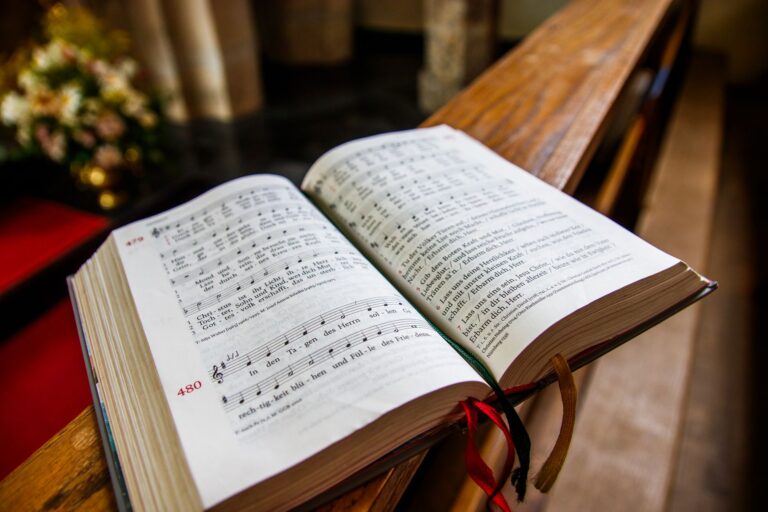
The hymnal in my lap that first Sunday was the same red one they hand out to every soul who walks through the doors of Bethel Chapel. Cracked spine. Gold letters worn down to a ghost of themselves. I had held that book so many mornings that my thumb knew exactly where to fall along its edge, the way a body knows the last stair in the dark. And that Sunday, the third Sunday after Easter, I stood up in front of the whole congregation, opened it to a page I could no longer see, and sang every word of “Great Is Thy Faithfulness” from the front of the sanctuary while the letters swam gray and shapeless under my eyes.
Nobody knew. That was the whole point. Nobody was supposed to know.
My name is Opal, and I have led the singing at Bethel Chapel for fifty years. That is not a boast. It is closer to a confession, because for the last three of those years I have been going blind, and I hid it from every person who loved me.
Let me back up, because a thing like that does not happen all at once. It happens the way water gets into a boat. A little at a time, and then you are bailing, and then one day you understand you have been sitting in it for longer than you want to admit.
I noticed it first at the kitchen sink. I was rinsing a jar and there was a shadow at the edge of my sight, a smudge like a thumbprint on a window that would not wipe clean. I blinked at it. I told myself it was the light coming through the curtains wrong. My husband Foster had passed four years before, and when a woman lives alone she gets used to explaining small things to herself. A shadow. A trick of the morning. Nothing.
But the shadow did not leave. It sat in the corner of my eye like a boarder who had decided to stay. And it grew. By the next spring I could not read the small print in the church bulletin without holding it out at arm’s length and turning it toward the window, and even then the words had a way of dissolving if I looked at them straight on. The doctor in town, a young man named Maynard who I had known since he was a boy in the third pew, sat me down in his office with his hands folded and told me it was macular degeneration. He said it kindly. He is a kind man. But there is no kind way to tell a woman that the center of her sight is going out like a lamp turned low, one slow turn of the wick at a time.
“It won’t take everything,” he said. “You’ll keep the edges. Your side vision. But the middle, Opal, the part you read and sew and see faces with, that’s going to fade.”
I asked him how long.
“Hard to say. Could be years. Could be faster. It’s different for everyone.”
I remember I thanked him. I remember I drove myself home, which I probably should not have done, and I sat in my driveway with the engine off for a long time looking at my house through the windshield, at the porch Foster built and the swing that still hung from its two chains, and I thought about the singing.
Because here is the thing you have to understand about me. The singing is not a hobby. It is not something I do. It is closer to who I am. My mother led the singing at that same church before me, and her mother before her, and when I was eight years old I stood on a wooden crate so I could see over the pulpit rail and I led “Bringing In the Sheaves” in a voice too big for my body, and the whole congregation laughed and cried at the same time, and I knew right then what I was for. Some children want to be firemen. I wanted to be the woman at the front who lifts her hand and brings four hundred voices up out of their seats and into the rafters. And I got to be her. For fifty years I got to be her.
So when Maynard told me the middle of my sight was going, the first thought I had, before fear, before grief, was this: they will take the book away from me. They will decide, out of love, that I cannot do it anymore. Delia will step in, or one of the younger women, and they will pat my hand and thank me for my years of service, and they will sit me in the third pew and let me sing along with everybody else. And that, I understood in my driveway with the engine ticking as it cooled, would be the end of me. Not the blindness. The kindness. The gentle, loving, unbearable kindness of people deciding what I could no longer do.
Get a new story in your inbox every morning.
Facebook doesn’t show you every story we post. Our free newsletter does. Join 2,500+ readers.
I decided that afternoon that they would not decide it. I would.
And so I began to memorize the hymnal.
I want to tell you it was noble. It was not noble. In the beginning it was pure stubbornness, the same mule-headed streak that had carried me through Foster’s long dying and through the years alone after. I sat at my kitchen table with that red book and a magnifying glass the size of a saucer, and I read each hymn out loud, over and over, until the words lived in my mouth instead of on the page. I started with the ones I knew best, “Amazing Grace” and “How Great Thou Art” and “Blessed Assurance,” because they came easy and gave me courage. Then I moved to the harder ones. The Christmas hymns with their long strange verses that nobody remembers past the first. The communion hymns. The old fire-and-brimstone ones from the back of the book that we only sang at revival, all four and five verses of them, with words like “Ebenezer” and “fetter” that I had to say out loud a hundred times before they would stay.
There are four hundred and twelve hymns in the Bethel Chapel hymnal. I know because I counted them, the winter I could still count them. Four hundred and twelve, most with three or four verses, some with six. I am telling you that so you understand what I did in that kitchen over those months, alone, with a magnifying glass and a failing lamp of an eye, night after night after the dishes were done and the house was quiet and there was nobody left in it to hear an old woman singing hymns to her own refrigerator.
I memorized them all.
I want to tell you what those nights were like, because a person hears “she memorized the hymnal” and pictures something quick and clever, a party trick. It was nothing like that. It was the loneliest work I have ever done.
I would clear the supper dishes, just my own plate and cup, because there is only ever one plate to clear now, and I would wipe the table down and set the red book in the pool of light under the kitchen lamp. Foster’s chair still sat across from me. I never moved it. And I would begin. I would put the magnifying glass down flat on the page and drag it slow across a single line, catching two or three letters at a time in the round of it, building the words up like a child sounding them out, and then I would close my eyes and say the line back, and then the next, and then both together, and then the verse. Over and over. My voice going hoarse in the empty house. The refrigerator clicking on and off. The clock in the front room striking nine, then ten, then eleven, while I sat there dragging that glass across “Come Thou Fount” for the fortieth time because the third verse would not stick, the one about the wandering heart, prone to leave the God it loves. I understood that verse. I lived inside that verse those nights.
There was an evening I will not forget. It was February, and the wind was coming hard off the fields and finding every gap in the old windows, and I had been working on the Advent hymns, the ones with all the verses. “O Come O Come Emmanuel.” Seven verses, each one a different name for the Lord, Wisdom and Lord of Might and Rod of Jesse and Key of David, strange old names that would not hold in my head no matter how many times I said them. And around midnight my eyes gave out. Not the disease. Just plain tiredness, the kind that makes the letters double and slide. I put the glass down and I laid my head on my arms right there on the open book, and I cried, hard, the way I had not let myself cry since the funeral. Because I was seventy-seven years old and going blind and sitting alone at midnight teaching myself to fake something I had done freely and joyfully my whole life, and the loneliness of it came down on me all at once. I said out loud, into the crook of my own arm, “Foster, I can’t. I can’t do this by myself.” And the house did not answer, because houses don’t, and Foster did not answer, because the dead don’t. But I sat up after a while and I dried my face on my sleeve, and I picked the glass back up, because the alternative was to be sat down in the third pew, and I would rather have gone blind twice than that. So I found the line again. Rod of Jesse. And I said it until it stayed.
It took me the better part of a year. Some nights the words would not stay and I would weep at the table out of frustration, this proud old woman crying over a hymnbook like a child over homework. Some nights the shadow in my eye seemed to grow while I watched, and I would put the book down and press my hands over my face and pray, not politely, not the way you pray in church, but the way you pray when you are afraid. Lord, let me keep this one thing. You have taken Foster and you have taken the small print and you are taking the faces of my grandchildren one blur at a time, but let me keep the singing. Let me stand at the front and give them the songs. Let me be useful. Do not sit me down.
And whether it was the Lord or my own stubbornness or some braid of the two, the words came. One by one they moved off the page and into me, so that by the following Easter I could open that red book to any hymn in it, hold it in my two hands in front of the whole congregation, look down at a page I could not read, and sing every word without a stumble. The book was a prop. A beautiful, cherished prop. My thumb still knew where to fall along its edge. I would turn the pages at the right moments, I would look down at the paper with an expression of following along, and the words would come up out of my memory clean and sure, and nobody, not one living soul, knew that the woman leading their worship was reading nothing at all.
I kept that secret for three years.
Three years, every Sunday, and the Wednesday night services, and the funerals, and the weddings, and the Christmas Eve candlelight when we sing “Silent Night” in the dark with only the little flames going, which I loved most of all because in the dark everyone else was as blind as me and for once we were even. Three years of standing at the front and lifting my hand and bringing the voices up, while behind my eyes the world went softer and softer, the faces in the pews melting into pink smudges, the stained glass losing its picture and keeping only its colors, my own hands going vague on the pulpit rail.
I got clever about hiding it. Oh, I got clever. I learned the sanctuary so well I could walk it blind, which I nearly was. I counted my steps from the side door to the front, eleven, and from the front to my seat, four. I memorized where every board creaked so I would know where I stood by the sound of my own feet. When Delia handed me the order of service each Sunday I would take it and nod and thank her and then hand it right back saying I had the hymns picked already, which I always did, because I was the one who picked them, and I picked from memory. When someone showed me a photograph of a new grandbaby I learned to hold it and smile and say oh, isn’t she precious, and ask her name, because a name told me more than the blur ever could. When the new young preacher, Reverend Sela, asked me to read the responsive reading one Sunday I felt my heart stop, and then I heard myself say, smooth as anything, “Oh honey, you read it, my old voice is saving itself for the hymns.” She laughed. She never suspected. Why would she? I had been at that front rail longer than she had been alive.
I told myself I was protecting them. That is the lie you tell. I told myself the congregation did not need the burden of my blindness, that they came to worship and not to worry over an old woman, that the kindest thing I could do was to keep giving them the songs and spare them the sight of me failing. But I know now, in the plain light of everything that came after, that I was not protecting them. I was protecting myself. I was terrified of the day someone would look at me with soft eyes and gently, lovingly, take the book out of my hands.
The day the secret came out was an ordinary October Sunday. I have gone over it a thousand times.
It was communion Sunday, and the sanctuary was full, and the light through the west windows had that thin gold color it gets in the fall. I stood at the front with the red book open to hymn number one hundred and eighteen, “Just As I Am,” which we always sang at communion, and I lifted my hand and brought them in, and my voice went up strong and true the way it always did, and I sang all six verses without looking at a thing.
And a child saw.
There was a little girl in the second pew, Delia’s granddaughter, seven years old, sharp as a tack the way seven-year-olds are, and she had been watching me instead of singing the way children do. And after the service, in the fellowship hall over the coffee and the sheet cake, in a voice that carried the way a child’s voice always carries at exactly the wrong moment, she tugged her grandmother’s sleeve and said, “Grandma, why does Miss Opal hold the book upside down?”
The hall went quiet. Not all at once. In a ripple, the way quiet moves through a room, from the child outward.
I had turned the book. Somewhere in the singing, turning the pages by feel, I had gotten it upside down and never known, because it made no difference to me, because I had not read a word on that page or any page in three years. And I had stood in front of the entire congregation of Bethel Chapel and sung all six verses of “Just As I Am” from a book held upside down in my hands, and a seven-year-old had seen what four hundred grown souls had missed.
I felt the heat come up my neck. I felt every eye in that hall turn toward me and I could not see a single one of them, only the smudged pink shapes of faces, and I stood there holding my coffee with my heart going like a bird against a window, and I thought, well. Well. Here it is, then. Here is the day.
It was Delia who came to me. My oldest friend, seventy-eight years old, who had sung the alto beside me for forty years. She crossed the hall and she took my arm, gentle, and she said quietly, just for me, “Opal. Look at me. Really look at me.”
And I could not. That was the answer, and she saw it. She saw me try to find her face in the blur and fail. She saw my eyes go to the sound of her voice instead of to her, the way a blind woman’s do, and she understood everything in that one moment, three years of it, all at once. I watched her face go from a pink smudge to a pink smudge with the shape of grief in it. And I said, because there was nothing left to say, “I can’t, Delia. I haven’t been able to for a long while now. I’m sorry. I’m so sorry.”
I braced myself for it. For the soft eyes. For the gentle hand. For the terrible kindness of being sat down.
Delia was quiet for a long moment. And then she did not say oh you poor thing, and she did not say why didn’t you tell us, and she did not say we’ll get you settled in the pew now. She said, in a voice that shook, “Fifty years, Opal. And you learned the whole book. You learned the whole book by heart so you could keep giving it to us.”
And she put her arms around me, and I felt her shaking, and I understood she was not grieving my blindness. She was undone by what I had done in the dark of my kitchen for a year, alone, so that I could keep standing at the front. And over her shoulder I heard the hall, which had been so quiet, begin to fill again with sound, not the sound of pity but a low murmur going around the room as the story passed from mouth to mouth, and here and there I heard somebody’s breath catch, and somebody else say oh, and I stood in the middle of a room full of people I could not see and felt something happen that I had spent three years trying to prevent, and it was not what I feared at all.
I did not lead the singing the next Sunday. Delia asked me to stay home and rest, and I let her, because I did not have the heart for it, and because some part of me believed it was over now, that the book had been, in the end, taken out of my hands, only by a child’s honest question instead of a loving decision, which somehow was worse. I sat in my kitchen that Sunday morning at the hour of the service and I did not sing. I could not. The refrigerator hummed and the house was quiet and I thought, so this is how it ends. Fifty years, and it ends with an upside-down book and an old woman who did not have the grace to tell the truth.
I did not know what they were doing.
For two weeks I did not go to church. Delia came by with a casserole and she was cheerful in a way that made me suspicious, and Reverend Sela called to say they missed me and to please come this Sunday, they had something they wanted me to be there for, and would I come, and let Delia drive me. I said I did not want a fuss made. Sela said, gently, that it was not a fuss, and that I of all people had earned the right to sit still one Sunday and let the church come to her instead of her going to the church. I did not know what she meant. I said all right. I said I would come.
Delia drove me that Sunday. She walked me in on her arm through the side door, eleven steps, and I heard the sanctuary was full, fuller than usual, and there was a hum in it, a held-breath quality, and I thought they have come to say goodbye to the old singer, and I set my jaw and told myself I would bear it with dignity.
She did not walk me to the pew. She walked me to the front. To my place at the rail. And she put something into my hands.
It was the book. The red hymnal. My thumb found the cracked spine, the worn edge, and I knew it the way you know your own hand in the dark. But it was different. It was thicker. Heavier. The cover was the same but the inside was not, and I ran my fingers over the pages and felt that they were not paper, or not only paper, they were raised, they were bumps and ridges under my fingertips in ordered rows, and I did not understand, and then all at once I did, and my knees nearly went out from under me.
Braille.
They had made me a Braille hymnal.
Reverend Sela’s voice came from beside me, close, so I would not have to find her in the blur. “We couldn’t buy one, Opal,” she said, and her voice was thick. “There isn’t a Braille edition of our hymnal. It’s an old book, our own book, the one your mother used. So we made you one.”
And Delia, on my other side, said, “Maynard’s wife knows Braille. She taught it, years back, at the school for the blind over in the county seat. And Foster’s old friend Maynard, our Maynard, the doctor, he learned it too, this fall, on the evenings. And the young people. The whole choir, Opal. We’ve been meeting on Thursday nights for six weeks. We learned to write it. And we made you the book. Every hymn. All four hundred and twelve. We each took a section.”
I stood at the front of Bethel Chapel with that heavy sacred book in my two hands and I could not speak. Six weeks. On Thursday nights, while I sat alone in my kitchen believing it was over, they had gathered in that same sanctuary and bent over paper and learned, letter by raised letter, an alphabet none of them knew, so that they could give back to me the thing I had spent a year in the dark learning by heart to keep. I had memorized the whole book so they would never know I was blind. And when they knew, they did not sit me down. They learned my darkness so I would never have to leave the front.
“You don’t have to hide it anymore,” Sela said softly. “You don’t have to hold it upside down and pretend. You can read it now. Your fingers can read it. Go on, Opal. Lead us.”
I opened the book. My fingers found the top of the page, the raised dots, ordered and patient, made by hands that loved me. And I understood that I did not even need them, because I had every word already, but that was not the point and had never been the point. The point was that they had made me a way to stay. They had built me a bridge across the dark so I would not have to cross it alone and would not have to leave.
I found the hymn by feel. I do not remember choosing it. My fingers were shaking too hard to read a word and it did not matter, because it rose up in me on its own, the first one I ever led, the one I sang standing on a wooden crate when I was eight years old.
I lifted my hand. And I brought them in.
“Bringing in the sheaves,” I sang, and my voice did not shake, my voice never shakes, it is the one thing in me that the years have not touched, “bringing in the sheaves, we shall come rejoicing, bringing in the sheaves.”
And four hundred voices came up out of their seats and into the rafters, the way they have for fifty years, only this time I could hear something new in them, something wet and broken and glad, and Delia’s alto beside me thick with crying, and Maynard’s low bass, and the young people, and the children, all of them singing, and my fingers resting on the raised dots of a book my church had made me with their own hands so that a blind woman could keep leading them home.
I lead the singing at Bethel Chapel still. I am eighty years old and I cannot see the faces of the people I have sung with for half a century. But every Sunday I stand at the front rail with a red book in my hands, and my fingers move across the raised dots that the people I love pressed into the paper for me, and I open my mouth, and I lift my hand, and I bring them in.
I hid my blindness for three years because I was afraid they would take the book from me out of kindness. I was wrong about the kindness. It did not take the book. It made me a new one. And I have stopped being ashamed of needing it, because the needing was never the shameful thing. The shameful thing was believing, for three long years in the dark of my own kitchen, that the people I sang to every Sunday of my life would love me any less for being an old woman going blind at the front of her church.
They loved me more. They loved me enough to learn the dark.
I still hold the old red hymnal my mother used, the plain one, the one with no dots in it, on the little shelf by my bed at home. I cannot read a word of it. I never will again. But my thumb still knows the cracked spine, and my heart still knows every word between its covers, and on the nights when the shadow feels too big and the house feels too quiet and Foster has been gone too long, I take it down and hold it in the dark and I sing to my empty kitchen, all four hundred and twelve of them if I have to, until the fear goes back to sleep.
A body knows the last stair in the dark. And a church, it turns out, knows how to build a rail for the ones who can no longer see the steps.
I could not read the hymn. So they taught their hands to write it. And I have never in eighty years been so glad to be caught at anything as I was to be caught singing from an upside-down book by a seven-year-old child who did not yet know that the kindest thing you can ever tell is the truth.
This story is a dramatization. Names, characters, and details are invented, and any resemblance to real people or events is coincidental.