The Headstone The Whole Town Bought
The grave had been bare for eleven months when I finally admitted to myself that it might stay that way.
I want to be honest about how a thing like that happens, because nobody tells you. When you bury a husband of forty-one years in a town the size of Wickfield, Nebraska, everybody brings a casserole. The Lutheran women brought scalloped potatoes in foil pans I am still finding in the back of my cupboard. The men from the grain co-op carried Orlin’s casket without being asked, four of them on each side, their good boots polished and their faces folded up tight against the cold. The pastor said the right words. The choir sang the hymn Orlin liked, the one about the storm and the anchor. And then the cars pulled out of the cemetery lot one by one, and the casseroles got eaten, and the world went back to spinning, and I was left standing in a kitchen that had gone quiet in a way I did not have a word for.
What nobody tells you is that the headstone is not part of the funeral. The funeral is one bill. The vault is another. The plot is another. The man at the funeral home in Hadley, the next town over with the only mortuary in three counties, sat across his desk from me with a laminated catalog and a kind, tired face, and he turned the pages slowly so I could see the granite. Gray. Rose. Black so polished you could see your own face in it. There were prices in a little column down the side, and the prices started at a number that made my stomach drop and went up from there, and I sat there in my church coat with my hands in my lap and I nodded like a woman who was going to be able to do this.
I was not going to be able to do this.
My name is Verna Aldous. I am sixty-eight years old. Orlin and I farmed a quarter section out on the Loup River road, corn and a little soybean, never a big operation, never the kind that buys a new combine without losing sleep over it. We did all right. We paid our note every year and we put a little by, and we thought there would be time. There is never as much time as you think. The cancer in Orlin was the fast kind, the kind that gives you a season and not a lifetime, and by the time it was finished it had taken the savings with it, the way it does. The medicine that the insurance called experimental. The drives to Omaha, two hundred miles each way, gas and motels and the meals you buy because you are too gutted to cook. By the time I buried him I had emptied the account that was supposed to bury him properly, and I did not tell a living soul, because that is not a thing you tell.
So the grave stayed bare. A little aluminum marker the funeral home gives you, free, the temporary kind, with his name printed on a card behind a plastic window. ORLIN DEAN ALDOUS. The card had gone soft and buckled from the weather by spring. The first hard rain after the thaw beaded up on it and I stood at the kitchen window and watched the sky go gray over the section and I thought, I cannot even keep his name dry.
I am telling you all of this so you understand the marigolds.
—
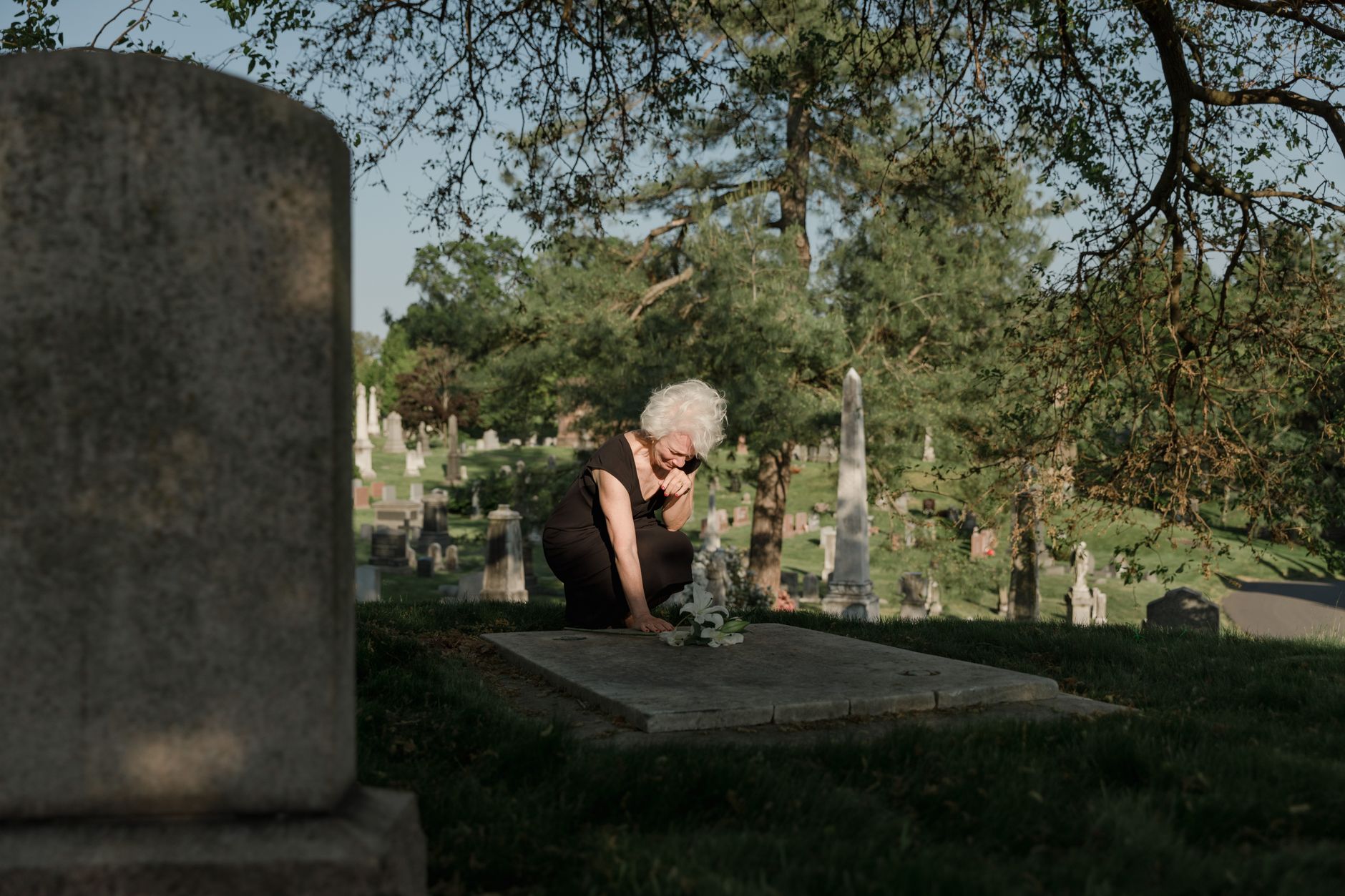
In April I drove out to the cemetery with a flat of marigolds on the seat of the truck, the orange and yellow kind, the cheap ones the hardware store in Wickfield sells four-dozen to a tray for next to nothing. I could not give my husband granite. I could give him marigolds. I knelt down at the head of the bare plot, where a stone was supposed to be and was not, and I dug into the cold spring dirt with a garden trowel and I planted them in a tidy double row, and I talked to him the whole time the way I had talked to him every day for forty-one years.
You would have laughed at me, I told him. Forty years of you telling me marigolds keep the rabbits off the beans and here I am planting them on you.
The cemetery at Wickfield sits on a low rise north of town, behind the white frame Lutheran church, and from up there you can see the whole valley, the river timber, the elevator standing up against the sky like the one tall thing for miles, the water tower with WICKFIELD painted on it in letters that need redoing. It is a beautiful, plain, ordinary place and Orlin had picked our plots himself, years back, the way practical men do, so I would not have to. He had picked the spot under the bur oak because, he said, a man likes shade. He said it like a joke and I had swatted his arm. Now I knelt in that shade and planted flowers because I could not buy a stone, and I was not crying, which surprised me. I had cried myself out months before. I just felt hollow and old and ashamed in a way I could not have explained to anybody.
A woman saw me. I did not know it at the time. Her name was Hettie Brungardt, and she ran the little flower-and-card shop on the corner of Main and Second, and she had come up to the cemetery that same morning to set silk peonies on her own mother’s grave two rows over. She watched a widow plant dime-store marigolds where a headstone should be, and she put two and two together, the way women in a small town do, quietly and without a fuss. She did not come over and embarrass me. She just watched, and she understood, and she drove back down the hill into town and she did not keep it to herself.
I want to be careful here, because I did not know any of this was happening. That is the whole heart of it. I was not part of it. I did not ask for it. For most of that spring and into the summer I went on the way a widow goes on, and the thing that was happening underneath the town was happening without me, and I had no idea.
—
Let me tell you about Wickfield so you understand what kind of place keeps a secret like this.
It is not a rich town. The young people leave, the way they leave all these towns, off to Lincoln and Omaha and Denver, and the ones who stay are stubborn or rooted or both. The school graduates a class of nineteen some years, eleven in a bad year. The cafe on Main is called the Spur and it serves a hot beef sandwich on Thursdays that people drive in from the country for, and the same nine men have been drinking coffee at the same back table since before I was married, although it is not all the same nine men anymore, because some of them are up on the rise under the oaks with Orlin now. There is one bank, one elevator, one hardware store, two churches, a Lutheran and a Methodist, and a long peaceful rivalry between them that comes out mostly at the summer ball games and the fall bazaars. People here have known each other their whole lives. They have buried each other’s parents. They have stood up at each other’s weddings. When something is wrong with one of them, the others know it before it is spoken, and they have a way of fixing it that does not require anybody to say out loud that it is broken.
I should have known they would not let it stand.
But grief makes you blind to kindness sometimes. It builds a little wall around you. All that summer I thanked people for their casseroles and I went to church and I sat in the pew Orlin and I had sat in for four decades, third from the back on the left, and I made myself small, because I did not want anybody to ask me about the stone. Pastor Aldenderfer, our young pastor, the one who came to us from a seminary in Iowa with a wife and a baby and a way of preaching that made the old men cry without admitting it, would catch my eye sometimes after the service and I could tell he wanted to say something and I would turn away. I thought he was going to ask me about the headstone. I thought he was going to offer the church’s help, and I would have to say no, because pride is the last thing a poor proud woman puts down, and I was not ready to put it down.
I know now that he was not going to ask me anything. He already knew. They all already knew. He was only trying to find a way to look at a woman he was keeping a secret from, and that is a hard thing to do across a sanctuary, and I read it wrong.
—
The marigolds came up. That is the thing about marigolds, they are cheap and they are stubborn and they do not care that you are poor. By June they had filled in, a low blaze of orange and gold at the head of the bare plot, and I have to tell you, when I drove up that hill on a Sunday afternoon in June and saw them, my heart lifted for the first time since the funeral. The grave did not look forgotten anymore. It looked tended. It looked like somebody loved the man underneath it, which somebody did.
I started going up more after that. Tuesday mornings, mostly, with my watering jug, because June in Nebraska will cook a marigold to a crisp if you let it. I would water the flowers and pull the little weeds and talk to Orlin about whatever there was to talk about, the price of corn, the Hagerty girl who was getting married, the leak in the porch roof I did not know how to fix and he had always meant to. I got to where those Tuesday mornings were the best part of my week, which tells you something about the rest of my week.
It was on one of those Tuesday mornings in early July that I noticed the dirt.
At the foot of the plot, away from the marigolds, the ground had been disturbed. Not dug up, just, settled wrong, the way ground looks when somebody has been working it and tamped it back down. I stood there with my watering jug and looked at it and could not make sense of it. I thought, a badger, maybe, or the cemetery board doing some leveling. I did not think much of it. But over the next two Tuesdays I saw it again in different spots, a little scuff of fresh dirt, a boot print in the soft ground after a rain that was not my boot, the marigolds at one corner crushed flat and then, the next week, propped back up and watered, watered by a hand that was not mine.
Somebody was coming to my husband’s grave when I was not there.
I will be honest, the first thing I felt was not gratitude. It was a kind of fright. A woman alone gets protective of the one thing that is hers, and that grave was mine, that bare poor flowered grave was the last thing on this earth that was just Orlin’s and mine, and the idea that somebody was up there in it when I was not, doing I did not know what, sat me down on the little iron bench by the path and made my hands shake. I thought about calling the sheriff. I thought about Delbert Yost, who ran the cemetery board and had a key to everything and a nose for everybody’s business, and I almost called him, and then something stopped me. The marigolds at the crushed corner had been propped back up. Tended. Whoever it was, was not hurting anything. Whoever it was, was helping.
I decided I was going to catch them.
—
It sounds foolish, an old woman staking out her own husband’s grave. But I had nothing but time, and I had a question that would not let me sleep, and on a gray Tuesday morning at the end of July I drove up the hill before dawn, parked the truck down behind the church where it could not be seen, and walked up to the cemetery in the half dark and sat on the iron bench under the oak two rows down from Orlin, with my coat collar up and my thermos of coffee, and I waited.
I want to describe that morning to you because I have gone back over it a thousand times since.
The sky came up slow and pink over the river timber. A meadowlark started somewhere down the slope, that long liquid call they have, the most hopeful sound in the world. The dew was heavy and it soaked through my shoes. The whole valley lay there under the mist, the elevator, the water tower, the grid of section roads, the little town just starting to put up its breakfast smoke, and I sat in the cold and watched my husband’s grave and I felt, for no reason I could name, that something was about to be given to me.
A little after six, a truck came up the cemetery lane. An old maroon Ford, rust at the wheel wells, a truck I knew. It belonged to Asa Tichenor, who was eighty-one years old and had farmed the place next to ours my whole married life, and who had carried one corner of Orlin’s casket on a bad hip because nobody could have stopped him. He parked, and he got out slow the way the old ones do, one hand on the door and one on the bed rail, and he reached into the back and lifted out a five-gallon bucket, and he walked up the row to Orlin’s grave, and he set the bucket down, and he took off his cap.
I sat very still on the bench.
Asa stood at the foot of the grave with his cap in his hands and his head bowed for a long minute, the way you stand at a friend, and then he put his cap back on and he knelt down, eighty-one years old on that bad hip, and he started to weed the marigolds. Gently. Knowing how. He poured water from the bucket, a little at the base of each plant. He propped up the ones the rabbits had bent. And the whole time his lips were moving, and I was too far to hear, but I did not need to hear, because I have prayed beside that man at a hundred funerals and I knew what praying looked like on him.
I do not remember deciding to stand up. I just found myself on my feet, walking up the row toward him in the wet grass, and he heard me and turned, and his old face went through about four things at once, surprise and guilt and something soft, and he got up off his knee the slow way and stood there caught, an eighty-one-year-old man caught red-handed watering a dead neighbor’s flowers, and he said the thing I will hear in my head until the day I lie down beside Orlin myself.
He said, Verna. We meant to have it done before you found out.
I said, Have what done, Asa.
And he looked at me a long moment, and I watched him decide that the secret was over, and he said, Come down to the church Sunday. Come down to the church and let the boy tell you. It is not mine to tell.
—
I did not sleep that week. I want you to understand the not-knowing. I knew now that Asa Tichenor came in the mornings to tend my husband’s grave, and I knew there was a thing they meant to have done, and I did not know what it was, and the four days until Sunday stretched out like four years. I went up to the grave on Saturday and the marigolds had never looked better, fat and watered and weeded, an old man’s love poured out on them in five-gallon buckets, and I knelt in the dirt and I cried for the first time in a long time, not the hollow crying from before but the other kind, the kind that comes when the wall around your grief gets a crack in it and something warm gets through.
Sunday I put on my good dress. The blue one Orlin liked. I sat third from the back on the left, in my pew, and Pastor Aldenderfer preached on the loaves and fishes, the little boy with five barley loaves and two small fish and the five thousand fed, and I did not understand yet why he had picked that text, and I do now. He preached on how the miracle was not that God made food appear. The miracle was that a whole hungry hillside of people, when one small offering was put down in front of them, found that they had been carrying enough all along, hidden in their own coats, and only needed somebody to start.
And then he closed his Bible and he came down out of the pulpit, which our pastor does not do, and he stood at the front of the church in front of all of us, the Lutherans of Wickfield, Nebraska, the farmers and the widows and the co-op men and the women who had brought me scalloped potatoes, and he said, Verna Aldous, will you come up here.
I did not want to. Every eye in that church was on me. But Hettie Brungardt was sitting beside me, she had sat herself down beside me that morning on purpose, I understood later, and she put her hand on my arm and she said, low, Go on, honey. Go on up. And I got up on legs that did not want to hold me and I walked up the aisle of the church I was married in, to the front, where the pastor was waiting, and he turned me around gently by the shoulders to face the congregation, and he said:
Verna, this town has something it needs to give back to you. And then your son in law is going to drive you up the hill.
—
I had no idea what was on the hill.
They drove me up in a line of trucks and cars, the whole congregation, like a little funeral but the opposite of a funeral, and we came over the rise into the cemetery, and I saw it from a hundred yards away, and I had to put my hand on the dashboard.
Where the bare plot had been, where the soft buckled name-card had been, where my poor stubborn marigolds had bloomed all summer over nothing, there was a headstone.
Rose granite. The good kind, the kind from the top of the funeral man’s catalog, polished so it caught the morning sun and threw it back. And cut into it, deep and clean and forever, ORLIN DEAN ALDOUS, and the dates, and below the dates the line I had only ever said out loud to Orlin in the dark, the line from the hymn he loved, WE HAVE AN ANCHOR THAT KEEPS THE SOUL. They had known. Somebody had told them. Of course somebody had told them. In Wickfield everybody knows everything, and for once in my life that was not a curse, it was the whole salvation.
I could not stand up. My son in law, Orlin’s nephew Cleve, who had driven up from Grand Island, had to take my arm. They walked me up to the stone and I put my hand flat on the cold rose granite and I felt the cut letters under my fingers, my husband’s name made permanent at last, and I turned around to that crowd of plain ordinary people standing in the cemetery grass in their Sunday clothes, and I asked the only thing I could ask.
I said, Who. Who did this.
And nobody answered. That is the part I have to make you understand. Nobody stepped forward. Pastor Aldenderfer just shook his head, gently, almost smiling, and he said, That is the one thing we are not going to tell you, Verna. They asked me not to. And it was not one of them. It was all of them.
It came out, over time, in pieces, the way these things do in a town that cannot fully keep a secret even when it tries. Hettie Brungardt had seen me plant the marigolds in April and had not been able to live with it. She went to Pastor Aldenderfer. The pastor went, quietly, to a few people, and the few people went to a few more, and within two weeks there was a coffee can. An actual coffee can, a Folgers can, on the counter of the Spur cafe, with a slot cut in the plastic lid and no sign on it, nothing written on it at all, because if you needed it explained you were not from Wickfield. The men at the back table knew. The women at the church knew. The hardware store knew, and the elevator knew, and the bank knew, and the can filled up. Five dollars at a time. The Methodists across the street heard about it, and the long peaceful rivalry went quiet, and the Methodists filled a can of their own and brought it over. The high school kids did a car wash and did not tell their parents what it was for, except that their parents already knew. Asa Tichenor, who had next to nothing himself, put in more than he could spare and tended the grave on his bad knees all summer so it would be ready, so the marigolds would look like something when the stone went in.
And when the can had enough, the cemetery board, Delbert Yost, the very man I had almost called the sheriff on, ordered the rose granite from the monument works in Hastings and arranged for it to be set on a Saturday when I was at my sister’s in Columbus, which they had arranged too, the whole town conspiring to get a grieving widow out of town for one day so they could give her the thing she could not give herself.
Nobody signed it. There was no card. There was no envelope, no note tucked in a coat, no lawyer with a letter, none of the things you would expect. There was only a town, and a coffee can, and a stone that appeared on a hill where there had been nothing but flowers and shame.
—
I want to finish by telling you what I understand now that I did not understand kneeling in that cold April dirt with a trowel and a flat of marigolds and a heart full of shame.
I thought I was alone. That is the lie that grief tells you, and it tells it to everybody, and it is the cruelest lie there is. I thought I had failed Orlin because I could not buy him granite. I thought my poverty was a secret I was keeping, when the truth is that there are no secrets in a town like Wickfield, and the people I was hiding my need from were the very people quietly meeting it, five dollars at a time, in a Folgers can on a cafe counter, while I sat in my pew and thanked God I had hidden it well.
I had not hidden it at all. They had let me think I had, which is its own kind of mercy. They let me keep my pride all summer, and then they gave me the stone anyway, and they refused to tell me who so that I could never pay it back, so that I would have to do the only thing you can do with a gift that big, which is carry it, and pass it on, and let it change you.
The marigolds still come up every spring. I plant them myself, a double row, the cheap orange and yellow ones from the hardware store, at the foot of that rose granite stone with my husband’s name cut deep into it and the anchor line from his hymn. Asa Tichenor passed two winters ago and he is up there now, three rows over, and on Tuesday mornings I tend his marigolds too, because somebody has to, and because that is how it works in a place like this, the kindness going around and around like water in a five-gallon bucket, never used up, only poured.
I am Verna Aldous. I could not afford my husband’s headstone. So I planted marigolds and kept my shame, and the whole town I thought I was hiding from reached into its own thin coats and bought him granite, and set it on the hill while I was away, and would not let me thank a single soul.
I have stopped trying to find out who. I know who. It was all of them. It is still all of them. And every spring when I kneel in that dirt in the shade of the bur oak Orlin picked because a man likes shade, I understand the thing the pastor was trying to tell me from the loaves and the fishes, all the way back at the start, before I had ears to hear it.
We were never as alone on this earth as our grief tries to tell us we are. We are all of us carrying more than we know, hidden in our own coats. It only ever takes one person to start. Hettie Brungardt, on her knees at her mother’s grave on an April morning, saw a widow plant flowers where a stone should be, and could not live with it, and started.
That is the whole story. That is the whole town. That is the only kind of miracle I have ever needed to believe in, and I have it on a hill north of Wickfield, cut into rose granite, paid for by hands that will not let me thank them, blooming orange and gold every June.
This story is a dramatization. Names, characters, and details are invented, and any resemblance to real people or events is coincidental.