The Garden They Paved Over
I came home from two weeks at my sister’s place in St. Paul, and my son-in-law Chad was standing in the middle of a four hundred square foot concrete slab where my husband’s garden used to be, and when I could not make a sound, he shrugged at me and said, “It’s just dirt, Nguyet. I’ll buy you some pots.”
He said my name wrong, the way he has said it wrong for eleven years. New-gett. My name is Nguyet. It means moon. My husband Minh, whose name means bright, used to tell people that when he married me he got moonlight for the rest of his life, and then he would laugh at his own joke like it was the first time he had made it. Minh has been dead three Junes now. He died in that garden, between the tomato rows, with the hose still running.
And Chad poured concrete over it so he would have somewhere to park a boat he had not even taken delivery of yet.
I want to tell this the way it happened, start to finish, because half of Halloway, Iowa was part of what came after, and because my husband deserves to have it told right.
The strange thing is that I knew before I saw it. You live in a house for twenty years and you learn its light the way you learn a face. In late June, at six in the evening, the sun is supposed to come over the Kesslers’ silver maple and lie down across my backyard in long green stripes: the tomatoes first, then the pole beans, then the lemongrass hedge along the south fence, which caught the low sun and glowed like it was keeping a secret. That was the picture I had been carrying in my head for two weeks in Minnesota, sitting in my sister Trang’s kitchen while her new knee healed, missing my own kitchen window.
When my daughter Linh turned the car onto Sycamore Street, the light coming off my backyard was flat and white. Parking lot light. I remember saying, “Linh, what is wrong with the yard,” and my daughter, who had been talking nonstop since the Des Moines airport about the flight and the weather and everything except home, gripped the steering wheel and said, “Ma. Chad did something. I need you to know I did not know.”
I walked through the side gate Minh hung in 2007, the one that still drags a little in August when the wood swells, and I stood on the edge of it.
Four hundred square feet of fresh gray concrete, still pale at the corners, with a lawn chair sitting in the middle of it and my son-in-law in the lawn chair with a tape measure on his knee, figuring out where the boat trailer would sit.
The tomato rows were gone. The bean poles were gone. The cedar trellis Minh built and sanded with his own hands over a whole rainy October was broken up and stacked by the burn barrel like scrap lumber. The lemongrass hedge, which my husband grew from three stalks he bought in 1986 because he missed the smell of his mother’s kitchen in Vietnam, a hedge that stood as high as my shoulder, had been torn out by a machine. I could see one tread mark from the skid loader pressed into the strip of dirt they had not bothered to pour.
Twenty years of soil. I need you to understand what that means, because Chad never did. Soil is not something you have. Soil is something you make. Every fall for twenty years, Minh and I raked the leaves off half the block, because the neighbors were glad to be rid of them, and dug them into those beds. Eggshells, coffee grounds by the bucket from Dot at the diner, manure from the Vandersloot farm every spring, fish bones buried under the tomatoes the way Minh’s grandfather did it in the Mekong Delta. Farmers at our church potluck used to joke that we had better ground in our backyard than they had in their bottom forty. Bill Vandersloot once offered, half serious, to trade me an acre for the recipe. There is no recipe. The recipe is twenty years, on your knees, married.
Chad looked at my face and had the nerve to look impatient. He is thirty nine years old, sells farm equipment out of the dealership on Highway 14, and has never once in eleven years been early, wrong, or sorry. He stood up off the lawn chair and put his hands up like I was the one being unreasonable, and that is when he said it.
“It’s just dirt, Nguyet. I’ll buy you some pots.”
Then, because silence makes him nervous, he kept going. He said the yard was a liability, that I am sixty five and should not be on my knees out there anyway, that a poured pad adds value to the property, and that when the house sold someday, and he said “someday” in a way that told me he had already spent the money, the next owners would rather have a parking pad than, and I am quoting my son-in-law exactly, “a bunch of old lady vegetables.”
He had a deal on the concrete from a buddy’s crew, he said. Done in a week. He called it a win-win.
My daughter was crying behind me at the gate. I did not cry. I have been told my whole life that my face goes still when the worst things happen, and I suppose it went still then, because Chad shifted his weight the way men do when they expect to be yelled at and cannot find the argument they prepared for.
I asked him one question. I asked where the dirt went.
He blinked at me and said the crew hauled it to the ravine out past the fairgrounds, with the rest of the fill.
I went in the house and closed the door, and I stood in my kitchen where the window looks out on that slab, and I understood that I could not stand at my own sink ever again without seeing it.
Here is what Chad paved over, since he never asked.
I came to Iowa in 1979. I was eighteen years old and I weighed ninety one pounds and everything I owned fit in a plastic rice sack. My family went into the sea off Vũng Tàu in a boat built for river work, thirty one of us, and I will not tell that whole part of the story here except to say that not everyone who got in the boat got out of it. We were eleven months in the camp at Pulau Bidong. Then a Lutheran congregation in a town in Iowa I could not have found on a map signed a piece of paper, and in February, in a coat somebody’s daughter had outgrown, I stepped off a bus into more snow than I believed the sky could hold, and a row of strangers from First Lutheran stood there in the cold holding a bedsheet with words painted on it. I learned to read English partly off that bedsheet. It said WELCOME HOME.
People talk a lot now about what this country is and is not. I only know what Halloway did. The governor of Iowa back then said our state would take people no one else wanted, and Halloway took us, and it was not simple and it was not perfect, and I have been called things at the grocery store I will not repeat. But when my father died his first winter here, of a heart that had simply finished, the funeral was full of Iowans who had known him four months, and the ladies’ circle fed us for two weeks. You do not forget that. You spend a life paying that back.
Minh came through the same church two years later, sponsored out of a camp in Thailand. The first time I saw him he was fixing the church furnace, twenty four years old, grease to his elbows, singing to himself in Vietnamese, some love song from Saigon radio before the fall, and I stood at the top of the basement stairs and listened until Pastor’s wife caught me and grinned. We were married in 1984 in that same church basement. Trang sewed my dress. The reception was casseroles and one hundred egg rolls I rolled myself, and old Mr. Halvorsen, who sponsored half the refugee families in the county, stood up and cried and could not finish his toast, and Minh finished it for him.
Minh worked thirty one years at the window plant. I sewed at home, and then for twenty eight years I worked the lunch line at Halloway Elementary, which means half the adults in this town, including two of the men who will show up later in this story with sledgehammers, went through my line with a tray when they were seven years old. Linh came along in 1988. We bought the house on Sycamore Street in 2005, when the plant made Minh a supervisor. It was not much house. It had one thing. A backyard with full sun, and dirt that had never been asked to do anything.
The first spring, Minh dug the first bed by hand while I was at work, as a surprise. Ten feet by four. He was so proud he made me come look at it in the rain.
By the time Chad’s crew got there, it was four hundred square feet in raised rows, and it was the most alive thing in our part of town. We grew what Iowa grows: Better Boy tomatoes, Kentucky Wonder pole beans, sweet corn along the back fence, zucchini that got away from us every August like it does for everybody. And down the south side, Minh’s side, we grew home: lemongrass, rau răm for the chicken salad, tía tô with its purple underside, Thai basil, bitter melon vining the fence, mustard greens that came up volunteer wherever they pleased, because Minh said greens should have some independence.
That garden fed more people than us. That is the part Chad never saw, because giving is invisible to a man who keeps score. Tomatoes went over the fence to Rosemary all summer, every summer. Zucchini went to porches at dawn, sometimes anonymous, which in Halloway in August is closer to a prank than a gift. Herbs went to the church kitchen. When anyone died, and I mean anyone, I made phở for the family, real phở, bones simmered overnight, the herbs cut an hour before serving, and I have carried that pot into more farmhouse kitchens than I can count and watched grief-struck Iowans who had never eaten Vietnamese food in their lives go quiet over a bowl of it. When Minh died, the line at Kruger’s funeral home went out the door and around past the bank, and the grocery store ran out of white flowers, and for one month straight I did not cook a single meal, because casseroles arrived like weather.
And every season, four times a year, for twenty years, Minh photographed the garden.
It started with the Kodak we bought for Linh’s baptism. Later it was his phone, but he never trusted a picture he could not hold, so he printed them at the drugstore, four by six, glossy, and he wrote on the backs in Vietnamese in his small square handwriting. Always from the same place: the back step, one foot up on the rail, the same framing, so that if you flipped through them fast the garden grew and greened and browned and slept and rose again like one of Linh’s flip books. And every July, a second kind of photograph: the first ripe tomato of the year, held out in his flat palm toward the camera like a medal being presented. Twenty first tomatoes. Twenty summers of my husband’s hand.
They live in a Royal Dansk butter cookie tin in the hall closet, and if you are laughing right now because your family also keeps photographs in the blue cookie tin, then you know exactly which shelf it sits on, too.
I have to tell you about one photograph in particular, because the whole rest of this story turns on it.
In 2010 the creek came up in June and sat in our yard for four days. The garden drowned. Every plant went black and slimed, and the smell of it hung around for a month, and Minh, who I saw cry maybe five times in forty years, stood at the back window and wiped his eyes with the heel of his hand. That fall we dug the beds out and started the soil again from nothing. The next July, when the first tomato ripened on the vines we had planted into ground we had rebuilt wheelbarrow by wheelbarrow, Minh photographed it in his palm, and on the back of that one he wrote four words in Vietnamese.
Đất tha thứ mình rồi.
The dirt has forgiven us.
That was my husband. He apologized to soil. He thanked the rain when it came at night, because it saved him watering. He said “just dirt” is a thing only said by people who have never been hungry, and he said it without anger, the way you state the boiling point of water.
He died on the eleventh of June, three years ago, at 7:40 in the morning, between the tomato rows, with the hose running. His heart, like my father’s, simply finished. Rosemary saw him fall from her kitchen and was over the fence in her nightgown, seventy years old, faster than the ambulance by nine minutes. He was gone before any of them touched him. The doctor told me he almost certainly felt one hard second and then nothing, and I have chosen to believe her, and on good days I do.
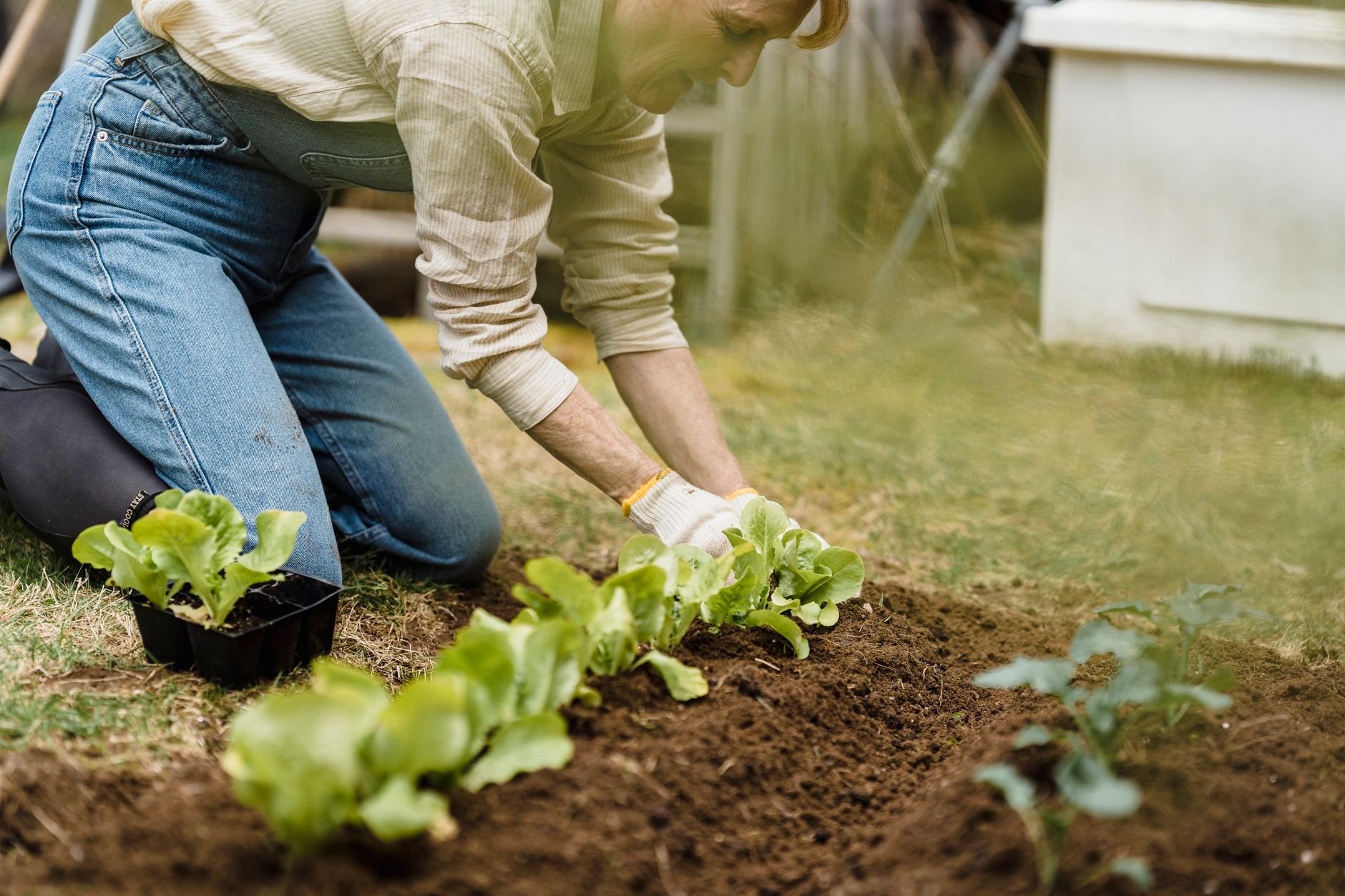
People asked me, after, if I would keep the garden up. I did not know how to explain that the garden was where I still lived with him. Grief needs somewhere to kneel. Church gave me Sundays, but the garden gave me every morning: his rows, his order, his lemongrass smell on my hands, the little conversations I had with him at the level of the ground where nobody could hear. The first spring alone, I planted every single thing he would have planted, in the exact places, off the map in the photographs, and when the first tomato came in July I stood in the yard and held it out in my own palm and took the picture myself, crying so hard the first three came out blurred.
So. That is what was under Chad’s concrete. Not dirt. Us.
Now I have to be fair, because this story got told loudly around town and some versions of it are harder on my daughter than the truth is. Linh knew nothing. She was at a conference in Kansas City the week it happened, and Chad timed it that way, the same way he timed it for my trip to Trang’s. He told her it was a surprise for me, an upgrade, that I had been complaining about the weeding, which I never did, not once, not ever. When Linh got home and saw it, she called him a liar in their own kitchen and drove to a friend’s house, and then she had to get up the next morning and drive to Des Moines and pick her mother up from the airport with that thing waiting in the backyard like a grave with no name on it.
And there is worse, which I found out over the next two days, the way you find things out in a small town, which is that everyone knows a piece and nobody has the whole.
Chad told the concrete crew that I had asked for the pad. The crew was out of Marshalltown, not local boys, or it would have stopped right there. He told Rosemary, over my fence, to her face, while the skid loader was tearing out the lemongrass, that I was tired of the upkeep and had asked for this while I was away, and Rosemary stood in her yard with her heart going sideways, because it did not sound like me, but he is family, and what do you do. He pulled no permit. He signed nothing at the county because he filed nothing at the county. He poured a four inch slab with no footings over living topsoil on a house whose deed has two names on it, mine and my dead husband’s, and neither one of them is Chad’s.
The boat, I will mention once and try to be done with it, was a nineteen foot bass boat from a dealer in Cedar Rapids, and he had put two thousand dollars down on it, and the model name, I am sorry, I cannot help it, was the Legend. He was going to park the Legend on my husband.
The first night home I did not sleep. At two in the morning I stopped pretending, and I went to the hall closet and took down the blue tin, and I sat at the kitchen table with all twenty years of that garden spread out in front of me, and I did something I had not done since the funeral. I read every back. Every date. Every little note in his square handwriting. First bean, June 2, plant more next year. Linh’s rabbit fence works. Too much rain, tomatoes split, still sweet. Eighty photographs of the same forty feet of ground, and in every one of them, somewhere, the years of my marriage.
That is where Rosemary found me at seven in the morning, because I had never locked the back door, and when I did not answer her knock she let herself in the way neighbors do when they have known you thirty years and buried a husband of their own. She is a retired school secretary and she ran Halloway Elementary’s front office like a battleship for decades, and she looked at me, and looked at the concrete out the window, and looked at the photographs all over my table, and she went very quiet in a way I now understand I should have paid more attention to.
She picked up the flood tomato photograph, 2011, and turned it over and asked what the writing said. I told her.
The dirt has forgiven us.
Rosemary put it down, and smoothed it flat with two fingers, and said, “Nguyet, I would like to borrow fourteen of these. I will bring back every one, I promise you on my mother.”
I asked her what for. And I will tell you exactly what she said, because people quote it around town to this day.
She said, “Chad tells a story fast. I want the truth told faster.”
What Rosemary did with fourteen photographs over the next five days, I mostly heard about afterward, the way the guest of honor is the last to know. She started Saturday morning at the counter at Dot’s diner, where the farmers sit at six, and she laid the photographs on the counter next to the pie stand, in order, spring to spring to spring, and she let the pictures do the talking and then told the counter what she had watched from her own kitchen window, and whose name had been borrowed to do it. Dot taped the 2011 tomato photograph to the register, where the whole town files past. Monday it was the bulletin board at the feed store, with a card in Rosemary’s handwriting underneath. Sunday, and this is the part that undoes me still, Pastor Jeffries gave her five minutes in the fellowship hall after second service, and Rosemary passed my husband’s photographs down the potluck tables, hand to hand, and half those hands had eaten out of that garden, and the room, they tell me, got quieter and quieter, and Rosemary never raised her voice once, because a school secretary knows you never have to if you wait.
She asked one question. “Who’s free Saturday?”
Monday evening there was a knock at my door, and it was Virgil, who is seventy nine and poured concrete in this county for over forty years. Sidewalks, silo pads, the approach at the church, half the driveways in Halloway. He also went through my lunch line at the elementary school as a grown man for years, because Virgil believes no one in three counties makes better Salisbury steak, which is flattery, but I have never argued with it. He asked, polite as anything, if he could look at “the work.” I walked him out back, and Virgil walked that slab corner to corner in the last light, and kicked it twice with the toe of his boot, and crouched down and looked at the edge where it met the fence line, and stood up with his knees cracking.
And Virgil smiled.
He said, “Ma’am, I don’t want to speak ill of anybody’s buddy’s crew. But this is four inches, no rebar, no footings, no gravel base, poured right over topsoil by boys in a hurry, and it’s pitched wrong, it drains at Rosemary’s foundation, which the county takes an interest in. And there’s no permit on file, I checked at lunch.” He looked at it a while longer, happier and happier. “This isn’t a slab. It’s a lid. And a lid,” he said, “comes off.”
I said I could not ask people to do that. Virgil looked at me the way you look at a child you are fond of and said, “Nobody’s asking. It’s already organized. I’m just here to measure.” His nephew runs the equipment rental out on Highway 14, two doors down from where Chad sells tractors, and there is a skid steer with a hydraulic breaker attachment, and Saturday, it turned out, the rental was free of charge, on account of, and I am quoting the nephew’s invoice, which I have kept, “community beautification.”
Saturday morning, the eleventh of July, the first pickup was at my curb at 6:40. By 7:05, when Virgil’s breaker bit into that concrete for the first time, there were pickups down both sides of Sycamore Street like a funeral or a farm auction, and my backyard was full of people. I stood on my back step in my apron, because I did not know what else to wear to such a thing, and I counted. Forty three neighbors, not counting children.
The men’s group from First Lutheran. Bill Vandersloot and his boys with the grain truck for hauling. Dot, who closed the diner, which has happened three times in my memory, and set up coffee and lemonade on my patio table like she was catering a threshing crew. Two of my old lunch-line kids, men in their forties now with kids of their own, swinging sledgehammers at the edges where the breaker could not reach. Rosemary in gloves directing everything and everyone, including Virgil, who let her. Kids running wheelbarrow relays like it was a fair ride. My daughter Linh, hair tied up, hauling broken concrete two chunks at a time, working like she was on fire, and I knew what she was carrying with every load and I let her carry it, because that is a kind of penance too, even when the sin is not yours.
The slab that took Chad’s crew a day to pour came apart by 11:30 in the morning. Virgil ran the breaker like a man playing an instrument he missed. The Vandersloots hauled every chunk to a washout on their creek where broken concrete does honest work as riprap, so even the lid ended up useful, which Virgil said was more than he expected of it.
Chad showed up at 9:15.
I will tell this part carefully, because it would be easy to make it a cartoon, and it was not. It was a man arriving at his mother-in-law’s house to find half the town dismantling his gift, if that is the word, with hand tools and heavy equipment, on a Saturday, cheerfully. He came through the side gate already talking about liability and trespassing and how everyone was destroying an improvement he paid for, and the yard did not stop working, which I think frightened him more than shouting would have. Only Virgil shut the breaker down and walked to the fence and stood in front of him, seventy nine years old, forearms like fence posts, with the whole town listening while pretending not to.
Virgil said, “Son, there’s no permit on this pour. It drains at the neighbor’s foundation. It’s on a deed you’re not on. The county inspector goes to my church, and you can talk to him Monday, or you can grab a wheelbarrow. Those are both fine with me.”
Chad looked at the yard. Forty three neighbors looked back, friendly as a jury.
And my daughter walked over to her husband and held out a wheelbarrow by the handles, and said, quietly, so that only he and I and probably Rosemary heard it, “You can help carry your gift out of my mother’s yard, or you can drive home and figure out how to explain yourself to the county and to me. But you are not going to stand here and watch.”
Chad took the wheelbarrow.
He worked until dark. Nobody handed him a sandwich and nobody poured him Dot’s lemonade, and I want to say someone should have, but I understand why the town let him be thirsty for one afternoon. He hauled broken concrete off my husband’s garden for nine hours in July heat, and I watched him from the back step, and I felt no triumph at all, and that surprised me. I felt like I was watching a man meet, for the first time in his life, a thing his money and his mouth could not fix. That is a terrible first meeting to have at thirty nine. I had it at eighteen, in a boat. It makes you or it breaks you.
The dirt underneath, when the last of the lid came up, was compacted and pale and sad, but it was ours. Rau răm came up through it wild within two weeks, by the fence where the pour had missed. Independence, like Minh said.
What happened over the rest of that summer, I can only list, because if I described it all this story would never end.
The Vandersloots brought composted manure, and the co-op sent a dump load of black topsoil and refused payment so completely that the manager crossed his arms and became rude about it. The men’s group built new cedar raised beds in two weekends, and here is the thing that stops my breath still: they built them off Minh’s photographs. Rosemary had them enlarged at the drugstore and pinned to the fence in plastic sleeves, spring after spring after spring, and the men measured off the pictures, so the rows went back where the rows had been, to the foot. Dot’s granddaughter, home from Iowa State, drove to the Vietnamese grocery on 2nd Avenue in Des Moines with a list in my handwriting and came back with lemongrass stalks, rau răm starts, tía tô, and Thai basil, and would not take gas money. We planted three stalks of lemongrass by the south fence. Three. The same number Minh started with in 1986, and I did not plan that, Rosemary did, because she remembered the story, because she has been hearing it over that fence for thirty years.
And Dot, at the diner, went into her freezer and brought me a labeled bag of Kentucky Wonder seed she had saved for years, and she said, “You’ll want these. They’re his.” Minh had given her seed off our vines a decade ago. My husband’s beans came home to his own garden through a diner freezer. If you want to know what a small town is, that is what it is. It is where the things you gave away come back to you when you have nothing.
Chad paid for all of it, everything the town did not flat refuse to let him pay for. The boat deposit was gone either way, so the Legend money bought cedar and soil and a new gate hinge and the drugstore enlargements. Linh took over their bank accounts that week, and as far as I know that arrangement stands. I stayed out of their marriage all summer, and I will mostly stay out of it here, except to say they are still married, that he is in counseling in Marshalltown where nobody knows his truck, and that my daughter is nobody’s fool and no one’s warden either, and whatever she decides in the long run will be right.
But I owe you the end of Chad’s part, because it did not end at the wheelbarrow.
He came back in August, on a Saturday, alone, no Linh. He stood at the side gate, the one that drags in August, and he did not come in. He asked if he could rebuild the trellis. I asked him how, since he had never built anything I knew of, and he took a folded paper out of his back pocket, and it was a photocopy of one of Minh’s photographs, the trellis in full bean, 2014, and he had drawn measurements all over it in pencil, worked out from the fence posts behind it. He had done arithmetic to my husband’s photograph. He said, and his voice did not sound like a salesman for the first time in eleven years, “It won’t be as good as his. I know that. But it can be where his was.”
I opened the gate.
He built it over three weekends out of the cedar scraps and new stock, and it is not as good as Minh’s, the joints are proud and one upright is a half bubble off plumb, and I told him so, and he laughed, and then he sat down on my back step, this big sunburned Iowa man, and cried into his cap for a while, and I let him, and then I fed him, because he was in my yard at suppertime and I am who I am. He asked me that evening, unprompted, to teach him to say my name. We sat on the step and did it a dozen times until it came out right, or close, closer than eleven years of New-gett. I told him what it means. Moon. I told him Minh means bright, and what Minh used to say about the moonlight, and Chad was quiet a good while, and then he said, “So the garden was you two saying it back and forth.” Eleven years. But he got there.
I have not forgiven him all the way. I want to be honest about that, because this is not a greeting card. Some mornings I stand at my kitchen window with my coffee and I do not see the new cedar beds, I see the lawn chair and the tape measure and I hear “just dirt” and something in my chest goes cold and stays cold till noon. Forgiveness, I have learned twice now in my life, is a garden too. You plant it before you feel anything. You water it when it looks like bare ground and you feel like a fool for watering. And one morning, some year, there is green where you put the work in, and it is not the old garden back, nothing brings the old garden back, but it is alive, and it is yours, and it feeds you.
The fall crops went in late but they went in. Beans off Dot’s seed, Minh’s own line of them, climbed the crooked trellis like they recognized it. The mustard greens came up volunteer in the new soil, which should not be possible, and I do not care to have it explained to me, because some seed rode out the whole thing in the ground under that lid, waiting, and if my husband had been there he would have nodded like he expected nothing less. Greens should have some independence.
And in September, on the seventeenth, I picked the first tomato off the new beds. It was small, and late, and lopsided, and perfect. I carried it to the back step, and I put one foot up on the rail where his foot used to go, and I held it out in my flat palm the way he held twenty of them, and I took the photograph. I had it printed at the drugstore, four by six, glossy, and the girl at the counter, who knows the whole story, because everyone knows the whole story, would not let me pay for a single print either, and I have started carrying exact change around this town in self defense.
That night I sat at the kitchen table with a pen, and I turned the photograph over, and under the date I wrote two words in Vietnamese, in my best square handwriting, as close to his as I could make it, and I put it in the blue tin on top of the 2011 tomato, the flood tomato, so that his four words and my two words are lying there in the dark together, face to face.
Đất nhớ.
The dirt remembers.
It does. It remembers the leaves of twenty autumns and the fish bones and the flood and the man who apologized to it, and it remembers being called nothing by a man in a lawn chair, and it remembers forty three neighbors who took a lid off it with sledgehammers because a school secretary asked one question in a church basement. My name means moon, and some clear nights I stand out by the crooked trellis in the dark, and the light lies down across the new rows the way it always did, and I say it back and forth with him, the old joke, bright and moon, moon and bright.
It was never just dirt, Chad. It was never even close.
This story is a dramatization. Names, characters, and details are invented, and any resemblance to real people or events is coincidental.