
The new pastor smiled at me across the fellowship hall and told me my name had been removed from the church rolls, and that the building fund my husband spent thirty years raising would no longer carry his name.
He said it the way a man tells you the weather. Pleasant. Untroubled. A paper cup of weak coffee in his hand and a little gold cross pinned to his lapel that caught the light from the window. Behind him the long folding tables still had the plastic cloths on them from the Wednesday potluck, and somebody had left a crockpot of green beans warming on the counter, and the whole room smelled like ham and burnt percolator coffee, the way that room had smelled every week for as long as I had been alive.
His name was Bram Hollister. He had been the pastor of Cedar Hollow Bible Church for four months.
My husband, Theron, had been its pastor for thirty-one years before that, and he had been dead for nine.
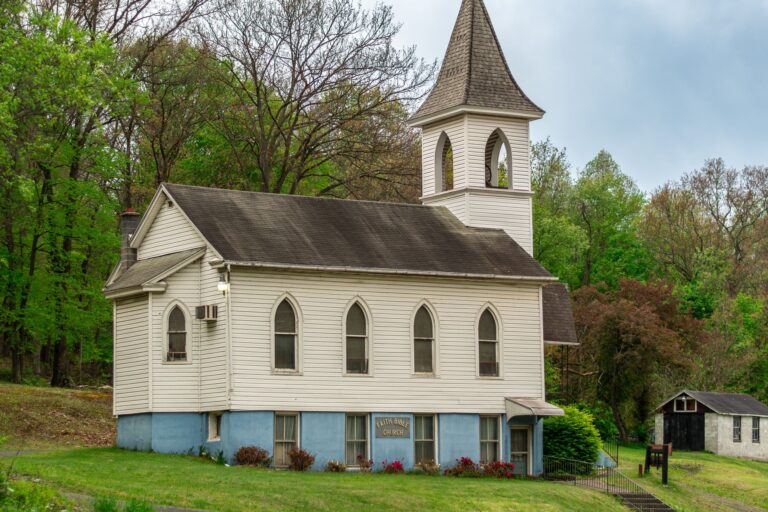
Let me back up, because if I just start at the cruel part you will not understand what was taken, or from whom, or why a roomful of farmers and widows and feed-store men finally did the thing they did. You have to know the man first. You have to know the church. You have to know what a legacy fund actually is in a town like Cedar Hollow, which is not much of a town at all, just a grain elevator and a Casey’s and a four-way stop and a white frame church sitting up on the only hill for nine miles in any direction.
My name is Opaline Renner. People call me Opal. I am sixty-eight years old. I have lived in Tama County my whole life, and I married Theron Renner the summer I turned twenty, in that same church, in a dress my mother sewed at the kitchen table by the light of a gooseneck lamp.
The man and the church
Theron was not a famous preacher. He never wanted to be. He turned down a bigger church in Cedar Rapids twice, the second time after they offered him a parsonage with central air, because he said the Lord had not called him to comfortable, the Lord had called him to Cedar Hollow, and a man does not get to renegotiate his call just because his knees hurt in January.
So we stayed. We raised two children in the little parsonage behind the church, with the radiator that knocked all winter and the one bathroom and the kitchen window that looked out over Sutliff’s bean field. Theron made almost nothing. A country preacher in a county like ours makes almost nothing, and what he made he gave back half of without telling me, which I only found out later, and which I will get to.
What Theron had instead of money was the people. He buried their fathers. He married their daughters in that sanctuary and then, twenty years on, baptized those daughters’ babies in the same chipped font. He sat up all night in the waiting room at the hospital in Vinton with men he had known since they were boys, drinking machine coffee, saying nothing, because sometimes the whole job is just being the one who does not leave. When the Lindgren place burned in the dry autumn of 1989, Theron was on that fire line in his shirtsleeves with a wet feed sack, and afterward he organized the whole county to put a roof back over that family before the snow came.
And he had a dream, which was the building fund.
The church was old. It had been old when Theron got there. The bell tower leaned. The basement flooded every spring melt and ruined the Sunday school felt boards and the boxes of Christmas pageant costumes. The furnace was older than I was. Theron used to say that you cannot ask people to come worship the living God in a building that is slowly drowning, and so, the year our son left for the service, he started the fund.
He did not do it with capital campaigns or pledge cards or a thermometer painted on a board out front. He did it the country way. He did it a coffee can at a time. He did it with the proceeds of the men’s pancake breakfast, every fourth Saturday, two dollars a plate, sausage from Aldous’s hogs donated free. He did it with the quilt the Ladies’ Aid raffled at the county fair every August. He did it with the change jar by the door that said MERCY HOUSE on a strip of masking tape, because that was the name he had given the dream: a fellowship building, a real one, with a dry basement and a working kitchen and a room where the women could meet and the youth could meet and where, he always said, the AA group from three towns over could finally have a warm place on Thursday nights instead of that freezing Grange hall.
Thirty years. Coffee can by coffee can. By the time Theron died, the Mercy House fund had a little over four hundred thousand dollars in it.
I want you to understand what that number means in a place like ours. It does not mean we were rich. It means thirty years of two-dollar pancakes. It means thirty years of quilts and bake sales and the Henning brothers tithing off a soybean crop that failed as often as it came in. It means a man went without, and a whole congregation went without, and they put it in a jar by the door, because they trusted that the dream had a name on it and that the name would hold.
The name on it was Theron’s. Not because he was proud. Because the people insisted. After his heart gave out in the pulpit on a Sunday in October, gave out right there mid-sentence with his hand raised over them in benediction, the trustees voted that the fund would be called the Theron Renner Mercy House Fund, and that when the building finally went up, his name would be over the door. It was the only monument that man would ever have. He is buried in the churchyard under a flat stone because he thought standing stones were vanity. The fund was supposed to be the marker. The fund was supposed to be the place his name lived.
Get a new story in your inbox every morning.
Facebook doesn’t show you every story we post. Our free newsletter does. Join 2,500+ readers.
Then Bram Hollister came to Cedar Hollow.
The arrival of Bram Hollister
The pulpit committee had brought him in the spring. I was not on the committee. After Theron died I had stepped back from anything that looked like authority, partly out of grief and partly because I did not want anyone to ever feel the dead pastor’s wife was hovering over the new man’s shoulder. I taught the four-year-olds on Sunday morning and I ran the prayer chain and I kept my opinions in my own kitchen, which is where a widow’s opinions are supposed to stay, or so I had been raised to believe.
Bram was young. Maybe thirty-eight. He came from a church-growth program out of a suburb of Kansas City, and he had ideas, and I want to be fair and say that some of the ideas were not bad. He put the words to the hymns up on a screen. He started a coffee bar in the narthex. He was a good speaker, smooth, confident, the kind of man who can make a sentence sound profound by lowering his voice at the end of it.
But there was a coldness in him that took me a while to name. Theron used to come down off that little platform after the service and stand at the back and shake every single hand and know every single name and every single sorrow attached to it. Bram stood up front and let the people come to him, and when they came, his eyes were already moving past them to the next person, to the door, to whatever was next. He looked at our church the way a man looks at a piece of ground he intends to develop. He saw potential. He did not see the people standing on it.
The first thing he wanted to talk to me about, the very first real conversation we ever had, was the fund.
He came to the parsonage, where I still lived. That was part of Theron’s arrangement, written into the call decades ago: the parsonage was the pastor’s home for life, and after Theron died the trustees had voted to let me stay there, the widow of thirty-one years’ service, rent free, until I passed or chose to leave. It was understood. It was in the minutes. Forrest Aldous, who had been clerk of session for forty years and kept every minute book in a fireproof box in his milk house, could put his finger on the exact page.
Bram sat in my front room, on Theron’s chair, with his ankle crossed over his knee, and he told me about his vision.
The vision did not have Mercy House in it. The vision had a “Cedar Hollow Family Life Center,” a gymnasium, a café, a media room, a thing he kept calling a “campus.” And the four hundred thousand dollars of pancake money, he explained to me gently, as though I were a child, was an “underutilized legacy asset” that the previous administration had let sit “sentimental and stagnant.” He smiled when he said sentimental. He used the word twice.
I said the fund had a name on it. I said the trustees had voted it.
He said, still smiling, that the trustees had been “graciously transitioned,” which I would learn meant that over the spring he had quietly stacked the board with three men nobody in Cedar Hollow had ever heard of, two of them from his Kansas City program, who had moved to the area and joined the church and been made trustees inside of ten weeks, which is a thing that has never happened in the history of that congregation. Forrest Aldous had been clerk for forty years. He was not clerk anymore. A man named Dock Velliquette was clerk now.
I did not argue with Bram in my front room. I was raised not to. I gave him coffee and I let him talk and when he left I sat in Theron’s chair, in the warm spot he had left in it, and I shook.
The cruelty was quiet
I want to be honest about something, because I have read enough of these stories to know that people expect a screaming match, a slammed door, a villain who shouts. That is not what cruelty looks like in a place like ours. In a place like ours cruelty wears a clean shirt and uses soft words and never, ever raises its voice, because raising your voice would give the other person something to point to. The real damage gets done in the minutes of a meeting nobody invited you to.
Over that summer, piece by piece, it happened.
First, my Sunday school class was “restructured.” The four-year-olds were folded into a new “early childhood ministry” run by Bram’s wife, and I was thanked for my years of faithful service in a printed bulletin announcement I found out about by reading the bulletin, sitting in my pew, like everyone else.
Then the prayer chain, which I had run for twenty years off the phone in my kitchen, was moved to an app. Bram explained that the app was more efficient. He was not wrong that it was more efficient. He was wrong about what a prayer chain is for. When Verla Stubbe got her diagnosis, she did not want an app. She wanted me to drive out to her place with a hotdish and sit at her table while she cried. You cannot put that in an app. But my name came off the prayer chain, and Verla cried at her own table alone, and I did not know to come, because no one told me.
Then, in August, the letter came about the parsonage.
It was on church letterhead, the new letterhead, with the new logo Bram had paid a firm to design, a swoosh and the words CEDAR HOLLOW in a font that looked like it belonged on a vitamin bottle. The letter informed me that the board had voted to “monetize underused real estate assets” and that the parsonage would be sold, and that I had ninety days to vacate the home I had lived in for forty-one years, the home my children were brought back to from the hospital in Vinton, the home in whose kitchen my mother had sewn my wedding dress, because that kitchen table had stayed in that house.
It was signed by Dock Velliquette, clerk. Bram’s name was not on it. That was deliberate. He never put his name on the cruel things. He let the cruel things arrive in other men’s handwriting.
And then, the worst of it, the thing that I still cannot say without my throat closing.
They voted to remove Theron’s name from the fund.
Dock Velliquette read it into the minutes at a Tuesday board meeting I was not allowed to attend, because I was no longer a member. That was the part I had not understood until I read it in black and white: at some point that summer, in the great “transition,” my membership at Cedar Hollow Bible Church, where I had been baptized as an infant and married as a girl and widowed as a woman, had been allowed to lapse. There is a clause in the bylaws about inactive membership. They had used it on me. The pastor’s widow was, on paper, no longer a member of her own husband’s church.
So I had no standing. No vote. No voice. And the Theron Renner Mercy House Fund became, by a vote of a board full of strangers, the Cedar Hollow Family Life Center Capital Fund. The pancake money. The quilt money. The thirty years.
His name came off the door before the door was ever even built.
The fellowship hall
Which brings me back to where I started, to the fellowship hall, to Bram Hollister with his paper cup of weak coffee.
I had gone there on a Wednesday in September to drop off a box. Just a box. The last of the Sunday school supplies that had been in my front closet, construction paper and safety scissors and the felt board with the felt Noah and the felt animals that I had used for thirty years, two by two, into the ark. I thought I would leave it on the table and go. I did not want a scene. I have never in my life wanted a scene.
But Bram was there, helping his wife set up for something, and he saw me, and he came over, and he was kind in that way of his that is worse than unkindness, and he said the thing about the rolls, that my name had been removed, that it was all just “administrative,” nothing personal, and then he said the thing about the fund, that it would no longer carry “the Renner name,” and he said it like he was doing me a favor by telling me to my face instead of by letter.
And then he said the line I will hear in my head until I die. He set his coffee down, and he put his hand on my shoulder, and he said:
“Opal, I know this is hard. But the dead don’t build buildings. The living do. It’s time we stopped running a church for the comfort of a man who’s been gone almost ten years.”
The dead don’t build buildings.
I stood there in that room that smelled like every potluck of my whole life, holding a box of felt animals, and I did not say a word. What was there to say. I was sixty-eight years old and I had just been told that my husband, who gave that congregation his health and his heart and finally his very life, who fell dead with his hand raised in blessing over those people, was a sentimental burden on the living.
I went home to the house I had ninety days left in. I did not cry that night. I was past crying. I sat in Theron’s chair and I thought about leaving Cedar Hollow altogether, going to my daughter’s in Dubuque, letting them have the church and the fund and the parsonage and the whole hill. I thought, let them have it. The man I loved it for is gone. The dead don’t build buildings. Maybe he was right.
I did not know that the thing was already moving. I did not know that Forrest Aldous, the old clerk, had heard about the fellowship hall from his wife, who heard it from Verla Stubbe, who had come back to church for the first time since her diagnosis and had been standing close enough to hear Bram say it. I did not know that Forrest had spent two nights at his kitchen table with his fireproof box of minute books open in front of him, reading by the same kind of gooseneck lamp my mother sewed by, going back forty years through the handwriting of every clerk before him. I did not know what he had found.
The congregational meeting
There is a thing in the bylaws of Cedar Hollow Bible Church, written in 1951 and never once changed, that says any twenty members in good standing may call a congregational meeting, and that at a congregational meeting, the congregation, not the board, is the final authority under God on any matter of church property. Forrest found it. It had not been used in the living memory of anyone in that town. The board governed. The congregation showed up and worshipped and went home. That was how it had always worked.
But it was not how it had to work. And so Forrest Aldous, seventy-nine years old, with a heart stent and a bad hip, got in his truck and drove the gravel roads of Tama County for two weeks, farm to farm, and got not twenty signatures but a hundred and forty, and he filed them with Dock Velliquette in a manner so exactly correct, so perfectly by the book, that there was no clause and no technicality Bram Hollister could use to stop it. The meeting was called for a Sunday afternoon in October. The bylaws required that every member be notified. That was how I found out. A letter came, the old letterhead this time, Forrest’s careful hand, telling me there would be a congregational meeting, and that there was a question of my membership that the congregation, not the board, would decide, and would I please be present.
I almost did not go. I want to be honest about that too. I was so tired. I had started packing boxes. There were boxes in every room of that house. But my daughter called me from Dubuque, and she said, “Mom, Daddy drove gravel for thirty years for those people. You can drive yourself up that hill one more time.” So I went.
I have never seen that church so full. Not on Easter. Not at Theron’s funeral. They were standing along the back wall and out into the narthex by the new coffee bar. They had come in from every township in the county, men I had not seen in church in years, in their good shirts, with their caps in their hands. Verla Stubbe was there, thin and gray from the chemo, sitting up front with an oxygen line, but there. The Henning brothers were there, both of them, who had not been in the same room since they quarreled over a fence line in 1998. They sat in the same pew.
Bram ran the meeting. He had to, it was his by office, but you could see he did not want to, you could see he had counted on his stacked board and his lapsed memberships and his bylaws to keep this from ever happening, and now here it was happening, and he had lost control of it before it started. He stood at the front in his nice jacket and tried to keep it to “procedure.” He called first on the question of my membership, I think because he thought it was the safe one, the technical one, the one his clause covered.
He said that according to the inactive-membership provision, Opaline Renner’s name had been properly removed from the active rolls, and that this was simply an administrative matter, and he asked if there was any discussion.
There was discussion.
The congregation stood up
Forrest Aldous stood up first.
He stood up slow, on his bad hip, and he held up the oldest minute book, the one bound in cracked black cloth, and he said, “Pastor, I have been clerk of this session for forty years, and my father was clerk before me, and I want to read into the record what this church voted on the twelfth of October, nineteen and seventy-three.” And he read it. The congregation had voted, in 1973, by unanimous standing vote, that Theron and Opaline Renner were called to Cedar Hollow “for the term of their natural lives” and that the parsonage was their home “so long as either should live.” Not the board’s to sell. The congregation’s gift. Voted by the congregation, and under the 1951 bylaw, only the congregation could undo it. The board never had the authority. The letter Dock Velliquette signed was not worth the church letterhead it was printed on.
Forrest sat down. And then Verla Stubbe stood up, with her oxygen line, and she did not let go of the pew in front of her, and she said, in a voice that did not have much air behind it but carried all the way to the back wall anyway:
“When they told me I had the cancer, the first car in my yard was Opal Renner’s. Before my own sister. Before the doctor even called me back. She sat at my table and she held my hand and she did not say one empty word, she just stayed. That woman is not an administrative matter. That woman is the reason half of us are still in this church at all.” And she sat down, and she had to take a long pull of oxygen, but she had said it.
Then a man named Cleavon Sutliff stood up, who farms the bean field behind the parsonage, and he said, “Pastor Renner pulled my dad off a tractor that had rolled on him in ’81 and sat with him in the ditch holding his head out of the water in the bar pit until the ambulance came forty minutes from Vinton. My dad lived eleven more years. I was eight. I watched him do it. You want to tell me the dead don’t build anything.” His voice broke on the last word and he sat down hard.
Then Aldous’s wife stood. Then both Henning brothers stood, together, the first thing they had done together in twenty-five years. Then a widow named Ottilie Brauer stood and said Theron had paid her heating bill out of his own pocket two winters running and never let her thank him. Then a young man I did not even recognize stood up at the back, a man maybe thirty, and said his name and said he was sober eleven years because of the Thursday AA meeting that Pastor Renner fought to bring to that county, and that he had driven three hours to be in this room, and that he had named his son Theron.
They kept standing. One after another, all over that sanctuary, on a Sunday afternoon in October, the people of Cedar Hollow stood up out of their pews and testified to what one country preacher and his wife had been to them across half a century. There was no order to it and Bram lost any pretense of running it. They simply stood, and spoke, and sat, and another stood. It went on for the better part of an hour. The room was crying and not ashamed of it. I sat in the front pew where Forrest had put me and I could not turn around to see them all, I could only listen to them rise behind me, voice after voice after voice, and I understood that this was the marker. Not a stone. Not a name over a door. This. The thing my husband had actually built, standing up on its own two feet all over that room, and it could not be voted out by any board, because it had never been on any ledger to begin with.
The vote
When the last of them had spoken, Forrest Aldous stood up one more time, and he made a motion. Three motions, really, all in his careful clerk’s language.
That the congregation affirm, under the bylaw of 1951 and the standing vote of 1973, that Opaline Renner is a member in good standing of this church and a lifetime resident of the parsonage, the board’s actions to the contrary being void.
That the board be dissolved and its recent appointments with it, the three transitioned-in trustees having held office in violation of the membership-tenure requirement Forrest read aloud from the bylaws, and a new board be elected by the congregation that very afternoon.
And that the fund be restored to its name, the Theron Renner Mercy House Fund, and dedicated to its purpose, a fellowship building with a dry basement and a warm room for the Thursday meeting, exactly as the man had dreamed it.
Bram tried, at the last, to call it out of order. Dock Velliquette tried to back him. But the bylaw was the bylaw, and Forrest had the book, and Cleavon Sutliff stood back up and said quietly that maybe the pastor would like to let the people vote, since it was their church and their money and their pancakes, and something in the room made it clear that this was not really a request.
They voted by standing vote, the old way, the 1973 way. On the question of my membership, the whole church stood. On dissolving the board, the whole church stood. On the fund, every soul in that building came to their feet, and Verla Stubbe pulled herself up on her oxygen line to be counted standing, and somebody, I never found out who, started singing the doxology, and the whole room sang it, “Praise God from whom all blessings flow,” in that flat country harmony that I had heard in that room my entire life, and I finally put my face in my hands.
Bram Hollister left Cedar Hollow before Thanksgiving. There was no scene. He simply was not there one Sunday, and a letter of resignation was read, and he and his wife moved on to another church-growth program in another state, and I hope, I truly do, that someday in some fellowship hall some old woman with a box of felt animals teaches that man what a church actually is.
What was built
I am still in the parsonage. The kitchen table is still by the window that looks out on Cleavon Sutliff’s beans. I am still teaching the four-year-olds, felt Noah and the felt animals two by two, because the new board, which is just the old congregation, asked me to come back, and I did.
They broke ground on Mercy House this spring. It will have a dry basement and a real kitchen and a warm room where the Thursday meeting will finally come in out of the cold, and the young man who named his son Theron drove three hours to swing the first shovel. There will be a name over the door, the trustees insisted, and it will be Theron’s, and I have made my peace with that, because I know now that the name over the door was never the real monument anyway.
The real monument stood up in that sanctuary on a Sunday afternoon, all over the room, one farmer and one widow and one sober young man at a time, and testified, and could not be voted down.
Bram Hollister said the dead don’t build buildings. He was right about that, and wrong about everything else. The dead don’t build buildings. They build people. And on a cold October afternoon in Tama County, the people my husband built stood up out of their pews and gave me back my life, and gave him back his name, and gave that little church on the hill the one thing no capital campaign can buy.
They stayed. They stood. They were the ones who did not leave.
That was the dream. It always was. The building is just where we will keep it warm.
This story is a dramatization. Names, characters, and details are invented, and any resemblance to real people or events is coincidental.