
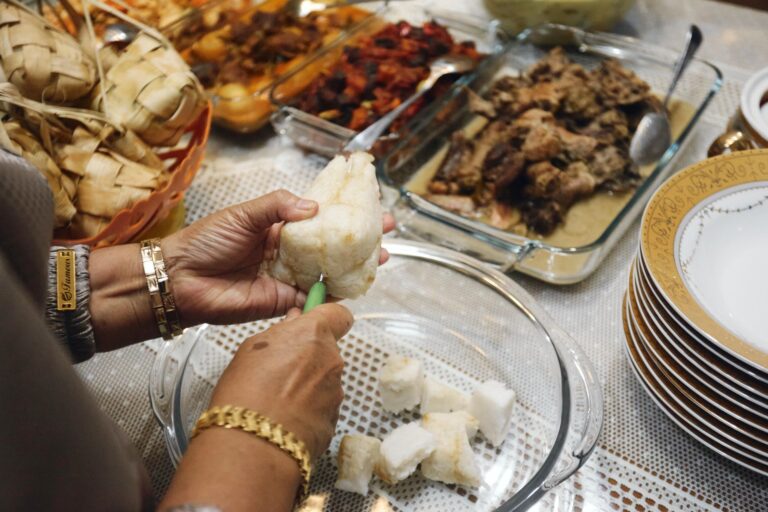
For eleven years I set my mother’s dish down on the end of the potluck table at Grace Lutheran, on the far side by the coffee urns, and for eleven years the same woman walked past it like it was not there.
Her name was Prudence Hale. Everybody in Marshfield knew her, or knew of her, which in a town our size is close to the same thing. She ran the altar guild, she ran the funeral luncheon committee, she ran the flower fund, and I think in her own mind she ran the Lord’s own dining room. She had a way of standing at the head of that long folding table with her hands folded at her waist, surveying the casseroles like a general reviewing troops, and she had a way of letting her eyes slide right over the one covered dish that did not match the rest.
My dish. My mother’s dish. Larb, we call it, though half the women there never learned the word and the other half decided they did not care to. Cool minced pork tossed with lime and fish sauce and toasted rice powder, mint and cilantro from my own garden box, the fresh green heat of it, the little wet crunch. My mother made it in the camp in Thailand where I was a girl, and she made it in the apartment in St. Paul where we landed, and she made it in the small house here in Wisconsin where she came to live out her last years near me. She wrote the recipe on a index card in her own hand, in Hmong, the letters careful and slightly shaky at the end, and when she passed I framed nothing of hers, I kept nothing of hers on a shelf, but I kept that card. I kept it in a plastic sleeve and I brought it with me every single time I made the dish, tucked flat under the bowl, because it felt like bringing her along.
I want to tell you the whole of it, so let me go back to the beginning, to the first potluck, because that is where the wound started and it is the only place the story makes any sense.
My husband was named Tou Lor. We were married thirty-one years. He had a laugh you could hear from the far end of the parking lot and hands that could fix anything with a motor, and he was the one who wanted us at that church. I was raised with the old ways, the spirits and the string-tying and the shaman, but Tou had taken to the Lutheran faith the way some men take to a new town, all at once and completely, and he loved the hymns even when he sang them a half beat behind everyone else. When he got sick, the church brought food to our door for six weeks. Prudence Hale herself brought a hotdish, tuna and noodles and crushed potato chips on top, and she stood on my porch and told me she would pray for us and I believed her, because back then I did not know her yet.
Tou died on a Tuesday in the fall. The maples on our street had gone the color of a struck match. After the funeral I did not know what to do with my Sundays, so I kept going to Grace Lutheran, because it had been his and I did not want to hand it back. And when they announced the harvest potluck that first November, I made my mother’s dish. It seemed right. It was the food of comfort in my family, the food you made when someone you loved was gone, and I carried the bowl in both hands into that fellowship hall like an offering.
I set it on the table between a green bean casserole and a slow cooker of little sausages. I stepped back. And I watched Prudence Hale come down the line with a paper plate, and I watched her stop at my dish, and I watched her lean in the way you lean toward something spoiled, and I watched her say, not quite under her breath, to the woman beside her, “Well. I’m sure someone will be brave.”
Someone will be brave. Eleven years and I can still hear the shape of it, the little laugh tucked inside the words.
The woman beside her was Marlene, and Marlene laughed too, a soft polite laugh, the laugh you give the woman who runs the flower fund. And the two of them moved on down the line and filled their plates with things they recognized, and my mother’s dish sat there in its bowl, untouched, sweating a little under the fluorescent lights, until the end of the night when I carried it home again just as full as I brought it.
I told myself it was the newness. I told myself that people are shy of what they have not tasted, that next time would be different, that I would bring a little card with the name written out and maybe some small spoons so it would not seem strange. And I did all of that. I even changed how I made it the second year, cut back on the fish sauce, cut back on the lime, made it milder and paler and closer to something a Marshfield tongue might recognize, and I hated myself a little for doing it, standing at my stove watering down my mother’s food to make it acceptable to a woman who was never going to taste it either way. I brought little printed labels that read HMONG PORK SALAD in a friendly font, as if the problem were that the ladies did not have enough information. I set out a stack of the small paper cups the church used for the after-service coffee, thinking maybe the trouble was that a person did not want to commit to a whole helping of the unknown, that they might try a spoonful in a little cup. All of it, every year, some new small humiliating accommodation. And it did not matter. Because the next potluck went the same way, and the one after that, and slowly I came to understand that it was not the food. The food was only the thing she could point at. What Prudence Hale could not abide was me. The small brown woman in the good coat who did not have a maiden name anyone in Marshfield recognized, who prayed with an accent, who did not know until her third year there that you were supposed to sign up on the clipboard by the door and bring a dish that started with cream of something soup.
I was the dish she walked past. The larb was just the part of me she was allowed to say out loud.
Get a new story in your inbox every morning.
Facebook doesn’t show you every story we post. Our free newsletter does. Join 2,500+ readers.
I kept coming. I want you to understand that, because I have had people ask me since why I did not simply find another church, or stop bringing the dish, or stop bringing food at all and just sit in the back. And the answer is my husband. Tou had loved that place, and the last clear thing he said to me that made sense, before the medicine took his words, was that he did not want me to be alone on Sundays. So I was not going to be alone on Sundays. I was going to sit in the fourth pew on the left where we always sat, and I was going to sing the hymns a half beat behind out of habit now, and I was going to bring my mother’s dish to the potluck because it was mine to bring, and I was not going to let a woman with folded hands decide who belonged in a house that did not belong to her either.
But do not mistake that for strength. Most Sundays it was not strength. Most Sundays it was just stubbornness wearing strength’s coat. I would drive home with the full bowl on the passenger seat where Tou used to sit, and I would set it on my kitchen counter, and I would eat it alone, standing up, and some nights I would cry into it, which is a thing I have never told anyone until now.
Marshfield has a real Hmong community, more than you would think for central Wisconsin. There is a New Year celebration every winter with the ball toss and the paj ntaub embroidery and the long silver necklaces, and there are three generations of us here now, farmers and nurses and the boy down the street who fixes everyone’s phones. But Grace Lutheran was not that. Grace Lutheran was Norwegian and German stock going back to the land grants, good people mostly, the kind who will shovel your walk without being asked, but the kind too who had a picture in their heads of what a church lady looked like, and I was not in the picture. I was in the church. I was just not in the picture.
There was one year, the fifth or the sixth, I lose track now, when I thought the wall might come down on its own. A new pastor had come, a young man named Pastor Dahl fresh out of the seminary in the Twin Cities, and he stood up at the harvest potluck and said grace over the food and he made a point, a kind point, of naming the dishes. He got to mine and he said, “And it looks like we have something new and wonderful this year,” and he came down the line himself and took a helping, and my heart lifted so fast it frightened me. But he was the pastor, and a pastor takes a little of everything, that is his office, and when he had moved on Prudence Hale leaned to Marlene and said something behind her hand and Marlene laughed, and the moment closed over like water over a stone. The young pastor did not last three years. Prudence Hale outlasted him the way she outlasted everything. And I learned that a kindness performed from the front of the room does not travel to the back of it, that the pastor could bless my dish all he liked and the women would still walk past it, because the women, not the pastor, were the church I was actually living in.
The years went by the way years do. I got the reputation, without ever earning it on purpose, of being the quiet Xiong widow who kept to herself. Which was not the truth. I was not quiet by nature. My mother used to say I had a mouth on me like a market woman. But you learn, when a room has decided what you are, that it costs less to be what they decided than to keep correcting them. So I got quiet. I brought the dish, I sat in my pew, I put my envelope in the plate, I helped fold the tablecloths after, and I went home. And Prudence Hale walked past my mother’s larb every single year, and every single year I told myself it did not touch me, and every single year it touched me anyway.
Now I have to tell you about the woman who changed it, because she is the whole reason I am writing this down, and her name was Ingrid.
Ingrid Sundberg was eighty-four the year it happened. She had been at Grace Lutheran longer than the pastor, longer than the pews, longer than Prudence Hale’s family, and that mattered more than you would think, because in a church there is an order older than any committee, and it is the order of who was there first. Ingrid had buried a husband and a son and had come out the other side of it with the softest eyes I ever saw on a person and a habit of saying exactly what she meant in the plainest words. She used a walker with tennis balls on the feet. She sat in the second pew on the right. And for reasons I did not understand at the time, she had started, over that last year, to sit near me at coffee hour, to ask me about my garden, to call me Mai instead of Mrs. Xiong the way the others did when they had to name me at all.
The potluck that changed everything was the Easter one, in the spring. I almost did not go. I was tired that year in a way that had gotten into my bones, a tiredness that was really just the long arithmetic of being unwelcome for a decade, and I stood in my kitchen that morning with the empty bowl in my hands and I very nearly put it back in the cupboard and stayed home. But I thought of Tou, and I made the larb, and I tucked my mother’s card in its plastic sleeve flat under the bowl the way I always did, and I drove over.
I set the dish on the table in its usual spot by the coffee urns. And here is the thing I did not know as I set it down, the thing I would not learn for another hour. My mother’s recipe card had slipped a little out from under the bowl, so that the top corner of it showed, the plastic sleeve catching the light, the shaky Hmong letters just visible. I did not notice. I stepped back into my usual place against the wall.
Prudence Hale came down the line. She had a fresh perm and a spring cardigan the color of a robin’s egg and she had the funeral luncheon clipboard under her arm even at Easter, because there is always a next funeral to plan. She reached my dish. And she did the thing she always did, the little lean, the little turn to the woman beside her, and she said, loud enough this year, loud enough that I think she had stopped caring whether I heard, “Every year. I do not know why she keeps bringing this. It is not as if anyone.”
And she did not finish, because Ingrid Sundberg’s walker came down on the linoleum next to her with a sound like a gavel.
I have thought a great deal since about what made Ingrid stop that day, of all days, after standing by silent for as many years as I had. And I think the answer is the card. I think she saw the corner of my mother’s recipe card sticking out from under the bowl, the handwriting, and something in her went still. Because Ingrid reached past Prudence Hale, and she did not touch the food, she touched the card. She slid it out of its plastic sleeve with two fingers, gentle as lifting a bird, and she held it up close to her glasses, and the whole line of women went quiet the way a room goes quiet when the oldest person in it decides to speak.
“Whose hand is this,” Ingrid said. She was not asking Prudence. She was looking at me.
“My mother’s,” I said. My voice came out smaller than I wanted. “She wrote it. In our language.”
And Ingrid Sundberg, eighty-four years old, stood there in the fellowship hall of Grace Lutheran with my dead mother’s recipe card trembling a little in her hand, and she began, very quietly, to weep.
I did not understand it. Nobody did. Prudence Hale’s mouth was still half open around the end of her sentence and she looked, for the first time in eleven years, like a woman who did not know what came next.
Ingrid turned the card over in her fingers. Then she looked up, and she looked at the whole line of them, all those faces I had watched walk past me for a decade, and she said, “When I came here I was six years old and I did not have a word of English. My mother made blodklub and lefse and rullepolse and she brought them to the church suppers, and the ladies here, the ladies who were the ladies then, they would not eat it. They would look at my mother’s food and they would look at my mother and they would fill their plates with what they knew. And my mother would carry it home again and she would cry, and she thought I did not see her, but I saw her.”
The urns hummed. Nobody moved.
“My mother kept her recipes on cards,” Ingrid said. “In Norwegian, in her own hand. I have them still. And I have spent seventy-eight years in this church, and I have watched us do to this woman”and here she looked at me, and she said my name, she said “to Mai” as plain and clear as a bell”exactly what was done to my mother, and I have said nothing, because I was afraid of you, Prudence. I was afraid of the committee and the clipboard and the way a person can be frozen out of a church without a single unkind word being written down. And I am eighty-four years old and I am done being afraid. This is the food of somebody’s mother. And her mother is dead. And you have walked past her grief for eleven years and called it a casserole nobody wanted.”
I will not pretend I stood there composed. I was crying by then too, standing against the wall with my back to the coat hooks, an old woman crying in a church basement over a bowl of pork.
Ingrid set the card down. Very carefully she slid it back into its plastic sleeve, and she squared it on the table beside the bowl like she was setting a place. And then she picked up a paper plate, and she picked up the serving spoon, and she served herself a full helping of my mother’s larb, the first helping anyone at Grace Lutheran had taken in eleven years, and she carried it to a folding chair and she sat down and she ate it, slowly, in front of everyone, with tears still wet on her face.
And the strangest thing happened then. It was not that Prudence Hale apologized. She did not, not that day. It was that the wall broke somewhere else. A young mother named Kaylee, who had never so much as looked at me, came up to the table with her little boy on her hip, and she said, “Could I try some? Wyatt, do you want to try some?” And she put a spoonful on her plate, and the boy ate it off her fork and said it was spicy and asked for more, the way children will say the true thing in a room full of people being careful. And then Marlene came, Marlene who had laughed the soft polite laugh eleven years ago, and she did not meet my eyes but she took a small spoonful, and she ate it standing up, and after a moment she took a little more.
By the end of that potluck my mother’s bowl was empty. Empty. I stood there and I looked at the scraped bottom of it and I could not make sense of the sight, because in eleven years I had never once carried it home light.
I would like to tell you Prudence Hale was struck down and transformed on the spot, because that is how these stories are supposed to go. But that is not what happened, and I promised myself when I started this that I would tell you the true shape of it. What happened was slower and, I have come to think, better.
Prudence did not eat the dish that day. She stood at the head of the table with her clipboard and her robin’s egg cardigan and she watched her own kingdom rearrange itself around her, and she went home, I am told, without saying much to anyone. But something had come loose in her too, I think, or maybe just in the story she had been telling herself about who she was in that room. Because two weeks later there was a knock on my door on a Saturday afternoon, and it was Prudence Hale standing on my porch, on the same boards where she had once brought me a tuna hotdish and a promise to pray, and she was holding an empty glass dish of her own, and she said, without any preamble, because she was not a woman built for preamble, “I would like to learn to make it. If you would teach me. And I would like to say I am sorry, though I know that is not worth much this late.”
I did not answer right away. I am not going to lie to you and tell you my heart leapt with Christian forgiveness. It did not. There was a part of me, a large part, that wanted to close the door on her the way she had closed a room on me for eleven years, and let her feel one one-hundredth of it. My mother’s mouth, the market-woman mouth, was ready with something sharp.
But I thought of Ingrid Sundberg eating my mother’s dish with tears on her face. I thought of my mother crying in a St. Paul apartment where the neighbors would not learn her name. I thought of Tou, who wanted me not to be alone on Sundays, who had loved a whole church full of people who did not, most of them, ever quite learn to love me back, and who had loved them anyway, easily, the way he did everything.
So I stepped back, and I opened the door wider, and I said, “The pork has to be very fresh. Come in and I will show you how to smell it.”
She came into my kitchen. She was awkward in it, this woman who had been so sure of herself at the head of every table in that church, and I found I did not mind her being awkward, found in fact that it settled something old in me to watch her not know where to stand. I took my mother’s card out of its sleeve and I set it on the counter between us, the shaky Hmong letters facing up, and I did not translate it word for word. I just cooked, and I let her watch, the way my mother let me watch, and I told her the parts you cannot write on a card: how you toast the rice until it smells like popcorn and a little past that, how you taste for the lime, how it is not really the ingredients at all, it is the hand.
We did not become friends that afternoon. I want to be honest. We became something slower than friends and sturdier, two old women in central Wisconsin who had hurt each other, one on purpose over eleven years and one in her heart on a Saturday, learning to stand in the same kitchen. She came back three more times that spring. By summer she could make it herself, badly, and then less badly, and one Sunday at the potluck there were two bowls of larb on that long folding table, mine by the coffee urns and hers three dishes down, and Prudence Hale stood up in front of the whole fellowship hall and told them where the recipe came from, and whose mother wrote it down, and she said my name, and she said my mother’s name, which I had told her, and which she pronounced carefully and got almost right.
Ingrid Sundberg lived one more year. She sat near me every coffee hour of it. When she passed, that next spring, the funeral luncheon committee, which Prudence Hale still ran because some things do not change and do not need to, served larb at her funeral, along with the blodklub and the lefse that Ingrid’s own granddaughter made from her mother’s cards. I stood in that fellowship hall and I looked at the two of them side by side on the table, the Norwegian food and the Hmong food, two dead mothers’ handwriting in two languages under two bowls, and I understood at last what Ingrid had seen the day she picked up my card. She had not seen larb. She had seen her mother. She had seen every woman who ever carried a full bowl home from a room that would not taste her, and she had decided, at eighty-four, that she was done watching it happen in a house of God.
I am sixty-six now. I still sit in the fourth pew on the left. I still bring my mother’s dish, and it still comes home empty, and I have gotten used to the strangeness of that, though I do not think I will ever fully stop being surprised by it, the empty bowl, after so many years of the full one.
My mother’s recipe card is worn soft at the edges now from being handled by more hands than just mine. I keep it in the plastic sleeve still, and I still tuck it flat under the bowl every time I make the dish, and I still bring my mother along to church that way, every potluck, every funeral, every Easter and every harvest. But I do not hide the corner of it anymore. I let it show. Because I have learned that you never know who in the room is going to see her mother in your mother’s handwriting, and decide, finally, to be brave.
Prudence Hale is seventy-nine now and she is not well, and I bring her food on Wednesdays. I make the larb a little milder for her than my mother made it, because her stomach is not what it was, and she complains that it is too mild, and I tell her that is what she gets for waiting eleven years to taste it. We laugh. It is a real laugh now, both of ours, not the soft polite kind she used to give the flower-fund woman.
She asked me last month, out of nowhere, sitting at my kitchen table with a plate in front of her, why I never gave up on that church. Why I kept setting the dish down all those years when nobody would touch it.
I told her the truth. I told her that my husband asked me not to be alone on Sundays, and that my mother taught me you do not stop feeding people just because they have not yet learned to be hungry for what you have to give. I told her that a full bowl carried home is still a bowl you made with love, and love does not spoil just because a room refused it. And I told her that somewhere in all those years I had stopped setting the dish down for them at all. I was setting it down for my mother. And for the one person, whoever she might turn out to be, whenever she might finally come, who would look at that handwriting and know exactly what she was looking at.
It turned out to be Ingrid. But for eleven years I did not know it would be anyone. I just kept setting it down.
That is the whole of it. That is what a dish can carry, if you keep bringing it. That is what one old woman with a walker and the softest eyes I ever saw can undo in a single afternoon, after a lifetime of silence, when she finally decides that being afraid is a thing she is too old for.
I still miss my mother every day. I still miss Tou every Sunday, in the fourth pew, on the left, where the space beside me stays open. But the bowl comes home empty now. And some days, standing in my kitchen with that worn soft card in my hand, I think that is the closest thing to an answered prayer I have ever been given: not that they should love me all at once, but that they should, one by one, however late, finally sit down and taste what my mother left me, and find, to their own surprise, that it was food all along.
This story is a dramatization. Names, characters, and details are invented, and any resemblance to real people or events is coincidental.