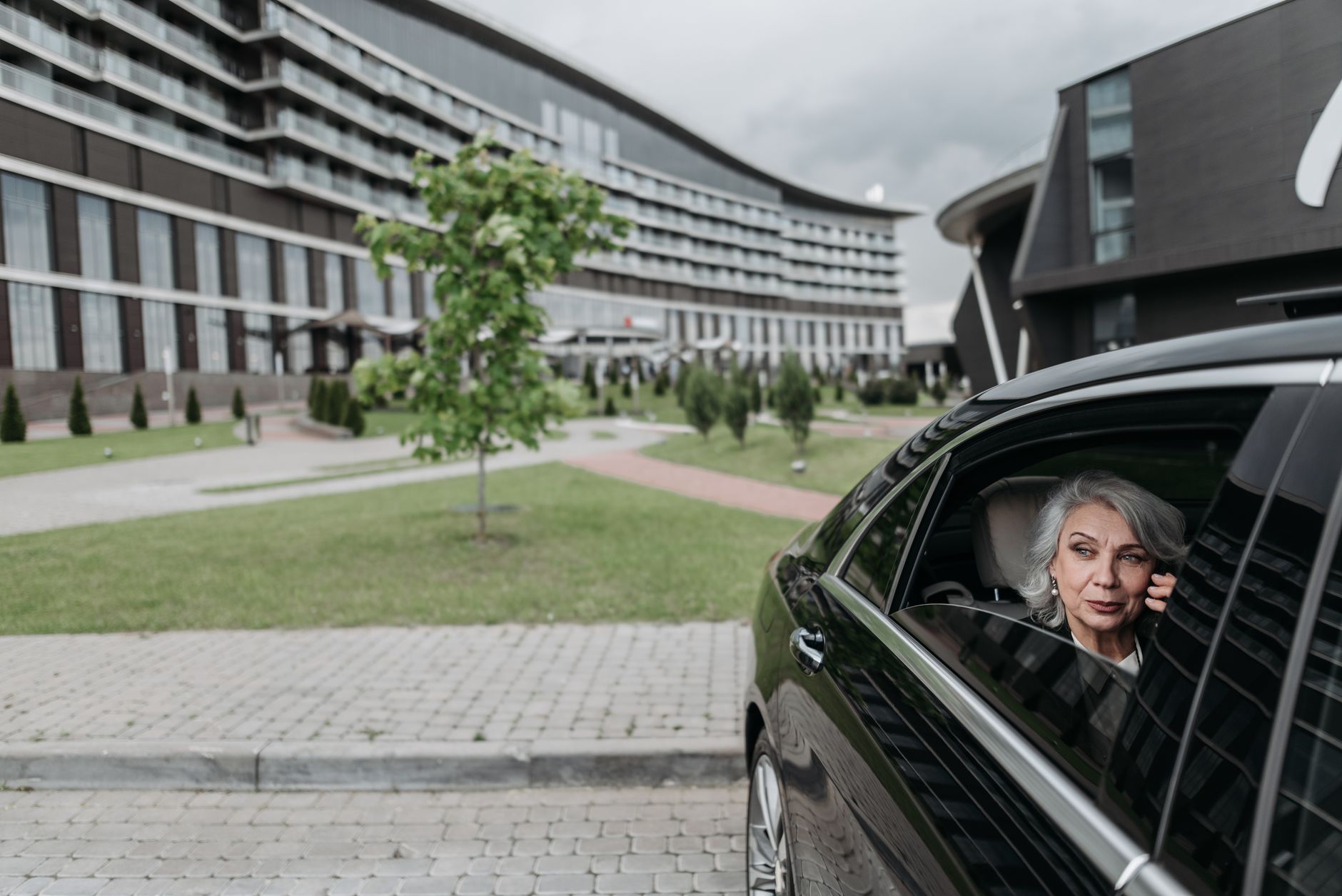
The Dashcam He Forgot Was Running
At 9:14 that Saturday morning, three days after a woman at the Bellhaven municipal court read me the words bench warrant over the phone in the same flat tone she probably used for reading out parking fines, I sat at my own kitchen table with my nephew Roan’s laptop borrowed back from him without his knowledge, and pressed play on nine weeks of a dashcam I had somehow forgotten was even running.
The first clip loaded slow, the little wheel spinning while my coffee went cold. Then the dashboard camera view filled the screen: my own front seat, my own steering wheel, and behind it, not me, my nephew Roan Petrie, twenty-six years old, driving my silver Buick through a green light at an intersection I did not recognize, timestamped 6:47 in the evening on a Thursday I remembered perfectly, because it was the same Thursday I had waited on my porch for two and a half hours wondering where my car and my Saturday-morning grocery money had gotten to.
I am sixty-seven years old. I buried my husband Kendrick fourteen months before that Saturday, and in the year and change since, my nephew had become the person I leaned on hardest, the one who drove me to my cardiology follow-ups and carried my church casseroles and changed my porch light bulbs without being asked. I had let him borrow my car more times than I could count, because that is what family does for family, because he had always asked properly, because I trusted him with my house key years before I ever trusted him with my ignition. What that dashcam showed me, timestamp after timestamp, was not simply a nephew who had stopped asking. It was six unpaid tickets sitting in my name, a warrant threat with my name on the letterhead, and a story underneath all of it that I never once saw coming, even sitting three feet away from him at my own table every single Sunday.
—
My name is Ambrosine Danvers, and I have lived in Cardwell, Missouri my whole life, a town of just under nine hundred people where the water tower still has the class of 1974’s initials painted on the leg nobody ever got around to sandblasting off. I married Kendrick Danvers the summer after I turned twenty-one. He drove a propane delivery truck for thirty-eight years, out before sunup in the winter to keep half the county’s furnaces running, and I kept the books for the Cardwell feed store for most of that same stretch, a job I loved because I liked knowing everybody’s name and everybody’s dog’s name too. We never had children of our own. We tried for the first eight years of our marriage and then we stopped trying and started building a different kind of life instead, one with a big garden, a house full of other people’s kids on weekends, and Sunday dinners that somehow always fed twelve people even though it was only ever the two of us doing the cooking.
Kendrick died on a Tuesday in April, at home, in his recliner, his heart simply stopping between one breath and the next while I was in the next room folding towels. I found him with the television still on. I do not tell people the details of that morning very often, but I tell you now because I want you to understand what kind of year I was already having before any of this started. I was a woman alone in a house built for two, in a town where half the people who used to stop by for coffee had died themselves or moved to be near their grown kids, and the one person who kept showing up at my door without being asked was my sister Vespera’s boy, Roan.
Roan grew up two farms over from us. Kendrick taught him to change a tire and gap a spark plug before he taught his own nephews the same thing, because Roan was always the one who showed up ready to learn. He called Kendrick “Uncle Kendrick” his whole life and stood up at the funeral in a borrowed tie that did not fit him right and read a passage from Ecclesiastes in a voice that cracked twice. In the weeks after, when half the county’s sympathy casseroles had stopped coming and the house had gone quiet in a way I was not prepared for, Roan was the one who kept coming back. He mowed my yard without asking. He drove me to my cardiology appointment in Bellhaven when my own hands were shaking too badly to trust myself on the highway. He put a dashcam on my windshield, tucked up behind the rearview mirror, small and black and easy to forget, after a woman rear-ended me in the Cardwell IGA parking lot eight months before Kendrick died and her insurance company spent six weeks pretending the accident never happened until I had a witness.
“It just loops,” Roan told me, screwing the little bracket into place while I held the ladder steady for him in the driveway. “Records over itself every few weeks unless something big happens. You’ll never even have to think about it.” I did not think about it. That was, I understand now, close to the whole point.
The other person who kept me upright that first year was my neighbor Fern Kirchner, who has lived across the ditch from me since before either of us had gray in our hair. Fern is the kind of woman who shows up at your back door with a pound cake and does not leave until she has found something to laugh about with you, even in a year built almost entirely out of things that were not funny. We quilted together most Wednesday afternoons that spring, her machine and mine set up on opposite ends of my dining room table, and it was Fern who noticed, weeks before I let myself notice, that I had started flinching a little every time I heard my own screen door open, because I never knew anymore whether it was Roan bringing my car back or Roan taking it away again.
—
I tell you all of that so you understand exactly who I thought I was lending my car to.
It started small, the way these things always do. Roan’s own truck, a fifteen-year-old Chevy he had been nursing along on a transmission that whined going uphill, finally gave out for good on a Tuesday in early spring. He came by that evening looking truly rattled, said the transmission shop in Bellhaven wanted twenty-two hundred dollars he did not have sitting around, and asked if he could borrow my Buick just to get to his shift at the co-op until he sorted something out. I said yes without a second thought. What is a car sitting in a widow’s driveway for, if not to help the boy who mowed her lawn without being asked?
For the first two weeks, it was exactly what he said it would be. He would come by in the morning, take the Buick, drop it back that evening smelling faintly of the co-op’s grain dust, and thank me every single time like it was the first time I had ever said yes. I did not need the car much myself in those early weeks. I was still moving slow, still catching myself walking into rooms to tell Kendrick something before I remembered, and having somewhere to send the car felt, if I am honest, like it gave a small shape to my days.
Then the pattern started to shift, quietly, the way water finds a crack before you ever see the crack itself. Roan stopped asking the night before and started asking on his way out the door, or not asking at all, taking the spare key off the hook by my back porch while I napped in the afternoon and leaving me a text that said gone a little while, back soon, love you. Back soon started meaning four hours. Then six. Once, on a Thursday in April, he had the car from two in the afternoon until almost eight that night, well past when I needed to drive myself to a church potluck I ended up missing entirely because I had no way to get there. Another time he had it clear through a Saturday I had circled on my calendar three weeks in advance for a standing hair appointment in Bellhaven, the first one I’d made since Kendrick’s funeral, and I sat at my own kitchen window in my good blouse until it was too late to bother rescheduling, telling myself it was only hair, telling myself a woman my age should not feel this unsteady over a missed appointment.
I started keeping a small spiral notebook by the coffee pot after that, jotting down the date and the hour every time the Buick left my driveway and the hour it came back, not because I suspected anything as specific as tickets or a warrant, but because some old bookkeeper’s instinct in me, the same one that balanced the feed store’s ledgers for thirty years without ever being a dollar off, wanted the pattern written down where I could look at it plainly instead of only feeling it in my chest.
When I finally said something to him about it, gently, over coffee at my own kitchen table, he waved it off with the kind of half-laugh that is built to end a conversation before it starts. “It’s probably a computer glitch, Aunt Ambrosine,” he said, though I had not even mentioned a ticket yet, only asked where he kept getting off to for so long. “Don’t make it a whole thing. I’ve got a lot going on right now.” I let it go. I did not know yet that he had just answered a question I had not finished asking.
—
The first ticket came ten days later, tucked into a stack of church bulletins and seed catalogs I had not gotten around to sorting, a thirty-five dollar parking citation from the City of Bellhaven, issued to my license plate at 4:12 in the afternoon on a Wednesday I could account for completely, because I had spent that whole Wednesday afternoon at my own kitchen table piecing a quilt square with my neighbor Fern, forty miles from wherever that meter had run out.
I brought it up to Roan that Sunday, holding the little paper citation like it was something that might bite me. He looked at it for exactly as long as it takes to decide on a story, and told me the meters in Bellhaven were notoriously broken, that half the town had gotten a bad ticket at some point, that I should just pay it and not worry, it happens all the time. I paid it. Thirty-five dollars did not feel like a hill worth dying on, not with everything else in my life that spring already feeling like a hill.
A second one arrived twelve days after that. Then a third, this one with a fifteen dollar late penalty already stacked onto it because I had not realized the first two were part of a pattern instead of bad luck. By the time the fourth ticket showed up, a no-parking violation from a street-sweeping zone on the same block as the second and third, I was no longer able to talk myself into believing this was Bellhaven’s meters being unreliable. Four citations, four different dates, four times I had never once driven into that city in my entire adult life, all landing on a registered plate that only had one name on it. Mine.
I called my sister Vespera before I called Roan that time, thinking, foolishly, that a mother might want to know before I said anything harder to her son. What she gave me instead was the sentence I have turned over in my mind more than almost any other sentence from that whole spring. “He’s going through a lot right now, Ambrosine,” she said, her voice already sharpening into the tone she uses when she has decided a conversation is over before it has properly begun. “Can’t you let one thing go for him? You’re retired. You’ve got nothing but time. He’s got a lot on his plate.” I sat with the phone against my ear for a long moment after she said it, turning that sentence over. Nothing but time. As though the hours I had left, alone in a house Kendrick and I built our whole life inside of, were somehow worth less than whatever Roan was spending mine on.
—
The fifth ticket was the one that scared me, not because of the dollar amount, thirty dollars, but because of where it had been issued: a metered space directly outside Bellhaven Family Health Clinic, on a Tuesday afternoon. I remember staring at that address longer than I stared at any of the others, some instinct in me snagging on it without yet being able to say why.
The sixth arrived nine days after the fifth, and it was not a parking ticket at all. It was a red-light camera citation, a hundred and twenty dollars plus points against whatever license was on file for that vehicle, timestamped 6:47 on a Thursday evening at the intersection of Route 9 and Vance Street in Bellhaven, the exact Thursday I had waited on my own porch until almost dark, wondering where my car had gotten to, because I had a Friday morning physical therapy appointment I could not get to without it.
Six citations. Two hundred and eighty dollars in fines before penalties, climbing toward four hundred once the late fees stacked on, all of it sitting against a Missouri license and a Missouri registration that had exactly one name attached to either: mine. I did not know yet that unpaid municipal citations in that county, left long enough without a response, could trigger a compliance hold on a driver’s license, or that a missed court date tied to that red-light citation, one I never received notice of because Roan had, I would later learn, quietly intercepted the certified mail slip from my porch and told me it was “some city junk mail,” could escalate all the way to a bench warrant for failure to appear. I found all of that out the way most people find things out that should terrify them: from a stranger’s voice on the telephone, reading it to me like a grocery list.
“Mrs. Danvers, I need you to understand this is now a compliance issue,” the clerk told me. “If this citation isn’t resolved and you don’t appear for the hearing already scheduled, the court can issue a warrant. Your license is also flagged for a possible suspension hold pending resolution of five additional citations on the same plate.” I sat down hard on my own kitchen chair. I am sixty-seven years old, a widow, in a town with no bus line and no rideshare and a grocery store eleven miles from my front door, and a woman I had never met was telling me I might lose the one thing standing between me and total dependence on people who had, up to that point, not exactly proven themselves dependable.
—
It was Fern, my neighbor, who asked the question that cracked the whole thing open. I had told her the story over her back fence, the six tickets, the warrant threat, Vespera’s sentence about nothing but time, and she was quiet for a second and then said, “Ambrosine, doesn’t that boy drive your car near about every week? Don’t you have that little camera Kendrick’s nephew put on your windshield?”
I had somehow forgotten it existed. It had become part of the car the way a coat hook becomes part of a wall, a thing you stop seeing after enough years of walking past it. That Saturday morning, three days after the warrant call, I asked my great-nephew’s friend, a sixteen-year-old down the road who fixes half the town’s computers for gas money, how to pull footage off a dashcam SD card, and by nine that morning I had it loaded onto a borrowed laptop, and I was watching my own car, my own steering wheel, my own dashboard, with somebody else’s hands on the wheel.
The first clip I watched was that Thursday, 6:47 in the evening, Route 9 and Vance Street, the light already amber and going red as the Buick sailed through it. Roan’s face, unmistakable, lit by the dashboard glow, jaw set, eyes flicking to a clock on the dash that was not even the right time because he had never once reset it after daylight savings.
I watched five more after that, one for every citation, dates and times matching exactly, a small folder of proof I had been driving around with, unknowingly, for two months. But it was the seventh clip, one I almost skipped past because it fell on a day with no ticket attached to it at all, that told me the part of this story nobody in my family had bothered to tell me. In it, Roan was parked, engine off, my Buick sitting still outside an apartment building on Elm Street in Bellhaven, the same block as three of the tickets, and he was on the phone, his voice carrying clearly through the dashcam’s little microphone in the quiet of a parked, idling-off car.
“I know, I know, I’m coming up,” he said. “I just need five more minutes, I had to feed the meter again. Is she okay? Is our girl okay?”
Our girl. I sat with those two words for a long time before I let myself keep watching.
—
I called Vespera that same afternoon, and for the first time in that whole spring, I did not ask a single question. I told her what I had, told her the folder had a name on the file properties and a timestamp on every clip, and I told her I intended to bring it to Roan myself before I brought it to a lawyer or a courtroom, because whatever this was, it was still family, even now.
We did it on a Sunday, at my own kitchen table, the same table where Roan had sat every week for a year telling me not to make things into a whole thing. I asked Vespera to bring him over under the pretense of Sunday dinner. I set the laptop on the table between the pot roast and the green beans, closed, and I waited until he had a fork halfway to his mouth before I opened it.
He tried the first excuse before the video had even finished loading. “Aunt Ambrosine, whatever this is, I can explain, those tickets got sent to the wrong plate, that happens with cameras all the time, you can’t even tell that’s me in a parking ticket photo.” I let him finish. Then I pressed play on the Route 9 clip, his own face lit up on his own aunt’s laptop screen, running a light he had told me for weeks was somebody else’s mistake.
He went very quiet. Vespera, beside him, went quieter still, her fork setting down against her plate with a small, definite click. “That’s not a computer glitch, Roan,” I said, and I want you to know my voice did not shake, though everything under my ribs did. “That’s you. Six times. And I want to know what was worth six tickets, a warrant with my name on it, and eight weeks of telling me it was probably nothing.”
He put his head down for a long moment, and when he lifted it, the story that came out of him was not the one I had braced myself for.
—
Her name is Sable Renshaw. Roan met her the winter before, working a delivery route out of Bellhaven that overlapped his shifts at the co-op, and by early spring they were more than friends, and by the time my Buick started racking up citations, Sable was seven months pregnant with Roan’s daughter and living alone in that apartment on Elm Street, because her own family had all but cut her off over a decision she had made years before he ever met her, one Vespera considered close enough to a scandal that she had told Roan flat out, more than once, that if he kept seeing “that Renshaw girl” she would stop helping him with anything, the truck, the rent he sometimes fell behind on, all of it.
Roan’s transmission had truly died. That part was never a lie. But once it did, instead of asking Vespera for the truck money and risking the conversation he had been avoiding for months, he started borrowing my Buick three and sometimes four evenings a week to drive the forty minutes to Bellhaven, to sit with Sable through the worst of a hard, frightening pregnancy, to go with her to two ultrasounds and one emergency room visit for preterm contractions that turned out, thank God, to be a false alarm, all of it hidden from a family he was certain would make Sable feel exactly as unwelcome as his own mother had already promised she would be. He fed the meters when he remembered and forgot when he was rushing, in a hurry to get the car back to me before I noticed how long he’d been gone, in a hurry, on that last Thursday, to get home before my Friday physical therapy appointment, running a light he swears to this day he did not see change.
“I never meant for it to land on you,” he said, and his voice cracked in almost exactly the place it had cracked reading Ecclesiastes at Kendrick’s funeral. “I thought I could handle it quiet, pay the tickets myself before you ever saw them, and nobody would have to know anything until I was ready to tell it. I didn’t want you carrying a warrant over something that was never yours to carry. I just didn’t know how to tell any of you the truth without losing all of you.”
Vespera did not say anything for almost a full minute. Then she said her son’s name, once, in a voice I had not heard her use since our own mother’s funeral, and reached for his arm, not, I think, to comfort him, but to steady herself against the particular collapse of a mother realizing the son she thought she knew had been carrying something this heavy, this scared, and this alone, three towns over, for two months, because she herself had built the wall he was hiding behind.
“You told him I’d stop helping him,” I said to her, quieter than I meant to. It was not a question. Vespera had said something close to that exact sentence to me more than once over the years, about that Renshaw girl, in a tone that made clear the conversation was closed before it opened. My sister looked at her plate for a long time before she answered.
“I said a lot of things about the Renshaw family that had nothing to do with Sable herself,” she finally said, “and everything to do with something her older brother did to our daddy’s business twenty years before she was even born. I never once stopped to ask if that was fair to lay on a girl who wasn’t alive yet to have done any of it.” She looked at Roan then, and her voice cracked on the next part in a way I had never once heard from my sister in sixty-some years of being her sister. “I would rather have known about a scared, pregnant girl than found out about a warrant with your aunt’s name on it. I need you to understand that. I need you both to understand that.”
—
I will tell you plainly that I was angry for longer than I expected to be, and that the anger did not disappear the moment I understood the reason behind it. A reason is not an excuse, and I told Roan that directly, more than once, in the weeks that followed. He had put my license, my insurance, and very nearly my freedom at risk to avoid a hard conversation with his own mother, and there is no version of loving someone that makes that acceptable. But I had also spent fourteen months since Kendrick died learning the difference between a person who has failed you and a person who is drowning, and Roan, it turned out, had been both at once.
The following week, I drove myself, alone, for the first time in months, back to the Bellhaven municipal court, dashcam files saved to two separate flash drives in my purse in case one failed to open on their office computers. A clerk named Nessa Faraday met me at the counter, and once she saw the first clip, the timestamp lining up exactly with the red-light citation in front of her on the screen, she called back a records officer, Fenwicke Ashworth, a broad, unhurried man who reminded me a little of Kendrick in the way he took his time reading something instead of skimming it. The two of them sat with me for the better part of an hour, running each clip against each citation on the log, Nessa reading dates aloud and Fenwicke nodding slowly as they matched, one after another, six for six.
What they told me I had not known existed until that morning: an actual violator affidavit, a sworn statement, backed by evidence, that allows a registered owner to formally identify who was actually operating the vehicle at the time of a civil citation, shifting responsibility for the fine, and any resulting compliance action, off the plate owner and onto the true driver. “This isn’t rare, Mrs. Danvers,” Fenwicke told me, sliding the blank form across the counter. “We see it with teenagers all the time. We don’t see it much with a driver in his twenties who let his aunt carry it for eight weeks straight, though.” Roan signed that affidavit in front of a notary two days later, admitting in writing to all six citations, his hand steady on the pen in a way that struck me, watching him, as almost unbearable given how unsteady the eight weeks before it had been. My license came off the suspension hold within the week. The warrant, which had never technically been issued, only threatened, was cancelled before it ever became real.
Roan paid every dollar of it himself, four hundred and eighteen dollars once the late penalties were counted, plus the notary fee, plus a hundred dollars he insisted on adding on top “for the trouble,” which I did not ask for and almost did not accept, and did, in the end, put straight into a small savings account I quietly started for his daughter without telling him. He picked up a second, honest job doing oil changes on Saturdays at the Bellhaven Firestone to cover it, no longer needing to hide the hours because there was, finally, nothing left to hide.
—
Hazel Renshaw Petrie was born eleven weeks after that Sunday dinner, seven pounds two ounces, with Roan’s stubborn Petrie chin and, according to Sable, her mother’s exact temper already on full display in the delivery room. I drove myself to Bellhaven General that night, my own hands steady on my own wheel for the first time in two months, and sat in a hallway chair beside my sister while a nurse settled Sable and the baby, both of us too keyed up to sit still and too tired to stand.
Vespera held Hazel for the first time in that same hospital hallway, and I watched my sister’s whole face come undone in a way fourteen years of family stubbornness had never quite managed to do on its own. She apologized to Sable the following afternoon, not with a speech, but with a soft yellow blanket she had knitted in secret over one long week while none of us were looking, and an invitation to Sunday dinner that Sable, God bless her, accepted with more grace than I think I would have managed in her position. Watching my sister hold that baby, I thought about how much of this whole ordeal had never really been about a car at all. It had been about which parts of ourselves we let our families see, and which parts we decide, long before anyone asks us to, are too dangerous to bring to the table.
I drive that Buick myself again now, most days, my license clean, my insurance premium settled back down once the affidavit cleared my name from every record that mattered. Some Saturdays I drive it the forty minutes to Bellhaven on my own, not because anyone is hiding anything from me anymore, but because there is a baby girl over there who has started reaching both arms up toward me the second I walk through Sable’s door, and there is nowhere in Cardwell or Bellhaven I would rather my car be taking me.
I think often about that dashcam, small and black and easy to forget, tucked up behind my mirror for two years doing exactly what Roan built it to do, catching the truth and holding onto it quietly until somebody finally thought to look. I do not think Kendrick would be surprised that it was the same nephew he taught to gap a spark plug who ended up, without ever meaning to, leaving me the very thing that saved us both. A car is just a car. But a family that can survive being shown the whole truth of itself, tickets, warrants, a hidden granddaughter and all, and choose to stay at the same table anyway, that is worth every one of those four hundred and eighteen dollars, and then some.
This story is a dramatization. Names, characters, and details are invented, and any resemblance to real people or events is coincidental.