The Checks My Nephew Signed For Me
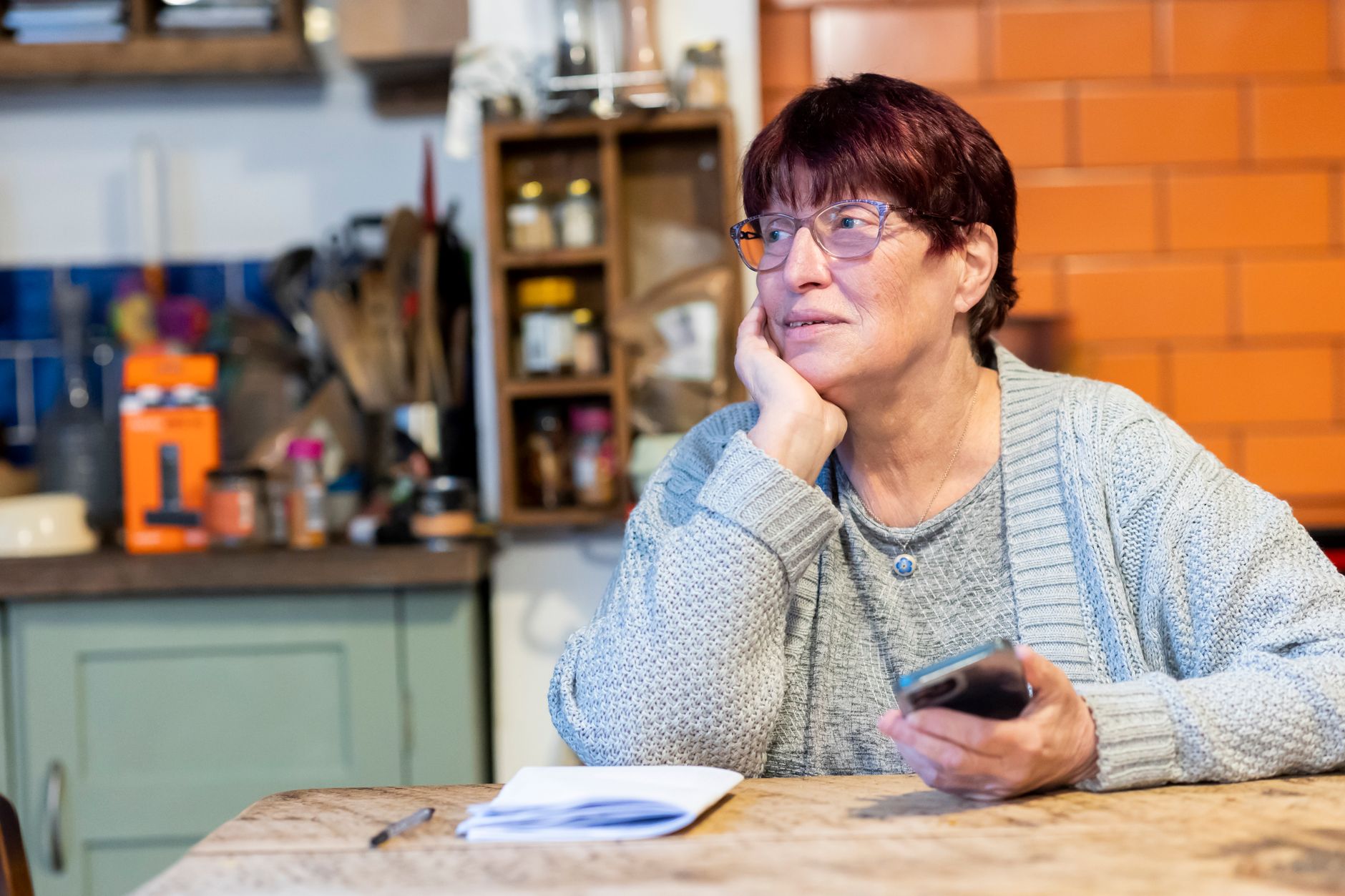
At 10:03 that Thursday morning, six weeks into speech therapy after my stroke, I finally got the sentence out clean enough for my nephew Trevor to understand what I was asking him for. It took me four tries. The word I needed was checkbook, and my mouth kept handing me chair, coat, book, anything but the right one, the way it still does when I am tired or rushed or both, and I was both, because I had just come in from physical therapy and my right leg was still shaking from forty minutes on the parallel bars. Trevor set his coffee down on my kitchen counter, looked at my right hand where it still curls in on itself if I forget to watch it, and said, “Aunt Marilyn, what are you going to do, sign your own checks with your teeth? Let me handle the money. That’s just easier for everybody.”
He said it kindly. That is the part that stayed with me the longest, longer than the words themselves. Not the cruelty in it, though it was cruel. The kindness sitting right on top of the cruelty, like frosting on something gone bad underneath.
I did not have the words that morning to tell him he was wrong. I am seventy-four years old, and until eight weeks before that Thursday I had run my own household, my own accounts, and my own small alterations business out of the sewing room off my kitchen in Millrace, Iowa, for thirty-one years. I had never once in my adult life asked another living soul for permission to look at my own checkbook. But my stroke had taken the words I needed exactly when I needed them most, and Trevor knew it, and he used it, the way a man uses a locked door when he is the only one holding the key.
I said, “I. Want. To see.” Three words, hard fought, each one costing me something in my chest to push out. He smiled the way you smile at effort rather than at meaning, patted my shoulder, told me he’d bring the folder by that weekend, and went back out to the mailbox, which by then had been collecting mail for his house instead of mine for six weeks, ever since I signed a piece of paper in a hospital bed that I do not, if I am honest with you, remember reading.
That was the morning I decided, in the wordless, furious, patient part of my mind that the stroke had not touched at all, that I was going to find out exactly what was in that folder.
—
My name is Marilyn Aldrich. I grew up two farms over from where I still live, on the county road outside Millrace, a town of about nine hundred people where the grain elevator is the tallest thing you can see from any direction and the Zion Lutheran fish fry still draws a line out the door every Friday in Lent. I married Harold Aldrich the summer I turned twenty, and he spent thirty-four years running the scale house at the co-op elevator while I built a tailoring and alterations business out of a spare room, hemming wedding dresses and taking in Sunday suits and letting out prom gowns for half the girls in three counties. Harold died of a heart attack in the co-op parking lot in 2019, sitting behind the wheel of his own truck with the engine still running. I buried him at Zion under the same oak tree where we’d buried his parents, and I kept sewing, because a woman who stops moving in grief has a harder time getting moving again, and I had a business and a reputation for turning work around in three days that I was not about to let slide.
Our son Dean lives in Tucson, Arizona, where he does something with water systems engineering that I have had explained to me four times and still could not repeat back correctly. He calls every Sunday evening, without fail, and he flies in twice a year, and he is a good son from a distance, which is its own kind of good, though it is not the kind that is standing in your kitchen when you need a glass of water at two in the morning.
My younger sister Rhonda lives on the other side of Millrace with her husband, and her son, my nephew Trevor Kessler, grew up close enough to us that he called Harold “Uncle Harold” and spent every August of his boyhood riding along in the scale house, weighing trucks of soybeans, eating the peppermints Harold kept in the drawer. Trevor is thirty-seven now. He runs Kessler Auto Sales on the highway out of Millrace, a lot with maybe twenty cars on it at any given time, and for as long as I have known him as a grown man he has run a step and a half ahead of his bills, the way some people always do, not dishonest exactly, just always reaching for next month to cover this month.
I tell you all of that so you understand who I thought I was trusting.
—
My stroke happened on a Tuesday morning in April, in the sewing room, with a bridal veil half-pinned to the mannequin in front of me. I remember reaching for the pincushion and finding my hand would not close around it. I remember trying to call out and hearing a sound come out of my own mouth that did not belong to me, something flat and slurred, like a record played at the wrong speed. I do not remember the ambulance. Rhonda told me later that she was the one who found me, because I had not answered three calls about a dress fitting, and she drove over and let herself in with the spare key and found me on the sewing room floor, and it was Rhonda who called it in, and Rhonda who rode with me to St. Agnes Hospital in Redfield, twenty-six miles east, and Rhonda who called Dean in Tucson and told him to get on a plane.
The doctors called it an ischemic stroke on the left side of my brain, which is the side that runs your speech and, in most of us, your right hand. I spent six days in the hospital and came home with a walker, a schedule of outpatient physical therapy three days a week at Cedar Rehabilitation Center in Redfield, speech therapy twice a week with a woman named Bridget Calfee who I have come to think of as one of the sturdiest people I know, and a right hand that, six weeks later, still would not hold a pen steady enough to write my own name the way I had written it for fifty-some years.
It was somewhere in those first foggy days in the hospital, with Dean flown back to Tucson because his company needed him and Rhonda in and out with casseroles and my head still swimming from whatever they had me on, that Trevor showed up with a folder of forms. He told me, and I believe he meant it kindly in that first moment, that my mail was piling up at the house with nobody to collect it, that bills would start coming due, that it would be easier if he had authority to open things and handle the routine stuff, the utility bill, the church tithe, the little regular checks, while I got my strength and my words back. He had a document with him, a limited power of attorney for financial matters, the kind you can pick up a template for online or from a title company, and he had a pen ready, and he held my hand steady while I signed it, because my hand was shaking too badly to hold the pen alone.
I do not remember reading it. I remember his hand over mine. I remember being grateful, in that soup-fogged moment, that somebody in my family who was not six hundred miles away in Arizona was willing to step up and carry a piece of this for me. I signed it because I trusted him, and because a woman flat on her back in a hospital bed with her own words locked somewhere behind a wall she cannot get through yet is not exactly in a position to read fine print, and Trevor knew that too, whether he let himself know it or not.
A nurse’s aide was in the room when I signed it, changing the water pitcher, and I remember her pausing a half second at the door on her way out, the kind of pause you give a scene that does not sit quite right but is none of your business to interrupt. I have thought about that pause more than almost anything else from that week. She saw a nephew holding his aunt’s hand steady around a pen. She had no way of knowing whether that was tenderness or something else wearing tenderness like a coat, and neither, if I am honest, did I, not yet. It would be six more weeks before I knew which one it actually was.
—
For the first two or three weeks, I noticed nothing wrong, because I was not in any condition to notice anything at all. I was relearning how to swallow soup without choking. I was relearning how to lift my right foot high enough to clear a curb. Bridget Calfee had me doing exercises with picture cards, naming a cup, naming a dog, naming a church, and some days I could get through the whole stack and some days I could not get past the second card without my throat closing up in frustration, and on those days Bridget would set the cards down and say, “We’re not in a hurry here, Marilyn. Your words are still in there. They’re just standing behind a door that’s swollen shut, and it opens a little more every week whether it feels like it or not.” I held onto that sentence the way you hold onto a fence rail in a wind.
Trevor came by most Sundays after church with the mail he’d collected, a stack of catalogs and church bulletins and the occasional bill he said he’d already handled, and he would sit at my kitchen table for twenty minutes, tell me about a truck he’d flipped or a customer who’d bounced a check on him, and leave. I did not think much of it. I was tired all the time in those weeks in a way I had never been tired in my life, a bone-deep tired that made even being grateful feel like an effort.
The first small crack came in week five, on a Wednesday, at the front desk of Cedar Rehabilitation Center. I handed the receptionist my copay check, the same twenty-dollar check I wrote every visit, printed for me in advance by Rhonda because my handwriting still would not hold a straight line, and the receptionist ran it and came back a minute later with an apologetic look and told me it had come back insufficient funds. Twenty dollars. I had a Social Security check and Harold’s co-op pension direct deposit and a modest monthly benefit from the long-term-care insurance policy Harold had insisted we buy back in 1998, all of it landing in my account every month like clockwork for fifty years, and a twenty-dollar check had bounced.
I stood at that desk with my face going hot, fumbling in my purse for cash to cover it, saying “I’m sorry, I’m sorry” in the flat, effortful way I still say things, and a young woman behind me in line looked at me with pity, and I understood in that moment, with a clarity that had nothing wrong with it at all, that pity was not a thing I was going to sit still for.
That night I asked Trevor, over the phone, in the halting way I have to ask things, whether he knew why the account might be short. He laughed, a short laugh, and said, “Aunt Marilyn, you had a stroke. Sometimes you get confused about what you’ve spent. I’ve got it under control, I promise you.” I remember sitting with the phone against my ear after he hung up, turning that sentence over. You get confused. He had said it so easily, so ready-made, like a shirt already pressed and hanging in the closet waiting for the moment he needed it.
That was the seed. The Thursday morning with the checkbook, ten days later, was the moment the seed cracked open.
—
Investigating anything with a right hand that will not hold a pen and a mouth that gives you the wrong word half the time is slower than you would think possible, and it is a particular kind of humiliation, because every single person you need to talk to, from a bank teller to a sheriff’s deputy, has to be patient with you in a way that makes you feel like a child even when they are being perfectly kind about it. I could not simply drive myself to the bank. I could not simply call and explain what I needed. I had to build a small army out of the two people in my life I trusted completely who were not named Kessler.
The first was Bridget, my speech therapist, who I told, haltingly, over three separate sessions, that I thought my nephew was taking money that was not his. Bridget did not flinch and did not tell me I was confused. She said, “Then let’s build you the words you need to say that to a bank.” We spent one whole session, cards set aside, working only on the sentence I need to see my account records, said slowly, four separate times, until I could get it out clean under pressure, the way you drill a fire escape route until your feet know it even if your head goes blank.
Bridget also gave me something I had not thought to ask for, a small laminated card, the size of an index card, with the sentence printed out in plain block letters, so that on a day my mouth simply refused to cooperate at all I could hand the card across a counter instead of speaking it. “There is no rule,” she told me, “that says every hard conversation has to come out of your mouth to count. A pointed finger is still you talking.” I carried that card in my coat pocket for the rest of that spring, the way another woman might carry a rabbit’s foot, though what it actually held for me was not luck. It was proof, in my own handwriting on the back where I had practiced signing my name over and over that same week, that the words were still mine even on the days my voice would not carry them.
The second was my friend Jolene Pruett, who I have known since we were both girls scrubbing pie tins in the Zion Lutheran kitchen for the harvest supper, and who has driven me to every single appointment since I lost the right to drive myself. I told Jolene what I suspected on a Friday afternoon in her car in the Cedar Rehab parking lot, and she did not say a word for almost a full minute, and then she said, “Well. We’ll go to the bank Monday morning, and I will sit right beside you and I will not say one word unless you ask me to, because this is yours to say, not mine.” That is a particular kind of friendship, the kind that shows up and then makes itself small on purpose so you can be the one who is big.
Monday morning, Jolene drove me the eleven miles into town to Millrace State Bank, where I have banked since before Trevor was born, and I asked, in the sentence Bridget and I had built together, to see copies of my recent statements and any cancelled checks. The teller, a kind young man, brought out our branch officer, a woman named Carrie Ostwald who had handled Harold’s estate paperwork after he died and remembered me, and who did not once make me feel foolish for asking, slow as my asking was.
—
Carrie printed six weeks of statements and laid them across the little round table in her office, and it took me the better part of an hour, with my finger tracing each line because reading numbers in a column still tires my eyes faster than it used to, to see the shape of what had happened. My Social Security deposit had come in on schedule, every month, exactly as it always had. Harold’s co-op pension, same thing, direct deposit, untouched. But six checks had been written and cashed against the account in the six weeks since I’d signed that hospital paperwork, none of them written by me, totaling just over six thousand two hundred dollars, made out variously to cash, to Kessler Auto Sales, and once, almost brazenly, to Trevor Kessler himself, for eleven hundred dollars, memo line reading “reimb. gas/errands.”
And then there was the big one. My long-term-care insurance carrier, after the standard elimination period every such policy carries, had approved my post-stroke disability claim in week four and issued a retroactive lump-sum payment covering the first weeks of my eligibility, nine thousand four hundred dollars, mailed as a paper check to the address on file, which by then was Trevor’s house, not mine. That check had been endorsed on the back and deposited, not into my account, but into the business account for Kessler Auto Sales. I had never seen it. I had never known it existed until Carrie slid the deposit record across the table and I saw my own name signed on the back of a check I had never held.
I looked at that endorsement for a long time. Something about it was wrong in a way I could not name at first, and then Carrie said the thing I had not let myself say out loud yet.
“Mrs. Aldrich,” she said gently, “I’ve pulled your signature card from before your stroke, for comparison. I want you to look at these side by side.”
She laid three things in front of me. My old signature, from a slip I’d signed the year before, looping and confident, the same hand I’d signed a thousand receipts and a thousand hemming tickets with. My new signature, from the one check I had managed to sign myself two weeks earlier for the church tithe, unsteady, the letters heavy and slightly dragged where my hand fights me now, the M starting strong and trailing off crooked by the end. And the signature on the back of that nine-thousand-four-hundred-dollar check, and on four of the other six checks besides.
That third signature was smooth. Confident. Looping exactly the way my hand used to loop before it forgot how. My own hand had not produced a line that clean since the sewing room floor.
“That’s not my hand,” I said, and for once every single word came out exactly the way I meant it to, sharp and clear, because some sentences apparently do not need practice at all when the truth behind them is strong enough to push them out on its own. “My hand hasn’t written like that in eight weeks. Whoever signed this forgot I’d had a stroke.”
—
Carrie froze the account activity that same afternoon and walked me, in person, to the Cedar County Sheriff’s office two blocks down Main Street, where a deputy named Boyd Lanning, who I have known since he was a boy delivering the Redfield paper on a bicycle, took down my statement with more patience than I had any right to expect, waiting out every halting sentence without once finishing it for me the way some people do, which I have come to understand is its own small act of respect.
Iowa, like most states, has a specific statute for exactly this, financial exploitation of a dependent adult, and it exists precisely because people like my nephew count on the fact that a woman recovering from a stroke, or living with dementia, or simply old and trusting, cannot fight back the way she could have thirty years earlier. Boyd explained it plainly. What Trevor had done, using a power of attorney signed under circumstances a court would almost certainly view as compromised, to divert funds for his own use from a dependent adult in his care, was not a gray area. It was a felony, and the signature comparison alone, backed by a licensed bank’s own signature card records, was close to airtight.
They asked me if I wanted to confront him myself before charges were filed, or let the investigation run quietly and pick him up cold. I thought about that Thursday morning, and the kindness sitting on top of the cruelty, and I said I wanted to see his face when he understood that I knew.
—
We did it on a Sunday, after church, at my own kitchen table, the same table where he’d sat for twenty minutes every week telling me about trucks he’d flipped. I asked Rhonda to bring him over for what I let her believe was just a family visit, and I am sorry for that small deception to my sister, though not sorry enough to have done it differently. Boyd waited in an unmarked car up the lane, out of sight, in case things went somewhere they should not, though I did not think they would. Trevor was never a violent man. He was a man who had convinced himself, one small justification at a time, that a woman who could not speak clearly was a woman who would not notice.
I had Carrie’s printouts in a folder on the table, the way he had once brought me a folder of his own. When he sat down and reached for his coffee, I slid it across to him instead.
He opened it, and I watched his face do the thing a face does when a story it has been telling itself for six weeks runs straight into a piece of paper that will not agree with it. He started with the thing people always start with. “Aunt Marilyn, I can explain, the business has been tight, I was always going to pay it back before you even noticed.”
“I did notice,” I said. Slow, but clean. “My hand hasn’t written like that since April. Yours has.”
He did not have an answer for that. Rhonda, sitting beside him, went very quiet and very pale, and I watched my sister’s face do something I hope I never have to watch again, the particular collapse of a mother realizing her son is not who she has spent thirty-seven years believing him to be. She reached for his arm, not to comfort him, I think, so much as to steady herself, and she said his name once, just “Trevor,” in a voice I had not heard my sister use since our own mother’s funeral.
Trevor tried a second run at it, the way people do when the first excuse does not land. He said the car lot’s floor-plan lender had called the loan due without warning, that he’d meant to put every dollar back before I was ever well enough to check, that he had lain awake plenty of nights over it, as though the losing of sleep were itself a kind of repayment. I let him finish. I did not interrupt him, though I could have, because Bridget had taught me by then that a woman who has fought to get her words back does not waste them shouting over someone who is only trying to outtalk the truth. When he ran out of sentences, I slid the signature comparison across the table last, the three of them side by side, my old hand, my new hand, and his forgery sitting in between pretending to be mine.
“You forgot I’d had a stroke,” I said. “That’s the part I keep coming back to. Not that you took it. That you forgot.”
Boyd came up the lane a minute later, at the signal Jolene sent him from the porch, and it was, in the end, a quiet arrest. Trevor did not run. He sat at my table with his head down while Boyd read him his rights, and the last thing he said to me before they took him out to the car was, “I never meant for it to be this much,” which is, I have come to understand, the sentence almost every man in his position says, as though the size of the theft were the only sin in it, and not the six weeks of watching his aunt struggle to say the word checkbook while he had already spent part of what was in it.
—
Trevor pleaded guilty three months later to financial exploitation of a dependent adult rather than take it to trial, on the advice, Rhonda told me, of a lawyer who took one look at a bank signature card sitting next to a forged endorsement and told him there was no version of a jury trial that ended well for him. The court ordered full restitution, fifteen thousand six hundred dollars, plus five years of probation and a permanent felony record that has already cost him his floor-plan financing on the car lot, which he has since had to sell off piece by piece. He did not go to prison. I will tell you honestly that there is a part of me that wanted him to, in the raw weeks right after the arrest, and a different part of me, the part that remembers riding along in the scale house with him as a boy eating Harold’s peppermints, that is glad a judge saw a way to make him pay it back rather than simply locking a door on him. Both parts of me are still true. I have stopped trying to make them agree with each other.
Rhonda and I did not speak for two months. That was, I think, the hardest piece of the whole ordeal, harder in its own quiet way than the theft itself, because Rhonda is my sister and I love her, and she needed time to be angry at her son without also being asked to comfort me, and I needed time to grieve the version of Trevor I had trusted without asking my sister to defend him. We are speaking again now. She came to my house on a Tuesday in June with a pie she had not been asked to bring, and she sat at that same kitchen table, and she said, “I am not going to make excuses for him to you ever again,” and I believe her, and that was enough of a bridge for both of us to start walking back across.
The restitution came in full, paid down faster than the court required once Trevor sold the last of his inventory, and I used a piece of it to hire an elder law attorney out of Redfield to draw up a proper, durable power of attorney, the real kind, done in an office, in daylight, with a notary and Dean on speakerphone from Tucson asking every question a careful engineer asks, naming Dean as my agent and a licensed professional fiduciary as backup, with built-in reporting requirements that mean no single person will ever again be the only set of eyes on my money. I used another piece of it to finally pay off Cedar Rehab in full and to send Bridget Calfee a card that took me forty-five minutes to write in my own crooked hand, because some debts are not measured in dollars.
—
I want to tell you about the check, because it is the part of this whole ordeal I am proudest of, more than the confrontation, more than the conviction. It was a Sunday in late June, ten weeks after that first Thursday morning, and I sat down at my kitchen table with my own checkbook, restored to my own name only, and I wrote a check to Zion Lutheran for the summer fish fry fund, the same twenty dollars I have given every year of my adult life. My hand still shakes. The letters still drag a little by the end, the way they will, Bridget tells me, for a good while yet, maybe forever, maybe not. It does not loop the way it used to. It is not the signature I had for fifty years.
But it is mine. Every crooked letter of it is mine, made by my own hand, and no one signed it for me, and no one told me it would be easier if they handled it instead.
I am seventy-four years old, and I had a stroke that took my words for a while and is still, some days, working on giving them back to me one at a time. I could not speak clearly enough that Thursday morning to tell my nephew he was wrong. It took me six more weeks, a patient speech therapist, a loyal friend willing to sit quietly beside me, and a bank officer who did not once make me feel foolish for asking slow questions, to find every word I needed and say them, one at a time, until a folder of paper finally said what my mouth could not say fast enough that morning. A body that has been hurt does not stop being capable. It only asks you to be patient with it, the way I hope somebody will be patient with you, someday, when it is your turn to fight for your own words. I got mine back. I intend to keep them.
This story is a dramatization. Names, characters, and details are invented, and any resemblance to real people or events is coincidental.