
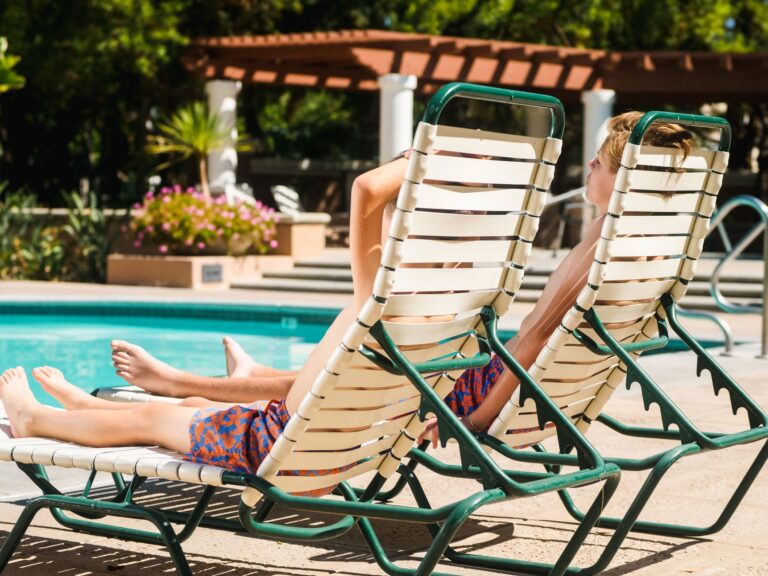
Eleven days after my daughter finished her last round of chemotherapy, all she wanted in the whole world was one ordinary day beside a swimming pool.
Not another hospital room with its particular smell of rubbing alcohol and recycled air. Not another needle sliding into the crook of her small arm while she squeezed my hand and pretended it didn’t hurt. Not the hushed, careful voices adults use when they think a child can’t hear the fear underneath the words. She wanted sunlight. She wanted water closing cool over her shoulders. She wanted, more than anything, to feel like a regular eight-year-old again, if only for a few hours.
Nell had spent her eighth birthday in a hospital bed at Cedar County Regional, connected to an IV pole she’d named Steve, while the rest of the third grade went to a bounce house two towns over without her. She never once mentioned the party she missed. But two weeks later, when her oncologist looked at her latest labs and finally said the words we had been waiting eleven months to hear, “We’re done for now,” she didn’t ask for a cake or a bicycle or a trip to the toy aisle.
She looked up at me with tired little eyes, still fogged from the sedation of that morning’s port flush, and whispered, “Can we go somewhere with a pool? I just want to feel like a normal kid.”
That same afternoon, sitting in the hospital parking lot with the engine running and my hands still shaking from relief, I booked us two nights at Blue Spring Resort, a family place with a horseshoe-shaped lazy river about forty-five minutes outside of Millhaven, close enough that it barely counted as a trip, far enough that it felt like an entirely different life.
To most people it would have been nothing. A modest weekend at a mid-tier resort off the county highway, hardly worth remembering. To Nell it was the trip of a lifetime.
She packed three swimsuits, though she’d barely worn any of them in the year since her diagnosis. She packed pink swim goggles with a strap she’d chewed on since she was six. She packed a paperback about a girl detective that she would almost certainly never open, its spine still stiff and uncracked. And she packed Scout, a stuffed otter one of her infusion nurses had given her on the worst night of treatment, the night her fever spiked to a hundred and four and I sat in a vinyl recliner beside her bed until dawn, watching numbers blink on a monitor and praying to a God I wasn’t sure, some weeks, I still believed in.
I remember that night more clearly than almost any other from that entire year. The nurse, a soft-spoken woman named Odalys who worked the overnight shift on the pediatric oncology floor, had pressed the otter into Nell’s arms around two in the morning and said, “Every kid who makes it through a night like this one needs somebody waterproof to hold onto.” I didn’t understand what she meant until months later, watching Nell drag that otter through bathtubs and rain puddles and one memorable incident involving a garden hose, never once letting it out of her sight. Scout had survived everything Nell had survived. That was the whole point of him.
At check-in, a receptionist with a name tag that read SHELBY handed us two plastic towel clips stamped with our room number.
“If you want good chairs by the pool, clip your towels down early,” she said, kind and brisk in the way of someone who has explained this a hundred times and still means it every time. “It fills up fast on weekends, even a modest one like this.”
I thanked her. Then I apologized when Nell’s goggles slipped from her hands and clattered against the tile floor. Then I apologized again when my card wouldn’t scan on the first try, my fingers fumbling with the little chip reader while a line formed politely behind us.
“No trouble at all,” Shelby said, and smiled like she meant it, and I barely absorbed a word of it, because that was what the last year had done to me. Hospital hallways. Insurance calls on hold for ninety minutes at a stretch. School absence forms. Waiting rooms with fish tanks nobody ever cleaned. Bills that arrived like small paper accusations. All of it had trained me, quietly and completely, to say sorry for existing in other people’s way. Somewhere in the long grinding months of Nell’s illness, I had started behaving as though needing anything from anyone, even something as small as a credit card machine working correctly, was an imposition I owed the world an apology for.
I didn’t notice I’d become this person. You rarely do, while it’s happening. You only notice later, if you’re lucky enough to have a later.
That night Nell slept better than she had in weeks, curled around Scout with the hotel comforter pulled to her chin, and I lay awake beside her listening to the hum of the air conditioner and thinking, for the first time in longer than I could remember, about nothing terrible at all. Just the pool. Just tomorrow.
She was awake before the sun had fully cleared the tree line, standing in front of the bathroom mirror in her yellow swimsuit, which hung a little loose on her narrow shoulders now, the fabric gathering where there used to be more of her to fill it. She turned side to side, studying herself with the frank, unembarrassed curiosity only children seem to manage.
“Do I look like a pool girl?” she asked.
“You look like the pool should be nervous,” I told her, and she giggled, a real giggle, bright and unguarded, and for a second I could have wept from the simple sound of it.
Then her fingers drifted, almost without her noticing, to the hospital ID bracelet still circling her thin wrist. The plastic had gone soft and slightly yellowed from months of wear, her name and birth date printed in fading ink.
“Should I take it off?” she asked, quieter now.
I knelt down so we were eye level. “Only when you’re ready, baby. Not a second before.”
She looked at the bracelet a long moment, turning her wrist this way and that, watching the light catch the plastic.
“Not yet,” she decided.
I understood. That bracelet had become something like proof. Proof that the thing had happened, that she had survived it, that the bald head and the thin arms and the small port scar just under her collarbone were not imagined, not exaggerated, not something people could talk her out of. Some days I think she wore it the way soldiers keep dog tags long after the war ends. Not because they need reminding of what they carried through, but because forgetting, even for a moment, feels like a kind of betrayal toward everyone who didn’t make it out the other side.
We found two lounge chairs beneath a wide blue umbrella near the shallow end, close enough to hear the shrieks and splashes of other children but shaded from the worst of the morning sun. I clipped our towels down exactly the way Shelby had shown me, smoothing Nell’s towel flat not once but twice, because I had learned that neat, ordered things made her feel steady now, in a world that had taught her how quickly everything could come undone. Illness takes so much control away from a child. It decides when she eats, when she sleeps, when strangers in scrubs are allowed to touch her body. I had made it my quiet mission, in every small way available to me, to hand some of that control back.
For half an hour, it worked better than I could have hoped. Nell floated on her back in the shallow end with her goggles pushed up on her forehead, kicking lazy circles, shrieking with delight every time another kid’s cannonball sent a wave across her face.
“I love it here, Mom,” she said, treading water, sunlight scattering gold across the surface around her.
I had to look away and pretend to adjust my sunglasses, because I was crying behind them and didn’t want her to see.
Around ten thirty she climbed out, breathless and pink-cheeked, and announced that what the moment truly required was a smoothie. Peach mango, she specified. With whipped cream if they had it.
Get a new story in your inbox every morning.
Facebook doesn’t show you every story we post. Our free newsletter does. Join 2,500+ readers.
“We’ll be quick,” I told her, wrapping a towel around her shoulders. “Two minutes, tops.”
We were gone closer to fifteen. The line at the pool bar was longer than it looked from a distance, and the teenager working the blender kept apologizing for the wait in a way that made me want to tell him it was fine, truly fine, we weren’t in any hurry at all. When we finally made our way back toward the umbrella, our smoothies in little seashell-shaped cups sweating in our hands, I saw the chairs before Nell did, and something in my stomach dropped.
A woman in a white designer swimsuit was stretched across my lounge chair, sunglasses pushed up into hair that had clearly seen a professional blowout within the last twenty-four hours. A man beside her, presumably her boyfriend, sat in Nell’s chair with his ankles crossed, scrolling through his phone with the unhurried confidence of someone who has never once wondered whether he was allowed to be somewhere.
Our towels were nowhere in sight. I found them a moment later, crumpled into the trash bin beside the pool ladder.
For a second I could only stand there, cup sweating in my hand, staring.
Nell’s small fingers tightened around her own cup.
“Mom?” she whispered. “That was our spot.”
“I know, baby,” I said, keeping my voice level for her sake, though my heart had started slamming against my ribs. “Let me handle it.”
I walked over, doing my best to look calmer than I felt.
“Excuse me,” I said. “Those chairs were reserved for us. Our towels were clipped right there.”
The woman didn’t so much as glance up from her phone. “Reserved doesn’t mean anything if you leave.”
“We were gone about ten minutes.”
She shrugged, a small, bored movement of one shoulder. “Not my problem.”
Her boyfriend smirked at his screen without lifting his eyes.
I pointed toward the little side table, where the plastic towel clips, still bearing our room number in neat black marker, sat exactly where I’d left them.
“Those tags are ours,” I said. “Room 118.”
That, finally, made her look up. Her gaze traveled from me down to Nell, taking in, in the space of a second or two, the bare scalp beneath the little sun hat, the thinness of her shoulders, the hospital bracelet catching the light.
I have thought many times since about what might have happened if, in that moment, something in the woman had softened. If she had looked at my daughter and felt even a flicker of the tenderness most strangers manage to summon for a sick child. Instead her mouth curled into something small and cruel.
“Honestly,” she said, “maybe you should go somewhere more appropriate.”
For one full breath, the entire pool deck seemed to go silent. The splashing stopped meaning anything. The pool speakers, playing some tinny summer song, faded into background static. Even the blender at the bar, which had been running nonstop all morning, seemed suddenly, impossibly far away.
All I could hear was the small, sharp intake of my daughter’s breath beside me.
A year’s worth of fear and helplessness and exhaustion rose in my chest so fast and so hot that for a moment I did not trust myself to speak. I wanted to say something cutting. I wanted this stranger to understand, in precise and devastating language, exactly what my daughter had survived to be standing in that swimsuit on this ordinary Tuesday. I wanted the whole pool deck to turn and see this woman for what she was.
But Nell was standing right there, watching me. And she had already spent the better part of a year watching grown adults talk over her head as though her pain made her invisible rather than important. I was not going to teach her that the answer to cruelty was more of the same.
So I didn’t scream. I didn’t argue. I reached into the trash can, pulled out our damp, slightly sticky towels, and walked away with as much dignity as I could manage while my hands were shaking.
A lifeguard near the pool gate had watched the whole exchange, his whistle motionless against his chest, his expression unreadable. So had a young man in a resort polo shirt standing near the towel station, a clipboard tucked under one arm. He caught my eye for just a second as I passed. I looked away first, too raw to hold anyone’s gaze.
We ended up at the back fence, in the only two chairs left unclaimed, one with a torn strap that dug into the backs of your legs, the other sitting half in glaring sun with no umbrella in reach. Nell lowered herself carefully onto the good one, her smoothie forgotten and sweating in her lap.
“Maybe they weren’t really ours,” she said, so quietly I almost didn’t hear her.
I knelt in front of her chair and took both her hands in mine. “They were ours, sweetheart. One hundred percent.”
She glanced back toward the woman, who was now laughing at something on her boyfriend’s screen, utterly unbothered, as though the last five minutes had left no mark on her at all.
“Then why didn’t she just give them back?”
I didn’t have an answer that wouldn’t make the day uglier than it already was. So I gave her the gentlest version of the truth I could find.
“Because some people forget the rules apply to them too.”
Nell looked down at her bracelet again, turning it slowly around her wrist, and I hated, more than almost anything that had happened that whole difficult year, that my daughter’s instinct in the face of unkindness was to look for reassurance from the one object that reminded her how much she’d already survived.
About twenty minutes later, the young man in the resort polo walked past us, this time carrying a glossy blue gift box tied with a wide silver ribbon. As he passed our chairs he gave me a small, quick wink, so subtle I almost missed it. Not theatrical. Not showy. Just enough to make me sit up a little straighter, some instinct telling me to pay attention.
He walked directly toward the woman in our chair.
“Excuse me, ma’am,” he said, his voice bright and professionally warm.
She pushed her sunglasses up into her hair. “Yes?”
“Congratulations. You’ve just won our Sunshine Raffle, drawn fresh every week from our guest folios. We have a welcome gift for you.”
Her whole face lit up, transformed in an instant from bored indifference to delighted surprise.
“I told you this place had incredible service, Grant,” she said to her boyfriend, who finally set down his phone.
A few nearby sunbathers began to glance over, drawn by the small commotion. The young man in the polo held out the box with both hands, and she accepted it eagerly, lifting the lid to reveal a set of VIP wristbands, a cabana upgrade voucher, two spa passes, a sunset photography session, and a dinner reservation at what was clearly the resort’s finest restaurant.
She gasped, one hand pressed to her chest. “Oh my God.”
“That’s insane,” Grant said, sitting up straighter now, suddenly very interested.
She reached eagerly for the wristbands, already imagining, I suppose, the rest of her upgraded weekend. The young man in the polo shirt kept his professional smile fixed in place.
“Wonderful,” he said. “I just need to confirm your room number before I can activate everything.”
She gave it proudly, without a moment’s hesitation. A number that was not 118.
He glanced down at the tablet tucked against his clipboard, tapped at the screen, and I watched something shift in his expression. It didn’t vanish exactly. It simply became careful, measured, the smile of a man choosing his next words with precision.
“I’m sorry,” he said. “These weren’t drawn for your room, ma’am.”
Her hand froze halfway into the box. “What?”
A resort manager stepped forward from near the towel station, unhurried, his badge catching the light. His name tag read ROURKE. The lifeguard came with him, his whistle now held loosely in one hand rather than resting against his chest.
“These gifts,” Mr. Rourke said, his tone perfectly polite, “were arranged specifically for the guests assigned to these reserved lounge chairs. Room 118.”
A slow, uncomfortable silence rippled outward across that section of the pool deck. Conversations paused mid-sentence. A few people lowered their phones.
The woman’s smile flickered, then steadied itself, defensive now. “They left.”
The lifeguard spoke up, calm and matter-of-fact. “They were gone less than fifteen minutes. Their towels were clipped down with room tags, and I watched you take them off and put them in the trash.”
Grant shifted, suddenly finding something very interesting to look at on the horizon.
Mr. Rourke glanced toward the trash bin, then back at her. “Did you happen to notice the room number written on those clips before you disposed of the towels?”
She said nothing. The silence answered for her. Everyone standing near enough to see her face understood, in that moment, that she had noticed. That she had looked directly at another family’s claim to that space and decided it simply didn’t apply to her.
Mr. Rourke reached out and gently, without any drama, took the box back from her lap.
“Unfortunately,” he said, “violating our guest policy means you’re no longer eligible for this particular promotion. We’ll also need the chairs returned to the guests who reserved them.”
Her face went pale beneath her tan. “This is ridiculous.”
Mr. Rourke only nodded once, unbothered by her tone. “I’m sorry you feel that way.”
Nobody clapped. Nobody cheered. In a strange way, that silence was worse for her than applause would have been, worse than jeering, because it meant the pool deck had simply, quietly decided she was in the wrong and moved on, the way a jury delivers a verdict without needing to raise its voice. There was only the scrape of Grant standing, the rustle of her cover-up as she gathered her things, and the low, uncomfortable hum of dozens of people pretending not to watch while watching very closely indeed.
I felt, unexpectedly, a small pang of something almost like pity for her as she walked away, her chin lifted in that particular way people hold themselves when they know they’ve been caught and are trying to leave with whatever dignity remains available to them. I understood, watching her go, that whatever had made her the kind of person who could look at a bald-headed child’s hospital bracelet and tell her mother to go somewhere more appropriate was probably its own kind of unhappiness, the sort that curdles into cruelty because it has nowhere else to go. It didn’t excuse what she’d said. It didn’t make Nell’s flinch hurt any less. But it kept me, standing there, from wanting to see her humiliated any further than she already had been.
Then the young man in the polo shirt, whose name I still didn’t know, turned and carried the blue box toward us.
He knelt down until he was at eye level with my daughter.
“Hi, Nell.”
She looked at me, startled. “How do you know my name?”
He smiled gently. “Your mom mentioned it at check-in yesterday. While she was apologizing for dropping your goggles, actually. I’m Desmond, by the way. I work the pool deck.”
I felt my face go warm.
“We have something that really does belong to you,” he said, and handed her a smaller box, also blue, tied with the same silver ribbon.
Nell opened it slowly, the way she opened everything now, as though she’d learned that good things deserved to be savored rather than rushed through. Inside was a plush dolphin wearing a tiny pair of swim goggles, two dessert vouchers, a photography session card, and a laminated badge that read BRAVEST SWIMMER in cheerful orange letters.
Beneath everything else was a handwritten card, folded in half. Nell lifted it out carefully and opened it, and I leaned over her shoulder to read along with her. Different handwriting filled the inside, message after message layered one beneath another, clearly written by several different staff members over the course of the morning.
Welcome back to being a kid.
Your cannonball this morning made my whole shift better.
We saved you the shadiest umbrella for tomorrow.
Peach mango smoothies are better with whipped cream. Come find me and I’ll fix that.
Keep swimming, brave girl.
I looked up. The teenager from the smoothie bar was watching from a distance, and when our eyes met he lifted a hand in a small wave. The lifeguard smiled at Nell from his chair. A housekeeper standing near the towel station wiped quickly at her eyes with the back of her wrist and pretended to be very busy with a stack of folded towels.
My throat closed. I had to look at the horizon for a second to keep from falling apart entirely.
Mr. Rourke came and stood beside me while Nell examined every item in the box with wide, delighted eyes.
“I hope you don’t mind me saying this,” he said quietly.
I shook my head, unable to guess what was coming.
“You’ve apologized to nearly every member of my staff you’ve spoken to since you arrived yesterday afternoon,” he said. “You apologized when you asked where the elevator was. You apologized when your daughter dropped her goggles at the front desk. You apologized this morning when housekeeping held the door open for you.”
Heat climbed up my neck and into my face.
“I don’t say this to embarrass you,” he added gently. “I say it because I don’t think you’ve done a single thing since you got here that actually needed an apology.”
For a moment I couldn’t answer him at all, because he was right, and hearing it said aloud by a stranger landed with more force than I expected. I had spent the better part of a year apologizing my way through survival. To nurses drawing blood from my daughter’s small, scarred veins. To receptionists at the oncology clinic when our insurance authorization hadn’t gone through in time. To teachers when Nell missed weeks of school she could never fully make up. To pharmacists, to bank tellers, to strangers in grocery store lines who sighed audibly when Nell, exhausted from treatment, walked too slowly down the cereal aisle. I had become so practiced at asking the world to make just a little room for my sick child that somewhere along the way I had forgotten we were allowed to take up space at all, without qualification, without apology, simply because we existed and were trying, like everyone else, to get through the day.
Nell was still reading the card, her lips trembling slightly as she took in each message. Then she lifted the photography voucher and looked up at me, her eyes suddenly serious in the way that always startled me a little, the seriousness of a child who has learned things about time and its limits that most adults spend a lifetime avoiding.
“Mom?”
“Yeah, baby?”
“Can we take a picture while I still look like this? Before my hair comes back and I forget what it felt like?”
Something in my chest cracked open, wide and sudden. I looked at her bare scalp, soft as new peach skin under the sun. Her bracelet, worn and yellowed. Her thin arms that still, even now, could pull herself through the water with a fierceness that took my breath away. The whole small, fierce, impossible body that had fought harder than any eight-year-old should ever have to fight, and had won.
I brushed my thumb gently across her cheek. “Exactly like this,” I told her. “We’ll take a hundred pictures exactly like this.”
Mr. Rourke had our original chairs returned beneath the wide umbrella within minutes, fresh towels brought over and clipped down with careful hands. New smoothies arrived, peach mango with whipped cream and tiny paper umbrellas perched on the rim exactly as promised. Nell held the stuffed dolphin against her chest the way some children hold a trophy, turning it over now and then to admire its little goggles.
Then she looked at me, and there was something almost triumphant in her expression.
“Mom? See? Sometimes people are nice.”
I laughed, though it came out half tears. “Yes, sweetheart. Sometimes they really are.”
She grinned, wicked and delighted. “Even when other people are gross.”
I nearly choked on my smoothie, and for a moment we were just laughing together under that umbrella, the two of us, the way we hadn’t laughed together in longer than I wanted to admit.
The afternoon settled into something quieter after that. The woman and Grant had vanished toward another part of the resort, and I found, to my own surprise, that I didn’t spend a single further minute thinking about them. For once, someone else’s cruelty wasn’t the center of gravity around which the rest of the day had to orbit. It had simply happened, and then it had ended, and the pool kept right on being a pool.
Nell did three careful, tentative cannonballs, testing the water and her own strength with each one. Then five, growing bolder. Then one so dramatic, arms flung wide, knees tucked, that she sent a wave clear over the edge of the shallow end, and the lifeguard gave her an appreciative thumbs-up from his chair, which made her preen for a full five minutes afterward.
Near sunset, with the light going soft and amber over the water, a little boy in a medical mask appeared at the pool gate with his mother trailing behind him. He looked about Nell’s age, maybe a year or two younger, his own head bare beneath a floppy sun hat that had clearly been chosen for shade rather than style. His mother scanned the crowded pool deck with an expression I recognized instantly, having worn it myself not twenty-four hours earlier. That careful, pre-emptive apology already forming behind her eyes before anyone had said a single unkind word to her.
I raised my hand before I’d fully decided to.
“We’ve got plenty of room over here,” I called.
The woman blinked, clearly startled by the offer. “Are you sure?”
“Absolutely sure,” I said, and meant it more fully than I think she understood.
I unfolded one of our extra towels and clipped it down beside Nell’s chair with one of our spare room tags, making it official, making it theirs for as long as they wanted it. The boy’s mother, who introduced herself as Marisol, smiled at me like I’d handed her something far more valuable than a strip of shade, and in a way, I suppose I had.
The little boy, Rhett, settled onto the towel, and Nell turned to him immediately with the easy, unguarded friendliness only children seem able to manage on the first try.
“This umbrella is the best one,” she informed him. “And the left slide is faster than the right one, but don’t tell the lifeguard I said that.”
Within minutes they were comparing scars, lifting sleeves and pant legs to show off port marks and IV bruises the way other kids compare skinned knees from the playground, each one a small badge of survival worn without shame. Marisol and I exchanged a look over their heads, the particular, wordless look of two women who understand exactly what the other has been through without needing to say a single word about it.
I leaned back in my chair as the sky began its slow slide into orange and pink, the sun warm and low against my arms, the little blue gift box tucked safely beneath the side table where Nell had insisted it stay for the rest of the day, close enough to check on every so often. Somewhere behind us the lazy river kept turning its slow, endless horseshoe. Somewhere near the bar, the blender whirred one more time.
That morning I had believed, in the particular exhausted way you believe things after a year of fighting for someone else’s life, that I would have to fight the entire world just to give my daughter one ordinary day. By evening I understood something gentler, and truer. There were still people, quiet, unglamorous people in resort polo shirts and lifeguard whistles and housekeeping uniforms, making room for us without being asked, without needing thanks, simply because it was the right thing to do and they had decided, each in their own small way, to do it.
I watched Nell laugh with her new friend, watched her toss her head back the way she used to before any of this started, watched the water catch the last of the light as it slid off her thin shoulders, and for the first time in longer than I could measure, I did not feel the old reflex rising in my throat, the automatic, apologetic sorry waiting to smooth over some imagined inconvenience I’d caused simply by being present.
I simply sat there, in the ordinary gold light of an ordinary evening, and watched my daughter laugh in the pool like any other eight-year-old girl on any other summer day, exactly as she deserved to.
We drove home the next afternoon with Scout and the new dolphin buckled into the seat between them, Nell narrating the entire ride about the left slide being faster than the right one, about Rhett’s favorite dinosaur, about how she planned to wear her BRAVEST SWIMMER badge to her first day back at school. I kept glancing at her in the rearview mirror, at the sunburn across her nose, at the bracelet still circling her wrist, and I thought about how close I had come, in that first ugly minute at the pool, to letting one cruel stranger decide what this weekend would mean to my daughter.
She never did take the bracelet off that weekend. She took it off three weeks later, on her own, without ceremony, dropping it into a small keepsake box on her dresser beside her hospital pin and her BRAVEST SWIMMER badge, right where Scout the otter stands watch over both of them still. On hard days, and there are still a few, I think back to that gold hour at the pool gate and remember that somewhere out past the cruelty of strangers, there is almost always someone quietly making room.
This story is a dramatization. Names, characters, and details are invented, and any resemblance to real people or events is coincidental.