
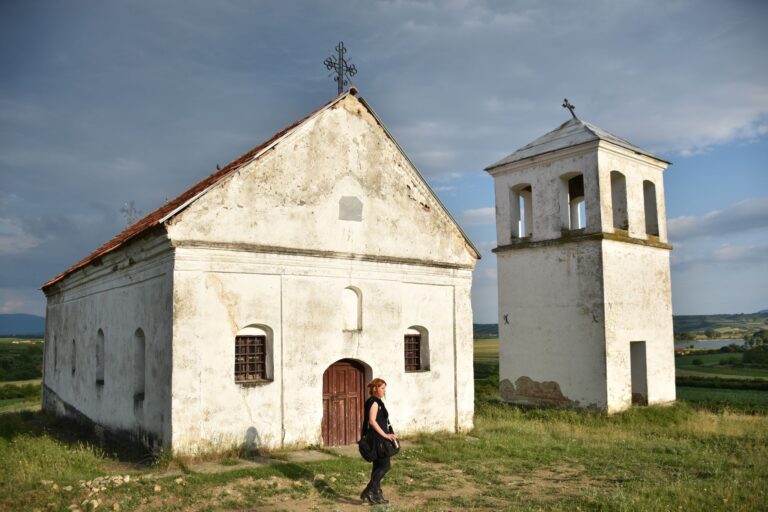
The truck came up County Road A a little after seven, pulling a flatbed with a rigging crane folded down flat like a sleeping animal, and I was already standing under the bell tower with my coffee going cold in my hand, because I had not slept, and because I had made up my mind that whatever happened next, I was not going to watch it from my kitchen window a mile away.
There were nineteen people in the churchyard by the time the truck’s brakes hissed. By eight there were over sixty. By the time Rev. Kessler came out of the parsonage in his shirtsleeves, still buttoning his collar, there were more people standing in the wet grass around Trinity Lutheran than I had seen there on an ordinary Sunday in a decade, and every single one of them was looking up at the bell my husband rang for forty years, waiting to see if a stranger from Madison was going to be allowed to take it down.
I am seventy two years old. My name is Marguerite Voelker, and I have lived on the same stretch of the Wisconsin River bottomland outside Boscobel my whole married life, and until eight months ago I would have told you that nothing left in this world could still surprise me. I was wrong about that, the way I have been wrong about a few important things, and this is the story of how a church bell taught an old woman and a young preacher the same lesson from two different directions.
Amos and I were married fifty one years. He courted me the summer I turned nineteen, driving a hay truck with a rattle in the door that he never fixed because he said the sound reminded him which truck was his in a crowded lot. He was not a demonstrative man. He did not write me poems or bring me flowers on ordinary Tuesdays. What he did was show up, every day, for fifty one years, and the one place he showed up most faithfully of all, more faithfully than he showed up for planting or for harvest or even for his own supper table some Sundays, was the bell tower at Trinity.
The bell itself came before either of us. It was cast in 1921 by the Meneely Bell Company out of Troy, New York, a foundry that had been ringing bells for small Wisconsin river towns since before my grandmother was born, and it was hauled up from the rail depot in Boscobel by six draft horses and hung in the tower by men who are all dead now, their names on a brass plaque inside the narthex that nobody reads anymore except me. It has a voice like nothing else in this town. Low and round and a little cracked at the very top of the note, the way an old man’s singing voice goes a little cracked, and when it rings across the bottomland on a still morning you can hear it from the Ruoff place two miles east and from the boat landing down on the river.
Amos started ringing it the year we lost our first baby. I have never told this part to many people, not even to Delphy, who has been my closest friend since we were girls together at the county fair scrubbing 4-H hogs. Our son lived four days. Pastor Halvorsen, who held this church for thirty six years before Rev. Kessler ever set foot in Wisconsin, asked Amos if he wanted a task to keep his hands busy that terrible autumn, something steady, something that could not be taken from him the way our boy had been taken. Amos said he would ring the bell. He climbed those narrow tower stairs the very next Sunday, and he kept climbing them, rain or ice or hundred degree heat, for the next forty years, until his heart gave out in the hayfield on a Tuesday in September three years ago and he never climbed them again.
Forty years of Sunday mornings. Forty years of ten minutes before the nine o’clock service, standing under that bell with the rope in his big cracked hands, pulling it steady and even, never rushed, because he said a bell rung in a hurry sounds like it is announcing a fire instead of calling people to worship. He rang it for our wedding, for both our daughters’ weddings, and for every funeral this congregation held for four decades, tolling it once for each year of the person’s life, slow and even, so that old Elmer Bratz who lived to ninety three got ninety three long tolls and half the town stood in the churchyard counting along under their breath. He rang it the morning of the 2008 flood, standing in water past his boot tops, to call the men down to the levee before the sirens even started. I remember that morning clear as anything, the sky the color of a bruise and the river already over the county road by the boat landing, and Amos pulling on his waders at four in the morning saying somebody needed to ring the bell before the water got any higher, because half the men in this valley did not have a working radio out in their barns but every one of them would hear that bell. He was right. By the time the official siren finally sounded from the fire hall, the sandbag line was already three men deep, because Trinity’s bell had beaten the county to the punch by twenty minutes, and twenty minutes, in a flood, is the difference between a wet basement and a lost house. Old Corky’s father, who ran the hardware store then, always said that bell saved his lumber yard that year, and he never once forgot it, even after he stopped coming to services altogether.
And on the last Sunday he was alive, three years ago this coming September, I stood at the bottom of those stairs same as I had a thousand times, and I watched him climb up in his good church trousers, and I heard that bell ring out over the bottomland one more time, not knowing it was the last time, because you never do know, and that is the mercy and the cruelty of an ordinary morning.
He died four days later, in the hayfield, with his cap still on. I was not there. Delphy was the one who found me in the garden and told me, and I remember exactly nothing about the rest of that day except that somebody, I never found out who, climbed the tower that evening and rang the bell forty three times, once for each year we had been married up to that point, though we were not quite at forty three, we were at forty eight, and I have never had the heart to correct whoever miscounted, because it was kindness either way.
For three years after Amos died, that bell was the only thing in Boscobel that still sounded like him. His voice went quiet in our kitchen. His boots stopped standing by the door. But every Sunday at ten minutes to nine, somebody, usually young Garrett Ambler from the church council or one of the Palek boys, climbed those stairs and rang the bell, and for those ten minutes I could close my eyes in my pew and believe, just a little, that Amos had only stepped out to check on something and would be right back.
Rev. Kessler came to Trinity eight months ago, after Pastor Halvorsen finally retired to Arizona at seventy nine, his hands too unsteady for the work anymore. Kessler was thirty four years old, came to us from a large church outside Green Bay, and the search committee was proud of him the way you are proud of a shiny new tractor. He had energy. He had ideas. He talked about “reaching the unreached” and “meeting people where they are,” and for the first few months I told myself, and told Delphy, that a little new blood might do this old congregation some good.
Get a new story in your inbox every morning.
Facebook doesn’t show you every story we post. Our free newsletter does. Join 2,500+ readers.
He brought a worship band from the next county over, a young man on electric guitar and a girl who sang with her eyes closed. He put in two large screens on either side of the altar so people could read the hymn words without holding a hymnal, and I understood the thinking on that, truly, even if I still preferred the feel of the old cloth-bound Lutheran hymnal in my two hands. He talked, more and more as the months went on, about what he called “the sound problem.” Trinity’s sanctuary, built in 1919, had a wooden ceiling that swallowed voices, and the little speaker system Pastor Halvorsen had installed back in 1987 crackled and hummed and occasionally cut out entirely mid-sermon. Kessler wanted a real system. A modern one. He had a number for it: twenty eight thousand dollars, quoted by an outfit down in Madison that did sound for megachurches.
I did not think much of it when he first brought it up at a potluck, standing by the coffee urn with a paper plate of Ione Palek’s hotdish in his hand, saying the church needed to invest in its future instead of just maintaining its past. I thought he meant a fundraiser. A capital campaign, the kind Trinity had run twice before in my lifetime, for the new furnace and for the parking lot resurfacing. I did not think, not for one single moment, that he meant the bell.
I found out from Ione Palek, who found out from her husband Denny, who sits on the church council with Garrett Ambler and four others. There had been a meeting on a Thursday night in late April, one I had not attended because I no longer go to every council meeting the way I did when Amos was alive and the bell tower repairs were on the agenda every other year. At that meeting, Rev. Kessler presented what he called “an underused asset opportunity.” A bell broker out of Madison named Gaylen Feit, who deals in architectural salvage and antique church bells for collectors and for churches building new sanctuaries who want an authentic old bell without the cost of commissioning a new one, had appraised Trinity’s Meneely bell at somewhere between sixteen and twenty thousand dollars, on account of its age, its foundry, and its excellent condition. Sell the bell, Kessler told the council, and Trinity could nearly fund the entire sound system in one transaction, without a single fundraiser, without asking a struggling farm congregation to dig any deeper into pockets that were already thin.
The council voted five to two to approve exploring the sale. Garrett Ambler was one of the two no votes. He came to my door himself the next morning, hat in his hands, to tell me before I heard it from anyone else, because he said Amos would have wanted somebody to tell me straight and not let me hear it secondhand at the feed store.
I sat at my kitchen table for a long time after Garrett left. I did not cry, not right away. I have found that the deepest griefs do not announce themselves with tears at first. They sit in your chest like a stone dropped in still water, and you watch the ripples go out and out before the water finally closes back over and you understand what has actually happened.
What had actually happened was that a man who had known my husband for exactly zero of his forty years in that tower had decided, on a spreadsheet, that Amos’s bell was worth more as scrap and salvage than as a voice calling this town to worship.
I asked Rev. Kessler for a meeting, and he gave me twenty minutes on a Tuesday afternoon in the church office, a room that used to smell like Pastor Halvorsen’s pipe tobacco and now smelled like the vanilla candle Kessler kept on the windowsill. I brought Delphy with me for courage, though she sat quiet in the corner chair and let me do the talking, which is its own kind of loyalty.
I told him what the bell meant. I told him about our son. I told him about the flood, about forty years of Sunday mornings, about the ninety three tolls for Elmer Bratz and the way this whole valley had learned to set its Sunday morning by that sound the way sailors set their watch by a lighthouse. I did not raise my voice. I have never been a woman who raises her voice, and I was not about to start in a room with a vanilla candle burning.
Rev. Kessler listened. I will give him that much credit even now, looking back. He did not interrupt me. He even wrote a few words on a legal pad while I spoke, though I could not tell you what, and when I finally ran out of words myself, the office was quiet enough that I could hear the vanilla candle’s little flame hissing on the windowsill.
He folded his hands on the desk in a way that I have come to understand young men do when they have already made up their minds and are only waiting politely for the other person to stop talking, and he said, “Mrs. Voelker, I understand this is emotional for you. I truly do. But the church’s mission isn’t a museum. A bell that rings for ten minutes a week and sits silent the other one hundred and sixty seven hours isn’t serving this congregation’s future.” He said the appraisal was fair, that Gaylen Feit was a reputable dealer who worked with churches all over the Midwest, and that the sale had already been approved through the proper channels, the way a man says a thing when he wants you to understand the matter is settled and not open for further discussion. “Sentiment doesn’t pay for speakers that let a hundred and forty people actually hear the Gospel on Sunday morning.”
Sentiment doesn’t pay for speakers.
I have turned that sentence over in my mind more times in the eight months since than I can count. I do not think Rev. Kessler is a cruel man, not the way some men are cruel, with intention and relish. I think he is a man who has never once stood in a hayfield and heard a bell toll forty three times for a marriage he did not get to finish, and so he truly believed, in that room, that he was making a wise and forward-looking decision, and that my objection was a soft and backward-looking one, the kind old women make about things that do not matter next to the Gospel.
He was wrong about what mattered. But I did not know yet how to prove it to him, so I thanked him for his time, the way my mother raised me to do even when my chest was full of stone, and Delphy and I walked out to the parking lot, and I sat in my car for twenty minutes before I trusted myself to drive.
That night I did something I had not done in three years. I went up to the attic and I took down the metal box where I keep the papers that matter, the deed, the wills, the insurance policies, and underneath all of it, in an envelope that had gone soft at the corners from handling, I found the eleven thousand four hundred dollars in cash that Amos had been quietly saving for a decade, folded into hundreds and fifties, a little at a time from good harvest years, money he told me the week before he died was “for whatever Trinity needs someday that nobody else will pay for.” He never told the council. He never told the pastor. He told me, in our kitchen, three days before the hayfield took him, and I had never once found the strength to spend it, because spending it felt like admitting he was really gone, the same way giving away his boots by the door would have.
I sat on the attic floor with that envelope in my lap for a long while. I understood, sitting there, that I had been doing to that money exactly what Rev. Kessler accused me of doing to the bell. Holding it silent. Keeping it as a monument instead of letting it do the work it was meant to do. The difference, I told myself, was that I still got to choose what work that was. And I already knew.
I called Delphy first thing the next morning, and by noon she had called four more people, and by suppertime half of Boscobel knew that Trinity’s bell was for sale to a stranger from Madison who wanted to hang it in some rich collector’s barn conversion or worse, melt it for the bronze. That is not quite what Gaylen Feit intended to do with it, I would learn later, but grief and anger are not always precise instruments, and by the time the story had traveled from the feed store to the diner to the VFW hall and back around through the quilting circle, it had picked up some understandable exaggeration along the way.
What did not need any exaggeration was the truth underneath it. This town had buried its dead to that bell. It had married its children to that bell. It had waded into floodwater because of that bell. Old Corky out at the hardware store, who is not a churchgoing man himself, closed up shop early and drove out to Delphy’s kitchen table to ask what he could do, because his father’s funeral had been tolled by that same bell in 1974 and he said some things belong to a whole town even if you never once sat in the pews.
We did not plan a protest, exactly, not the way you might picture one with signs and shouting. This is Boscobel, not a city. What we planned, over three days of phone calls and kitchen table meetings and one long evening in the church basement with a coffee urn going the whole time, was simpler than that. We planned to show up. All of us, on the morning Rev. Kessler had told the council the rigging crew was coming, and we planned to stand under that bell, quietly and without anger, until somebody with the authority to stop the sale looked us in the eye and decided whether he could still go through with it.
The quilting circle met on the Monday night, seven women around Delphy’s dining table with a coffee can passed hand to hand instead of a needle for once, and by the time the can came back around it held four hundred and twenty dollars in cash and a stack of checks nobody counted out loud because that felt unseemly in a kitchen. Ione Palek called her sister in La Crosse, who called two more women from her own church, women who had never once set foot in Trinity, and by Tuesday evening envelopes were arriving through the mail slot at the parsonage office addressed simply to “the bell fund,” five dollars here, fifty there, one for a thousand dollars from a family who had moved away to Eau Claire a decade back but still remembered being married under that tower. Nobody organized a spreadsheet. Nobody needed one. A valley that has passed the plate every Sunday for a hundred years already knows how to raise money for something it believes in, and it does not need a consultant from Madison to teach it.
Garrett Ambler found out from a friend on the council which morning Gaylen Feit’s crew was scheduled, a Wednesday, chosen deliberately for a weekday when the sanctuary would be empty and the sale could go through with the least amount of fuss. Rev. Kessler, I believe, honestly thought a quiet Wednesday morning would spare the congregation an emotional scene. He had no way of knowing that Boscobel does not need a Sunday to know when something in this town is under threat. We have our own kind of bell, the telephone line and the church basement and the counter at the diner, and it rings just as far.
So that is how I came to be standing under Amos’s bell tower at seven in the morning on a Wednesday in May, with my coffee going cold, watching a flatbed truck with a folded crane come up County Road A, and watching, over the next hour, as the churchyard filled with more of Boscobel than I had seen gathered in one place since Amos’s own funeral.
Garrett Ambler came in his work coveralls, straight off the morning milking. Ione Palek brought a thermos of coffee big enough for twenty and ran out within the first half hour. Old Corky stood at the edge of the crowd with his cap off, the way men of his generation take their cap off without thinking about it in front of a church whether they believe or not. Three of the men from the VFW post came in their windbreakers with the eagle patch, and stood at attention near the tower door like they were guarding something, which I suppose they were. Young families brought children still in their pajamas, bundled into the truck at six thirty because their mothers said this was something worth missing school for. Delphy stood beside me the whole time, her hand finding mine the way it has found mine at every hard moment of my life since we were nine years old.
And at eight minutes past eight, before Gaylen Feit had even climbed down from his truck cab, Garrett Ambler walked past the whole crowd, opened the tower door, climbed those narrow stairs the same way Amos used to climb them, and began to ring the bell.
Not a warning peal. Not an alarm. He rang it slow and even, the way Amos taught him one Sunday years back when Amos was training the next generation of ringers without either of them quite calling it that, and the whole churchyard went still to listen, the way this whole valley has gone still to listen to that sound for over a hundred years. And when Garrett’s arms tired, young Denny Palek climbed up and took the rope from him without a word passing between them, and kept the same slow, steady rhythm going, and when Denny tired, somebody else climbed those stairs, and somebody after that. We did not let that bell go silent, not for one single minute, the entire morning.
Gaylen Feit stood by his flatbed for a long while, looking up at the tower, looking at the crowd, looking, I think, at a situation his appraisal spreadsheet had never once prepared him for. He was not an unkind man either, I want to say that plainly, because this is not a story where every stranger turns out to be a villain. He walked over to me, since I suppose something in the way I was standing told him I was the one to talk to, and he took his cap off too, and he said, “Ma’am, I don’t want any part of taking something away from people who feel like this about it. I buy from churches closing their doors for good, mostly. Nobody told me this congregation was still standing here ringing it.”
Rev. Kessler came out of the parsonage at twenty past eight, still buttoning his collar, and I watched his face change three separate times as he crossed the churchyard. First surprise, plain and open, the look of a man who planned a quiet Wednesday and got a churchyard full of his own congregation instead. Then something that looked, for just a moment, like frustration, the look of a man who believes he has already made the correct decision by every measure available to him and cannot understand why the facts on a spreadsheet are not persuading anyone. And then, as he got close enough to hear the bell and to see who exactly was standing under it, veterans with their caps off and children in pajamas and Garrett Ambler with milking still on his coveralls and old Corky who does not even attend, something in his face went quiet and unsettled in a different way entirely.
I walked up to him before he could speak, and I held out the envelope. Eleven thousand four hundred dollars, in an envelope gone soft at the corners.
“This is Amos’s,” I told him. “He saved it for ten years for whatever Trinity needed someday that nobody else would pay for. I believe a sound system so a hundred and forty people can hear the Gospel qualifies. I have Garrett and five others ready to match it dollar for dollar with what the quilting circle raised in three days once they heard what this was for. That is more than nineteen thousand dollars toward your twenty eight, Pastor, without a single stranger’s truck driving one inch closer to this tower.”
I will tell you honestly that I do not know exactly what turned in Rev. Kessler in that moment. I was not inside his heart. But I watched him look up at that bell, still ringing, Denny Palek’s young arms pulling the rope steady the way Amos taught him, and I watched him look back at that envelope in my hand, and I watched something in his shoulders come down, the way a man’s shoulders come down when he finally sets a weight he did not realize he had been carrying wrong the whole time.
He asked Gaylen Feit for a moment. He walked to the base of the tower and stood there a long minute, listening, really listening, the way I do not think he had ever once let himself listen to that bell before, only heard it as a sound competing with his plans. And then he turned to the whole churchyard, sixty some people who had given up a Wednesday morning to stand in wet grass for a bell, and he said, in a voice that had none of the polish of his usual Sunday sermon, “I was wrong to call this an underused asset. I think I was measuring the wrong hundred and sixty seven hours.”
He sent Gaylen Feit home. He did it kindly, and Gaylen, for his part, seemed almost relieved, and told Rev. Kessler he’d take a fair commission finding him a donor-appraisal instead if the church ever wanted a proper valuation for insurance, no charge for his morning’s trouble. The council met again that Sunday after service, and this time it was seven to nothing, and the money, Amos’s money and the quilting circle’s money and, in the end, a good deal more that came in over the following month once word spread of what almost happened, paid for the sound system by August, every speaker properly installed under a ceiling that had swallowed voices for a hundred years and would not have to swallow them any longer.
The bell still rings every Sunday morning, ten minutes before nine, slow and even, the same rhythm Amos taught this town without ever once writing it down, because some things are taught by hand and by ear and by forty years of showing up, not by instruction. Garrett Ambler rings it most weeks now. But on the first Sunday of every month, I climb those narrow stairs myself, my knees complaining the whole way up same as they complain about most stairs these days, and I take the rope in my two hands, and I ring it myself, slow and even, the way my husband taught this whole valley to expect.
My grandson Caleb is nine now, and he has started coming up with me on those Sunday mornings, standing beside me with his small hands wrapped around the rope below mine, learning the rhythm the same patient way Amos once taught Garrett, without either of us quite calling it a lesson. I do not know if Caleb will still be ringing that bell in forty years the way his great-grandfather did. I do not know if Trinity itself will still be standing in forty years, in a world that seems to want everything faster and louder and mostly quiet about the things that used to matter. But I know that on one Wednesday morning in May, a whole valley stood in wet grass with their caps off and would not let a piece of their history be measured only in scrap value and appraisal numbers, and a young pastor who came to us certain he already understood what mattered most learned, standing at the base of a tower, that some hours are not underused just because they are quiet.
Rev. Kessler still leads worship differently than Pastor Halvorsen did. He still has his screens, and his sound system, working beautifully now, carries every word of his sermon clear to the back pew where old Corky has, more than once since that Wednesday morning, quietly slipped in to sit for the last ten minutes just to hear the bell wind down before he leaves again. Kessler asked me, a few weeks after, if I would tell the confirmation class about Amos and the bell, about our son, about the flood, about all forty years of it, and I did, and I watched a room full of fourteen year olds sit still and listen the way I do not think fourteen year olds usually sit still for anything.
I think that is the part I hold onto now, more than the bell itself, more even than the money I finally let go of after three years of holding it silent in an attic box. A whole town remembered, together, out loud, in the one moment it actually mattered, that some things are worth more standing than sold, and that the sound a life makes, ringing out steady over a valley for forty faithful years, does not stop when the hands that rang it are gone. It only waits for the next pair of hands willing to climb those stairs.
This story is a dramatization. Names, characters, and details are invented, and any resemblance to real people or events is coincidental.