
I was forty-three years old when I packed up my apartment in Charlotte and drove four hours north to move back into the house I swore I would never sleep in again.
I want to be honest about that, right at the start, because the version where the loving daughter rushes home with an open heart is not the version that happened. I did not come home because I had forgiven her. I came home because the oncologist had used the word months instead of years, and because my brother Danny lives in Oregon with three kids and a job he cannot leave, and because somebody had to, and the math of our family had always worked out to me. I was the unmarried one. The one without children. The one whose life looked, from the outside, like the kind of life you could fold up and move.
So I folded it up. I gave my landlord notice. I told the marketing firm I would be remote indefinitely, and when my manager asked how long indefinitely meant, I could not make my mouth say the real answer, so I said a few months and we both pretended that was a number.
My mother’s name is Rosemary. Everyone in Millbrook called her Miss Ellie, even people younger than me, the way small towns hand out titles like that. She had been a church secretary for thirty-one years at First Methodist, the kind of woman who knew which families were quietly behind on their giving and never said a word, who kept peppermints in her desk drawer and a list of the homebound taped inside the cabinet so she would not forget a single name. People loved my mother. I need you to understand that, because it makes the rest of this harder to explain. The woman the town loved and the woman who raised me were not always the same woman, and for most of my adult life I had let the gap between those two women turn into a silence twelve years long.
The wound, if you want the short version, was my father’s funeral.
He died when I was thirty-one. He had not been an easy man, and I had spent my twenties putting distance between myself and the house, and at his service my mother stood up in front of the whole congregation and talked about what a devoted family we had been, what a faithful home, and I sat in the second pew with my hands in my lap and felt something close in me like a door. Because it was not true. Because the home she described was a home I did not get to live in. And afterward, in the fellowship hall, over the ham and the funeral potatoes, she pulled me aside and told me I had embarrassed her by not crying enough.
That was it. That was the whole crime, said plain, it sounds almost too small to ruin twelve years over. But grief does not run on a fair scale, and neither does a daughter’s heart, and I drove back to Charlotte that night and we did not have a real conversation again until the day I called to check on a cough that would not go away and a nurse answered her phone.
So that is who I was when I pulled into the driveway that first day. A daughter coming home to do a duty, not to mend anything. I told myself I would keep her comfortable, keep her clean, keep her fed, and keep my heart exactly where it had been, behind that closed door, for however many months this took. I was very sure of that plan. I had it all worked out.
Get a new story in your inbox every morning.
Facebook doesn’t show you every story we post. Our free newsletter does. Join 2,500+ readers.
The house smelled like her, is the thing nobody warns you about. You walk in and twelve years collapse into one breath. Lemon furniture polish and old hymnals and the particular dust of a house where the windows do not get opened anymore. She was in the back bedroom, and she had gotten so small. That was the first crack in my plan. I had been carrying around the mother from the funeral, the one with the steady voice and the wrong story, and the woman in that bed was eighty pounds of bird bones and thin white hair, and when she saw me in the doorway her whole face came apart with something I did not have a name for yet.
“You came,” she said.
“I came,” I said. And I put down my bags.
The work of caregiving is not what the movies tell you. It is not soft lighting and meaningful conversations. It is mostly logistics. It is the pill organizer with the seven little doors, Monday through Sunday, and the second one for the evening doses, and learning the names of medications I still cannot spell. It is the calendar of appointments, the oncologist and the palliative team and the woman from hospice who came on Thursdays and talked to my mother in a voice so kind it made me leave the room. It is laundry. My God, the laundry. Nobody tells you that dying generates laundry, sheets and nightgowns and towels, load after load, and I spent that whole first month in a kind of grim motion, doing tasks, avoiding her eyes.
We did not talk about anything that mattered. We talked about whether she wanted the window open. We talked about the soup. I made a lot of soup, because it was something I could control, something I could put in front of her and watch her take three spoonfuls of and then push away, and at least it was an action, at least it was not sitting still in a room with a woman I did not know how to love anymore.
The radio is what started to undo me.
She kept a little clock radio on the nightstand, the kind with the red numbers, and every morning she would have me turn it to the gospel station out of Roanoke. I thought it was background noise at first. But I started to notice that she knew them, all of them, every hymn, and on the mornings when the pain was bad and she could not say much, her lips would still move. “It Is Well With My Soul.” “Great Is Thy Faithfulness.” “Blessed Assurance.” The old ones, the ones I had grown up rolling my eyes at in those pews, and her cracked voice would find the melody even when it could not find the words, and I would stand in the doorway with a basket of laundry on my hip and feel my throat do something I did not give it permission to do.
One morning the station played “Be Thou My Vision,” and she opened her eyes and looked right at me and said, “Your daddy and I had this at our wedding.”
I did not know that. I realized, standing there, that there were a thousand things I did not know, that I had spent twelve years so certain of my grievance that I had never once been curious about the woman who held it on the other side. And I sat down on the edge of the bed, which I had not done, not once, in a month, and I said, “Tell me about the wedding.”
And she did. It took her a long time, with rests, but she told me about the dress her own mother sewed, and the church with no air conditioning in July, and how my father had been so nervous he forgot the ring in his other suit and his best man had to run home for it. She laughed, a little, a dry sound, and the laugh turned into a cough, and I held the cup of water to her lips, and something between us that had been frozen for a very long time moved about an inch.
That was the beginning. Not forgiveness, not yet. Just the beginning of being curious about her again.
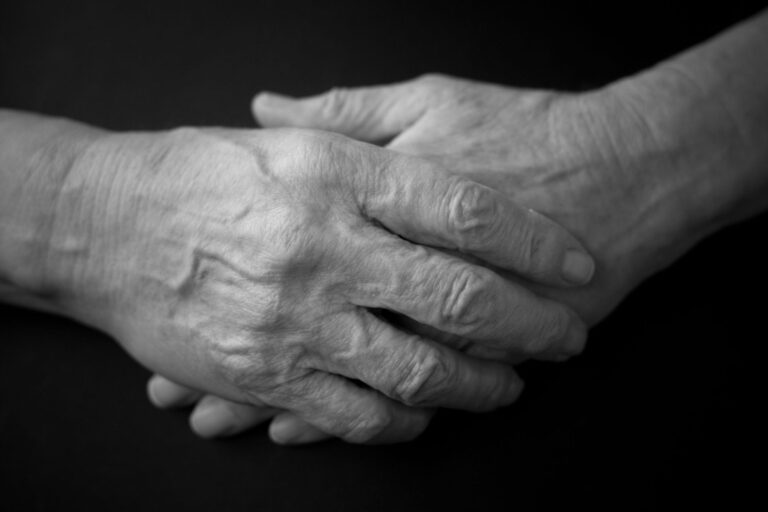
The nights were the hard part. The pain did not keep daytime hours, and there were weeks when she would wake at two and three in the morning frightened and disoriented, not knowing where she was, calling out a name, sometimes mine and sometimes her own mother’s. I moved a recliner into the corner of her room so I could be there. I slept in fragments. I learned the rhythm of the breakthrough medication, the dropper under the tongue, the fifteen minutes of waiting with my hand on her papery hand while it took hold. In the daylight I could keep my old anger company. But at three in the morning, holding the hand of a frightened woman who weighed nothing, the anger had no oxygen. There is a kind of tenderness that only exists in the dark, in the exhaustion, in the surrender of being needed that completely. You cannot stay angry at someone you are keeping alive one frightened hour at a time. The body does not allow it.
I started to know her. That is the only way I can say it. Through the ordinary work, the meals and the meds and the hymns and the hard nights, I started to know the actual woman, not the symbol I had built her into. I learned she was afraid of being a burden, that she apologized every single time I changed her, that it humiliated her in a way that broke my heart once I let myself feel it. I learned she had kept every birthday card I ever sent, even the perfunctory ones, even the year I sent nothing and she had clipped a blank one to the calendar with my name on it like a hope. I found them in a shoebox when I was looking for her insurance papers, and I had to go sit in the car.
Winter came. We found a rhythm. I would get her settled in the morning, the radio on, the light right, and I would work from the kitchen table on my laptop, the marketing job that felt more absurd by the week, and every hour or so I would go check on her. We started watching her programs together in the afternoons. She liked the cooking shows. We started, God help me, to enjoy each other. There were whole afternoons that were almost happy, which is a strange thing to say about the slow death of your mother, but it is true, and I will not pretend it is not.
But the wound was still there. The funeral, the thing she said, the home she described that I never lived in. It sat under everything, and I think we both knew it, and I think we were both afraid to touch it, because we had finally built something gentle and neither of us wanted to be the one to break it. So we went around it. For months we went around it.
The doctors had told me there would be a window near the end, sometimes, a stretch of clarity, what the hospice nurse called the rally. She warned me about it so I would not get my hopes up, so I would understand it was not recovery, it was the candle flaring before it goes. I held onto that warning. I did not let myself hope. But I prayed for it anyway, secretly, in the way of a person who is not sure she believes but is not willing to risk being wrong. I prayed for one clear morning. Just one. Because there were things I needed to say and things I needed to ask and I could not do it to a woman who did not know my name.
It came on a Tuesday in March.
I knew it the second I walked into the room. The light was doing that thin early thing through the curtains, and the radio was already on, she had reached over and turned it on herself, which she had not been able to do in weeks, and she was sitting up against the pillows and her eyes were clear. Not foggy. Not far away. Clear and present and looking right at me, and she said my name, my full name, the way she used to say it when I was small and had done something to make her proud.
“Come here,” she said. “Sit down. I have been waiting for a good morning to do this.”
And I sat, and I held her hand, and the radio behind us was playing “Great Is Thy Faithfulness,” soft, and she looked at me and the first thing she did was apologize for the funeral.
She remembered it. That is what undid me first, that she had carried it too, all these years, that she knew exactly what she had said in that fellowship hall and exactly what it had cost. She told me she had been wrong. Not in the small way people apologize, the I’m sorry you felt that way way. She named it. She told me she had stood up at my father’s service and told a story about our family that was the story she wished were true, not the one that was, and that she had done it because she could not bear, in front of the whole town, to admit what our home had actually been. And she told me that when I did not cry, she had not been embarrassed at all. She had been terrified. Because she saw, in my dry eyes, a daughter who had already left, who had survived that house by leaving it long before she ever drove away, and she could not forgive herself for the leaving she had made necessary. So she turned it into something that was my fault, because that was easier than the truth.
“I spent your whole childhood protecting the wrong thing,” she said. “I protected the way it looked. I should have protected you.”
I want to tell you I said something wise. I did not. I put my face down on the blanket next to her hand and I cried the way I had not cried at my father’s funeral, the way she had once accused me of not crying, twelve years of it, and she put her hand on my head, that hand that weighed nothing, and she said the thing.
She said, “You were never too much for me. You were never the problem. I am so proud of the woman you are, and I have been proud of you every single day, even the days you could not stand me. Especially those days.”
That was the oldest wound. Not the funeral. The funeral was just the scar over it. The wound was a little girl who had spent her whole life certain she was the problem, the difficult one, the too-much one, and a mother who had let her believe it because the alternative meant looking at herself. And on that Tuesday morning, with the hymn playing and the thin light coming through, my mother reached all the way back to that little girl and told her the truth. That she had never been the problem. That she had always, always been loved.
We stayed like that a long time. And then she said she wanted to tell me what she was leaving me.
I told her I did not care about any of that. The house, whatever was in the accounts, I did not want to talk about money, not then, not on that morning. And she squeezed my hand and she smiled, and she said, “Not money.”
She told me to go to her closet, to the top shelf, and bring down the old hatbox. I did. Inside was not jewelry and not deeds. It was her Bible, the one from her own mother, worn soft at the spine. And it was a stack of letters. She had been writing me letters. For years. One on every birthday I did not come home, and a few in between, on the bad days, the days she said she had wanted to call and could not find the courage. She had never sent a single one. There must have been forty of them, in her cramped church-secretary hand, and on the front of the box she had written, in case I never said it out loud.
“That is what I am leaving you,” she said. “Not money. Proof. Proof that I never stopped. Read them slow. Read one a year if you have to. But know that every year you thought I was not thinking of you, I was sitting at that kitchen table writing to a daughter I did not know how to call.”
She was leaving me herself. The mother I had been so sure did not exist, the one underneath the church secretary and the wrong funeral speech, she had been writing herself down for years so that someday, when she could no longer say it, I would have the proof in my hands. She left me her faith, worn soft at the spine. And she left me her own words, the conversation we never had, forty years of a mother loving a daughter across a silence, set down in ink so it could not be taken back.
She slipped under again by that afternoon. The clear morning was the only one. The hospice nurse had been right about the rally, and right that it was not recovery, and I have never in my life been so grateful for a warning I refused to believe. My mother lived nine more days, mostly sleeping, the radio on, and I read to her from her own Bible and held her hand through the hard nights, and she died on a Thursday morning in the quiet, with “It Is Well With My Soul” playing low, the way she would have wanted, the way she had been singing under her breath since the day I came home.
I have read all forty letters now. It took me a while. I could not do them fast. And I want to tell you what I learned, the thing I drove four hours north not wanting and came home with anyway.
I came home to do a duty and keep my heart behind a closed door, and instead my mother spent the last good year of her life teaching me how to open it. Not with grand gestures. With soup and laundry and the gospel station and the hard nights and one clear Tuesday morning when she finally told a little girl she had never been the problem. The reconciliation I thought I would never get did not come because I forgave her. It came because I showed up, day after ordinary day, and let the showing up do the work my pride never could.
She did not leave me money. She left me back to myself. And every year now, on my birthday, I take down the hatbox and I read one. Just one. A new letter from my mother, who is gone, who loved me the whole time, who is, even now, still finding ways to tell me so.
It is well. It is well, with my soul.
This story is a dramatization. Names, characters, and details are invented, and any resemblance to real people or events is coincidental.