
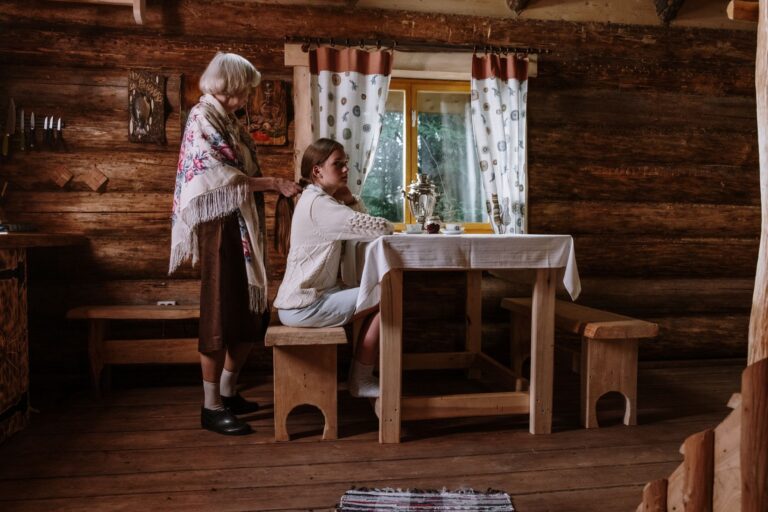
My granddaughter Posy stopped eating exactly halfway through every meal I set in front of her, and for six days I told myself it was nerves. Children get overwhelmed. Children miss their mothers. I had told myself a hundred small stories like that across thirty-one years of nursing, because a comfortable story is easier to swallow than the truth standing right in front of you in a yellow sweater.
It was the seventh night when she finally told me, and after she told me I never again let myself off the hook with a comfortable story.
I had made hamburger steak, mashed potatoes, and peas, because she had asked for it in the shy way she asked for everything, like she was requesting a favor she expected to be refused. I let her help me shape the patties. She stood on the step stool at my counter with her sleeves pushed up and her tongue poked out in concentration, and for a few minutes she looked like an ordinary little girl doing an ordinary thing, and my whole chest ached with how badly I wanted that for her.
She ate happily. She cleaned half her plate.
Then her fork stopped.
I watched it happen the way you watch a cloud cross the sun. One moment she was a child at supper, and the next she was somewhere else entirely, her eyes gone flat and careful, her small hand setting the fork down beside the plate with a precision no five year old should have. She looked at the food that was left as though it belonged to someone more important than she was.
“Are you full, sweetheart?” I asked.
She shook her head.
“Then eat a little more. You did such a good job helping me.”
She slid off her chair. She stood beside it with both hands pressed flat against her chest, over the yellow sweater, and she said the sentence I have not stopped hearing since.
“I have to save this half. For Mommy.”
The call
Let me go back, because you cannot understand that kitchen without understanding the six days that came before it, and you cannot understand the six days without understanding that I almost missed all of it.
My name is Coralie. I am sixty-two years old, and I spent thirty-one of those years as a pediatric nurse at the county hospital in Tanager Bend, Iowa, before my knees and my back finally told me it was time to hand the night shifts to younger women. I raised my daughter Sylvie in the same white farmhouse my husband Ford and I bought the year we married, and after Ford’s heart gave out four winters ago, I kept that house running the way you keep running toward the only thing you have left, out of habit and stubbornness and the simple fact that stopping was worse.
Sylvie married Thaddeus six years ago. I want to be honest with you about him, because the honesty is the whole point. Thaddeus was the kind of man other people liked immediately. He ran a successful insurance office two towns over. He coached a peewee soccer team on Saturdays and let the local paper photograph him doing it. He remembered the names of everyone’s children and asked after everyone’s mothers. When he shook your hand he covered it with his other hand, warm, like he was letting you in on something. At church suppers the older women pressed extra pie on him and called him a catch, and I, God forgive me, was proud my daughter had found a man everyone admired.
I did not see it. That is the part I have to carry. I am a trained nurse who spent three decades learning to read the small silent signs a body makes when something is wrong, and I did not see it in my own daughter, because he was charming and she was quiet and I mistook her quiet for contentment.
The call came on a Tuesday, a little after ten in the morning, while I was hanging wash on the line behind the house. It was not Sylvie. It was Thaddeus’s mother, Ramona, who had never once called me in six years except to coordinate holidays.
“Coralie,” she said, in that smooth managing voice she used for everything, “now, don’t get yourself worked up. Sylvie’s had a little accident. She’s at Tanager Bend General. She’s going to be fine, but she’ll be laid up a few days, and Thaddeus has the office, so somebody needs to take Posy.”
“An accident,” I said. “What kind of accident. Is she hurt.”
“She fell down the porch steps. You know Sylvie, always in a hurry, never watching her feet.” Ramona gave a small laugh, the kind that is meant to smooth a thing over before anyone has a chance to look at it too closely. “Thaddeus will drop the little one by this afternoon. It’s a blessing you’re retired and have the time.”
The line went quiet before I could ask a single one of the questions rising in me. I stood in my own backyard with a wet pillowcase in my hands and a feeling I did not have a name for yet moving through my chest like cold water finding the low place in a field.
I did not know that feeling would turn out to be the most important thing I felt all year. I only knew that Ramona had used the word accident the way you use a lid, to keep a thing from being seen.
The drop-off
Thaddeus brought Posy at four that afternoon.
He came up my drive in his clean silver SUV and he got out smiling, and Posy climbed down out of the back seat holding a small pink backpack against her chest like a shield. She had her mother’s dark hair and her mother’s careful eyes, and she was dressed for a photograph, every button done, her shoes on the correct feet, her hair brushed smooth. A stranger would have seen a well cared for child. I saw a little girl standing very still on my gravel drive, watching her father’s face the way you watch weather.
“Coralie, you’re a lifesaver,” Thaddeus said, and he covered my hand with both of his. “Sylvie feels just terrible about the trouble. You know how she is. She’ll be up and around in no time.”
“How bad is it,” I asked him. “Ramona said a fall.”
“A bad step and a hard landing.” He shook his head, rueful, warm. “Cracked her wrist, banged up her face pretty good. I keep telling her to slow down.” He crouched to Posy’s level then, and something in the child went rigid, a stillness so complete it stopped my breath. He smoothed her hair. “You be a good girl for Grandma Coralie. You do everything right. You don’t make trouble.” He said it lightly, the way any parent might. But Posy nodded like she was accepting a set of instructions she could not afford to forget, and she did not look at him when she did it.
Get a new story in your inbox every morning.
Facebook doesn’t show you every story we post. Our free newsletter does. Join 2,500+ readers.
Then he was gone, and the two of us stood in my kitchen, and Posy set her little backpack down by the door with great care and folded her hands in front of her and waited. She did not run to the window. She did not ask for a snack or the television or her mother. She stood in the middle of my kitchen and waited to be told what she was allowed to do, and every nurse instinct I owned came awake at once and told me something was wrong in this child’s world.
I just did not yet know how wrong, or how close to home.
The first night
I put her in Sylvie’s old room, the one with the yellow curtains and the shelf of horse figurines Sylvie had collected as a girl. I told her it was her room now, for as long as she needed it, and that she could touch anything she liked. She looked at the horses the way another child might look at a fire, wanting and afraid, and she did not touch them.
She ate half her supper that first night. I did not think anything of it. Children pick at their food in a strange kitchen.
I checked on her before I went to bed. Her blanket had slid to the floor, and when I lifted it and laid it back over her small shoulders, her whole body jerked awake, rigid, her arms coming up over her face.
“It’s only Grandma,” I whispered. “It’s only your blanket. You’re safe.”
She stared at me in the dark for a long moment, and then she said, “I’m sorry,” and closed her eyes.
I stood in that doorway a long time. I am sixty-two years old and I have comforted more frightened children than I could count, and I know the difference between a child who is startled and a child who is braced. Posy was braced. She apologized for being touched in her sleep. And I stood there in my dead mother’s nightgown in the dark and felt that cold water move through me again, and I told myself, the way I had been telling myself all day, that she was only missing her mother, that it was only the strangeness of a new place.
I am telling you plainly: I made excuses. A nurse who knew better made excuses, because the alternative pointed somewhere I was not ready to look.
The pattern
It was the meals that finally broke through to me, because a pattern is harder to explain away than a single moment.
Every meal, she stopped at half.
Toast and eggs in the morning, and she ate exactly half and set the rest aside as carefully as if it were made of glass. A sandwich at noon, and she ate half and folded her hands. Supper, and half, always half, even when her stomach growled loud enough that I could hear it across the table, even when she looked at what was left with a hunger she could not hide.
And the flinching. A cupboard door bumping shut made her shoulders leap toward her ears. A dropped spoon in the sink made her go still and silent. When I raised my voice, only a little, only to call her in from the porch, she came at a run with her face already arranged into something eager and afraid, ready to be whatever she needed to be.
At night she talked in her sleep. I started leaving my door open so I could hear her. The same words, over and over, in a small flat voice that has haunted every night of my life since.
“I’ll be good. I’ll do it right. I’ll do it right.”
On the fourth day I called Ramona, because I did not yet trust what I was seeing and I wanted to hear that I was wrong.
“She’s high-strung, that’s all,” Ramona said briskly. “Sylvie coddles her. You mustn’t spoil the child, Coralie, or she’ll run right over you. Children sense weakness. Thaddeus is very firm with her and it’s exactly what she needs.” A pause, and then, cooler, “You’d do well not to go looking for problems where there aren’t any. It upsets Thaddeus, and he has enough on his plate with Sylvie laid up.”
She hung up before I could answer.
I sat at my kitchen table with the dial tone in my ear, and for the first time I let myself think the thought all the way through instead of turning away from it halfway. Something is being done to this child. And maybe to my daughter. And the whole family has agreed not to see it.
The hospital
I went to see Sylvie the next morning, before I could talk myself out of it.
She was in a private room. Thaddeus’s insurance was good, and he had made sure of the private room, and later I would understand why a man like that prefers a private room, where there are no other patients and no other visitors to notice things. My daughter was propped up against the pillows with a cast on her left wrist and a bruise spread across the left side of her face, yellow-green at the edges, the kind of bruise that does not come from one clean fall but from a hand.
I had seen a thousand injuries in thirty-one years. I knew the geography of an accident and the geography of a person. This was a person.
“Mama,” she said, and her smile came up automatically, the way Posy’s careful stillness came up automatically, a thing installed by long practice. “You didn’t have to come all this way.”
“Sylvie.” I sat down in the hard chair by the bed and I took her good hand. “Tell me what happened.”
“I fell. Down the porch steps. I’m such a klutz.” The smile again, thinner now. “Thaddeus keeps telling me to slow down.”
“Sylvie. I diapered you. I nursed you through the measles. Look at me and tell me you fell down the steps.”
For one moment, one single moment, her face came apart. I saw the girl underneath the smile, and the girl was terrified, and the girl looked at me with something that was almost, almost a plea. And then the door opened and Thaddeus walked in with a bouquet of grocery-store carnations, and I watched my daughter fold herself back up and disappear behind her own face.
“Coralie,” he said warmly. “I didn’t know you were coming by.”
“She’s my daughter,” I said. “I don’t need an appointment.”
He laughed as if I had made a joke, and he set the flowers down, and he took Sylvie’s hand, the one with the cast, and I watched her fingers go stiff inside his. He talked easily about the doctors and the discharge and how he would take good care of her at home, and the whole time my daughter said almost nothing, and when she did speak she glanced at him first, a fast flick of the eyes, checking, the way Posy checked, and I understood that I was looking at the grown version of the frightened child asleep in my daughter’s old bed.
He had not fallen on her by accident. He had built her, the way he was building Posy, one correction at a time.
Dr. Rao
I did not leave the hospital when I left Sylvie’s room. I went down two floors to pediatrics, to the unit where I had worked for three decades, and I found Sunila Rao.
Sunila and I had stood over more sick and hurting children together than either of us liked to count. She had been a young resident when I was already gray, and she had become one of the finest doctors I ever worked beside, and more than that she had become my friend. She took one look at my face across the nurses’ station and walked me straight into an empty consult room and shut the door.
I told her everything. The half meals. The flinching. The apologies in her sleep, I’ll do it right, I’ll do it right. The way the child stood and waited to be told what she was permitted to do. The bruise on my daughter’s face that did not come from any porch step. I told her the way I would have presented a case, clinical and precise, because if I let it be anything other than clinical I was going to come apart, and I could not afford to come apart.
Sunila listened without interrupting. When I finished she was quiet for a moment, and then she said the thing I had come to hear and dreaded hearing.
“Coralie. You know what you’re describing. You’ve seen it before. You’re just not used to seeing it in your own family.”
“Tell me I’m wrong,” I said. “Tell me I’m a frightened old woman seeing shadows.”
“You’re not wrong.” She said it gently, but she did not soften it, because she respected me too much to soften it. “Food control is a documented pattern. A child made responsible for a parent’s feeding, told the parent will be punished if the child doesn’t comply, that is coercive control, and it is severe, and it does not appear on its own. It comes with everything else you’ve described. The flinching. The bracing. The self-blame.” She leaned forward. “Have you seen marks on the child? On her body?”
I had not. Not yet. But that evening, helping Posy into the bath, I did.
The bath
I run the bath a little cool for children, the way you learn to, and I was kneeling on the mat testing the water when Posy took off her shirt, and I saw her back.
Old marks. Faded now, shadows more than bruises, the greens and yellows of hurts that were weeks past. Across the small of her back and the tops of her arms. Marks a fall does not leave. Marks in the shape of a grip.
I kept my face still, because thirty-one years had taught me that a child in that moment needs the adult’s face to stay calm more than she needs anything else. I helped her into the water. I washed her hair the way I used to wash Sylvie’s, slow, gentle, my hands not quite steady.
“Posy,” I said, light as I could make it. “Those marks on your back. Do they hurt, honey?”
“I fell down,” she said. Automatic. The same words her mother used. The words had been given to both of them, mother and daughter, the same lie handed down like a family recipe.
“When did you fall?”
“I don’t remember.” She sank lower in the water. “I’m not supposed to talk about falling. Talking about it is making trouble.”
I am a pediatric nurse. I know what children look like when they come off a bicycle or out of a tree or down a real set of porch steps. I have held those children and charted those injuries for thirty-one years.
This was not that. This had never once been that.
I got her into her pajamas and I read her two stories and I sat with her until she slept, and then I went into my kitchen and I stood at the counter with both hands flat on the cold formica, and I made myself breathe. Because I knew now. And knowing meant I had to act, and acting meant I had to be right, and I had to be able to prove it, because I had already seen how this family closed ranks, how Ramona used the word accident like a lid, how Thaddeus’s warm two-handed grip made everyone trust him. A frightened grandmother’s word would not be enough. It never is. Children fall through exactly that crack, the gap between what an old woman knows and what she can prove, and they are never seen again.
I was not going to let Posy fall through it. Or Sylvie.
The seventh night
Which brings me back to the hamburger steak. The seventh night. The fork set down with that terrible precision, and my granddaughter standing beside her chair with both hands pressed to her chest.
“I have to save this half. For Mommy.”
I came around the table and I knelt down on my bad knees so that I was below her, looking up, the smallest I could make myself.
“Posy,” I said. “Your mommy is at the hospital. The nurses there bring her food. Good food, on a tray, three times a day. She doesn’t need you to save her any.”
“No.” Her voice cracked right down the middle. “No, she does. She does need it.”
“Who told you that, sweetheart? Who told you Mommy wouldn’t have food?”
Her lips trembled. Her eyes filled and this time the tears came, sliding down her round cheeks, and she looked at the door as if her father might come through it at any moment, and then she looked back at me and made the bravest decision I have ever watched a person make. She decided to tell.
“Daddy.”
“What did Daddy tell you, honey?”
“That if I don’t save half, Mommy doesn’t get to eat.” The words came faster now, tumbling, a dam giving way. “Every day I have to save half and give it to Daddy and he takes it to Mommy. If I eat it all, Mommy doesn’t get any, and it’s my fault she’s hungry, because I was greedy and I didn’t do it right.”
And then she grabbed the hem of my shirt in both her small fists, the way a drowning person grabs anything at all, and she said the thing that made the whole room tilt on its axis.
“If I’m not a good girl, Daddy says Mommy cries because of me. He says everything that happens to Mommy is because I didn’t do things right.”
I held my granddaughter while she shook. I held her and I told her, over and over, that none of it was true, that nothing that happened to her mother was her fault, that a little girl is never responsible for whether a grown woman eats, that she was good, she had always been good, she was the best and bravest girl I had ever known. I told her she never had to save half again. I told her she could eat every bite on her plate and it would not hurt anyone, not ever, and I felt her small body slowly stop bracing against mine, and it was the worst and most important night of my life.
He had used a child’s love as a leash. He had taught a five year old that her mother’s suffering was hers to prevent, and hers to blame herself for, and he had done it so a little girl would police herself, would stay small and quiet and afraid, would carry his cruelty for him so his hands stayed clean.
I did not sleep that night. I sat at my kitchen table and I made a list, in my nurse’s handwriting, of everything I had seen, with dates. And in the morning I started making it impossible for anyone to look away.
What a nurse knows how to do
Here is what thirty-one years in a hospital teaches you that a frightened grandmother might not know on her own: the system has doors, and if you know where they are, you do not have to knock and hope. You walk through them in the right order.
I called Sunila first. As a physician she was a mandated reporter, and more than that she was willing. She examined Posy that same morning, gently, thoroughly, with me holding the child’s hand, and she documented every mark on that small body in a medical record that no one could wave away as an old woman’s imagination. She photographed the marks with the hospital’s own equipment, dated and logged. She wrote down, in clinical language, what the pattern meant.
Then she made the report to the county, and because it came from a physician with photographs and a chart, it did not sit in a pile. A caseworker named Georgette came to my farmhouse that afternoon, and she was kind and unhurried with Posy, and she listened to the child tell the story of the half plate in her own small words, and I watched Georgette’s face do the thing Sunila’s had done, the ordinary kindness draining out and something harder and steadier coming in.
I gave them everything. My dated list. The account of the bath, the marks, the sleep-talking, the flinching. Sylvie’s bruise that no porch step ever made. Ramona’s phone calls telling me not to go looking for problems. I laid it all out the way you lay out a case, and I did not cry while I did it, because I had done my crying at the kitchen table at two in the morning and now it was time to work.
The hardest part was Sylvie. A protective order was one thing. Getting my daughter to walk through the door it opened was another, because Thaddeus had spent six years teaching her that the door led somewhere worse than staying. Georgette and Sunila and I did not push her. We did the thing you learn to do with a frightened patient. We made the safe path easier to take than the frightened one. We told her Posy was with me, was safe, was eating whole plates now. We told her what Posy had said about the half meals, and I watched my daughter’s face break the way it had broken for one moment in the hospital, except this time no one came through the door to make her fold herself back up, and this time she let it break all the way, and she wept, and she told us the truth.
Six years of it. It had started so slowly she could not name the day it began. A criticism, then a rule, then a punishment, then the isolation from everyone who might have noticed, then the day she understood that the only currency he would accept was her smallness. And when Posy came, he had simply extended the system to include the child, because a controlling man does not stop at one person, he only runs out of people. The half meals had been his newest refinement. Make the child responsible for the mother’s food. Make the child the guard.
What it cost him
I will not pretend the law moved like lightning, because it did not, and I would be lying to you if I made it sound clean and quick. But it moved, because we had built something it could not ignore.
The protective order came first, and it kept him away from both of them. Then the county’s investigation, with Sunila’s documentation at the center of it, and Posy’s account, and Sylvie’s, and eventually two other women who had been married to Thaddeus before my daughter and had never told anyone the whole of it, because who would believe it of a man who covered your hand with both of his. Charges followed. Child endangerment. Domestic assault. The private hospital room, it turned out, had a paper trail of its own, injuries across six years that a curious prosecutor could line up in a row.
He got a good lawyer. Men like that always do. But a five year old who tells the truth in her own words, backed by a physician’s chart and a mother who finally stopped protecting her own captor, is not a thing a good lawyer can talk his way around. He took a plea in the end, because the alternative was worse for him, and men like that always choose what is better for themselves. He will not be near my granddaughter again. The order is permanent. I have the paper in a drawer, and some nights I still take it out and read it, just to feel it be true.
Ramona never spoke to me again, which I count among my blessings. She told the family I had torn her son’s life apart over a misunderstanding. Let her. I know what I saw in a bathtub. I know what a child said with her fists in my shirt. I did not tear anything apart. I found something already broken and I refused to hand it back.
The whole plate
Sylvie and Posy live with me now, in the white farmhouse with the yellow curtains, and I will tell you how I know we are going to be all right.
It took months. Posy did not unlearn her fear in a day. For weeks she still stopped at half, her fork going down with that terrible careful precision, and every time it happened Sylvie or I would kneel down and say the same true thing, gently, again and again: you can eat it all, nobody goes hungry because you’re full, your whole plate is yours. Healing a child is not one grand moment. It is the same small truth repeated ten thousand times until the body believes it.
And then one evening in the fall, I made hamburger steak again, because it had become our dish, the one we made together, and Posy stood on the step stool and shaped the patties with her tongue poked out in concentration, and we ate at the kitchen table with the last light coming gold through the window.
She cleaned half her plate. Her fork slowed.
I saw it coming and I made myself say nothing, because some things a person has to reach on her own.
Posy looked at the food that was left. She looked at her mother, whose face was healed now, no bruise, no cast, just my daughter’s own face coming slowly back to her. She looked at me. And then my granddaughter picked her fork back up, and she ate the other half, every bite, the half she had been saving her whole small life for someone else, and when she was done she set her fork down and said, in a voice with no fear left in it at all, “I’m full, Grandma. That was the whole thing.”
Sylvie made a sound across the table, half laugh and half sob, and reached for my hand.
I am sixty-two years old. I spent thirty-one years learning to read the silent language a body speaks when something is wrong, and I nearly missed it in the two people I love most in the world, because the man hurting them was charming and my daughter was quiet and I mistook her quiet for peace. I will carry that. But I will also carry this: a little girl at my kitchen table, finishing her whole plate, saving nothing, afraid of no one.
That is the whole thing. That is everything.
This story is a dramatization. Names, characters, and details are invented, and any resemblance to real people or events is coincidental.