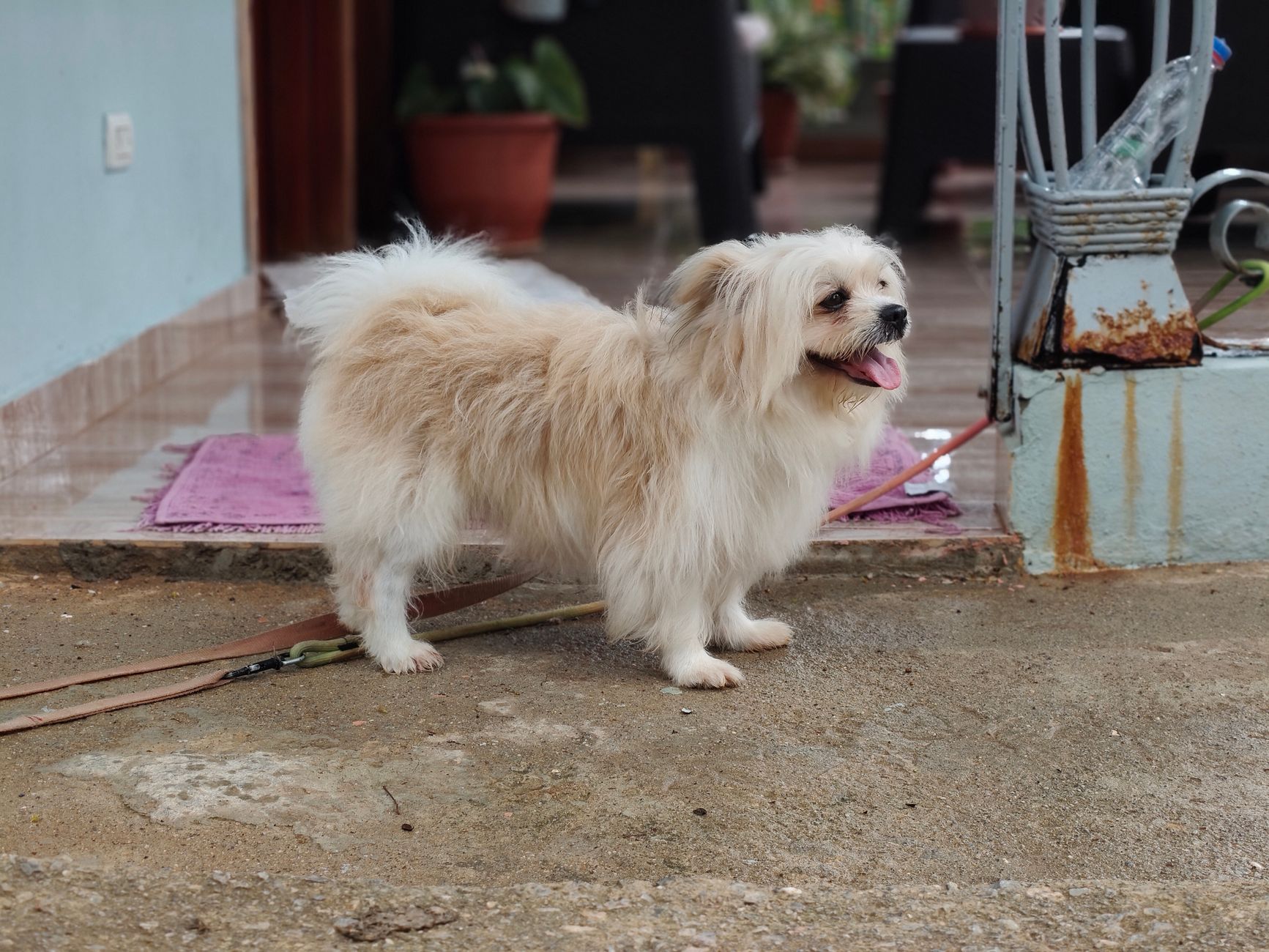
The Dog They Gave Away While I Was Gone
I came home from the hospital to an empty leash hanging on its nail by the back door, and no dog to clip it to.
That is the first thing I saw when Dwight helped me through the kitchen. Not the dishes he had left in the sink, not the mail piled on the counter, not the wheelchair the hospital had sent me home with. The leash. Biscuit’s leash, red nylon gone pink and frayed where he used to tug against it, hanging exactly where Cliff had hammered that nail into the doorframe eleven years ago. And under it, nothing. No dog scrambling across the linoleum to meet me. No click of nails. No whine. Just a clean floor and a quiet house and my son standing behind me with his hands in his pockets, not saying a word.
I want to tell you the whole of it, from the beginning, because I have gone over it so many times in my own head that I need to lay it down straight for once. My name is Lorene. I am seventy years old. I have lived in this town my whole life, in this house for forty-one years of it, and until the morning I fell in my own bathroom I would have told you I knew exactly what my family was made of. I was wrong about one of them. And I was right, in a way I could not have guessed, about people I had never met.
Let me start with Cliff, because none of this makes sense without Cliff.
The dog my husband raised
My husband Cliff passed four years ago this spring. Heart, in his sleep, which the doctor said was a mercy and which felt like anything but a mercy to me for a long while. We were married forty-six years. He was a big quiet man who fixed small engines out of the garage for extra money and never once in his life told me he loved me in those exact words, because he thought showing was better than saying, and he was probably right. He showed me every day for forty-six years. When he was gone I did not know what to do with my hands.
What I had left of him was the dog.
Biscuit came to us the last spring Cliff was well. A litter of pups nobody wanted, dumped out on the county road past the grain elevator, and Cliff found them on his way back from the feed store. Brought the runt home inside his coat because it was the only one still moving. Little brown and white thing, ribs like a washboard, one ear that never did stand up right. I told Cliff we were too old for a puppy. He said the puppy did not seem to think so. That was the end of the discussion.
Cliff raised that dog like it was the last job he had on this earth. Fed him by hand those first weeks when he would not eat. Taught him to sit and to stay and to walk to heel down the gravel drive. Biscuit slept at the foot of our bed and rode in the truck with his head out the window and followed Cliff around the yard like a shadow the color of caramel. When Cliff worked in the garage, Biscuit lay in the doorway in a patch of sun. When Cliff died, that dog lay in the empty doorway for two days and would not come in.
I understood him. We grieved the same man, Biscuit and I, and we did it together. For four years he was the warm weight against my legs at night and the reason I got up in the morning. He needed his breakfast, so I made mine. He needed his walk, so I put on my coat. On the worst days, the days the loneliness came up over my head like water, that dog would put his gray muzzle on my knee and look at me, and I would remember I was still somebody’s whole world. He was eleven years old now, slow in the hips, cloudy in one eye, but he was Cliff’s dog. He was the last living thing on earth that Cliff’s hands had shaped. When I looked at Biscuit I could still see my husband’s hands.
I need you to understand that before I tell you the rest. Because when my son says it was just a dog, and he did say that, more than once, I need you to know it was never just a dog. It was the last of Cliff. That is what they gave to strangers.
The morning I fell
It was a Tuesday in March when I fell. I have gone over it and I still do not know exactly how. I was getting out of the shower, and my foot went, and the next thing I knew I was on the bathroom floor and I could not get up and my hip was screaming at me. I lay there a long time. Biscuit came and stood in the doorway and whined and would not leave me, and eventually he did the smartest thing that old dog ever did, which was to go to the back door and bark and bark until my neighbor Corabelle heard him.
Corabelle Tuttle has lived across the fence line from me for thirty years. She let herself in the way we always do for each other, found me on the floor, and called the ambulance. She also, and I bless her for this, thought to grab Biscuit’s leash and take him back to her place before they loaded me up, because she knew I would fret about him more than I would fret about my own hip. The last thing I remember from my own house that morning was Corabelle telling me, don’t you worry about this dog, Lorene, I have got him, you just get yourself fixed.
I had broken my hip. They did surgery the next day, put a pin in it, and I was in the hospital and then in a rehabilitation wing for the better part of three weeks, learning how to walk again with a walker and then a cane. It was hard. I am not going to pretend it was not hard. There were nights I lay in that hospital bed and cried, seventy years old, crying like a girl, because I was afraid. Afraid of being old and alone and broken. But every single day, the thing that got me through the physical therapy, the thing I said to that young therapist when she asked me what my goal was, was this: I want to go home and take care of my dog.
That was my goal. Get home to Biscuit. Corabelle brought me a picture of him on her phone and I kept it on the little tray table by my bed, and when the exercises hurt I looked at that picture and I did the exercises.
My son Dwight came to see me twice while I was in there. He lives forty minutes away, him and his wife Peyton, in a new development with a homeowners association and a lawn that looks like carpet. He is my only child. He came, and he sat, and he looked at his phone, and he told me I was going to have to think seriously about my situation. Those were his words. My situation. I thought he meant the hip. I said the doctor thought I would recover well, that lots of people my age bounce back from a hip. He and Peyton looked at each other in that way married people do, and I did not think another thing about it. I should have. That look was them deciding my life for me while I lay there in a hospital gown.
Coming home to the empty leash
They discharged me on a Thursday. Dwight drove me home. Corabelle had said she would bring Biscuit over that evening once I was settled, and I could not wait. I had a whole afternoon planned in my head. I was going to sit in Cliff’s chair and let that old dog put his head in my lap and I was going to be home.
Dwight helped me up the back steps and through the door, and that is when I saw the leash on its nail with no dog under it, and something in me went cold before my mind had even caught up.
The house was too clean. Peyton had been in it. There was a smell of the cleaner she uses, lemon and chemical, over everything. Biscuit’s food and water bowls were gone from their spot by the stove. His bed was gone from the corner of the kitchen. The blanket he slept on, the old green one, gone. It was as though someone had gone through my house and erased him, and I stood there in the middle of my own kitchen leaning on my cane and I said, Dwight, where is the dog.
He did not answer right away. Peyton came out of the front room. She had been waiting there, I realized, the two of them had planned even this, who would be standing where. And Peyton folded her hands in front of her like a woman about to deliver news she had practiced, and she said it.
She said, Lorene, we found Biscuit a wonderful new home. A family with a big yard and kids to play with. It is really the best thing. You can’t take care of a dog anymore. You can barely take care of yourself.
You can barely take care of yourself.
I have turned that sentence over in my hands every day since. She said it kindly. That is the part I cannot get past. She said it in a soft, patient voice, the voice you use for a child or a confused old woman, and she was smiling a small sad smile the whole time, as if she were doing me a great favor, as if she were the good one in the room. You can barely take care of yourself.
I said, you gave away Cliff’s dog.
And Dwight, my son, my own boy that I raised in this house, said, Mom, it was just a dog. And he was getting old anyway.
The house without him
I do not remember all of what I said. I remember I did not scream. I have thought about that, that I did not scream, and I think it is because I was too far under the water to make a sound. I remember I asked when. Peyton told me they had done it the week before. The week before. While I was lying in that rehabilitation wing telling a stranger with a clipboard that my whole goal in life was to come home to that dog, my son and his wife had already loaded him into a car and handed him to people I would never meet. They had a week to tell me and they chose to let me find out from an empty nail.
I remember I asked who. Who has him. And Peyton got a look on her face, a careful blank look, and said it was a family from the listing site, she did not have all their information handy, it had been a private arrangement, but they seemed very nice. She did not have their information handy. She had erased my husband’s dog and she did not even keep a phone number.
I remember Dwight saying it was for my own good, that Peyton had been worried sick, that a fall like mine was a warning, that what if I fell again and the dog was underfoot, what if I could not manage, they were only thinking of me. I remember him saying, we can get you one of those little robot vacuum things and it will not be any trouble, as if the problem were vacuuming, as if what I had lost was a chore.
And then they left. They had a dinner reservation. My son kissed the top of my head and told me to rest and to call if I needed anything, and he and his wife got in their car and drove back to their carpet lawn, and I sat down in Cliff’s chair in the quiet, in the lemon smell, and I looked at the empty corner where the green blanket used to be, and I understood that I was alone in a way I had never been alone before. Not just a widow. A woman whose family had looked at the last piece of her husband and decided she was not competent to keep it.
I did not sleep that night. I sat up in the chair. Around two in the morning I got up on my cane and I went to the back door and I took the leash down off the nail and I held it in my lap the rest of the night. It still smelled like him. A dog has a smell, warm and doggy and particular, and it was still on that nylon, and I held it and I talked to Cliff out loud in the dark. I said, they gave him away, honey. I said, I could not stop them, I was flat on my back and I could not stop them. I have never felt so much like I had failed at something.
Corabelle across the fence
The next morning Corabelle came over. She had heard my car, seen Dwight leave, and she came with a coffee cake the way she does, and she took one look at my face and one look at that empty corner and she set the cake down and she said, oh no. Oh, Lorene. No.
I told her. I could barely get it out. And I watched Corabelle Tuttle, who is seventy-three and quiet and church-mannered and has never in thirty years said an unkind word about a soul, I watched her get angry in a way I had never seen. She stood up out of my kitchen chair and she said, they did what. And then she said something I will not repeat, and then she said, we are getting that dog back.
I told her it was hopeless. A week gone, no name, no number, a private handoff to strangers who could be anywhere in three counties by now. I told her Biscuit was eleven, slow, half blind, that even if he were alive somewhere he probably thought I had abandoned him, that maybe it was kinder to let it be. I was talking like a woman who had already given up, because I had.
Corabelle was not having it. She said, you listen to me. That dog barked at my back door until I came, when you were lying on that floor. That dog saved your life. We are not going to let those two throw him away like a sack of trash because it was convenient. And she got out her phone, the big one with the big letters that her granddaughter set up for her, and she said, now. What do we know.
What we knew was thin. We knew Peyton had said a listing site. We knew it had happened about a week before I got out, which put it in the middle two weeks of March. We knew the general kind of family Peyton had described, a big yard, kids. It was almost nothing. But Corabelle has a granddaughter, and that granddaughter turned out to be the difference between the empty nail and the rest of this story.
Marley
My granddaughter Marley is twenty-two. Dwight and Peyton’s girl. I need to say that plainly, because it matters: the young woman who fixed what her own parents did is their own daughter. Marley was away at school when all this happened, studying to be a veterinary technician, which will tell you something about the kind of heart she has. She had grown up with Biscuit. When she was a little girl and her folks would drop her at Grandma and Grandpa’s for a weekend, she and that dog were inseparable. Cliff used to say Biscuit thought Marley was his own puppy.
Corabelle, who has known Marley since she was in diapers, called her that same afternoon. Told her what her parents had done. And I am told, though I was not on the call, that there was a long silence, and then Marley said, very quietly, they gave away Grandpa’s dog. And then she said, I am coming home.
She drove three hours that night. She showed up at my door near midnight, this girl I love, and she put her arms around me and she cried and I cried, and then she wiped her face and she got a hard look that I recognized, because it was Cliff’s look, the look he got when a stubborn engine would not turn over and he had decided it was going to turn over or he was going to die trying. She sat down at my kitchen table with her laptop and Corabelle’s phone and my landline, and she said, okay. Tell me everything you remember. Every word Mom said.
I told her. The listing site. The two weeks in March. The big yard, the kids. Marley started making a list. She was methodical about it in a way that undid me a little, because it was Cliff all over again. She pulled up every pet rehoming listing and lost-and-found group and local sale page for the whole area for that stretch of March. She called the shelter. She called the two vet clinics in town on the chance the new family had brought an old dog in to be looked over. She made a flyer with the picture Corabelle had on her phone, that picture I had kept on my tray table, and she posted it everywhere a person could post a thing.
And then she did the thing that cracked it open. She confronted her own mother.
The line that broke it open
Marley called Peyton and asked her, flat out, for the family’s contact information. And Peyton gave her the same careful blank runaround she had given me. A private arrangement. Did not have it handy. It was done, and it was for the best, and Marley should not upset her grandmother by digging all this up.
But Marley is a smart girl, and she had grown up with these two, and she pushed. She asked which site. She asked what name they had listed the dog under. She asked, and I love her for this, she asked her mother to check her own email, because nobody arranges anything anymore without an email or a message trail. And there was a long pause, and then Peyton, cornered, admitted there had been some messages back and forth with the family, on the listing site, before they came and picked him up.
That was the thread. A screen name and a rough part of the county. It was not a phone number and it was not an address, but it was a screen name, and Marley the future vet tech who lives half her life online took that screen name and pulled on it, and it led to a first name, and the first name and the part of the county led, two days later, to a real family in a town about twenty miles east of me.
I want to say clearly that the family who took Biscuit did nothing wrong. I have thought about how to say this. They answered an honest listing in good faith. They were told an old woman could no longer care for her dog and that the dog needed a home. They had a big yard and kids and good hearts and they took in an old half blind dog that a lot of people would not have bothered with, and they were kind to him. When Marley finally reached them, the mother of that family cried on the phone. Because in the two weeks they had him, Biscuit had not settled. He would not eat right. He went to their back door and lay down facing the road and would not come in, the same as he had done in Cliff’s doorway four years before, and they had not understood why, and they had been worried about him. And now a young woman was on the phone telling them that this dog had a seventy year old widow who had been in the hospital and had never agreed to give him up, and that the dog was the last thing her dead husband had raised, and that the dog was pining, and would they, please, please, consider.
And here is the part I hold onto. That stranger, that mother in a town twenty miles away that I had never set foot in, that woman I will love the rest of my days, she did not hesitate. She did not ask for the money back. She did not make it hard. She said, of course. She said, that poor dog. She said, we knew something was wrong, he has been grieving, we just did not know for who. She said, bring his grandma. Bring her here.
The chain of strangers
I called it a chain of strangers and I mean that. Because it was not one person who brought Biscuit home. It was a whole chain of people who did not have to do a thing and did it anyway.
It was Corabelle, who thought to grab the leash before the ambulance came and who refused to let me give up. It was the young woman at the shelter who took Marley’s flyer and pinned it up and called two other rescues to keep an eye out. It was a man Marley never met who ran a lost pet page and boosted the picture to a few thousand people in the county. It was another woman who recognized the description and messaged Marley to say she thought she had seen a family a few towns over with a new old dog. It was the vet tech at the clinic in the east town who, when Marley called, remembered a family bringing in a senior dog with a cloudy eye for a wellness check and who, carefully, within the rules, was able to help point the way. Every one of these people was a stranger to me. Not one of them owed me anything. And every one of them, when they heard an old woman had lost her husband’s dog, moved a little to help.
That is the thing my son got wrong. He thought a person my age was a problem to be managed. He looked at me and saw a burden, a fall risk, a situation. And meanwhile a dozen strangers looked at the same old woman and saw somebody worth helping. I have thought a great deal about which of those two sets of people I want to be like for whatever years I have left, and it is not my son.
The drive east
Marley drove me the day we went to get him. Twenty miles east, out past the towns I knew and into ones I did not, a modest house on a corner with, yes, a big yard and a swing set. My hands were shaking. I had the leash in my lap. I had brought the leash. I do not know what I thought, that after two weeks and everything, that he would even know me.
The mother came out first, and she was younger than Marley almost, with a baby on her hip, and her eyes were already wet. And her two little ones came out behind her, and they were sad, I could see they were sad, they had gotten attached to that old dog in two weeks, and I felt a pang for them even in the middle of my own hope. And then the father opened the gate to the side yard.
And Biscuit came around the corner of the house.
He was slow. His hips are bad. He came at a stiff old trot, and he was maybe forty feet away, and I got out of that car on my cane as fast as a woman with a pinned hip can get out of a car, and I said his name. I just said, Biscuit. That is all. Biscuit.
He stopped. That old cloudy eye, that gray muzzle. He stopped and his whole body changed. And then he came. He came across that yard as fast as those bad hips would carry him, and he made a sound I had never heard him make, a high broken sound, and he hit my legs and I nearly went down and Marley caught me, and I got down on the grass, hip and all, I did not care, I got down on the ground and that dog climbed into my lap the way he had not done since he was a puppy, eleven year old dog trying to be a lap dog, shaking all over, pushing his face into my neck, and I held him and I held Cliff’s leash and I held, in that one warm shaking weight, everything I had thought I had lost.
The children were crying. The mother was crying. Marley was crying. I was past crying, I was somewhere on the other side of it. I looked up at that young family who had loved my dog for two weeks and were now giving him back, and I did not have the words. I have never had the words for it since. All I could say was thank you. Thank you. And that young mother knelt down in the grass next to me and put her hand on Biscuit’s back, next to mine, and she said, you take good care of your grandpa’s dog. She had understood the whole thing. A stranger understood in two weeks what my own son could not understand in eleven years.
What I came home to, the second time
We drove home, Biscuit’s head out the window the whole way, twenty miles into the setting sun, and I hung his leash back on Cliff’s nail that night with the dog standing right there under it where he belonged. And I sat in Cliff’s chair and that old dog put his gray head in my lap and I told my husband, out loud in the quiet, I got him back, honey. Our girl and a whole lot of strangers, they got him back for me.
I would like to tell you it is all tidy now. It is not. Some things did not go back the way they were.
My son and I are not right. I do not know if we ever will be all the way right. Dwight came by, after, when he heard what Marley had done, and there was a hard conversation at that kitchen table. He said Peyton had only been trying to help. He said I was making him into a villain in front of his own daughter. He never once, in that whole conversation, said the words I am sorry. He said he was sorry I was upset. That is a different thing, and at seventy I know the difference. I told him I loved him, because I do, he is my boy and I always will. And I told him that what he did was cruel, and that being certain you are right does not make a cruel thing kind, and that I would not be pretending otherwise to keep the peace. We are cordial. He calls on Sundays. It is not what it was. I have had to make my peace with the fact that I lost something real that spring even as I got something real back, and that both of those are true at once.
But Marley. Marley graduates in the spring, and when she does she is moving back to this town, and she says it is because the clinic here needs a tech and the rent is cheap, but I know better. She comes every weekend now. She and Biscuit take the same walks down the gravel drive that she took with him when she was six. She is the best of all of us, that girl, and she is Dwight and Peyton’s own child, and I have decided that says something hopeful about the world, that a hard person can raise a soft one, that the warmth skips a generation and comes out anyway.
And Corabelle and I are closer than we have ever been. We had always been fence neighbors, the wave and the coffee cake. Now we are something more like sisters. She checks on me and I check on her and we have an understanding that if either of us goes down in a bathroom again, the other one comes running and grabs the dog first.
What the strangers taught me
Biscuit is asleep at my feet as I write this. His paws are twitching. He is chasing something in his dream, a rabbit or a memory, I could not say. He is old and I know I will not have him forever, and I know the day is coming when I will take that leash down off the nail for the last time. I try not to think too hard about that. I try to think instead about the fact that I have him now, that he is warm and here and mine, that when I lost him a chain of people I had never met reached out one hand to the next until he was back in my lap.
Here is what I have learned, and it is the only thing I know for sure at seventy. The people who love you are not always the people you are related to, and the people you are related to do not always love you the way love is supposed to feel. My son looked at me and saw a problem. A young mother twenty miles away looked at me and saw a grief she could ease, and she eased it, and asked for nothing. A shelter volunteer, a man on the internet, a girl driving home at midnight, they all reached out a hand. I spent seventy years believing that family was the whole of it, that blood was the thing that would hold when everything else let go. I was wrong. Sometimes it is the strangers who hold. Sometimes it is your granddaughter and your fence neighbor and a woman you will never see again who kneel down in the grass to give you back your husband’s dog.
I lost a piece of my son that spring. I will not lie about that. But I found out that the world is full of people who will help an old woman if she lets them, and I found out my granddaughter has her grandfather’s stubborn heart, and I got Cliff’s dog back into Cliff’s chair where he belongs. When I look at Biscuit now, cloudy eyed and gray and dreaming, I still see my husband’s hands in him. But I see something else too, now. I see all those strangers’ hands. I see the whole chain of them. And that is a warmer thing to look at than I ever expected to find at the bottom of the worst day of my life.
They told me I could not take care of anything anymore. They were wrong. I take care of Biscuit, and Marley takes care of me, and Corabelle and I take care of each other, and somewhere twenty miles east a young family thinks, once in a while, about the old dog they gave back and the grandma who came to get him. We are all, every one of us, taking care of each other. That is the thing my son never understood. That is the thing the strangers knew all along.
The leash is on its nail. The dog is at my feet. I am home.
This story is a dramatization. Names, characters, and details are invented, and any resemblance to real people or events is coincidental.