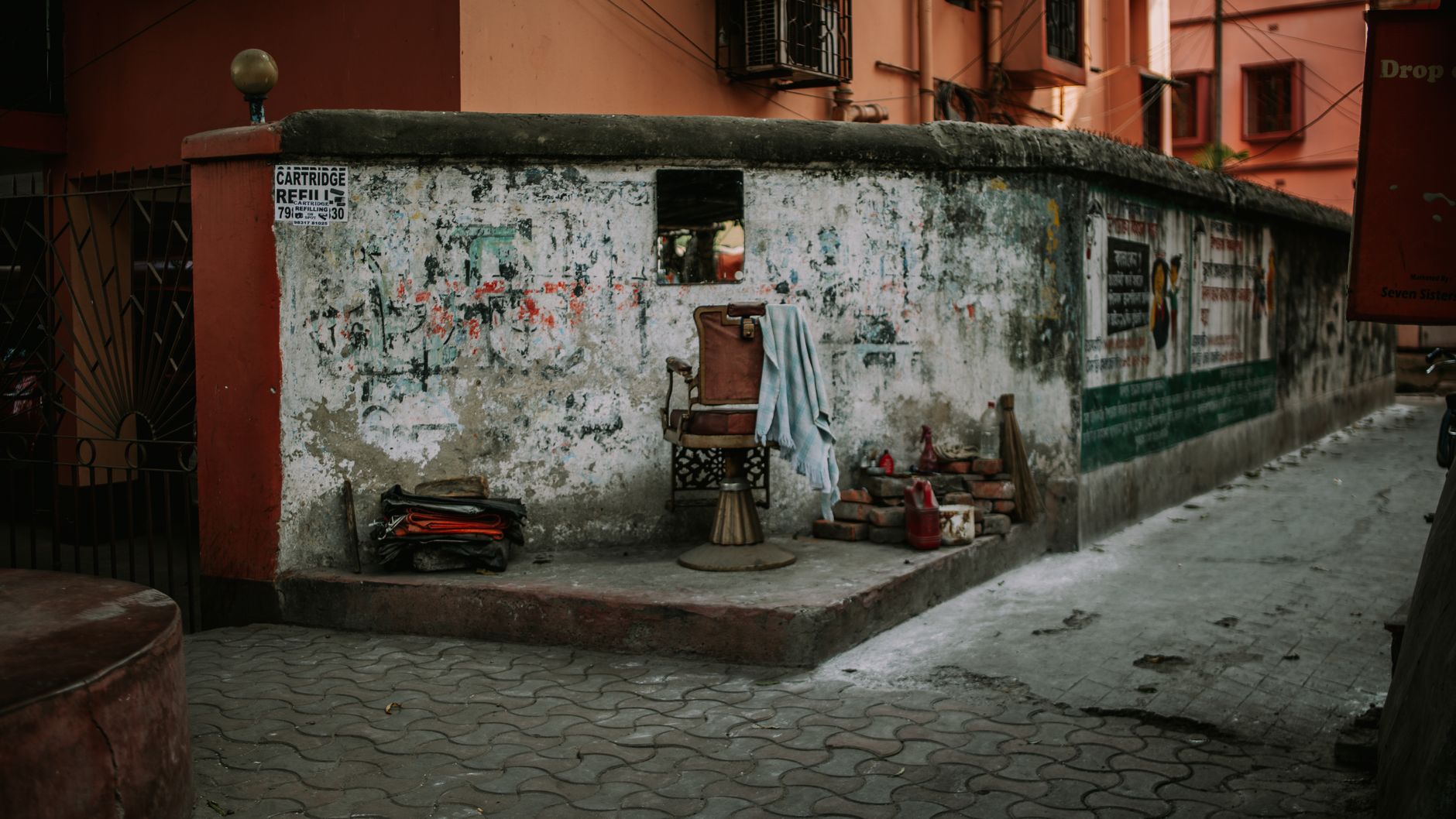
The Barbershop They Tried To Condemn
For forty-five years I opened that door at six in the morning, before the sun cleared the water tower, and I turned the key in a lock that had been sticking since the Nixon years. I never fixed it. A man gets used to the way a thing pushes back a little before it lets him in. That lock and I had an understanding.
My name is Curtis, and I have been a barber on Main Street in this small heartland town since I was twenty-five years old. I am seventy now. I have cut the hair of three generations in some families. I cut a boy’s first haircut, then cut it again on his wedding day, then cut it gray when he brought his own grandson in to sit up on the board across the arms of my chair, the same board my father used, sanded smooth by a hundred years of small squirming bodies.
I tell you this so you understand what they thought they were buying for pennies.
His name was Rooney. The developer. He came in on a Tuesday in a suit that cost more than I clear in three months, and he did not take off his sunglasses when he stepped inside, which is the first thing a man does when he walks into a room where he means no harm. He kept them on. He looked around my shop the way a man looks at a lot he is about to pave.
“You must be Curtis,” he said, like my name was a thing he had read off a form.
“I must be,” I said.
He held out a hand and I shook it, because my mother raised me and his did not, apparently. Then he told me why he had come. He and his associates were putting together a redevelopment on this block. Mixed use, he called it. Retail and residential. A real shot in the arm for a tired old street. He said “tired” while he was looking at my chairs.
He slid a paper across my counter, over the top of the jar of combs I keep in that blue liquid, and I looked down at it without picking it up. It was an offer. For the building, the whole building, the shop and the two rooms above it where Louise and I lived the first eleven years of our marriage. The number on it was thirty-one thousand dollars.
I have owned that building outright since 1979. There is no mortgage. There has not been a mortgage on it in my adult life. And this man in his sunglasses was offering me thirty-one thousand dollars for the one thing my family has ever truly owned, and he was smiling while he did it, like he was doing me a kindness.
I did not take the paper. I told him I would think about it. That is what you say. He nodded like he already knew how the thinking would go, and he left a card on the counter, and when the door shut behind him the little bell over it rang the way it has rung ten thousand times, and I stood there in the quiet and I felt something I had not felt in a long while. Not fear. I want to be honest about that. It was closer to insult. The insult of being handled.
I want to take you back further, because to understand what they tried to take, you have to understand what it was.
My father, Curtis Senior, opened a barbershop in this town in 1951. He could not open it on Main Street. I need you to sit with that a moment. In 1951, in this town, a Black man could not rent a storefront on Main Street. So he cut hair out of a converted shed behind a friend’s house, and men came to him through the alley, and he built up a trade one careful haircut at a time, and he saved. Lord, that man saved. He kept his money in a coffee can and then in the mattress and then, when he trusted it, in the bank, and it took him until 1962, when I was a boy of six sweeping his floor for a nickel, before a piece of Main Street came available and a man was willing to sell it to him.
The man who sold it to him was named Mr. Petrusky, and Mr. Petrusky took a lot of grief in this town for doing it, and he did it anyway, and I have never once driven past the Lutheran cemetery where he is buried without slowing down. My father bought this building in 1962. He signed the original deed at a kitchen table with his hand shaking, my mother told me, not from nerves but from something too big to hold steady. He was thirty-seven years old and he owned a piece of Main Street in a town that eleven years earlier would not rent him a broom closet on it.
That deed. I want you to remember that deed, because it is coming back.
He ran the shop until his hands got bad, and then I ran it beside him, and then I ran it alone, and I never once thought of it as a business the way Rooney thought of it. It was never a business. It was the front room of the neighborhood. You have to understand what a barbershop is in a place like this, especially for us. It is where the men come. It is where a boy learns how a grown man sits and talks and disagrees without swinging. It is where you hear who is sick and who needs work and whose boy is running with the wrong crowd and might still be turned around if the right man says the right word to him at the right time in a chair where he cannot easily get up and leave.
Deacon has sat in my second chair every Saturday morning for thirty years. He is not actually a deacon anymore, he stepped back from the church years ago over something he will not discuss, but the name stuck and he answers to it. Deacon knows everything that happens in this town before it happens. If you want to know something, you do not read the paper. You come Saturday and you wait your turn and you listen.
Let me tell you about an ordinary Saturday, so you know what Rooney was really pricing at thirty-one thousand dollars. A Saturday in my shop starts before the light. I get in at six and I run the water hot and I wipe down the mirror and the chairs, and I set the combs in the blue jar, and I turn the sign, and by seven there are two men waiting outside on the bench that has been bolted to the brick since Eisenhower. In the winter they wait inside, and there is always coffee, and it is not good coffee, and nobody has ever once complained about it in fifty years, because complaining about the coffee is not the point of the coffee. The point of the coffee is to have a reason to stay after your haircut is done. A man who is finished cannot linger without a reason. A cup in his hand is a reason.
By nine the shop is full and loud. There is a checkerboard on the little table that Roosevelt Biggs and old Sam Cleary have been playing on since before I can remember, and they argue over it like a married couple, and neither one of them can hardly see the board anymore, and they cheat each other blind and both know it and neither will say. There is a boy in my chair getting his ears cleaned up for a job interview, and I am telling him, without seeming to tell him, how to shake a man’s hand and how to look him in the eye, because his own daddy is not around to tell him and his mama sent him to me on purpose. That is a thing that happens in a barbershop and nowhere else. A mother cannot teach a boy to be a man. So she sends him to a room full of them and she trusts the room.
I have loaned money out of my till in that room. I have heard confessions in that room that no priest ever will. When Deacon’s wife was dying, he came in every single day, not for a haircut, there was no hair left to cut, but because he could not be in the house and he could not be nowhere, and my shop was the somewhere in between, and I let him sit in the second chair for three months and I did not charge him and I did not make him talk. That is what the block was. That is what Blanchard’s study called functionally obsolete.
When I told Deacon about the offer, he set down his coffee, and he did not say anything for a long moment, and then he said, “Curtis, that block ain’t blighted. Your shop is the only thing on it that’s been open every day for fifty years.”
And that word came back to me. Blighted. Rooney had not used it, not to my face. But it was on the paper, in the small print at the bottom, a reference to a proceeding. I had not understood it at the time. I understood it soon enough.
Two weeks after Rooney’s visit, a notice went up. Not just on my door. On every building on the block. A public notice of a hearing before the city, to determine whether our block met the legal definition of blight, so that it could be designated for redevelopment. And I learned, because Tamara taught me, that once a block is declared blighted, the city can use its power to force a sale. They can condemn it. They can take it, at a price they decide is fair, and hand it to a developer who has promised to fix the blight they just declared exists.
Tamara is my granddaughter. Louise and I raised no children of our own, the Lord did not see fit, but my brother’s line gave me Tamara, and I have loved that girl like she came from me. She is thirty-four and she is a lawyer, though not the kind who does this, she does contracts for a hospital two counties over. But she is the smartest person I know, and when I called her and read her that notice over the phone, she went very quiet, and then she said, “Grandpa, don’t sign anything. Don’t say anything to anyone. I’m coming Friday.”
The city official’s name was Blanchard. He was the one running the blight proceeding. And I want to tell you about the day I sat across from Blanchard, because that is the day the cruel thing was said, and it is the day, though I did not know it yet, that they made their mistake.
Tamara came Friday, and she went with me Monday to the city offices, to what they called a pre-hearing conference. It was meant to be informal. It was meant, I understand now, to soften me up. Rooney was there, without his sunglasses this time, and Blanchard was there behind a desk, a pale soft man of maybe fifty with reading glasses pushed up on his forehead, and there was a woman from the city taking notes.
Blanchard laid it out for me kindly, the way you explain a hard thing to a child. He said the block did not meet current code. He said my building had deficiencies. He used a lot of words like deficiency and non-conforming and functionally obsolete. He said the redevelopment would bring jobs and tax revenue and a fresh face to a street that, he was sorry to say, had seen better days.
I told him my building had passed every inspection for forty-five years. I told him I owned it free and clear and had the deed. I told him it was not for sale.
And that is when Blanchard took off his reading glasses and folded them, and he looked at me not unkindly, which somehow made it worse, and he said the thing I will not forget.
“Curtis,” he said, “I understand this is emotional for you. But let’s be realistic. You’re a barber, not a real estate lawyer. This is going to happen whether you fight it or not. The only question is whether you walk away with a check or walk away with nothing. Take the check. Nobody’s going to remember a barbershop.”
Nobody’s going to remember a barbershop.
I felt Tamara go still beside me. I have a temper, or I had one when I was young, and I have spent fifty years putting it away in a drawer, and I felt the drawer slide open. But I did not raise my voice. My father taught me that a man who has to shout has already lost the argument. I looked at Blanchard, and I looked at Rooney sitting there with his hands folded, and I said only, “We’ll see about the check.”
Then Tamara asked one question. She asked it very politely. She asked to see the blight study. The document that established, legally, that our block met the definition. Blanchard said it would be entered into the record at the hearing. Tamara said she understood, she would simply like a copy in advance, as was her right under the open records law. Blanchard’s pleasant face flickered, just for a second, and he said he would have it sent over.
It took eleven days and two more written requests before that study arrived. I have thought a great deal about those eleven days. A man who has nothing to hide hands you the paper. A man who needs eleven days is building something.
Now. I have to tell you about the deed, and about what my father kept, and what I kept, because that is the turn, and I have made you wait for it the way I made Rooney wait.
My father was a saver, I told you that. But more than money, my father saved paper. He did not throw things away. It was a Depression child’s habit and a careful man’s habit and, I have come to believe, the habit of a man who had learned young that in this country, for a man like him, the paper was the only thing that would speak for you when your word was not counted. He kept everything. Every deed. Every receipt. Every inspection certificate. Every letter from the city, going back to 1962. He kept them in a green metal strongbox, and when he died he left me the box, and I kept the habit, and I kept the box, and for forty-five years I put every piece of paper about that building into it, and I never once had reason to open it and look.
The night after the study arrived, Tamara sat at my kitchen table with the study on one side and the contents of my father’s strongbox on the other, and she read them against each other by the light over the stove, the same light my father read his receipts under, and around midnight she made a sound I had never heard her make.
The blight study made three main claims about my building. It claimed the building had significant unpermitted structural modifications that rendered it unsafe. It claimed there was an unresolved building code violation from a 2009 inspection that had never been remedied. And it claimed, and this is the one that mattered, that the property lines were irregular and encroached on the adjacent parcel, which created a legal cloud that only a comprehensive redevelopment could clear.
Every one of those claims was false, and my father’s box proved it, and it proved worse than false. It proved they had known.
The unpermitted modifications they cited were the rear addition my father built in 1974, and it was permitted. I had the permit. I had the signed inspection card. It was in the box, dated and stamped, the ink faded but legible, forty years old and perfectly clear.
The 2009 code violation they said was never remedied? I had the correction notice, and stapled to it, in the box, was the re-inspection certificate showing it was signed off as remedied by the city’s own inspector six weeks later. Signed by an inspector who, Tamara found out, still worked for the city.
And the property lines. The irregular property lines that supposedly created a legal cloud. My father’s original 1962 deed, the one he signed at that kitchen table with his hand too full to hold steady, had the survey attached to it. A clean, recorded, professional survey. The lines were not irregular. They were straight and clear and recorded at the county sixty years ago. There was no cloud. There had never been a cloud. Someone had taken a sixty-year-old clean parcel and described it as a legal mess in an official document, and I believe with all my heart they did it because they assumed the barber did not keep his papers. They assumed the shed-born trade and the coffee-can savings meant the man had nothing but his hands. They did not know about the box. They did not know about my father, who kept the paper because he had learned the hard way that the paper was the only witness that could not be intimidated.
I need to stop here and tell you what that night was, because it is the center of everything, and I have rushed past it. Tamara had the study spread across one half of the table and the box emptied out across the other, and I stood at the stove making tea I did not drink, and I watched my granddaughter do the work my father had been saving up to be done for sixty years without knowing it.
She would read a line from the study out loud in a flat voice, the way you read something you do not want to color with feeling. “Significant unpermitted structural modifications.” Then she would go into the box, and her hands got faster the more she found, and she would pull a paper and lay it down over the line in the study like she was covering a card, and she would say, quiet, “Permitted. Nineteen seventy-four. Signed off.” Then the next line. “Unresolved code violation, 2009.” Into the box. Out with the correction notice, and stapled behind it, the re-inspection certificate. “Remedied. Signed by the city. Their own man.” Then the last line, the one about the clouded property lines, and she went very slow into the box for that one, all the way to the bottom, and she came up with the 1962 deed itself, the original, my father’s shaking signature on it, and clipped to it the recorded survey, clean as the day it was drawn.
That was the sound she made. Not a cry. A kind of breath that went out of her and did not come all the way back. She put her hand flat on my father’s deed and she looked up at me and her eyes were wet and furious at the same time, and she said, “Grandpa, they didn’t make a mistake. You don’t get all three wrong by accident. They wrote it false. They wrote it false because they were sure you couldn’t prove it.” And then she said the thing that I think about still. She said, “They were counting on Great-Grandpa having thrown his papers away.”
Tamara did not sleep that night. She built what she called a rebuttal, but it was more than that. Because when she pulled the study apart, she found the name of the firm that had prepared it, and she found that the firm had done three prior blight studies in the county, all in the last four years, and every one of them had ended with a Rooney entity buying the land cheap. And she found, in the public filings, that Blanchard’s brother-in-law was a partner in one of those Rooney entities. She found the whole shape of it. A city official declaring blight where there was none, a compliant study firm papering it over, a developer waiting to buy, and a family connection tying the official to the profit.
We had two weeks until the hearing. Tamara wanted to take it straight to the county prosecutor. I told her no. Not yet. I had lived in this town seventy years and I knew something she did not, which is that a thing like this dies in a back office if you let the office handle it. It has to be seen. The neighborhood had to see it.
So I did the thing I know how to do. I opened my shop.
I put the word out the only way that has ever worked on Main Street, which is that I told Deacon. And Deacon, God bless his gossiping soul, told everyone. I said that the Saturday before the hearing, my shop would be open all day, no charge, and anyone who wanted to know what was really happening to our block should come and sit and hear it. And they came. Lord, they came.
They came the way they come to a wake and the way they come to a homecoming, which is to say all at once and all day. Men I had cut for fifty years and their sons and their grandsons. The women came too, which they do not usually do, filling the chairs along the wall and standing in the door. The pastor came. The man who runs the hardware store two doors down, whose building was also on the blighted block, came white in the face because he had already half agreed to sell. I stood in the middle of my own shop, in front of the mirror where I have watched myself go gray, and I laid it all out. I held up the 1962 deed. I held up the permit. I held up the re-inspection certificate. I read them the sentence from the study that said the property lines were clouded, and then I held up my father’s clean recorded survey, and I watched the understanding move across that room like weather.
And then Deacon, from the second chair, said the thing that turned it from a grievance into a movement. He said, “They picked Curtis because they thought he’d fold. They picked the wrong old man.”
The hearing was the following Thursday, in the city council chambers, which hold about sixty people. More than two hundred came. They lined the walls and filled the hall and stood out on the steps in the cold. Blanchard walked in with his study under his arm and he stopped in the doorway when he saw the room, and I will remember the look on his face until the day I die. Rooney was already seated up front, and he turned around to see what had stopped Blanchard, and he saw the whole neighborhood, and he did not have his sunglasses to hide behind.
Tamara stood up when they called for public comment. She was thirty-four years old and her hands were steady, steadier than her great-grandfather’s had been at that other table, and she laid the whole thing out for the record, one document at a time, the permit against the false claim, the re-inspection against the false claim, the sixty-year-old survey against the false cloud, and then the pattern, the three prior studies, the same firm, the same buyer, and last, quietly, the family connection between the official running the proceeding and the company that stood to profit. She entered every piece of my father’s box into the public record, where it could not be un-said.
When she finished there was no shouting. That is the part people always get wrong when I tell it. There was no cheering. There was a silence in that room heavier than any noise, the silence of two hundred people watching a powerful man understand that he has been caught in the light. One of the council members, an older woman who had gone to school with Louise, asked Blanchard to respond to the documents. He could not. He said something about reviewing the record. His voice did not hold.
The blight designation was voted down that night, seven to nothing. The councilwoman who knew Louise asked, before the vote, that the record reflect the council’s gratitude to the property owner for bringing the discrepancies to light. That is how they said it. Discrepancies. I let them have the soft word. I had what I came for.
It did not end there, and I will not pretend the ending was clean, because life is not clean and the audience I am telling this to has lived too long to believe a fairy tale. There was an investigation. The county prosecutor did, in the end, look at what Tamara had assembled, because two hundred witnesses make a thing hard to put back in a drawer. Blanchard resigned before they could remove him. He was charged, eventually, with official misconduct, and he took a plea, and he did not go to prison, which I have made my peace with, mostly. Rooney’s company withdrew from the county and I am told he does his business three states away now under a different name. The study firm lost its certification. None of that felt like a victory the way you would think. It felt like watching a flood recede. You are grateful, but you are looking at the mud.
Here is what felt like a victory.
The hardware store two doors down did not sell. Nobody on the block sold. And a year later, the same council that had almost condemned us put our block on the register of historic places, and there is a small bronze plaque now, mounted beside my door, below the sticking lock. It tells the story of the shop. It gives my father’s name, Curtis Senior, and the year 1962, and it says a sentence about a man who bought a piece of Main Street in a town that had told him he could not. Deacon reads it out loud to every stranger who slows down to look, whether they asked him to or not.
Blanchard said nobody would remember a barbershop. There is a bronze plaque with my father’s name on it that says otherwise, and it will be there long after every man in this story is gone.
Louise did not live to see it. I lost her four years before Rooney ever walked through my door, and there is not a day I do not wish she had been in that council chamber to see her granddaughter stand up straight and steady and take those men apart with nothing but paper. But I felt her there. I want to say that plainly and let the men who are embarrassed by such talk be embarrassed. I felt her in that room. When Tamara held up the 1962 deed with her great-grandfather’s shaking signature on it, I felt my whole family standing behind me in a line going back to a shed behind a house, back to a coffee can, back to a hand too full to hold a pen steady, and I understood, finally, why my father kept the paper.
He was not saving receipts. He was building a witness. He knew a day might come, long after he was gone, when a soft man in reading glasses would look at his son and see nothing worth remembering, and my father wanted there to be, in a green metal box in the back room, a stack of paper that could stand up in a public room and speak for a family whose word this country had spent a long time refusing to count.
I still open the shop at six. The lock still sticks. I still let it push back a little before it lets me in, and every morning now, when it finally gives, I put my hand on the doorframe just below the plaque, the way you would touch a photograph of somebody you loved, and I go in and I turn on the lights and I set out the combs in the blue liquid and I wait for the men to come.
They always come.
This story is a dramatization. Names, characters, and details are invented, and any resemblance to real people or events is coincidental.