
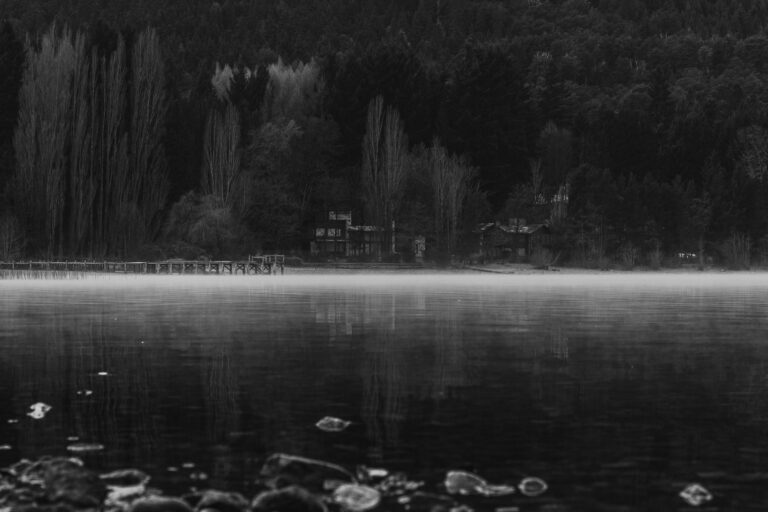
The message came through while I was still in my socks, drinking coffee at my own kitchen table, watching the fog lift off Cutter Lake the way it does most mornings in Millard Crossing, Missouri, slow and silver, like the water is exhaling.
Not in a rented room somewhere.
Not on somebody’s couch with my clothes in a duffel bag.
Not standing in a gravel lot outside a bank, staring at a sheriff’s notice stapled to my own front door.
I was sitting in the house. My house. Coffee cooling in my hand, laptop open to a spreadsheet of dissolved oxygen readings from three different lakes in two counties, when my phone buzzed against the table and lit up with the family group chat.
My brother Wilder had posted first.
“Bank finally took Adalric’s place. Buying it at the courthouse auction Monday for $28,000. Steal of the century.”
Then three little party emojis, the kind you’d use for somebody’s engagement, not somebody’s ruin.
I stared at it for a second too long. I actually thought, for one embarrassing heartbeat, that maybe I had read it wrong, that autocorrect had mangled something, that this was about a different Adalric on a different lake in a different life.
Then he added a second line, because Wilder never leaves a good moment unfinished.
“Worth way more than that once we fix it up. We can finally use the place right. I’ll grill on that dock all summer.”
Before I could even set my mug down, my father answered.
“Wired you half already. Your mother and I are in. About time that place got used the way it should be.”
Ninety seconds. I checked the timestamps later, twice, because I did not believe it the first time. Ninety seconds between my brother announcing that the bank had seized my home and my father sending him seven thousand dollars, the first half of fourteen thousand total, to help buy it out from under me.
He did not call me.
He did not text me first to ask if it was true.
He did not ask if I needed a couch, a loan, a hot meal, or one single word of comfort from the man who raised me.
He heard that his younger son had lost everything, and his very first move, faster than a phone call, faster than a single question, was to help fund my brother buying the wreckage.
My name is Adalric Bramblewood. I am thirty four years old. I grew up forty minutes from where I was sitting that morning, in a family that has lived around Cutter Lake and the low hills of Kettle County for three generations, and for as long as I can remember, I have been the son my parents apologized for.
The Son Who Counted Fish
My brother Wilder is two years older than me, and from the time we were boys he understood something I never did, which is that in our family, looking successful mattered more than being successful.
Wilder went into financial services right out of college. He sells whole life policies and manages retirement accounts for a firm two counties over, and he wears a blazer to Thanksgiving dinner like it’s a costume he’s still not sure fits. He leases a truck he cannot actually afford and calls it “investing in his image.” Two years ago he financed a boat he uses maybe six times a summer, and my father called that ambition. He talked about “portfolios” and “leveraging opportunities” at every family dinner, loud enough that nobody at the table ever asked a follow up question, because follow up questions were not really welcome.
I build water quality sensors. Buoys, mostly, the kind that sit out on a lake and quietly measure oxygen, temperature, and algae bloom risk, and feed that data to state park offices and fish and wildlife departments so they know when a lake is dying before you can see it with your own eyes. I started the company, Ozark Waters Analytics, out of a converted boathouse on Cutter Lake with money I saved doing contract environmental surveys after college. Three years in, we had contracts with parks departments in two states.
My father called it “playing with pool toys.” He said it in front of my aunt at a cookout once, and everybody laughed, including me, because that was easier than not laughing.
That was the shape of our whole family. Wilder performed success and got applauded for it. I built something real and got treated like I was still finding myself. Every accomplishment I had became a joke at dinner or a chance for somebody to mention how well Wilder was doing, as if the two things were in competition and I kept losing on purpose.
I remember the day our first state contract came through, back when the company was still just me, a laptop, and a folding table in the boathouse. I drove out to my parents’ place that evening to tell them, still half giddy about it, and my father asked how much the state was paying me for “floating some plastic balls around.” I told him the number. He whistled, low, the kind of whistle that sounds impressed until you notice it’s aimed somewhere past you. Then he asked whether Wilder had closed any big accounts that quarter, and the conversation moved on like I’d mentioned the weather. I didn’t bring up a work accomplishment at that table again for almost two years.
So I learned not to tell them things.
Three weeks before that morning at the kitchen table, I had paid off the mortgage on my lake house in full. Ninety two thousand dollars, the last chunk of a loan I had been chipping away at for six years while the company grew, gone in one wire transfer. I told nobody. Not my parents, not Wilder, not the family chat that existed mostly so my mother could forward us prayer chains and photos of her garden.
I signed the payoff paperwork on a Tuesday afternoon at the bank in town, watched the balance on my mortgage account drop to zero, and drove home with the kind of quiet in my chest I hadn’t felt in years. That night I sat out on my own dock with a cold beer, listening to the frogs start up along the shoreline, and thought, for the first time in my adult life, this is mine. Nobody can take this from me.
Get a new story in your inbox every morning.
Facebook doesn’t show you every story we post. Our free newsletter does. Join 2,500+ readers.
I should have known better than to think a thing like that out loud, even inside my own head.
The Chat
I set my phone face down on the table and opened my banking app instead, just to look at the number again, because some part of me needed to see it in writing before I could believe what I was reading in the group chat.
Current balance on the mortgage: zero dollars.
No foreclosure notice. No default. No auction listing anywhere with my name on it. Just a paid off house with my name alone on the deed, sitting exactly where I’d left it the night before.
My phone buzzed again. A private message from Wilder, separate from the group chat, like he wanted this part just between us.
“Don’t stress, little brother. I know things have been tight for you. This way it stays in the family. You can come out and use the dock sometimes, long as you call ahead.”
Call ahead. To visit my own house. As a guest.
Something in me went very still, the kind of still that has nothing to do with calm.
I did not text back. I did not jump into the group chat to correct anybody. I did not give them the panic they were clearly expecting, the version of me that would come apart in front of everyone and prove, once again, that I was the fragile one, the one who needed rescuing, the one who had finally confirmed every low opinion they’d ever held about me.
I just sat there at the table, watching steam curl off my coffee, when an unfamiliar local number lit up my phone.
I let it ring out.
It called again immediately.
Then a third time.
Nobody calls three times in a row unless something is actually happening. I answered.
“Mr. Bramblewood?” A calm, careful voice. “This is Baxter Holloway, senior vice president at Ozark Trust Bank. I apologize for the urgency, but we have a serious situation and I need a few minutes of your time.”
I set my coffee down. “Go ahead.”
“A man identifying himself as your brother, Wilder Bramblewood, is currently at the Kettle County Courthouse with a cashier’s check for twenty eight thousand dollars. He’s telling the clerk he’s purchasing your property at a foreclosure auction.”
I looked out the window at the sunlight breaking across the dock. “My house is not in foreclosure.”
“No, sir, it is not,” Baxter said. “You paid that loan in full three weeks ago. We have the release paperwork on file right in front of me.”
Neither of us said anything for a second.
“Mr. Bramblewood, your brother has presented documents that appear to show a notice of default and a public auction listing for your property. Our foreclosure department flagged them the moment they came across a desk, because that loan doesn’t exist anymore. It hasn’t existed for three weeks.”
There it was. Not a misunderstanding. Not an overeager brother jumping the gun on bad information.
Documents. Fabricated ones, built to look real enough to move a cashier’s check across a courthouse counter.
My brother had not just announced a lie in a family group chat. He had walked into a county building with forged paperwork and our father’s money, trying to turn my paid off home into a payday, and he had needed real information to make it convincing.
Baxter’s voice dropped, more careful now. “Sir, I need to ask you directly. Did you authorize Wilder Bramblewood to represent you in any capacity, negotiate on your behalf, or act with any financial interest in this property?”
“No.”
“Does he hold power of attorney for you?”
“No.”
“Did you sign anything at all giving him any claim to that house?”
I watched a heron lift off the far end of the dock, unhurried, like nothing in the world was wrong. “No,” I said. “And I want every department you have looking at this. All of them.”
“Then I’m bringing in our legal team and the county financial crimes unit,” Baxter said, his voice hardening. “Please stay on the line.”
I put the phone on speaker, walked into the kitchen, and poured myself a second cup of coffee. My hands were steady. That surprised me more than anything else that morning, because I’d spent ten years being underestimated by these people, ten years watching Wilder get praised for performing while I got mocked for producing, ten years of my parents needing me to be smaller than him so the story they told themselves about their family still made sense.
They needed me struggling. They needed me small. Because if I wasn’t small, they’d have spent a decade admiring the wrong son.
The Detective
My phone buzzed again. The family chat.
Wilder: “Clerk’s office is slow as molasses. Small towns, I swear. Almost through though.”
My mother: “Stay strong, sweetheart. You’re doing the right thing for this family.”
I took a screenshot.
Then my father: “Once this clears, we’ll finally have a real family place on the water. Somewhere we can all use.”
A real family place.
Not my home. Not the house where I built a company from a laptop and a folding table. Not the office where I signed contracts with two state parks departments without a dollar of help from anybody in that chat. To them, it had never been mine to begin with. It was just sitting there, wasted, waiting for someone more deserving to claim it.
A new voice cut into the call, sharp and businesslike.
“Mr. Bramblewood, this is Detective Marisa Quill with the Kettle County financial crimes unit. We’ve put a hold on the transaction at the courthouse. Your brother is currently in the lobby. We’re going to need your formal cooperation if we move forward with fraud charges.”
“You have it,” I said. “Whatever you need.”
“There may be other people involved in this,” she said. “The documents your brother presented include your correct loan number and an accurate legal description of the property. That’s not something you guess. Somebody with real access gave him that information.”
My stomach dropped, because I already knew.
Ottoline.
My ex fiancée had lived in that house with me for almost two years, right up until eight months earlier. She’d had a key. She’d had access to my filing cabinet, my mail, every document I owned. And she had always gotten along with Wilder a little too easily, laughing too long at his jokes, taking his side in small arguments that had nothing to do with her. The week before she finally moved out, I’d been away for four days on a lake survey out of cell range, and she’d had the house entirely to herself.
It made a sick kind of sense. The confidence in Wilder’s chat messages. The accuracy of the fake paperwork. Somebody had handed him the raw materials, and I was fairly sure I knew exactly who.
I walked to my filing cabinet, pulled out the original deed, the title policy, and the payoff letter from Ozark Trust Bank, and set them on the table in front of me. A zero balance in bold black print.
Final. Mine.
The Courthouse
Baxter came back on the line. “Mr. Bramblewood, the clerk is about to hand the phone to your brother directly. We can keep your line muted if you’d rather not be heard yet. Would you like to stay on?”
I looked down at the family chat one more time. Wilder had just written, “Easiest money we’ll ever make.”
I almost laughed, the first real thing I’d felt all morning that wasn’t cold.
“Put me through,” I said. “I want to be there for the exact second he understands there’s no auction.”
But something in me needed more than a phone line for that. I grabbed my truck keys off the hook by the door, slid the deed and the payoff letter into a folder, and told Baxter I was twenty five minutes out.
“We can hold him that long,” he said.
The drive into town took me past the feed store, past the diner where half the county eats breakfast on Saturdays, past the VFW post where my grandfather used to play cards on Friday nights, and past the little Baptist church where our whole family still sits in the fourth pew from the front every Sunday my mother can drag us there. Millard Crossing is small enough that everybody who works at that courthouse has known my family for twenty years. Small enough that whatever happened in that lobby in the next half hour would be common knowledge by supper.
I parked crooked, walked in still holding the folder, and found Wilder standing at the clerk’s counter in his good blazer, a cashier’s check in one hand and his phone pressed to his ear with the other, looking like a man who believed he had already won.
He saw me come through the door and his face did something complicated, surprise sliding fast into irritation, like I was the one interrupting something.
“What are you doing here,” he said, phone still up.
“Same thing you are,” I said. “Except I actually own the place.”
Baxter Holloway’s voice, still on speaker somewhere in that phone call, carried clear across the lobby. “Mr. Wilder Bramblewood. There is no foreclosure. There is no auction. The property belongs to Adalric Bramblewood, free and clear, and the documents in your hand are fraudulent.”
The lobby went quiet in the particular way small county buildings go quiet, every clerk and every waiting stranger suddenly very interested in a folder on a counter.
Wilder’s mouth opened and nothing came out for a second. Then, barely above a whisper: “What?”
I set my folder on the counter and slid it toward the clerk. “Deed’s right here. Payoff letter’s dated three weeks ago. Whatever he’s holding, it isn’t real.”
Detective Quill stepped in from a side office I hadn’t noticed, badge already out, calm in the specific way people get when they’ve done this a hundred times and know exactly how it ends. “Mr. Bramblewood, I’m going to need that check and those documents. And I’d like both of you to come with me so we can sort out exactly where this paperwork came from.”
Wilder looked at me like I had personally reached into his life and pulled the floor out from under him, which, in a way, I suppose I had, just by refusing to lose the house he’d already spent in his head.
“Dad wired me the money,” he said, quieter now, like that fact alone should have made it real. “This was supposed to be simple.”
“It was never simple,” I said. “It was never even yours.”
What The Town Already Knew
By the time I got home from the courthouse that first afternoon, the phone calls had already started, the kind that come from people who aren’t really asking questions so much as confirming a story they’ve already half heard.
The woman who runs the diner called to ask if it was true my brother had tried to buy my house out from under me with fake papers, because her sister in law works the counter at the clerk’s office and had seen the whole thing happen live. A man from the VFW post, an old friend of my grandfather’s, stopped me outside the feed store two days later, put a hand on my shoulder, and said only, “Your granddad would’ve horsewhipped him,” before walking on like that settled the matter entirely. Even our pastor found a way to work a very careful, very general sermon about honoring what belongs to your brother into the following Sunday’s service, and half the fourth pew looked at the back of my parents’ heads the whole time.
Millard Crossing is small enough that there was no controlling any of it, and for the first few days that scared me more than the fraud itself had. I’d spent ten years being the quiet Bramblewood son, the one nobody had much to say about, and now I was the center of a story everybody in three counties seemed to already know the shape of. But somewhere around the end of that first week, I noticed the story people were telling wasn’t the one I’d expected. Nobody was asking what I’d done to deserve it. They were asking how Wilder could have done that to his own brother, and whether our father had really wired money that fast without picking up the phone first.
For the first time in a long while, the version of our family that existed outside our own kitchen matched the one I actually lived inside.
What The Paperwork Showed
It took two weeks for the financial crimes unit to lay out the whole thing, and when they did, it was uglier than I’d let myself imagine sitting at that kitchen table.
Wilder hadn’t built the fake foreclosure packet himself. He didn’t have the access or, frankly, the patience for that kind of detail work. Ottoline had pulled the loan number and the legal description off documents still in a drawer in what used to be our shared office, back during that week I was offshore on the survey with no signal for four days. She’d photographed them, sent them to Wilder, and between the two of them they’d found somebody online willing to mock up a convincing notice of default and an auction listing for a few hundred dollars, the kind of amateur forgery that would fool a family group chat and, they’d hoped, a distracted courthouse clerk on a busy Monday.
What they hadn’t planned for was a bank that flags any document tied to a loan number with a zero balance, automatically, before a single dollar changes hands. Baxter told me later that the foreclosure department’s software caught it within minutes of Wilder filing his intent to purchase, long before he ever set foot in that courthouse lobby. The whole scheme had been dead before it started. Wilder just hadn’t known it yet.
Detective Quill charged Wilder with attempted fraud and possession of forged documents. Ottoline was charged separately for her part in obtaining and supplying the falsified information, since it turned out she’d kept a spare key to my old filing cabinet longer than either of us had ever admitted out loud. Neither charge was the kind that disappears quietly. Kettle County is small, and county business travels through the diner and the feed store faster than any newspaper could print it.
My father’s fourteen thousand dollars sat frozen in the transaction the whole time, then got returned to his account once the bank confirmed the sale had never been legitimate to begin with. He got his money back inside of a month.
I never got a call apologizing for how fast he’d sent it.
The Dinner
My mother asked us all to come for Sunday dinner three weeks after the courthouse, the kind of invitation that in our family means we are going to sit at a table and pretend everything is fine because pretending is easier than saying anything true.
I almost didn’t go. I sat in my truck in the driveway for a long ten minutes deciding, the same driveway I’d pulled out of a hundred Sundays as a kid, before I finally went in, because some part of me still needed to hear what they would say with all of us in the same room, not just typing into a phone.
Wilder wasn’t there. He was out on bond, avoiding the whole family as much as he was avoiding the county courthouse, and nobody brought his name up until the meal was half finished.
My father set his fork down at one point, looked at his plate instead of at me, and said, “We shouldn’t have wired that money so fast. That was wrong of us.”
It wasn’t much. It wasn’t a real apology, not the kind that names what actually happened, that his first instinct on hearing his younger son had lost everything was to help fund the taking of it. But it was the first time in thirty four years I had heard my father admit, out loud, in front of my mother, that he had gotten something about me wrong.
My mother reached over and put her hand on mine, the way she used to when I was small and scared of thunderstorms, and said, “We should have called you first. That was our mistake, not yours.”
I didn’t forgive them that night, not all the way, not in some clean movie ending where everybody hugs and the music swells. Trust doesn’t rebuild in a single dinner, not after ten years of being the son everybody apologized for. But it was a start, an actual one, the first real conversation we’d had as a family that wasn’t built on somebody performing for somebody else’s approval.
I told them plainly, over the last of my mother’s pot roast, that from here on, decisions about my life and my property got made by talking to me first, not around me. My father nodded like a man who understood, finally, that the cost of not doing that had very nearly been permanent.
Where It Landed
Wilder pled guilty to a reduced charge, six months later, in exchange for restitution and a period of supervised probation. He lost his license to sell insurance in the state, which meant losing the job he’d spent a decade building his whole identity around, the blazers and the leased truck and the talk of portfolios that had always mattered more to him than being any good at the actual work. Last I heard, he was doing warehouse logistics two towns over and had moved into a one bedroom apartment, a long way down from the man who’d once bragged in a family chat about flipping my house for margaritas on the deck.
Ottoline moved out of state entirely before her case resolved, and from what I understand through people who still talk to her family, she’s paying off a fraud conviction on a payment plan that will follow her for years. I don’t feel much of anything about that anymore. What we had ended the day I found out she’d handed a stranger the keys to my private records, whether or not a judge ever got involved.
I still live in the lake house. I sat out on that same dock the night everything finally settled, a cold beer in my hand again, watching the frogs start up along the shoreline the same way they had three weeks before any of this began. The water hadn’t changed. The house hadn’t changed. What had changed was smaller and larger at the same time: for the first time in my life, my family had been forced to see me clearly, not as the disappointment who counted fish for a living, but as the son who had quietly built something real while nobody was paying attention, and who was not, in the end, as easy to take from as they assumed.
Ozark Waters Analytics signed a third state contract that spring. I hired my first full time employee, a sharp young woman out of the state university’s fisheries program who asks better questions about dissolved oxygen than half the people who used to lecture me about wasting my life on it. My father came out to the boathouse once, unannounced, just to see what I actually did all day. He stood at the workbench for a long while, turning one of the sensor buoys over in his hands, and didn’t say a single word about pool toys.
That was enough, for now. Some things you rebuild slowly, on your own schedule, the way you’d restore a dock plank by plank instead of tearing the whole thing out and starting over.
My mother calls most Sundays now, before dinner instead of during it, just to ask how the lake looks that week and whether the herons are back yet. It’s a small thing, but it’s a real one, and real things were never what our family had much of. My father still struggles to say the harder sentences out loud, the ones that would actually name what almost happened, but he shows up now. He drives out to the boathouse on slow Saturday mornings, pours himself coffee from my pot without asking, and sits on an overturned bucket while I calibrate sensors, mostly quiet, occasionally asking a real question about the work instead of a joke about it.
Wilder and I haven’t spoken since the courthouse. I don’t know if we ever will the way brothers are supposed to. Some nights I think I could forgive the scheme itself, the desperation of a man in over his head who saw an easy exit and took it. What I can’t get past as easily is the ninety seconds it took our father to believe I’d already lost everything, and how ready my brother was to let that belief become someone else’s profit, mine, without a second thought for what it would cost me to find out that way, alone, over coffee, on a morning that started like any other.
My family and I are still working on ours. But it’s mine to build, this time, on my terms, the same way the house always was, long before anyone in that group chat decided otherwise.
This story is a dramatization. Names, characters, and details are invented, and any resemblance to real people or events is coincidental.