
I have spent most of my life being told what family means by a woman who has never once had to wonder if she belonged in a room.
My name is Undine, and I grew up in Redbud Crossing, Tennessee, a town small enough that the volunteer fire department still runs the Fourth of July raffle out of the feed store parking lot and everybody’s mailbox gets a Christmas card from the co-op bank. My grandfather built that feed store with his own hands in 1961, back when Main Street was still dirt past the second stoplight. He raised three daughters in the apartment above it, and one of them was my mother, and one of them was my Aunt Halden.
By the time I was a grown woman with two children of my own, the feed store had become the thing our whole family orbited around, the way some families orbit around a lake house or a church pew. My grandfather passed when I was twenty-six, and in his will he left the store and two small rental duplexes on Cardinal Street to be held in a family trust, with Aunt Halden as trustee because she was the oldest and the only one of his daughters who had ever wanted to run a business. The rest of us, my mother included, got small distributions and a line in the will that said the property could never be sold, only improved, “for the benefit of my grandchildren and their families, so long as they carry my name in their hearts even if not on paper.”
I want you to remember that phrase. It matters later.
For most of my childhood, that phrase seemed like sentimental language nobody would ever have reason to argue over. Then I married Kirkwood.
Redbud Crossing sits at the crossing of two county roads about forty minutes outside Cooperstown, close enough to a real highway that you can get to a hospital in time but far enough that everybody still waves from their porch when a truck they don’t recognize goes by slow. We have one blinking light, one Baptist church, one Church of Christ that split off from it two generations back over a disagreement nobody living can fully explain anymore, and a VFW hall that hosts every wedding reception, funeral luncheon, and Friday fish fry the town has ever needed. My grandfather was a deacon there for thirty years. My mother still irons the tablecloths for it.
Kirkwood was not from Redbud Crossing. He grew up two counties over, in a trailer behind his uncle’s auto shop, and he came into town nineteen years ago to work a summer laying gravel for the county road crew. I met him at the Baptist church potluck my mother dragged me to, where he ate three plates of my grandmother’s squash casserole and told me, straight-faced, that it was the best thing he’d eaten since his own mother passed. I found out later he’d never actually finished a plate of squash casserole in his life before that day. He just liked watching my face when I laughed.
He stayed in Redbud Crossing after that summer job ended, picking up shifts wherever the county or the plant in Cooperstown would take him, sleeping in a room above the hardware store for two years before he ever worked up the nerve to ask my father if he could take me to the Founders’ Day dance. My father made him stand on the porch and answer for himself for a solid ten minutes before he’d let him inside. Kirkwood told me later he’d never wanted anything as bad as he wanted my father to like him that night, because he’d grown up watching his own father leave twice, and he’d promised himself early that if he ever got the chance to belong somewhere, he was going to hold onto it with both hands and never once let anybody see him let go.
We married eight years ago in the side yard of my parents’ farm, under the pin oak my grandfather planted the year my mother was born. Aunt Halden came to the wedding. She gave us a gravy boat from her registry return pile and called Kirkwood “the road crew boy” in a toast that got exactly one uncomfortable laugh.
That was the first sign, if I am honest with myself. I chose not to see it, the way you choose not to see a hairline crack in a foundation because the house is still standing and you have somewhere to be.
There were smaller signs after that, plenty of them, the kind that are easy to explain away one at a time. The Christmas Halden mailed cards to every cousin’s household except ours, then told my mother she’d simply run out of stamps. The year she organized a family portrait at the feed store’s fortieth anniversary and had Kirkwood step out of frame because he wasn’t, in her words, “technically part of the legacy.” The way she introduced him at every gathering, every single time, as though his name required a footnote. “This is Undine’s husband, Kirkwood, he does road work.” Never just Kirkwood. Never just my nephew-in-law, or better yet, my nephew. Always the footnote.
Kirkwood never made me choose. He showed up to every Ashgrove Sunday dinner even after twelve-hour shifts. He replaced my father’s water heater the winter after his surgery without being asked and without ever mentioning the bill. He drove my grandmother to her dialysis appointments on Tuesdays for two years because none of her own children had the schedule for it. He learned to smoke a brisket the way my grandfather used to, low and slow over hickory, because he’d heard somebody at a funeral say nobody had done it right since my grandfather died, and it bothered him that a family tradition was just sitting there, unclaimed.
He never once asked to be thanked for any of it. He just wanted to belong to something. I think that is the truest thing I can tell you about my husband.
To Aunt Halden, none of that math ever balanced. Kirkwood mowed her rental lots for three summers in a row before she ever learned to say his name right on the first try.
—
Two years before the Fourth of July that split my family down the middle, Aunt Halden knocked on our door on a Tuesday morning with a folder under her arm.
She wanted to convert the old feed store, half of which had sat empty since the co-op moved out to the highway, into an event barn. Wedding receptions, church socials, the kind of venue Redbud Crossing didn’t have and every bride in three counties was currently driving forty-five minutes to Cooperstown to rent. It was a good idea. I told her so.
The bank would finance the renovation, but there was a hitch. My grandfather’s original deed on the feed store carried a use covenant, the kind small towns still had lying around from another era, and altering the building’s commercial use required signed consent from every living grandchild named as a beneficiary in the trust, not just the trustee. It was my grandfather’s way of making sure no single daughter could ever change what he’d built without the rest of the family agreeing to it.
I was one of five signatures Halden needed. I read the covenant waiver twice at my kitchen table, and I signed it, because I believed in the event barn, and because I believed helping my aunt meant something, even when she made it hard to.
I did not think about that folder again for two years. I had no reason to. I trusted that a signature freely given, in good faith, between family, meant what it said.
—
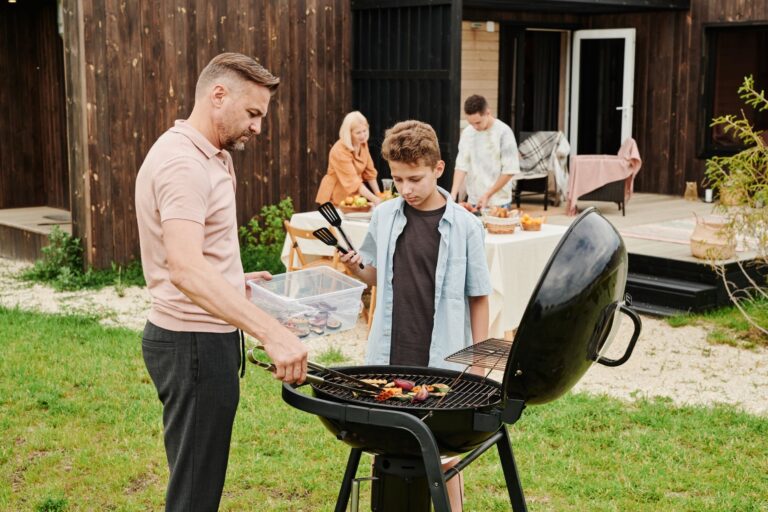
The Fourth of July at my parents’ farm has smelled the same my whole life. Cut grass and lighter fluid and my mother’s sweet tea steeping too dark on the porch rail. This year the sky stayed that flat white heat all afternoon, cicadas going in the tree line, and by two o’clock half of Redbud Crossing’s Ashgrove branch was spread across the yard on folding chairs while the men took turns at the smoker.
Kirkwood had been there since ten that morning. He’d hauled the folding tables out of my father’s barn, strung the string lights along the porch rail for the evening, and spent an hour teaching my youngest cousins how to load a water balloon slingshot without losing a finger. He never sat down. He never does. My father, still moving carefully eighteen months out from his knee replacement, had a cold glass of tea in his hand within thirty seconds of stepping outside because Kirkwood had it ready and waiting.
Nobody asked him to do any of that. He just does it, the way some people breathe.
My son Rowan is ten, all elbows and freckles, proud of the gap where his second tooth came out in June. My daughter Briar is seven and has spent this entire summer collecting lightning bugs in a mason jar with holes punched in the lid, naming every single one before she lets them go. They had spent the whole afternoon running the yard with their cousins, sunburned and grass-stained and happy in the specific, uncomplicated way kids are happy at a family cookout when they don’t yet know the adults in their life are capable of drawing lines around who counts.
Get a new story in your inbox every morning.
Facebook doesn’t show you every story we post. Our free newsletter does. Join 2,500+ readers.
Aunt Halden arrived at three in a car that cost more than my parents’ whole downstairs, wearing a white sundress that had never once touched a grill, carrying a designer bag she set down on a clean folding chair like the chair existed specifically to receive it.
Money does something to certain people. It doesn’t make them generous. It makes them keep score.
By four, the plates were scraped and the kids were sun-drunk and loud, and Aunt Halden stood up near the dessert table and clapped her hands together like she was calling a meeting to order.
“Kids,” she said, bright as a game show host. “Come on over here. I’ve got something for you.”
They came running, the way children run toward anything that might be a surprise. My cousin’s three, then my youngest cousin’s boy, lined up in front of her like she was handing out ribbons at a county fair. She had a stack of envelopes in that designer bag, thick enough that you could tell what was inside before she ever said a number.
“Five hundred dollars,” she announced to gasps and a couple of parents pulling out their phones to record it, “straight from the family trust. Every one of you Ashgrove grandbabies earned it just by being who you are.”
Five hundred dollars is not pocket change at a cookout. It’s a statement, dressed up as a gift.
Rowan hung back near the cooler, hands in his pockets, trying to look like he wasn’t watching. Briar tugged on the hem of my shorts, watching Halden’s purse the way she watches the last firework of a show, her whole face lit up and waiting.
Halden handed out four envelopes. Four names. Then she closed the clasp on her purse with a small, final click, and turned to refill her tea like the moment was already finished.
The yard went quiet in that specific, awful way a room goes quiet when everyone has noticed the same thing and nobody wants to be the first to say it out loud.
Briar tugged my sleeve. “Mama,” she whispered, “did she forget me and Rowan?”
My father’s fork stopped halfway to his mouth. My mother stared very hard at the paper tablecloth like the watermelon pattern printed on it had suddenly become the most important thing in the yard. Across the folding table, Kirkwood’s hands went still around the tongs he’d been using to turn corn.
Rowan’s ears went red first, then his whole face, and he dropped his eyes to the grass the way boys do when they’ve learned that crying in front of people only makes the humiliation worse.
I waited for the laugh. The little reach back into the purse. The “oh sweetheart, of course I didn’t forget you two.”
It never came.
“Halden,” my mother finally said, low. “You skipped Rowan and Briar.”
My aunt smoothed the front of her white dress with one hand, unbothered, like she was correcting a math error someone else had made.
“I didn’t skip anybody,” she said. “This is trust money. I gave it to the family children.”
“What is that supposed to mean,” I said. I heard my own voice go flat and careful, the way it gets right before I stop being careful at all.
She looked at me, and then at Kirkwood, and something in her face settled into the shape it had probably been wearing under the surface for eight years.
“It means what it means, Undine. That trust was your grandfather’s blood money, for his blood grandchildren. Rowan and Briar are wonderful, but their father isn’t an Ashgrove. He’s a man you married. Why should he benefit from what my father built with his own hands?”
“Rowan and Briar are my children,” I said, my hand closing hard around the edge of the table. “They are Ashgroves by blood, Halden. Through me.”
Her mouth curved into something that wanted to be a smile.
“And their father is not,” she said. “That’s the part that matters. If Kirkwood wants his kids to have five hundred dollars, he can pick up an extra shift at the plant.”
Somebody at the far end of the table sucked in a breath. It didn’t do a single thing to protect my son, standing there with his ears burning, or my daughter, who had started crying quietly into the fabric of my shorts. It only proved that everyone at that table had heard exactly what she said, and for one more second, nobody was going to be the one to stop her.
Kirkwood didn’t raise his voice. He never does. He set the tongs down on the edge of the smoker, slow and deliberate, and looked at his own boots like he was trying to make himself smaller so the words wouldn’t reach the kids twice.
For one ugly, satisfying second, I pictured flipping that whole dessert table, envelopes and deviled eggs and all, just to give the whole yard something honest to look at instead of another polite silence to hide inside.
I didn’t.
I looked at my aunt. Then I looked at my parents, sitting there stunned and quiet, unwilling to be the ones who upset the woman who controlled the trust and signed the checks.
“Then don’t call us family anymore,” I said.
My chair scraped hard against the grass when I stood. I picked Briar up onto my hip and took Rowan’s hand, and Kirkwood was already moving toward the truck without a word, the way he moves toward any job that needs doing.
Aunt Halden laughed behind us, thin and irritated, the sound of a woman who has never once had to live with a consequence she didn’t approve first.
“Undine, don’t be dramatic. It’s an inheritance policy, not a personal attack.”
I didn’t turn around. We walked past my father’s flag on the porch rail, past the cooler nobody had refilled, and the kids climbed into the truck without a word between them. Kirkwood drove. I sat in the back between my children, one hand in Rowan’s, one hand smoothing Briar’s hair while she hiccupped herself calm against my side.
That’s the thing nobody tells you about the man who married in. He is often the one holding everyone else together while they’re deciding whether he counts.
—
At home, I put a movie on for the kids and gave them the last of the sparklers for later, once it was properly dark. Then I kissed Kirkwood on the temple, told him I needed twenty minutes, and went into the little office off our kitchen where I keep the filing cabinet with every piece of paper that has ever had my name on it.
Aunt Halden believed she held every card, because she managed the trust, the store, and the renovation loan. What she had forgotten, in the two years since she’d needed something from me, was that the same covenant that let her call herself the gatekeeper of my grandfather’s legacy also made me one of the five signatures standing between her and that loan closing clean.
I found the folder. Land-Use Consent, Cardinal Street Trust Property, my signature on page four, dated a Tuesday morning two years back when I still thought a signature between family meant something simple.
I opened my laptop at the kitchen table while the kids’ movie played low in the next room, and I wrote a letter.
Not a rant. Not a single unkind word about my aunt, her dress, or her purse. I wrote a formal notice of withdrawal of consent, citing the trust’s own good-faith clause, which required every beneficiary’s consent to remain valid “for so long as the spirit of the original grant is honored in the treatment of the grantor’s descendants.” I attached my original signed waiver. I addressed a copy to the trust’s bank officer at the co-op, and a copy to the county zoning clerk who had the renovation permit sitting in a folder three doors down from where I used to work summers in high school.
I read it twice. I checked every date. I hit send at 8:52 that evening, while somewhere behind me my son and daughter chased lightning bugs across the yard with a jar that already had holes punched clean through the lid, because Briar never could stand keeping anything in the dark for long.
It wasn’t revenge. It was paperwork. The kind my aunt understood better than kindness.
Without my signature, the renovation loan would not close as written. The permit application would sit incomplete at the county office come Monday morning. The bank would need every beneficiary’s consent refiled before a single dollar moved, and Aunt Halden’s contractor was already scheduled to break ground on the event barn roof in nine days.
I closed the laptop, walked back outside, and sat on the porch steps next to my husband. He didn’t ask what I’d done. He just took my hand, the same slow, certain way he’d been taking it for eight years, and we watched our children write their names in the dark with sparks that didn’t last nearly long enough.
Twenty-three minutes later, my phone lit up on the porch rail.
Aunt Halden. Then Aunt Halden again. Then a text from my mother that just said, “Call her.”
I didn’t call her that night. I let the porch light and the lightning bugs and my family, my whole family, have the rest of that evening.
—
She called nine more times before nine the next morning. When I finally picked up, she didn’t apologize. She informed me, in a voice gone thin with something that wasn’t quite panic yet, that I had “no right” to interfere with a project meant to benefit “the whole family,” and that she expected me to call the bank back immediately and undo what I’d done.
“You told my son and my husband they weren’t family in front of thirty people,” I said. “I’m just using the paperwork the same way you did.”
“That is not remotely the same thing,” she said.
“It’s exactly the same thing,” I said. “You just don’t like how it feels from this side of it.”
She hung up on me. Then she called my mother, my father, my cousins, working her way down the family phone tree like a woman looking for anyone who might talk sense into me. What she found instead, over the course of that week, was a family quietly recalculating eight years of watching Kirkwood carry water heaters and tea glasses and dialysis appointments while being introduced, at every holiday, as “the road crew boy.”
One of my cousins, whose oldest boy had gotten an envelope that day while Rowan and Briar stood there empty-handed, called me Tuesday night, near tears herself. She said she’d almost handed her son’s five hundred dollars straight to Rowan right there in the yard, and hadn’t, because she was too embarrassed to make a scene in front of her own mother, and she’d been sick over it ever since. I told her it wasn’t her fault. I meant it. Nobody in that yard had built the trust or written the rules. They had just, all of them, gotten comfortable letting one woman decide who the rules applied to.
My mother called me on Wednesday, her voice smaller than I’d heard it in years. “I should have said something at the wedding,” she said. “I should have said something a hundred times since. I let her set the tone for this whole family for too long, and I let your husband feel like a guest at his own children’s table because I was afraid of what it would cost me to disagree with my own sister. I’m sorry, Undine. I am so sorry.”
That call meant more to me than anything Halden ever said, before or after.
—
On Thursday, going through my grandfather’s old cedar chest at my parents’ house, looking for anything that might strengthen my position if Halden decided to fight the withdrawal in front of a lawyer, my mother and I found a letter we had never seen. It was tucked behind a stack of feed store ledgers from 1974, in my grandfather’s own uneven hand, dated the year before he died.
He had written it, it seemed, as a private note to himself, or maybe to whichever daughter eventually found it. It talked about the store, about wanting it to outlast all three of his girls, about worrying, even then, that Halden’s ambition for the place might someday narrow instead of widen who it served.
Near the bottom, underlined twice, it said: Family is not the blood you’re born with. It’s the people who show up and keep showing up. Whoever marries into this family and stays, and whoever is raised by someone who stayed, is an Ashgrove in every way that has ever mattered to me. If any of my girls ever forgets that, remind her this store was built by a man whose own father-in-law never once let him forget he wasn’t blood, either, and I swore I’d never do that to anybody who loved one of mine.
My grandfather had married into a family too. I had never known that. Nobody had ever told me, because it had never mattered, because he had made sure it never mattered to anyone.
I photographed that letter on my phone before I let myself cry over it, and then I drove straight to the feed store.
—
Aunt Halden was in the back office when I got there, the same back office my grandfather used to keep his seed catalogs in, on the phone with her contractor, going pale as she listened to whatever he was telling her about the permit delay. She hung up when she saw me in the doorway.
“If you’ve come to gloat,” she said, “you can turn around.”
“I haven’t.”
She crossed her arms over the front of that white dress, still spotless three days later, like even her anger came pressed and tailored. “I don’t know what you want from me, Undine. An apology? Fine. I’m sorry it embarrassed the children. But I built the language of that trust to protect what my father worked for, and I am not going to apologize for wanting to protect it from getting spread thin.”
“Spread thin,” I repeated. “That’s what you call my son.”
“That’s not what I meant, and you know it.”
“I don’t think I do know it, Halden. I think you meant exactly what you said in that yard. I think you’ve meant it for eight years, every time you called him the road crew boy instead of his name.”
She opened her mouth to argue, and I didn’t give her the chance. I set my phone on her desk instead, the photograph of my grandfather’s letter filling the screen, and I let her read it in silence.
She read it twice. I watched something in her face come apart in a way I had never seen in thirty-some years of watching her manage every room she ever walked into. Her hand went to her mouth on the second read, and she sat very still, the way you sit when the ground has just told you it isn’t as solid as you assumed.
“He never showed me this,” she said finally, quiet.
“Maybe he thought he wouldn’t have to,” I said. “Maybe he thought his own daughter would just know it, the same way you’d want your own children to just know how you feel about them without you having to write it down and underline it twice.”
She sat down slow in her office chair, the designer bag forgotten on the floor beside her, and for a long moment she didn’t say anything at all. Outside the window I could hear the highway traffic on Route 9, the same sound my grandfather must have listened to for forty years while he balanced these same books. When Halden finally spoke, her voice had none of the polish left in it.
“I have spent so long trying to protect what he built,” she said, “that I think I forgot what he actually built it for. I was seven years old the summer he broke ground on this place. I used to think if I just held on tight enough to every piece of it, I was holding onto him.” She looked up at me, and for the first time in my whole life, my aunt looked like she was asking me for something instead of handing something down. “I don’t know how to let go of that and still feel like I’m keeping my promise to him.”
“You keep your promise to him by doing what that letter says,” I told her. “Not by deciding who gets to count.”
I told her I would sign the consent again, but on my terms this time. Kirkwood’s name would go on the trust’s list of family beneficiaries, formally, in writing, alongside every blood grandchild, exactly the way my grandfather’s letter said it always should have been. Rowan and Briar would get their five hundred dollars, and so would every future Ashgrove child born or married or raised into this family, no asterisks.
I told Kirkwood that night, sitting on the tailgate of his truck with the kids finally asleep inside. I expected him to shrug it off the way he shrugs off most things people say about him, the way a man learns to when he’s spent his whole life being the footnote. Instead he was quiet for a long minute, looking out at the tree line, and when he finally spoke his voice caught in a way I had heard maybe twice in eight years of marriage.
“Nobody’s ever put my name on anything that mattered before,” he said. “Not since my mother passed.”
“It should have happened years ago,” I said.
“Maybe,” he said. “But it happened. That’s the part I’m going to hold onto.”
She agreed. Not gracefully, not right away, but she agreed, and three weeks later, at a much smaller Sunday dinner on my parents’ porch, she handed Rowan and Briar their envelopes herself. She said their names first this time, before anyone else’s, and she said them right.
She never did become the warmest woman at our table. Some cracks in a foundation don’t fully close just because you’ve patched them. But she stopped calling my husband the road crew boy. She started calling him Kirkwood, and eventually, once, on a Thanksgiving two years later, she called him her nephew, and I watched him go still for a second the way he does when something lands somewhere he wasn’t expecting it to.
The event barn opened the following spring. There’s a small brass plaque by the front door now, one my mother insisted on, with my grandfather’s own words engraved into it: Family is not the blood you’re born with. It’s the people who show up and keep showing up.
Every bride who rents that barn walks past it on her way in. I like to think my grandfather would have liked that better than any wedding reception ever could have paid him back.
As for us, we still do the Fourth of July at my parents’ farm every year. The lightning bugs still get caught in Briar’s jar and let go before bedtime. Kirkwood still mans the smoker, low and slow over hickory, the way my grandfather taught half of Redbud Crossing to expect it. And every single grandchild at that table, blood or married or raised in, gets exactly the same envelope, handed over with exactly the same two words.
For family.
No exceptions. Not anymore.
This story is a dramatization. Names, characters, and details are invented, and any resemblance to real people or events is coincidental.