
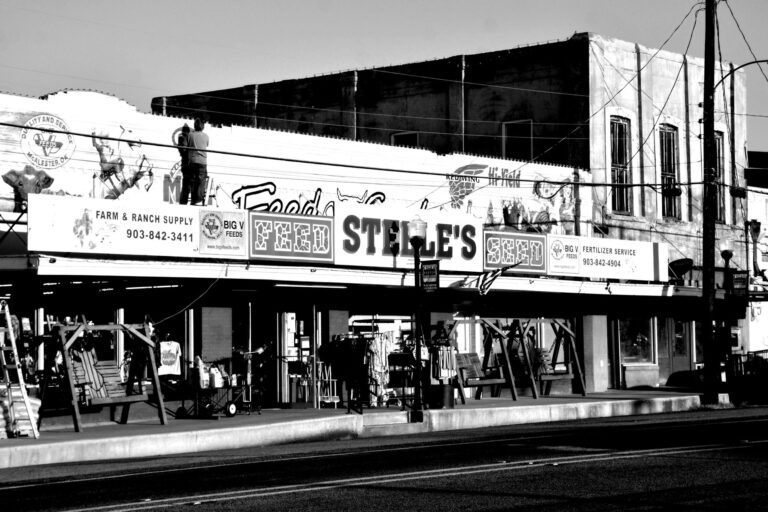
At 2:53 that Thursday afternoon, I was standing on the loading dock behind our store with both arms wrapped around a fifty pound sack of cracked corn, sweat cutting a line down the back of my shirt, when my phone buzzed in my apron pocket against my hip. I let the sack drop onto the pallet, peeled off one glove with my teeth, and answered it still catching my breath.
“Mrs. Holcomb, this is Winnie Aldrich over at Mercer Properties,” the voice said, bright and businesslike, the voice of a woman reading down a checklist. “I’m calling to get the annual fire insurance walkthrough on the calendar for the new ten year term. Mr. Mercer likes to get that scheduled within thirty days of the renewal going final, and since the renewal closed back on March the fourth, we’re already running a little behind.”
I stood there with corn dust on my forearms and a dead phone signal roaring in my ears for what felt like a full minute before I found my voice.
“Winnie, I think you’ve got the wrong file,” I said. “We haven’t signed any ten year renewal. I haven’t even seen a ten year renewal.”
“I’m looking right at it,” she said, not unkindly, just puzzled that I would push back on something so plainly documented. “Both partners’ signatures, notarized March fourth, right here in Mr. Mercer’s office. Rance came in that morning with the paperwork.”
March the fourth. I did not need to check a calendar to know exactly where I had been that day, because I had spent it two hours west at the Cheyenne County Livestock Auction with my son, bidding on eleven head of bred heifers, standing in a cold metal bleacher with an auction paddle in my hand from nine in the morning until well past three in the afternoon. I had never been anywhere near Garland Mercer’s office. I had never signed anything. And somewhere on a document sitting in a file cabinet across town, my name said otherwise.
I remember that Thursday in March with a clarity most ordinary days do not earn, because it had been a good one. Beckett had driven up from Scottsbluff the night before so we could go together, the way we used to when he was a teenager and Desmond would let him skip half a day of school for a good sale. We were in our seats by eight forty five with paper cups of gas station coffee going cold in the cup holders, and I bid on lot after lot of bred heifers through the cold morning air with my breath fogging in front of me, holding out for the right bloodline at the right money instead of getting caught up in a bidding war the way I had let myself do once or twice in younger years. I paid an average of just under fourteen hundred dollars a head for eleven animals, wrote a check against the store’s operating account that the auction barn cashier stamped and dated in front of me at 1:52 that afternoon, and Beckett and I ate gas station sandwiches in the truck on the drive home arguing cheerfully about whether the roan-colored heifer in lot forty three would settle in easily with the rest of the herd. That receipt, stamped and timestamped by a cashier who had no reason on earth to lie for me, sat in the glove box of my truck for three more weeks before it ever mattered to anyone but the store’s own books. It would end up mattering a great deal.
I found Rance forty minutes later in the back office, boots up on the corner of the desk, going through a stack of invoices like it was any ordinary Thursday. I set my phone down on the desk in front of him, Winnie’s number still glowing on the screen, and told him what I had just heard. I watched his face for the flicker of surprise a man shows when he is hearing something for the first time. It never came.
“It’s got your name on it, Adaline,” he said, not looking up from the invoices right away. “That’s all Garland needed to see. Don’t make this bigger than it has to be.”
That was the moment I understood, standing in the office my late husband had built with his own hands twenty six years ago, that my business partner had not misplaced a signature or filled in a form incorrectly. He had put my name on a document I never touched, on a day he knew exactly where I was, and he was looking at me now like the only real problem in the room was that I had noticed.
*The store Desmond built*
My husband Desmond Holcomb and Rance Kade opened Holcomb and Kade Feed and Farm Supply on the edge of Prairie Bend, Nebraska in the spring of 1998, the year I was pregnant with our son Beckett and the two of them were still young enough to think a shared bank loan and a handshake counted as a business plan. Desmond had grown up three miles down the county road on his family’s wheat and cattle operation and knew, better than any accountant could have told him, exactly what a working ranch needed on a Tuesday morning in February when the temperature dropped to nine below and a man could not get into town for feed without the roads closing first. Rance had grown up in Prairie Bend too, in town rather than on land, the son of the man who ran the co-op elevator, and what he brought to the partnership in those early years was a real gift for talking to people, for smoothing over a slow-paying customer or a nervous new supplier, the kind of easy charm that got the doors open and kept them that way through some truly difficult early winters.
I worked the front counter three afternoons a week for the first several years, Beckett strapped to my chest in a carrier while I rang up sacks of sweet feed and fence staples, and I watched the two of them build something real out of almost nothing. Desmond ran the physical side of it, the loading dock, the inventory, the relationships with the feed mills and the seed reps. Rance ran what he liked to call the outside relationships, the landlord, the bank, the insurance agent, the county officials who signed off on the propane tank permits. It was a fair division of labor for a long time, or it looked fair, because Desmond was not a man who cared much for sitting across a desk from Garland Mercer’s father negotiating lease terms, and Rance clearly seemed to enjoy that part of the work in a way Desmond never would have.
Get a new story in your inbox every morning.
Facebook doesn’t show you every story we post. Our free newsletter does. Join 2,500+ readers.
Desmond died of a heart attack in the loading dock office on a Tuesday morning in October, seven years ago this fall, forty nine years old, a coffee cup still warm on the desk beside him when one of our longtime hands found him. I was forty four years old with a nineteen year old son in his first semester of community college and a half share in a feed store that suddenly had my name on it whether I felt ready to carry it or not. The partnership agreement Desmond and Rance had signed back in 1998 included a survivor clause, plain and simple, that his fifty percent interest passed directly to me rather than being bought out or dissolved, and Rance himself was the one who sat across my kitchen table three weeks after the funeral and told me, with what I believed at the time was real kindness, that he wanted me in the business as a full working partner, not a silent one cashing a check.
I took him at his word. For six years I ran the books, managed the counter staff, handled payroll, and gradually took over more and more of the day to day operations Desmond used to carry, while Rance kept doing what he had always done, the landlord, the bank, the paperwork with the county. It made sense at the time. It was the same division of labor the store had always run on, and grief has a way of making you cling to whatever structure still feels familiar. I did not think to question, in those early years of learning to run a business and raise a son alone, why I never sat in on a single lease negotiation with Garland Mercer, or why every renewal for two decades had simply appeared on my desk already finished, needing nothing from me but a signature I gave gladly because I trusted the man who had promised my dying husband’s business partner would never let me down.
*What the renewal actually said*
I drove to Prairie Bend Title and Abstract the same afternoon Rance told me not to make it bigger than it had to be, and I asked for a copy of everything on file under our lease. The clerk who pulled it, a young woman named Dessa who had gone to high school with Beckett, handed me a folder without a second thought, because as far as the paperwork on file showed, I was a full co-signer entitled to my own copy of my own lease.
The renewal ran to fourteen pages, most of it standard language I recognized from every lease Holcomb and Kade had signed with the Mercer family going back to 1998, a ten year term instead of our usual five, a rent schedule that stepped up more aggressively than any previous renewal had, and language locking the store into that building through the year I would turn sixty three. My signature sat at the bottom of page eleven, next to Rance’s, dated March the fourth, notarized by someone named Beulah Fenton whose name I did not recognize at all.
It was page thirteen that stopped me cold. An addendum, three paragraphs long, granting a separate option agreement on Parcel 4, the three acre grain bin lot directly behind our building that Garland Mercer’s family had owned and left mostly idle for as long as I could remember. The option locked in the 2015 lease rate on that parcel, years below current market, exercisable at any time over the next decade. And the party named on that option was not Holcomb and Kade Feed and Farm Supply. It was Rance Kade, individually, doing business as Kade Custom Hauling and Grain.
I sat in my truck in the title company parking lot for a long time reading those three paragraphs over and over, feeling something shift and click into place that I had not let myself see clearly before. Rance had mentioned, maybe eight months earlier, some vague plan about getting into custom grain hauling on the side, a little extra income once Beckett’s kids started needing college funds of their own. I had thought nothing of it at the time, a man entitled to his own side project the way anyone is. What I understood now, sitting in that parking lot with corn dust still on my forearms, was that the side project needed cheap land directly behind our store, land Garland Mercer would only bundle into a favorable long term option if the main store lease renewed on his terms too, and Rance needed my signature on that main lease to make the whole package close. He had not been able to get it honestly, because I would never have agreed to a ten year term with rent increases that steep without renegotiating harder, and because I certainly would never have agreed to hand my late husband’s business partner a personal option on land behind our own building without asking a single question about what he planned to do with it. So he had gotten my name on it another way.
*“Don’t make this bigger than it has to be”*
I confronted Rance a second time two days later, this time with the folder from the title company spread out on the desk between us, page thirteen turned face up. I asked him directly whether he had signed my name to that document, and whether he understood what he had asked Beulah Fenton to notarize.
He did not deny it outright. He talked around it instead, the way he had always been good at talking around things, telling me the store needed the ten year security to qualify for the equipment financing he wanted to pursue, telling me Garland was not going to wait around for a meeting he could not get on my calendar during calving season, telling me he had every intention of bringing me in on the hauling business eventually, once it was up and profitable enough to be worth my time.
“I didn’t think you’d say no,” he told me, leaning back in the chair Desmond used to sit in. “I figured you’d sign it eventually anyway once you saw the numbers. I just moved the timeline up a little.”
“You forged my name on a legal document, Rance,” I said. “There is no version of that sentence that ends with moving up a timeline.”
“It’s got your name on it,” he said again, the same flat line he had used two days earlier, like repeating it enough times might finally make it sound reasonable. “Garland’s happy. The store’s secure for a decade. I don’t see what you’re so worked up about.”
“I have a receipt from the Cheyenne County sale barn, stamped at 1:52 in the afternoon, on the exact day you say I sat in Garland Mercer’s office and signed this,” I said, laying it on the desk beside the folder. “You knew where I was that day, Rance. You called me twice that morning about a delivery truck that broke down on Highway 26. So tell me plainly, right now, whose hand actually held the pen on page eleven.”
He looked at the receipt for a long moment without picking it up, and something in his face finally shifted, not into an apology, but into the particular stillness of a man doing arithmetic on how much longer a story can hold before it stops holding at all.
“I signed it,” he said finally. “Beulah didn’t ask many questions. She trusts me. Most people around here still do.”
“I used to be most people,” I told him.
I left the office that afternoon and did not go back for three days, the longest I had gone without setting foot in that building since the week Desmond died. I spent those three days doing two things: I called my son, and I called a lawyer.
*Roswell Pace*
Beckett, twenty six now and working construction crews out of Scottsbluff, drove the two hours home the same night I called him and sat at my kitchen table listening to the whole thing without interrupting once, his jaw working the way his father’s used to when he was holding his temper down by force. It was Beckett who gave me the name of Roswell Pace, an attorney in Scottsbluff his foreman had used two years earlier in a contract dispute and trusted enough to recommend without hesitation.
Roswell was a careful, unhurried man in his sixties who had spent thirty years handling exactly the kind of business and property disputes that never made the news but quietly ruined or saved the people caught inside them. He read through the full renewal twice, made notes in the margins in a small, tidy hand, and then looked up at me across his desk with an expression I remember exactly, not surprise, but a kind of grim recognition, like he had seen this particular shape of betrayal before and knew precisely how it usually went from here.
“Two things matter more than anything else in this file,” he told me. “First, your partnership agreement from 1998 requires unanimous written consent from both partners for any lease term over five years, or any instrument that encumbers or options partnership real property. That clause alone should void the ten year renewal regardless of what the signature question turns out to be. Second, and this is the part that matters most for what happens to Mr. Kade personally, forging a signature on a notarized real estate document is not a business dispute. In this state, it’s a felony.”
He explained what would need to happen next in plain, methodical terms. We would need a forensic document examiner to formally establish that the signature on page eleven was not mine, exemplars pulled from documents I had actually signed over the years so the comparison would hold up if this ever reached a courtroom. We would need to understand exactly what Beulah Fenton had witnessed, or had not witnessed, the morning she notarized that page, because a notary is legally required to watch the actual signing happen, not simply take another party’s word for it. And we would need to go to Garland Mercer directly, before filing anything, because a landlord who had unknowingly become party to a fraudulent lease had every incentive in the world to want it fixed quietly and quickly once he understood what he was actually holding.
*Gathering my own hand*
Before Marlow Chen could tell me anything at all, she needed a stack of documents I had actually signed myself, and pulling that stack together turned into its own strange, quiet errand through the last twenty years of my life. I drove to the co-op elevator on the north edge of town and asked the manager, a patient man named Odis who had processed our feed orders since before Desmond died, to pull whatever delivery logs he still had on file with my signature on them, and he spent the better part of an hour digging through a back room of banker’s boxes to find me two years of receipts I had signed in his own handwriting-worn ballpoint pen. I stopped at the bank and requested copies of two years of canceled checks drawn on the store’s account, watching a young teller feed each one through a scanner while I stood at the counter feeling strangely exposed, as though the ordinary act of writing my own name over and over had suddenly become evidence in a case I never wanted to be part of. I even drove out to the fairgrounds office and asked the extension agent if she still had my entry form from last August’s open cattle show, filled out on a folding table under the grandstand roof on an ordinary summer evening with absolutely nothing riding on it. She found it in a manila expandable file within minutes.
Standing in that fairgrounds office holding a form I had signed without a second thought less than a year earlier, I understood something I had not let myself feel yet in the whole ordeal. My own signature, the plain unremarkable shape of it, had never once in my life been something I thought to protect or prove. It was simply mine, the way my own face in a mirror was mine, so automatic I could not have told you the exact order the letters formed in without watching my own hand do it. Rance had taken something that ordinary and turned it into a weapon aimed at the one thing I had left of a marriage and a partnership I once trusted completely.
*What the pen strokes showed*
Roswell brought in a forensic document examiner named Marlow Chen, a soft spoken woman who worked out of Lincoln and had spent eleven years testifying in cases exactly like mine before state licensing boards and, occasionally, courtrooms. I met her in Roswell’s conference room on a Tuesday morning and watched her lay out, side by side under a portable magnifying lamp, six documents carrying my authentic signature: a feed delivery log from the co-op, two years of canceled checks from the store’s own account, a veterinary supply order I had signed the previous spring, and my entry form from the Panhandle County Fair open cattle show, of all things, which Marlow said was actually one of the more useful exemplars because I had filled it out under no pressure at all, sitting at my own kitchen table on an ordinary evening.
She walked me through what she was looking for in language I could follow even though I understood almost none of the technical vocabulary underneath it. My genuine signature, across every one of those six documents spanning nearly a decade, showed the same natural variation a real hand always shows, slight differences in pressure and spacing from one signing to the next, but an underlying consistency in letter formation, the particular way I loop the H in Holcomb, the way my M starts high and drops fast. The signature on page eleven of the renewal, magnified forty times on her screen, told a different story entirely. The pen strokes showed hesitation marks where a real signature shows none, small pauses and retouches consistent with someone tracing rather than writing, and the H and the M did not match the muscle memory pattern present in every other document in front of her. She was careful, professional, unwilling to overstate her own certainty in the moment, but by the end of that morning she told Roswell and me plainly that in her professional opinion, delivered later in a signed report, the signature on page eleven was not consistent with my known handwriting and showed clear indicators of simulation.
“People think forgery means copying badly,” she told me as she packed up her equipment. “The good forgeries copy the shape well enough to fool an eye at a glance. What they can never copy is the rhythm underneath it, the actual motion of a hand that has written that name ten thousand times without thinking about it. That rhythm is what I’m trained to see.”
*Beulah Fenton’s account*
Roswell reached Beulah Fenton the following week, and what she told him, once she understood the position she herself was in, came out in a rush of relief more than resistance. She had been a notary public at the title company for six years, competent and careful by her own account, and she told Roswell that Rance had come into her office alone on the morning of March fourth carrying the renewal already signed on both lines, telling her I had been called away to a family emergency and could not make the appointment, and asking her to go ahead and notarize the document based on his assurance that he had watched me sign it himself earlier that morning before he left the house.
She should have refused. Nebraska notary law is unambiguous on this point, and she knew the rule even as she broke it that morning, tired at the end of a long week, trusting a man she had done business with a dozen times before and had no particular reason to doubt. She notarized the page believing his account, stamped it, and moved on to her next appointment without another thought about it until Roswell Pace called her office and asked, calmly and specifically, whether she had personally witnessed Adaline Holcomb sign that document.
Faced with the forensic report and the plain fact that her own notary journal showed no record of my presence in the building that day, Beulah gave Roswell a full written statement within the week, cooperative and unflinching about her own error, and offered to testify to it directly if the matter ever required it. Her honesty in that moment likely spared her the worst possible consequence to her own commission. A notary who lies to protect a fraud faces losing her license outright and possibly her own criminal exposure. A notary who admits a mistake made under a trusted colleague’s false assurance, and cooperates fully once confronted, generally faces a formal reprimand and additional training rather than the end of her career. Roswell filed the complaint with the state on her behalf as part of the full record, and made clear to the board reviewing it that Beulah’s cooperation had been immediate and complete.
*Garland Mercer’s office*
We went to see Garland Mercer himself on a Thursday morning three weeks after that first phone call, Roswell and I together, carrying Marlow’s signed report and Beulah’s statement in a single folder between us. Garland was sixty eight years old, the third generation of his family to lease commercial land around Prairie Bend, and he had known Desmond and Rance both since the year they first walked into his father’s office asking about the building that would become our store. He read through both documents at his desk without saying a word for what felt like a very long time, and when he finally looked up, his face had gone the particular gray of a man realizing he has been used by someone he considered a friend.
“Rance told me you’d signed off on all of it,” he said. “Told me you two had already talked it through and you just didn’t want to sit through another meeting, that you trusted him to handle the details the way you two always had. I had no reason on God’s earth to doubt that.”
I believed him. Garland Mercer had built his own family’s reputation in this county on being straightforward with the people he did business with, and nothing about his shock in that office read as performance to me. He voided the ten year renewal on the spot, along with the option agreement on Parcel 4 naming Rance individually, and told us both, with what sounded like genuine anger of his own, that he intended to have a separate and considerably less friendly conversation with Rance Kade before the week was out.
“I’ve leased that lot to you and Desmond and now to you for twenty six years,” he told me before we left. “Any renewal on that building happens with your actual signature in this office, in front of me, or it doesn’t happen at all. You have my word on that, and this time it’ll mean something.”
*What happened to Rance*
Roswell laid out my options plainly once the fraudulent renewal was voided: I could pursue criminal forgery charges against Rance directly, which carried real consequences but would also mean months or years of a public process neither Beckett nor I particularly wanted hanging over the store’s name, or I could use the fully documented forgery as decisive leverage in a forced dissolution of the partnership, structured to end the business relationship cleanly and on terms that reflected exactly what he had done. I chose to pursue both, in sequence, on Roswell’s advice. The forensic report and Beulah’s statement went to the county attorney’s office as a formal complaint, a decision I did not make lightly but made without much hesitation once I understood what a pattern of unchecked forgery might do to the next person who trusted him with a signature.
The dissolution itself moved faster than I expected, in part because Rance’s own attorney, once shown the same documents Garland had seen, advised him in no uncertain terms that fighting the buyout terms in front of a judge with a signed forensic report already on file was a losing proposition on every front. I bought out his half of Holcomb and Kade Feed and Farm Supply at a valuation that accounted, at Roswell’s insistence, for the cost and disruption his forgery had caused the business, a figure meaningfully lower than a clean, honest dissolution would have cost me. Kade Custom Hauling and Grain, the side venture that had needed Parcel 4 to make its numbers work, never got off the ground at all once that option evaporated. I heard through the ordinary channels a small town runs on that Rance took a sales position with an implement dealer two counties over within the year, and that the county attorney’s office ultimately offered him a plea to a reduced charge, a felony still, with restitution and probation rather than prison, a resolution Roswell told me was fairly typical for a first offense of this kind once the victim herself was not pushing for the maximum available sentence. I was not.
*The store now*
I own Holcomb Feed and Farm Supply outright now, the first time in twenty six years a single name has sat alone above that door, and I will admit I cried the morning the new sign went up, not from grief exactly, something closer to relief finally allowed to land after months of holding it off. I signed a new five year lease with Garland Mercer myself, in his office, at a fair rate we negotiated face to face across his own desk the way it always should have happened, and I asked for and received a right of first refusal on Parcel 4 for the store itself, should the day ever come when I want to expand our own operation into it rather than watch someone else’s side project use it against me.
Word travels fast in a town the size of Prairie Bend, and by the time the new sign went up over the door, most of our regular customers already knew some version of what had happened, the honest version more often than not, because Garland himself was not a man inclined to keep quiet about being used. The Saturday after the sign went in, Odis from the co-op showed up with a case of soda and a folding table he set up on the loading dock without asking, and by early afternoon it had turned into something close to a small open house nobody had planned, ranchers and farmers I had sold feed to for two decades stopping by to shake my hand and tell me, in the plain, undecorated way people talk out here, that they were glad the name over the door finally matched the person who had actually kept the place running. An older rancher named Winslow Task, who had bought hay and mineral blocks from Desmond and then from me for over twenty years, told me flatly that he had always found Rance a little too smooth for his own liking and had never said so out loud because it was not his business to say. It was, in its own quiet small-town way, its own kind of vindication, the sense that the people who actually mattered to this store had never really been fooled at all.
Beckett moved back to Prairie Bend eight months ago and works the loading dock most mornings before his own construction jobs start, learning the parts of this business his father never got the chance to teach him directly. Dessa at the title company still pulls my file without a second thought, the way she always did, except now there is only one signature on any document that leaves that office, and it is truly mine every time. Beulah Fenton completed the additional notary training the state board required of her and still works at the title company, more careful now, she told me once at the grocery store, than she has ever been about anything in her professional life. Marlow Chen sent me a short note some months later saying she hoped the outcome had brought some measure of peace, a kindness from someone who had only known me for a handful of hours across a conference table.
I think about Desmond most on the mornings I unlock that front door before anyone else is in, the particular quiet of a store before the day’s first customer, the same quiet he used to stand in for a few minutes every morning before Beckett and I were even awake. I do not know what he would have said to me about trusting Rance Kade with the parts of this business I never learned to watch closely myself. I know what I would tell him now, standing in the store he built with his own two hands: that I learned, the hard way and later than I should have, that a signature is not a small thing to hand someone else, not even someone you have called family for twenty years, and that the store still stands, whole and mine, because I finally asked the one question nobody around that desk had thought to ask in a very long time. Whose name is actually on this, and did she really put it there herself.
This story is a dramatization. Names, characters, and details are invented, and any resemblance to real people or events is coincidental.