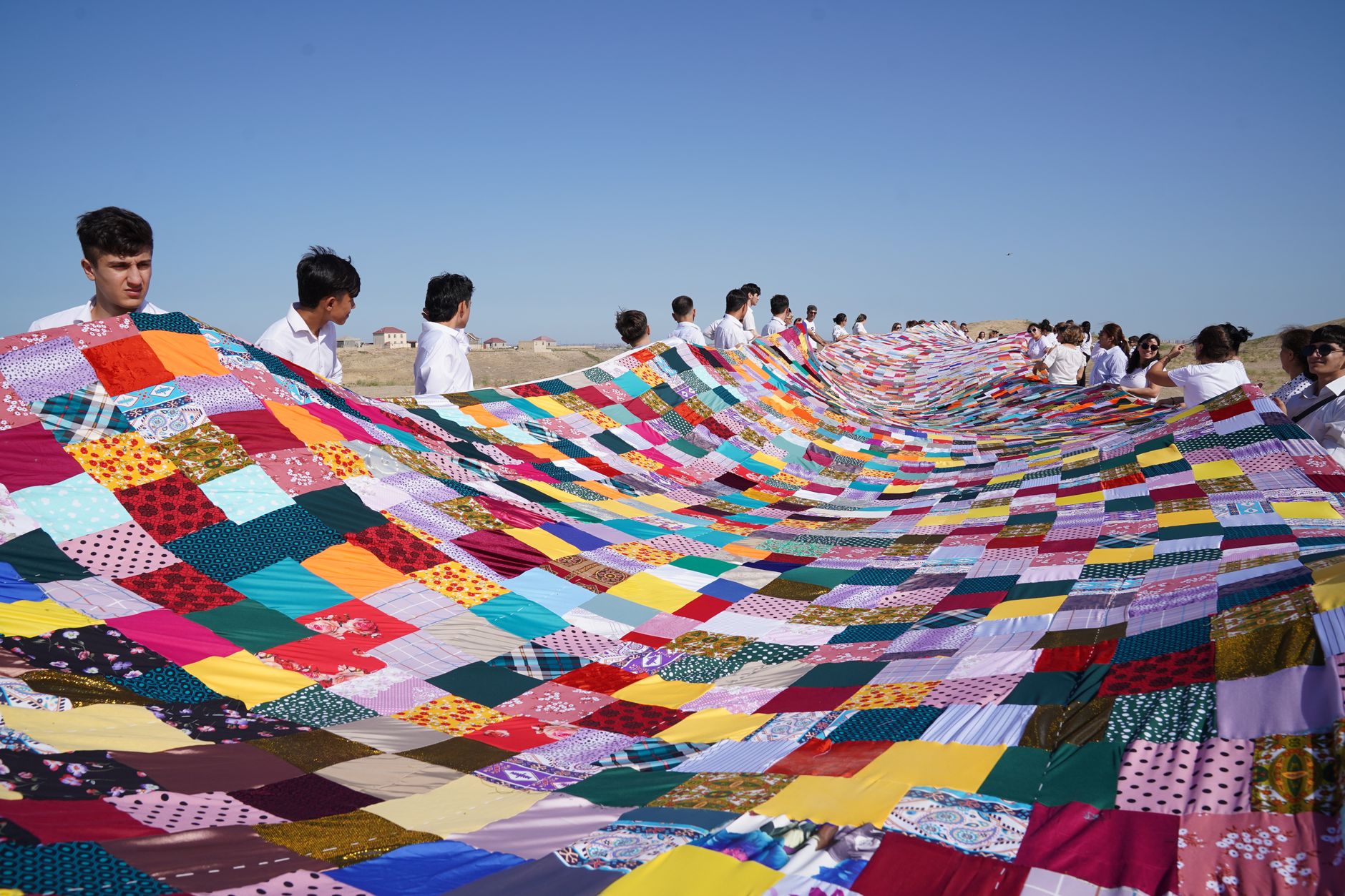
The Quilt My Aunt Tried to Take
At 6:52 on the fourth evening after my father’s hip replacement, I stepped out onto the porch of the farmhouse where I grew up, still smelling of the antiseptic wipes I had used to clean his incision twenty minutes earlier, and saw my aunt Charlene easing my grandmother’s Star quilt into the trunk of her Buick like she was tucking a sleeping baby under a blanket.
“Charlene.” My voice came out smaller than I wanted it to, worn thin from four nights of two-hour sleep shifts and lifting a seventy-year-old man in and out of a recliner. She did not jump. She did not even flinch. She shut the trunk with a soft click and turned around wearing the exact face she used to wear when we were girls and she had already decided she was right about something before anyone else got a vote. “It was promised to me, Reva,” she said. “Mama told me that thirty years ago, back before you were even born. I’m not stealing a thing. I’m just finally taking what’s mine while Colter’s laid up in there and can’t fuss about it.”
I stood on the bottom porch step in my father’s old barn coat, barefoot on the cold gravel because I had run out without thinking to grab shoes, and for a second I honestly could not make my mouth work. Behind me, through the screen door, I could hear the low hum of the box fan in my father’s room and the particular creak the recliner makes when he shifts his weight trying to get comfortable on a hip that is four days old and still swollen twice its size. That quilt had been folded across the foot of that same recliner every day of my life. My grandmother, Fern Ashby, had pieced it during the coldest winter Marrow’s Fork, Kentucky had seen in forty years, the winter I was nine years old, out of thirty-year-old scraps of my grandfather Emory’s work shirts and her own good church dresses, a pattern the old women in this county call a Bethlehem Star. She had been dead eleven years. And here was her daughter, my father’s own sister, walking off with it in the dark while he was too doped up on hydrocodone to know his own quilt was leaving the property.
“Put it back,” I said.
“I will not,” Charlene said, and she said it pleasantly, the way you would decline a second helping of green beans at supper. “I have wanted this quilt back in my house for thirty years, and every single time I have asked, somebody in this family has found a reason to say not yet, not now, Daddy’s not ready, Colter’s not ready. Well, I am done waiting on ready. Mama is not walking through that door to settle it for us, and I am not getting any younger waiting on her to. I settled it myself.”
I want to tell you I had some perfect, steady response to that. I did not. I stood there in bare feet with my heart going so hard I could feel it in my ears, and the only thing I managed to say was, “That is not your car to load it into and you know it,” before my daughter Junia came out onto the porch behind me asking what was wrong, and Charlene used the interruption to open her driver’s door, get in, and back the Buick down our long gravel drive with her headlights cutting yellow arcs across the hay field while I stood there and watched her take it.
I did not chase the car. I want to be honest about that, because for a long time afterward I was ashamed of it, ashamed that I let a forty-seven-year-old woman in a barn coat and bare feet just stand on a porch and watch a Buick carry off the one object in this world that still smelled, faintly, impossibly, eleven years after her death, like my grandmother’s kitchen. But I had a father four days out of hip surgery lying in a recliner twenty feet behind me, medicated and vulnerable and not to be left alone, and I understood in that instant that the quilt would have to wait, because he could not.
To understand what that quilt meant, and why I was willing to stand on a cold porch and let it drive away rather than leave my father’s side to chase it, you have to understand what the week already looked like before Charlene ever touched that trunk.
My father, Colter Ashby, is seventy years old and has farmed the same hundred and ten acres outside Marrow’s Fork his whole life, cattle mostly, a little hay, a garden that produces more tomatoes than any two households could eat. My mother died of ovarian cancer nineteen years ago, which is a fact that matters here because it means my father has lived alone in that farmhouse for almost two decades, and when something happens to him, there is no spouse down the hall to call an ambulance or answer the surgeon’s questions or sit up through the night listening for a change in his breathing. There is only whichever one of his children can get there fastest, and get there we did, but it also means every decision about his care, every hour of that week, fell on us with no buffer and no relief, which is part of why the house was already running on fumes before Charlene ever touched that quilt.
He fell off the back porch steps on a Tuesday morning chasing our neighbor’s loose beagle out of the tomato rows, and he shattered his hip so badly the surgeon in Somerset told us it was the worst break he had set that year. My husband Boone and I drove the two hours from our place in Kessler County the same afternoon, and we have not really left since. Boone has been running both farms, his and my father’s, on almost no sleep. Junia, who is sixteen and ought to have been at basketball camp that week, has been doing dishes and driving to the pharmacy and reading to her grandfather from the Farm Bureau newsletter because it is the only thing that makes him laugh right now. And I have been sleeping on a cot in the hallway outside my father’s room, waking every two hours to check his incision, to help him to the bathroom, to remind him which pills go with food and which do not, because that is what you do when it is your turn, and it was my turn.
Charlene and her husband Milo drove in from Pulaski County the second day, an hour and change away, and I want to say I was glad to see them, because for the first day I was. Extra hands mean extra sleep for everybody else. Charlene cooked. She ran a vacuum through rooms nobody had touched in a week. She sat with my father in the mornings so I could shower for longer than four minutes. For about thirty-six hours, it looked like the kind of family crisis that pulls people together instead of apart.
What I did not know, standing in that kitchen grateful for the help, was that Charlene and Milo had driven those two hours with a very specific plan already decided, and that my father’s surgery was not the reason they came. It was the opportunity.
I did not learn the real reason until three days after the porch, and I am going to tell it the way it actually unfolded, because the order matters.
The morning after Charlene drove off with the quilt, I called her. She did not pick up. I called Milo. He picked up on the fourth ring, sounding like a man who had rehearsed exactly what he was going to say and was uncomfortable saying it. “Reva, honey, I think you ought to let this lie for now,” he said. “Charlene’s had a rough go of it and this quilt business is not worth tearing the family up over while Colter’s laid up.”
“It is not quilt business, Milo,” I said. “It is theft. She walked out of my father’s house with something that is not hers, while he was too drugged to know it was gone, and she did it on purpose at an hour when the house was quiet and everyone was worn thin. That is not a coincidence. That is a plan.”
He did not have an answer for that, which told me more than any answer would have.
For two full days after that call, the house sat in a strange, brittle quiet. My father kept drifting in and out of pain-medicated naps, waking occasionally to ask, in a fog, whether his sister had gone home yet, and I kept finding reasons to step out onto the porch and check my phone, half expecting a text from Charlene that never came. Junia noticed the tension before I ever explained it to her, the way sixteen-year-olds notice everything adults think they are hiding, and one evening while we shelled a bowl of my father’s garden peas at the kitchen table she asked me, flat out, whether Aunt Charlene was a thief. I did not have a clean answer for her yet, because part of me was still hoping there was some explanation that made sense of what I had watched happen on that porch, some version of the story where my aunt was not the woman I was starting to believe she was. Boone, who has known me for twenty-two years and knows exactly when I am stalling instead of deciding, finally said over supper the second night, “You’ve got the number for the extension office in your phone already. Call the woman. Stop hoping this settles itself, because it hasn’t yet and it isn’t going to.”
I called my father’s pastor, Brother Garrison Teel at Marrow’s Fork Baptist, not because I wanted to drag the church into a family fight but because he had known my grandmother for forty years and I needed somebody outside the four walls of that house to tell me I was not losing my mind. He listened to the whole thing and was quiet for a moment before he said something I have thought about every day since. “Reva, cruelty in a family almost never looks like cruelty while it’s happening. It looks like somebody being reasonable at exactly the wrong moment.” That is precisely what Charlene had done. She had waited for the one moment none of us had the strength to stop her, and she had called it reasonable the whole time she did it.
I need to back up further, because you cannot understand what that quilt was worth to me, or why Charlene’s claim on it was such a lie, without understanding how it came to exist in the first place.
My grandfather Emory Ashby died of a heart that gave out on him in the barn while he was breaking ice on the water trough for the cattle, years before I was ever born. My grandmother Fern was left to finish raising my father Colter, still a boy at the time, largely on her own, while Charlene, already grown and recently married, was building a life of her own two counties over. That distinction matters more than anything else in this story. Charlene was gone from the home place, settled into her own household, years before that quilt was ever a single stitch. She did not sit at Fern’s knee threading needles. She came back to Marrow’s Fork for holidays and funerals, a visitor in the house she had once lived in, while my father stayed on and eventually raised me inside those same walls.
Fern kept every one of Emory’s chambray work shirts folded in a cedar chest for years after he passed, unable to bear giving them away and unable to bear cutting into them either, until the winter I was nine years old, when the arthritis had started stiffening her fingers sooner than she wanted to admit, and she decided that if she did not finally do something with those shirts, they would sit folded in that chest until after she was gone too, unopened by anyone who ever knew their story. That is the winter she pieced her Bethlehem Star, working by lamp light in the front room long after the rest of the house had gone quiet, using thirty-year-old scraps of my grandfather’s shirts, a stack of feed sack material she had been saving even longer, and pieces cut from her own good church dresses that she said she was too old and too widowed to wear to dances anymore anyway. She called it her Bethlehem Star. She told me once, and I was young enough that the memory has the soft, glowing edges of something half dreamed, that piecing that quilt through that whole cold winter was the only thing that kept her hands busy enough that her mind did not go somewhere she could not come back from.
I was the one who sat with her while she quilted it, not Charlene, not my father, who was too young then to remember much of it at all. I was nine years old on the exact night I am about to tell you about, sitting cross-legged under the quilting frame Fern had set up in the front room, handing her needles and watching her stitch the final corner block, the one nearest what would become the foot of the bed. She let me thread that needle myself, my hands clumsy and slow, and while I worked at it she told me something I did not fully understand until I was much older. “This one’s yours, Reva-girl,” she said. “Not because you’re the favorite, though don’t go telling your cousins I said that. Because you’re the one who sat still long enough to watch me make it. A thing like this belongs to whoever bothered to watch.”
Then she did something I did not think much of at the time, because I was nine and did not know yet how much it would come to matter. She had me hold the corner block flat while she worked a tiny cluster of hidden stitches into the seam allowance underneath the binding, out of sight unless you knew exactly where to look and pulled the folded edge back. “R.F.E., ’88,” she said the letters and the number out loud as she stitched them, quiet, like a private joke between the two of us. “Reva, Fern, Emory. So this quilt always knows whose hands it started in and whose hands it’s meant to end up in, even after I’m not here to say so out loud.” She folded the binding back down over it and it disappeared into the seam, invisible to anyone who did not already know it was there. I am not sure she ever told another living soul about it. I certainly never did, not for thirty-eight years, because it was not a secret meant to be used. It was just something true that the two of us shared.
Fern died when I was thirty-six, eleven years before the night Charlene loaded that quilt into her Buick. In all the years between that cold front room and my grandmother’s funeral, the quilt lived at the foot of whatever bed or chair my father was using, first in Fern’s house and then, after she passed and my father inherited the home place, at the foot of his own recliner in the same front room where it was made. Charlene never once asked for it while Fern was alive. Not at a single Thanksgiving, not at a single Christmas, not at the reading of Fern’s will, where the quilt was not even listed as a named item because it had never occurred to anyone that it needed to be, since everybody who mattered already understood whose it was.
Which is why the porch, four days into my father’s recovery, was the first time in thirty-eight years I had ever heard Charlene claim it had been promised to her.
For two days after that phone call with Milo, the house went quiet in the particular way a family goes quiet when everybody is choosing sides without saying so out loud. My father, groggy and in pain and not told the full extent of what had happened because his doctor had been clear that stress was the enemy of a clean recovery, kept asking where his quilt had gotten to, and I kept telling him it was being aired out, which was a lie I hated telling him and would tell again in a heartbeat to keep his blood pressure where his surgeon wanted it.
On the third day, Charlene and Milo’s son, my cousin Tucker, called me. Tucker is twenty-four, and growing up he was closer to me than to his own mother in some ways, because I used to take him fishing when Charlene and Milo’s marriage was going through a rough patch years back. He sounded exhausted in a way I had not heard from him before. “Reva, I need to tell you something, and I need you to not repeat where you heard it, at least not yet,” he said. “Dad’s business went under in April. The framing crew, the whole outfit, gone. And I had a back surgery in May that insurance only covered part of. Mom and Dad are into it for almost eleven thousand dollars they don’t have, and I heard Dad on the phone with a dealer out of Lexington who buys estate quilts. He quoted him somewhere around four thousand two hundred dollars for, and I’m quoting exactly what I heard, ‘a mint condition Kentucky Star, hand pieced, provenance from a family that’ll vouch for it.'”
I sat down hard on the edge of my father’s porch swing when Tucker told me that. Four thousand two hundred dollars. Not a sentimental disagreement about who Fern loved best. A number. My aunt had walked into her own brother’s house while he lay recovering from surgery and calculated, to the dollar, what our grandmother’s handwork was worth to a stranger, and had chosen the one week none of us had the strength to stop her to collect on it.
I did not go after Charlene in anger, though I understood by then exactly what I was dealing with. Cold cruelty does better against cold cruelty than hot argument ever does, and screaming at a woman across a porch had already failed once. What I did instead was call Bettina Marsh.
Bettina runs the Pulaski-Wayne Extension Office’s textile and heritage crafts program, and more importantly for my purposes, she had personally catalogued three of my grandmother’s quilts for the regional quilt registry about fifteen years ago, the year before Fern’s health started failing, because Fern had wanted a record made in case anything ever happened to the pieces after she was gone. Bettina had sat at Fern’s kitchen table with a magnifying loupe and a notebook and had gone over every one of those quilts stitch by stitch, and she remembered Fern well.
“I want to ask you something and I need you to be honest with me even if the answer isn’t the one I’m hoping for,” I told her over the phone. “Did my grandmother ever say anything to you, back when you catalogued her quilts, about who the Bethlehem Star was meant for?”
Bettina did not hesitate. “She told me flat out, Reva, sitting right at that table. She said, ‘This one goes to my granddaughter Reva when I’m gone, the one who sat with me while I made it. My daughter’s already got her own life built out from under this house and never wanted this quilt till it was worth something.’ I wrote it in my catalogue notes because that’s standard practice, provenance and intent, in case a family ever disputes an heirloom down the road. I never imagined I’d get a call using it.”
I asked her one more question, my hands shaking a little as I asked it. “Would there be any way, without cutting into the quilt or damaging it, to check the binding on the corner block nearest the foot end, and see if there’s hidden stitching underneath it?”
There was a pause on the line, and then Bettina said, quietly, “Fern mentioned something like that to me once, in passing, and made me promise never to write it down or tell a soul unless it ever came to a dispute. She said, ‘If anybody ever tries to tell you that quilt belongs to somebody else, Bettina, you have them look under the corner binding before they say another word.’ I did not understand what she meant at the time. I think I do now.”
I asked her if she would come to the house.
Bettina drove out to Marrow’s Fork on a Saturday morning, six days after Charlene took the quilt, and by then Charlene and Milo had agreed, reluctantly and only after I told them plainly that I intended to involve the extension office’s registry either way, to bring it back to the farmhouse “to settle this like adults,” which was Charlene’s phrase, delivered with the particular brand of confidence people use when they believe the facts are on their side.
We gathered at my father’s kitchen table. My father, well enough by then to sit up in a chair with a pillow behind his hip, was there, along with Boone, Junia, Milo, Tucker, Charlene, and Bettina, who set her canvas bag of tools down on the table with the calm of someone who had done this exact kind of quiet, careful arbitration before, over land lines and heirloom rifles and grandmother’s china, in a hundred other kitchens across two counties.
Charlene folded her arms the moment the quilt came out of the car and onto the table. “I don’t know what you think a magnifying glass is going to prove,” she said. “Mama told me this quilt was mine years ago, standing right in that living room. I don’t need somebody with a loupe to tell me what my own mother said to my own face.”
“Then it won’t hurt anything to look,” Bettina said, gently, and unfolded the quilt across the table.
She found the corner block within two minutes, the one nearest what would have been the foot of the bed, and she peeled back the binding with a tool no wider than a toothpick, careful not to strain a single thread. Underneath, in stitches so small you would need to know exactly where to look to ever notice them at all, were three letters and two numbers, brown thread on cream muslin, thirty-eight years old and perfectly intact.
R.F.E. ’88.
Bettina read it out loud for the table, and then she said what she had told me on the phone, that Fern herself had instructed her, more than fifteen years earlier, that if anyone ever disputed the quilt, this was the place to look and the mark that would settle it. She read her original catalogue notes off her phone, the ones stating in Fern’s own words that the quilt was intended for her granddaughter Reva, the one who had sat with her while she made it, and that her daughter had never wanted it until it carried a dollar value.
The kitchen went very quiet.
Charlene stared at that hidden stitching for a long time, long enough that Milo reached over and put his hand on her arm, and when she finally spoke, the confidence had gone out of her voice entirely. “I didn’t know that was there,” she said. “I swear to God I didn’t know that was there.”
“I believe you,” I told her, and I meant it, because I do not think Charlene knew about the hidden mark any more than she had known, all those years, that Fern had told Bettina the plain truth to her face. What Charlene had built her claim on was not a lie about a specific conversation. It was a decision, made sometime after Fern died, to believe the version of the story that let her take what she needed, because she needed it badly enough that believing it had stopped feeling like a choice.
It was Tucker who said the thing that finally cracked the room open. He had not said a word the entire time Bettina worked, sitting with his hands flat on the table like a boy waiting outside the principal’s office, and when his mother started to cry, quietly, with her hand pressed over her mouth, he said, “Mom, just tell them about the surgery. Tell them about Dad’s company. This isn’t about the quilt and everybody at this table already halfway knows it.”
Charlene told us then, in pieces, with long pauses where she had to stop and breathe. Milo’s framing business had gone under in April when their largest contractor defaulted on two jobs and left them holding materials costs they could not absorb. Tucker’s back surgery in May had cost them almost eleven thousand dollars out of pocket after insurance, money they did not have and had put on two credit cards at a combined interest rate Charlene said out loud like it embarrassed her more than anything else she had confessed that morning. They were three months behind on their own mortgage. Milo had found the quilt dealer’s number in an estate sale flyer at the feed store in Somerset, and somewhere in the space of one bad, frightened week, taking something that had always felt half hers anyway, in her own mind if nowhere else, had stopped looking like theft and started looking like a solution.
“I told myself Mama did promise it to me,” Charlene said. “I have told myself that story so many times these last few months that I think I actually believed it by the time I drove out here. I wanted it to be true badly enough that I made it true in my own head. And I am so ashamed of myself for choosing the week Colter couldn’t get up out of a chair to do it in.”
My father, who had said almost nothing the entire morning, sitting with his cane hooked over the back of his chair and his hip propped on a pillow, finally spoke. “Charlene, I have loved you my whole life and I am not going to stop now,” he said. “But you do not get to solve being scared by taking from the people who love you. You come to this table and you say the number out loud, and we solve it as a family, in the light, at a kitchen table, not in the dark with a car engine running.”
That is, in the end, exactly what we did.
The quilt came back to me that morning, wrapped in the same quilted cotton bag Fern had always kept it in, and it has hung on the wall above my own living room now for the better part of a year, in a shadow box Boone built me out of cedar so the light would never fade it. But the story does not end with me simply keeping what was always mine. It ends with what we did about the eleven thousand dollars, because vindication that leaves your own family drowning is not the kind of justice my grandmother would have recognized, and it is not the kind I wanted either.
My father, Boone, and I sat down with Charlene and Milo two weeks later, once Colter was steady enough on his new hip to sit at a table for an hour without pain medication clouding his judgment, and we worked out a real plan. My father forgave the balance of an old loan he had quietly extended to Milo’s business three years earlier, money none of us had known Charlene was still losing sleep over repaying. Boone, who does bookkeeping for half the farms in Kessler County on the side, sat down with Milo and helped him restructure the credit card debt into something that would not eat them alive on interest. And I did something that surprised even me. I asked Bettina Marsh whether the extension office ever paid a stipend for community quilting instruction, and it turned out they did, a modest one, enough to cover groceries some months, for anyone willing to teach a monthly class to the younger women in the county who wanted to learn the old patterns before nobody was left alive who remembered them. Charlene had pieced quilts at Fern’s side for years before she ever moved away. She still knew every stitch. She teaches that class now, on the second Saturday of every month, and last spring she pieced her own Bethlehem Star for the first time in her adult life, out of nothing borrowed and nothing owed.
Charlene and I do not talk every week the way close sisters or a mother and daughter might, and I have made my peace with the fact that we probably never will, because thirty-eight years of a certain kind of distance does not close itself in a single kitchen-table morning no matter how honest that morning turns out to be. But she called me on the anniversary of Fern’s death last winter, the first time she had ever done that in eleven years, and she did not mention the quilt once. She just wanted to tell me she had been standing at her stove making the same buttermilk cornbread Fern used to make, and that for a minute, with the oven warm and the kitchen smelling right, she had felt closer to her mother than she had in years. I told her I understood exactly what she meant, because some Sundays I feel it too, standing in my own kitchen. That is not forgiveness wrapped up with a bow. It is something slower and more honest than that, and I think it is the only kind of ending a story like this one actually deserves.
My father is walking without his cane most days now, out checking the cattle at dawn the way he always has, hip replaced and healed and stronger, the doctors say, than it had been in years before the fall. Junia asked me last month if she could learn to quilt, and I have started teaching her the way Fern taught me, sitting on the floor of my own front room threading needles too big for her hands, and when we got to the corner block last week, I showed her where the binding hides a secret if you know to look for it, and I let her stitch her own initials into a scrap quilt we are making together, small and crooked and exactly right.
I think about that porch a lot, the cold gravel under my bare feet and the sound of Charlene’s trunk clicking shut, and for a long time I thought the lesson of that night was about theft, about a woman who tried to take something in the dark that was never hers. I do not think that anymore. I think the real lesson was the one my grandmother left stitched into a seam thirty-eight years before any of it happened, small enough that you would never find it unless you already knew where to look, and true enough that it settled a family argument across three generations without her ever having to say a single word out loud to defend it. She always did tell me that a thing belongs to whoever bothered to watch it get made. I have started to believe that is just as true of a family as it is of a quilt.
This story is a dramatization. Names, characters, and details are invented, and any resemblance to real people or events is coincidental.