
My wedding dress disappeared forty minutes before I was supposed to walk down the aisle.
Hanging in its place was a gray maid’s uniform, pressed so sharply the creases looked drawn with a ruler, with a note pinned to the collar in Odette Kane’s handwriting. Two words. “Know your place.”
For one brutal second the whole bridal suite seemed to tilt around me, the mirrors, the garment rack, the little velvet stool where my shoes were waiting, all of it sliding sideways like a boat catching a wave broadside.
I was thirty two years old. I had negotiated labor settlements that made grown executives sweat through their shirts. I had survived boardrooms where three lawyers tried to talk over me at once and lost. I had buried my mother without breaking down in front of a single person outside my own family, and I had sat through depositions built specifically to make me doubt my own memory and walked out of every one of them with a settlement that made the other side go quiet for a week. I had let people twice my age go for cause and never once apologized for it. And still, that cheap gray uniform hit exactly where Odette wanted it to hit. She had spent two years hunting for the right instrument, and she had finally found it. Not the dress itself. What the dress represented, and what the uniform was designed to say about me in front of two hundred people who had flown in from three states to watch me get married. My hands trembled once, just once. Then I remembered the encrypted folder sitting on my father’s tablet, and my hands went still.
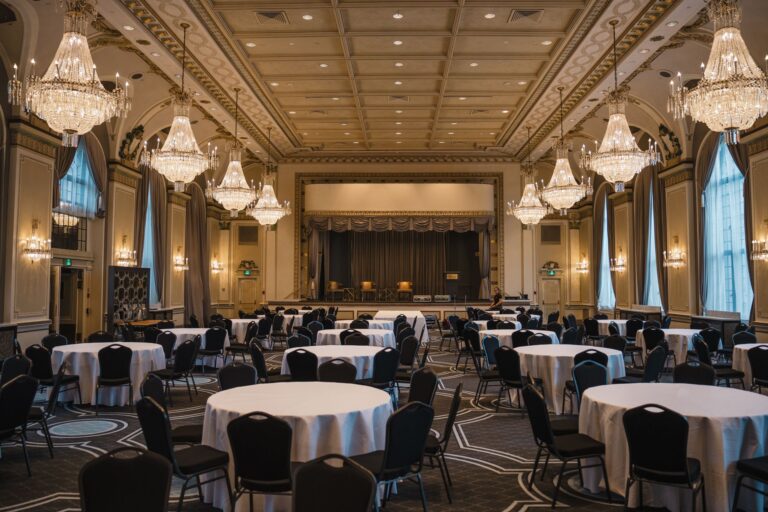
Outside those doors, just over two hundred guests filled the ballroom of the Winslow Grand, the anchor property of the hotel company my father had built from a single failing motor inn off old Route 30, on the edge of a two stoplight town called Bellwether Junction, Nebraska, that most of the people in that ballroom had never heard of and never would. String music drifted through the walls. Cameras waited at the back of the room, including the livestream camera that Odette herself had insisted on, because she wanted every Winslow employee watching at home to understand something about who held the power now. My fiancé, Weston Kane, stood under an arch of white roses, ready to marry the woman his mother had spent two years describing to anyone who would listen as lucky.
I need to explain what Weston actually was, because that word, lucky, worked on me for longer than I like to admit.
Weston was beautiful the way expensive things are beautiful, polished by attention, arranged to be admired from the correct angle. He had a voice built for boardrooms and a laugh that always arrived exactly on cue. He was fluent in the language of power because he had spent his whole childhood watching his mother perform it, and he had learned to use that fluency without ever building anything real underneath it. He was charming to everyone except the people who worked for him, and even to them he was charming whenever someone important was in the room. He made you feel seen in public and invisible at home, and the slide from one to the other happened so slowly that you never caught the exact moment it started.
We met at an industry conference in Vienna. He found me at the hotel bar after my panel, and he opened with a compliment that managed to be specific and warm at the same time, which is a harder trick than people think. The panel had been exhausting and I was tired, and he was funny, honestly funny, for the first hour. I remember thinking, here is a person who is actually paying attention to me. It took me two years to understand that what I had mistaken for attention was something colder. He was studying me. Calculating, quietly and with real precision, the exact distance between how warm I seemed and how much I was actually worth.
What he calculated was this. I held a 31 percent voting stake in the Winslow Group, inherited from my mother and consolidated when I became the company’s legal counsel. The hotels were profitable and still growing. My father was healthy, but he was not young, and everyone in that family knew it. In two or three years, once my father stepped back from day to day control, I would effectively run one of the more valuable midsize hospitality companies in the country. Weston and his mother had been watching the Winslow Group for years before I ever walked into that bar in Vienna. They needed someone on the inside, and I turned out to be reachable.
I would later learn that Weston had approached two other women before me. One turned him down flat because she had already heard things about the Kane family that made her uneasy. The other dated him for a few months before she noticed her banking passwords had quietly changed, and ended it the same week. I was the third attempt, and I was the one who stayed long enough to matter.
For the record, I do not think Weston was incapable of anything resembling feeling. I think he was capable of it the way some people are capable of playing an instrument competently, well enough to produce the expected sounds, without ever understanding what the music was actually for. There are moments from those two years I return to differently now than I did at the time. Whether what was there was real or performed does not change much about what happened afterward. It does not change what I had to do about it.
Odette Kane had never forgiven me for having more money than her son.
She came into the bridal suite without knocking, diamonds catching the light at her throat, her smile already assembled for whatever she had planned to say next. My four bridesmaids, women I had known since law school, went completely still the moment she stepped through the door. They had already seen the uniform. I had not.
“You found my gift,” Odette said.
“Where is my dress,” I asked.
“Safe.” She let the word sit in the air for a moment, enjoying it. “Weston agrees that a little humility would do you good. Wear the uniform. Show everyone in that ballroom that you finally understand what a marriage actually requires of a woman.”
Weston appeared behind her in the doorway, adjusting his cuff links with the unhurried precision of a man who is already certain he has won. He did not look embarrassed. It had simply never occurred to him that he might need to.
“Mother thought it would be meaningful,” he said. “Symbolic. After today you won’t need to play executive anymore. Sign the postnuptial documents, transfer your voting shares into the family trust, and focus on being a wife. It doesn’t have to be complicated.”
There it was. The thing they had spent months denying they wanted, said out loud in a bridal suite forty minutes before a wedding, in front of witnesses, while I stood there in a rose gold bracelet with a small enameled acorn charm that was not actually a charm.
I looked down at the uniform. Winslow Housekeeping was stitched over the breast pocket in the same looping script my father had chosen forty years earlier, because his own mother had liked the way it looked on the linens. Odette had chosen this uniform on purpose. She knew the history, because Weston had told her, and Weston had told her because I had told Weston, back when I still believed we were building something together that deserved my trust. She knew that my grandmother, Faye Winslow, had cleaned motel rooms for fourteen years while raising my father alone, saving every spare dollar in a coffee can under her kitchen sink outside Bellwether Junction. She knew my father had used that coffee can money to study hotel management, and had eventually bought the same failing roadside inn where his own mother had once made the beds. Odette thought that history was a wound. She thought it was something she could press on until I broke.
My father, Warren Winslow, stepped into the suite. He had been standing just outside the door, which told me he had heard every word of it. His face hardened as he took in the uniform, then the note, then Odette’s expression, which had not changed at all, because she did not believe she had done a single thing that needed hiding.
Get a new story in your inbox every morning.
Facebook doesn’t show you every story we post. Our free newsletter does. Join 2,500+ readers.
“Say the word,” he said quietly, looking only at me. “And this wedding ends right now.”
I touched the little enameled acorn on my bracelet. The recorder built into it was the size of a shirt button and had been running for four hours straight. It had already caught the conversation Weston and his mother had outside this door before they ever walked in. It had just caught everything they said inside it too.
“No,” I said. “The wedding continues.”
Odette laughed, a bright, delighted sound, unguarded in the way that people only sound when they think they have already won. “Finally. Some sense.”
I asked my bridesmaids for a moment alone. They left reluctantly, each one squeezing my arm on her way past. When the door clicked shut, I turned to my father.
“I need you to carry the tablet to the altar,” I said. “The documents are in the encrypted folder. Passcode is the year Grandma bought the inn.”
His jaw was tight. “How long have you known?”
“Four months of documentation. The board vote happened this morning.”
Something moved across his face, some tangled combination of pride and grief and fury that I recognized instantly, because I had felt all three of those things myself at two in the morning at my own kitchen table, staring at wire transfer records and trying to understand how a person I had loved could be so deliberately careless with that love.
I changed into the uniform. My bridesmaids cried when they came back in and saw me standing in gray instead of silk. I did not cry. I pinned my grandmother’s small silver brooch, a plain piece with a single piece of amber set in the center, just above the embroidered Winslow name on the pocket. I smoothed the fabric flat with both palms. Then I slid the sealed envelope into the uniform’s hip pocket and checked my bracelet one last time.
When my father offered his arm at the ballroom doors, his eyes found mine, and the question in them had nothing to do with strategy anymore.
“Are you sure you’re all right?”
I looked at the doors in front of us. Beyond them I could hear the shift in the music that meant the processional was about to start.
“They wanted a spectacle,” I said. “I’m giving them one.”
The ballroom doors opened.
Just over two hundred people turned toward me at once. I watched every one of them register the uniform, the gray fabric, the total absence of the silk gown that had been hanging in that suite for a solid week. The room held its breath the way rooms do when something unexpected is happening and nobody has decided yet how to feel about it.
Weston’s smile widened. He was reading my appearance as surrender, and watching him read it that way, wrongly, sent something cold and completely calm settling into my chest.
I stopped halfway down the aisle.
“My grandmother wore a uniform very much like this one for fourteen years,” I said. My voice carried, because my father had always insisted on excellent acoustics in every ballroom he ever built. “She scrubbed bathrooms. She changed sheets. She saved every dollar she could get her hands on. My father used that money to study hotel management. Together they built the company that certain people in this room have spent the last two years trying to steal.”
The silence was absolute.
Odette rose from the front pew, diamonds catching the light, her composure intact but only barely. “This is inappropriate.”
“So was hiding my dress.”
I took the envelope out of my pocket and handed it to my father. Inside were copies of wire transfers, six shell company registration documents spread across four different states, forged board authorizations carrying my digital signature, and a selection of emails between Weston and Odette that I had trimmed down because the rest were too tedious for a public occasion. Over nine months, they had moved forty one million dollars out of Winslow renovation accounts and into entities they secretly controlled.
That money had been meant to fund the full refurbishment of three of our properties. Instead it had funded a life Odette believed she deserved, and a life Weston believed he had earned simply by marrying me.
Weston’s composure came apart slowly, the way expensive things always come apart, the confidence first, then the certainty, then the easy assumption that consequences were something that happened to other people. “Those documents are private.”
“Some of them,” I said. “Some came out of the forensic audit that started the day you submitted a vendor invoice using a digital signature you copied from my legal filings, without my authorization.”
Odette went pale under her makeup.
I had been serving as the Winslow Group’s chief compliance counsel for seven years. I had overseen regulatory filings across four jurisdictions, negotiated settlements that kept three properties out of litigation entirely, and rebuilt the company’s internal audit framework after a minor accounting irregularity the year before Weston ever walked into my life. People found it easy to underestimate me in that role, because I wore silk and spoke quietly and had a habit of letting other people believe they controlled the conversation. Odette found it easy to underestimate me in particular, because she had decided who I was before she had even finished shaking my hand the first time we met.
None of them knew I had spent four months tracing every payment, preserving every server log, coordinating with outside auditors under a strict confidentiality agreement, and meeting weekly with federal investigators who had already been building their own case and found mine considerably useful.
The clue that started all of it was Weston’s carelessness about passwords. He used the same one for our wedding planning website that he used for one of the shell companies’ administrative portals. I found it by accident, following up on a vendor discrepancy late on a Tuesday night when I should have been addressing invitation envelopes. I stared at the screen for a long time before I understood what I was actually looking at. Then I made myself a cup of tea, sat down at my own kitchen table, and thought very carefully about what to do next.
I did not confront Weston. I had learned, across years of legal work, that confrontation is the last tool you reach for, not the first, and I had learned across two years with him that he was extraordinarily skilled at denial, at recasting, at finding whatever version of a story served him best and delivering it with enough conviction that the other person started doubting their own read of events. Confronting him with half the evidence would only have handed him time to destroy the rest of it.
So I kept planning the wedding. I kept being his fiancée. I kept attending his mother’s dinners and laughing at her jokes and behaving, in every visible way, like a woman who was happy and had no reason not to be. It was a performance, and I am not proud of how naturally it came to me. But it was necessary, and it protected the evidence, and by the end I had become a better liar than Weston had ever managed to be.
I spent the first week after finding it looking for an explanation that was not what it looked like. There was not one.
Weston stepped toward me, his voice dropping into something meant to sound reasonable. “You’re confused about what you found. We were protecting the family.”
“Your family,” I said. “Not mine.”
The ballroom screens, which had been quietly cycling through our engagement photos and a slide reading WESTON AND ADELINE, 3 YEARS TOGETHER, went dark. Then they lit back up with a clean, formatted timeline of transfers, partially redacted account numbers, signed authorizations, and a final note from the independent board committee confirming a vote completed at eight o’clock that morning.
BOARD RESOLUTION 2026-07: WESTON KANE TERMINATED FOR CAUSE. CIVIL RECOVERY AUTHORIZED.
The room erupted, not all at once but in rolling waves as different guests reached the screens at different speeds and arrived at the same understanding. Weston spun toward the row where his father sat and found a man who had stopped pretending sometime that morning.
“You knew?” Weston said.
His father looked past him, toward the windows.
“He cooperated,” I said. “In exchange for staying out of the civil complaint. He gave us the account access logs himself.”
Odette moved toward the ballroom’s technical station, intending, I think, to kill the displays. My father raised one hand. The doors closed. Hotel security, briefed the night before, moved quietly into position.
I kept walking until I was standing directly in front of Weston.
He was taller than me. He had always used that height as a form of pressure, the old habit of men who mistake physical presence for authority. He looked down at me and said, very quietly, “You’ll destroy your own reputation doing this.”
“No,” I said. “I’m protecting it.”
I unfastened the acorn charm from my bracelet and set it on the altar. The recordings had already gone to the investigators and been preserved in three separate locations, but what remained inside that small charm was more than enough for the room.
Odette’s voice, from forty minutes earlier: “Sign the postnuptial documents, transfer your voting shares, and focus on being a wife.”
Then Weston’s voice, from a conversation three weeks before the wedding: “Once the shares are transferred and the marriage is established, I can file for dissolution and claim the transfer was voluntary. She’ll spend years in litigation trying to claw it back.”
The gasps moved through the room in waves.
Weston stared at me across the altar. Something in his face had finally given way completely, the performance stripped down to what was underneath it, which was a man who had never actually believed I would go through with this.
“You recorded me.”
“For four months,” I said. “You chose the wrong woman.”
The ballroom doors opened again, and this time there was no music. Two financial crimes investigators walked in with uniformed officers behind them, carrying warrants federal prosecutors had secured that same morning after reviewing the evidentiary package I had submitted the week before.
One of the investigators walked straight to Weston. “Weston Kane, we have a warrant for your arrest on charges including wire fraud, conspiracy, identity theft, and obstruction of a federal investigation.”
Weston stepped backward into the altar. “This is a wedding day tantrum.”
“No,” I said. “This is an audit.”
Odette moved toward me, some impulse I still do not fully understand, maybe thinking the original device was still in my pocket and could be grabbed back. My father stepped between us before I had to. An officer caught her wrist before she got close.
“You ungrateful little maid,” she said.
I looked down at the uniform I was still wearing, then back up at her.
“My grandmother taught me that honest work has dignity,” I said. “You spent two years trying to teach me that expensive clothes are proof of worth. They aren’t. Neither are you.”
Weston’s lawyer pushed through from the side of the room, whispering fast and urgent, but Weston shoved him aside and pointed at me with the look of a man who still believed, even now, that this could somehow be recovered. “We are still getting married. You cannot do this and walk away.”
I took the engagement ring off my finger.
“We were never getting married,” I said. “The officiant standing at this altar isn’t a licensed minister. He’s an investigator from our corporate insurance carrier. The marriage certificate was never filed. This ceremony was never real.”
Weston went completely still.
“However,” I said, “every document you signed at the rehearsal dinner last night was real. You signed acknowledgments confirming your knowledge and control of the shell companies. You signed a temporary standstill agreement preventing the movement or destruction of assets. Odette signed as a witness.”
The evening before, I had let Weston believe he was doing me a favor. That part took some care. He had to believe the favor was for me and not for him, and he had to feel generous providing it, because generosity was one of the feelings he performed most convincingly. I told him the prenuptial attorney had flagged some language, that a few documents needed his signature before the ceremony could legally proceed. He was slightly suspicious, but not suspicious enough, because the request fit his idea of me as someone who needed reassurance and careful handling. He liked being the one who handled things. He signed the documents in the private dining room while his champagne sat untouched and his father watched from the corner with an expression I had learned, over months, to read as a man quietly calculating whether the exits were still open.
Weston signed without reading carefully. That was always the thing about Weston. He had so much confidence in his own ability to recover from any situation that he rarely did the work of preventing one in the first place. He signed the acknowledgments of knowledge and control. He signed the standstill agreement. He signed everything I put in front of him, one page after another, certain that any trap in that room was one he himself had set.
He had been in a good mood that night. He had thought he was winning.
My father opened the final document. “As majority shareholder,” he announced, “I accept the board’s decision to terminate Weston Kane and authorize civil recovery proceedings against all Kane controlled entities.”
The officers led Odette away. Weston followed, still shouting back at me over his shoulder as they crossed the room. I watched him go.
“I gave you three chances to tell the truth,” I said.
He did not hear me. Or he did not want to.
I meant it exactly. Three separate times in the months before the wedding, in three separate conversations he never knew were being recorded, I had handed him an opening. I told him once, I’ve noticed some irregularities in the renovation accounts, let’s sit down with the auditors together and sort it out. I told him, I want to know we’re building this company on solid ground before we build a marriage on top of it. And once I said it plainly, with no cushioning at all: Weston, if there’s something I should know about the renovation fund, now is the time. Every time, he looked me straight in the eye and told me there was nothing to know.
So I finished the audit. I filed the evidence. I coordinated with federal investigators. I planned the wedding, invited every guest, and walked down the aisle in a maid’s uniform to give him one final, public chance to understand exactly what he had done.
Outside the hotel, reporters who had been watching the livestream had already gathered at the entrance. I did not stop to speak to them. I went upstairs to Odette’s suite, where hotel security had confirmed my real dress had been kept the whole time. I found it hanging in the closet, untouched, still zipped inside its garment bag. I changed alone, taking my time, smoothing the silk down with both palms. I pinned my grandmother’s brooch at the neckline, exactly where it had always been meant to go.
Then I went back downstairs. My father and I returned to the ballroom, where the flowers were still standing and the dinner had already been paid for and just over two hundred people sat in complicated silence, unsure whether they were supposed to leave.
We asked them to stay. We turned the reception into a fundraiser for Winslow employees’ education scholarships. By the end of the night, the room had pledged enough to fully fund five scholarships. A journalist who had been there as a guest wrote a piece that ran the following week, and the fund received enough in additional donations to endow itself permanently.
Six months later, Weston entered a guilty plea. The server records and the audio left his legal team with no workable defense. He received seven years in federal prison and was ordered to pay full restitution on the forty one million dollars, plus interest and legal costs. Odette received five years for conspiracy and obstruction. Their personal assets, the mansion, the cars, three investment accounts, and a beachfront property in the Bahamas that Odette had paid for with funds I eventually traced back to a renovation invoice from the previous spring, were all liquidated and applied to the Winslow Group’s recovery.
I became the company’s chief legal officer. One of my first official acts was creating the Faye Winslow Fund, named for my grandmother, built to provide scholarships to employees and their children pursuing degrees in hospitality, finance, and law. The first scholarship went to the daughter of a Winslow Grand housekeeper who had worked for the company for thirteen years and was studying finance at a state university two hours from the hotel where her mother still worked every week.
The fund grew faster than I had projected. In the first year it awarded eight scholarships across five properties. By the third year we formalized it as the Faye Winslow Foundation, with its own independent board and an endowment large enough to run permanently without a single dollar from the Winslow Group. Several of the hospitality associations my father had belonged to for decades contributed. Two of Weston’s own former business associates, men who had been burned by his schemes in ways they had been too embarrassed to discuss publicly, made significant anonymous donations of their own.
My grandmother would have found the entire thing both moving and slightly excessive. She was a practical woman. Mostly she would have wanted to know whether the scholarship recipients were actually any good at their work.
On the anniversary of the wedding that never technically happened, my father and I stood together in the lobby of our newest property, a historic rail hotel we had bought and restored over eighteen months. The restoration had taken every bit of that time, and the finished building was the kind of place that made people stop in the entrance just to look up. On the wall near the door, framed simply, with no plaque and no explanation, was a photograph taken the morning of the wedding: me walking down the aisle in gray, head level, my father’s hand around mine, just over two hundred people watching in total silence.
Beneath it, on a small wooden shelf, sat my grandmother’s silver brooch.
People occasionally tell me that what happened that day must have been terrible. They mean it kindly, as sympathy. Some of them mean it as a kind of compliment, the idea being that you survived something terrible, and that survival alone makes you strong.
They are wrong about what actually happened.
Odette had intended humiliation. What she produced instead was clarity, a room full of witnesses, every word recorded, every document signed, every choice made in front of people who could never later claim they had not seen it happen. She built me a stage without meaning to, and I used it.
My grandmother scrubbed floors in a uniform not unlike the one I wore that morning. She did not do it because she lacked dignity. She did it because she had a son who needed tuition and a future that required money, and money required work, and in her town, in those years, work for a woman like her meant hotel housekeeping. She made beds and cleaned bathrooms and sent her son off to school and watched him build something out of it, and as far as I know she never once described what she had done as a sacrifice. She called it what needed doing. She was never a sentimental woman.
Odette chose that uniform to make a point about where our family had started. What she never understood was that our family’s origin was never a wound. It was the thing that made us who we are.
My father built a company. My grandmother made that possible. I spent seven years making sure the company my father built was protected, legally and financially and structurally, from exactly the kind of threat that Weston and his mother turned out to be. The three of us were, in different ways and across different generations, doing the same work. Making sure the thing we built could last. Making sure it could not be easily taken from us.
Dignity is not a function of what you happen to be wearing, or who is watching, or what conclusions they think they’re drawing about you in the moment. It is a function of what you actually know about yourself, and what you are willing to do about it.
I had always known who I was. I had simply allowed other people to believe otherwise, for a while, because it was convenient and because I needed the time.
That was the day I stopped allowing it.
And the people who mistook my patience for weakness got to spend the rest of their lives sitting with exactly what they had misunderstood.
I did not feel sorry for them.
I was not sure I was supposed to.
This story is a dramatization. Names, characters, and details are invented, and any resemblance to real people or events is coincidental.