
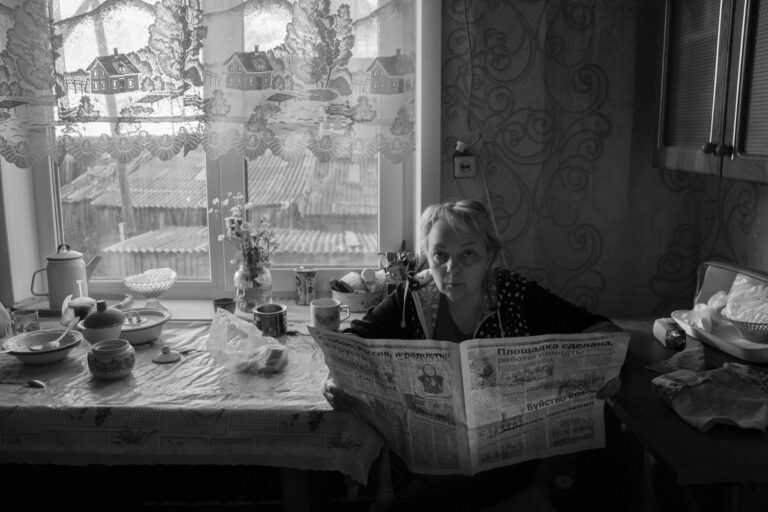
The rain that Thursday was the gray kind that does not fall so much as hang, and Corliss was tapping the kitchen table with one fingernail the way Ewald used to tap the arm of his chair when he had already decided a thing and was only waiting for me to catch up.
I had made coffee. I always made coffee when she came, even on a Thursday, even when she called ahead and said she could only stay a minute. I set the good mug in front of her, the one with the chickadee on it, and I sat down across from my only child and I waited.
“Mom,” she said, “Bryson and I have been talking.”
That is a sentence I have learned to be afraid of. When my daughter says she and her husband have been talking, it means the talking is finished and I am about to be told the result.
“We think it’s time we handled some things for you,” she said. “The bills. The house. All of it. We want to put my name on your accounts, and there’s a paper Bryson looked into, a power of attorney, so we can just take care of everything and you don’t have to worry about any of it anymore.”
She said it the way you would offer to carry a heavy bag for a woman at the grocery store. Kind. A little impatient. Already reaching.
I looked at her face and I looked for the girl I raised, the one who used to run across the church lot in a hand-me-down coat hollering for me to wait, and I could not find her anywhere in the woman tapping my table. Somewhere in the last few years the looking had changed. My daughter had stopped looking at me like her mother and started looking at me like a task on a list she had not gotten to yet.
I am sixty-six years old. My husband is four years in the ground. I cooked in the school cafeteria in this town for better than thirty years, and I know the arithmetic of doing without the way I know the back of my own hand. I know when a thing costs more than it is priced. And I knew, sitting there with the rain hanging outside the window, that this paper would cost me everything and they had marked it down to nothing.
“If you think it’s best,” I said.
It came out quiet. It surprised me, how quiet.
Corliss relaxed all at once, the way you do when a door you expected to be locked swings open. She had come loaded for a fight. She had the arguments ready, I could see them, folded up behind her eyes, all the reasons and the she-gets-so-confused-lately and the we-only-want-to-help. And she did not need any of them. She patted the back of my hand twice, quick and light, the way you pat a nervous dog you are not sure will bite. She leaned across and kissed my forehead, dry and fast, already gathering her purse. She left the chickadee mug half full and did not rinse it.
I sat at the table a long while after her car pulled out. The coffee went cold. I want to tell you I cried, but I did not. Something else was happening in me, slower and harder, the way ground freezes.
They come every Sunday, Corliss and Bryson. They have come every Sunday for three years. Five thirty on the dot, and the meal had better be on the table, because Bryson gets low blood sugar and gets mean with it. They bring nothing. Not a roll, not a bottle of pop, not so much as a bag of ice. Bryson goes straight to the recliner, Ewald’s recliner, and claims the big television for whatever ballgame is on, and he does not get up until it is time to leave. Corliss walks through my house touching things, opening the hall closet, running a finger along the top of the door frame like a landlord deciding whether to keep my deposit. And at the end of the night they load up the leftovers, all of them, into the plastic containers I will not get back, and they drive off to the nicer house across the county with my Sunday in the trunk.
I had been telling myself for three years that this was love. That a table full of people who did not thank me was still better than a table with nobody at it. Loneliness is its own kind of poverty, and I had been paying that particular bill with everything I had, and calling it a bargain.
That Thursday I stopped calling it a bargain.
I did not do anything foolish. I want to be clear about that, because of how it looks in the telling. I did not go bare and dramatic. I did not empty my house down to the walls to make a point. I am a practical woman. What I did was reclaim one room.
The front room was theirs, not mine. It had been theirs for three years. The whole thing was arranged around Bryson’s ballgame, the recliner aimed at the television, the couch angled so Corliss could see the screen and the driveway both. It was a waiting room for a service I provided. So on the Saturday, I called the consignment place out on the highway and they sent a truck, and the big television and the recliner went out my front door and did not come back. The fellow gave me a receipt and a check, and I felt lighter watching that recliner go up the ramp than I had felt in a year.
I gave away the second chest freezer too, the one in the garage that I kept stocked with meals for them, casseroles and soups portioned out in case they wanted to take extra, which they always did. A young couple from the Lutheran church came and got it, the Ostroms, expecting their first, and the girl cried a little and hugged me and I thought, that is what a thank-you sounds like. I had forgotten.
Then I made that room mine. Wilma Prentiss’s grandson, a good sturdy boy named Dell, came over and helped me move my mother’s treadle sewing machine in from the spare room where it had sat under a sheet since Mama passed. We set it by the window where the light is good in the afternoon. I brought in a wide table for cutting and laying out, and a lamp that actually lets a woman see her stitches, and one chair. One good chair, with arms, that fit me. My quilting studio. At sixty-six I finally had a room in my own paid-off house that was for me and nobody else.
Wilma came over while Dell was carrying the last of it and took a coffee can of buttons I did not need, just to be part of it. She stood in the doorway of my new room and looked at the sewing machine where the couch used to face the game, and she said the thing I have not been able to shake since.
“You know, Ardith,” she said, “that girl quit looking at you like her mother a long time back. I’ve watched it from my kitchen window. She looks at you like the house came with a cook.”
I did not answer her. There was nothing to say that would not have been a lie in one direction or the other.
Sunday came. Five thirty. I heard Corliss’s key in the lock, the key I gave her years ago for emergencies that were never emergencies. The door opened. And then there was a silence that I will remember the rest of my life, that held-breath second before she understood what she was looking at.
Then she cried out. Not a frightened cry. An offended one. The cry of a woman who has found her reserved seat given to somebody else.
“Mom? MOM. What is this? Where’s the TV? Where’s the recliner? What did you do?”
Get a new story in your inbox every morning.
Facebook doesn’t show you every story we post. Our free newsletter does. Join 2,500+ readers.
Bryson’s boots came heavy behind her. He came through into the front room and stopped when he saw it, the sewing machine, the table, the one chair, the blank wall where his ballgame used to live. Then he came into the kitchen and stopped again when he saw me, sitting calm at the table with my hands folded, no dinner on the stove, no places set.
“What did you do?” he said. Low. Like a threat.
“I sold a few things,” I said. “The recliner and the television. Gave the freezer to the Ostroms.”
“Why would you do that?”
“Because,” I said, “you two want to manage my money for me. And I thought before I let anybody manage it, I ought to find out what it feels like to manage it myself. Turns out I like it fine.”
I watched his face change. The shock went sour and turned into something red and ugly around the eyes. Corliss started in behind him, high and fast.
“This is so selfish. This is exactly the kind of thing. We come here every single week, we keep you company, we make sure you’re not sitting here alone, we make sure you’re okay, and this is how you repay us?”
Repay. There it was. The word landed on the table between us like a coin she did not mean to drop. Repay. As though the Sundays had been a loan she made me, and the interest was coming due, and I had missed a payment.
“There’s no dinner tonight,” I said. “I didn’t cook.”
That silenced her for a second, and in that second Bryson found the thing he had been reaching for all along. He said it quiet, almost to Corliss, but loud enough for me to hear, because he meant for me to hear it.
“You see how she is. This is what I’m talking about. Selling furniture, no dinner, snapping at us. Maybe this is proof she can’t make her own decisions anymore.”
And I understood, sitting there, that this was the story. Not a thing he was worried about. A thing he was going to use. The confused old woman who cannot be trusted, sold to a judge if it came to that, sold to the family, sold to anybody who would buy it. He had found his lever and he set it down where I could see it, on purpose, to watch me flinch.
I did not flinch.
They stormed out. Corliss was crying by the door, the angry kind, and Bryson slammed it so the pictures rattled against the bare wall where the television used to be. Then it was quiet, quiet like the house had exhaled.
I sat in my one chair in my new room. And I laughed. Once. Not because anything was funny. It came up out of me like a hiccup, one hard note, and then it was gone. I understood, right then, that I had lost my daughter a long time ago, somewhere back when I was too busy being proud of her to notice. She was already gone. And the only thing I had left that they had not carried out the door was myself. And I decided I would stop losing that too.
Let me tell you about Ewald, because you cannot understand what came after unless you understand what came before.
Ewald Halloran was a careful man. He drove a route for the co-op for thirty-one years and never once was late, and he kept every paper that ever came into this house in a gray metal file box in the hall closet, the receipts and the warranties and the insurance and the tax papers, all of it labeled in his square little pencil printing. People laughed at him for it. I did too, sometimes. When he passed, four years ago now, of the heart, that box was the only reason I did not drown in the paperwork of a death. Everything was there. He had left me the house, paid off in full, and a life insurance payout of about twenty-two thousand dollars, which is not a fortune but is not nothing, and which I put away and did not touch, because Ewald would have wanted me to have something behind me.
We raised Corliss on my cafeteria wage and his co-op wage, which is to say we raised her on arithmetic. There was a right way to have a coat and a wrong way, and when Corliss was in the eighth grade the right coat cost thirty-eight dollars I did not have, so I had a tooth that had been aching for a year pulled instead of crowned, because the pulling was cheaper, and I gave her the coat and told her I had gotten it on sale. I still have the gap. I run my tongue over it sometimes and think about that coat.
There was a class trip to the capital in her junior year, and I took a second shift washing dishes at the Elks for two months to send her, and I told her the school had a fund for it so she would not feel poor. There was a car she wanted to buy at nineteen, and the loan needed a co-signer, and I signed my name under hers without reading past the first page because she was my girl and she said she had it handled, and thank God she made those payments, because if she had not it would have been me.
She lived at home until she was twenty-six. Paid me nothing. I never asked, because a mother does not charge her child rent, that is what I believed, that is what my mother believed. And Corliss worked all that time, a good job at the insurance office, and she saved every dollar she did not spend on herself, because she was not spending it on us. And when she was twenty-six she took all that saved money and she and Bryson bought a house across the county that was nicer than the one she grew up in. Bigger. Newer. Two bathrooms.
And here is the part I am ashamed of. I was proud. I stood in their new front room the day they moved in and I felt proud, like I had done something right, like her nice house was my report card. I did not do the arithmetic then. I did not sit down and figure that the down payment on that house was every dollar she had not paid me for eight years of meals and laundry and a roof. I did not let myself see that I had funded the house that would look down on mine. Pride is a fog. It took me a long time and a metal file box to burn it off.
And the Sunday dinners. I have to be honest about the Sunday dinners, because I lied to myself about them for three years and I am done lying. They were not visits. A visit is when someone comes to see you. Nobody came to see me. They came to be fed and entertained and sent home with the surplus, and I was not the person they came to see, I was the place it happened. I was the site of a service. The way a woman is the site of a service at a restaurant, except the restaurant pays her. I paid them, in groceries and in the fiction that I was not alone.
Monday, Corliss came back. Alone, but not really alone, because Bryson was in everything she carried. She had a leather folder, dark green, the kind you buy to look serious. She set it on my kitchen table where the chickadee mug had been and she opened it and slid it toward me and uncapped a pen.
“We shouldn’t have argued,” she said. “I hate fighting with you. Let’s just get this handled so we can go back to normal. It’s just the power of attorney and adding me to the accounts. It protects you, Mom. If anything ever happened to you, I could step in.”
I looked at the papers. Dense stuff, small type, the language they write so a tired person will not read it. But I read insurance papers for a living, in a manner of speaking. Thirty years of school forms and lunch-account paperwork and Ewald’s file box teaches a woman to read the fine print. And there was the word, sitting in the second paragraph like a tack in a chair.
Durable.
A durable power of attorney does not end when you become unable to think for yourself. That is the whole point of the word durable. It stays in force especially then. It is a key that keeps working even after you cannot see the door. Bryson had already told me the story he was going to tell about my mind. And here was the paper that would let that story win.
I will tell you the truth. For one second, one tired second, I almost signed it. Not because they fooled me. Because I was tired. Tiredness is a weapon and they knew how to use it. It would have been so easy to sign and have the fight be over and have my daughter kiss my forehead again even if it was dry and fast. That is how they get you. Not with a lie you believe. With an exhaustion you would do anything to end.
Then I saw Bryson’s face again, the way it had looked in my front room. Not concerned. Furious. A man is not furious about a woman he is worried about. A man is furious about a thing he thought was his that got moved.
“I’d like a few days to read it,” I said.
Her jaw tightened. But she could not say no to that without showing her hand, so she said fine, take your time, and she left the folder on my table like a flag planted in ground she meant to claim.
I did not leave it there. That night I got Ewald’s gray file box down from the hall closet and I set it on the kitchen table and I opened it, and I started to do what I used to do with Corliss’s homework when she was small. I spread it all out on the floor where I could see the whole of it at once. Every statement. Every letter. Every scrap.
And I found things.
There was a cash withdrawal. Fifteen hundred dollars, in cash, from a branch clear across town on the far side, a branch I have never once set foot in. Three months back. I sat on the floor and I stared at the date until it meant something, and then it meant everything, because three months back was when Bryson had come by on a Sunday afternoon and said he needed to use my printer for some work thing, and I had been in the shower, and I had come out and he was at Ewald’s desk in the den with papers, and he had smiled at me and said all done.
Once I saw the first one I saw the rest. There was a store credit card, a card from a home-goods chain, in my name, that I never opened, never applied for, never held in my hand. A balance of about forty-five hundred dollars. The charges were in a town I do not shop in. Corliss’s town. There was an automatic payment coming out of my checking every month, a truck loan, Bryson’s truck, that had been set up during a spell last year when they had offered so sweetly to “help me get my bills organized.” They had organized his truck payment right into my account. And there was a small annuity Ewald had left, nothing big, and the beneficiary had been changed off of the church and onto Corliss, in handwriting that was trying to look like mine and did not.
Six months before all this, I had tried to get a modest credit line to fix the porch, and I had been turned down, and I had sat in my car in the bank lot and felt ashamed, and told myself I had let my credit go, that I was a foolish old woman who did not keep up. That is the part that still burns. They had wrecked my name and let me blame myself for it. They let me carry the shame of a thing they did.
I added it up on the back of an envelope, the way I add up a grocery order. It went past twenty thousand dollars. More than Ewald left me. They had already taken more than the insurance, in secret, while sitting in my recliner eating my pot roast and calling it keeping me company.
There is a lawyer in town, Mr. Sylvan Reese, in a little office up the stairs over the bakery, so the whole place smells like bread, which I took as a good sign. He has a ficus in the corner and his certificates framed on the wall and a way of listening that I was not used to. I laid it all out for him, the folder, the withdrawal, the card, the truck, the annuity, and he did not interrupt me once. He let me get to the end. Then he took off his glasses and he said something I have carried ever since.
“Mrs. Halloran, I want to be careful with my words. This is not a family disagreement. Families disagree over money all the time and I do not get involved in that. This is a pattern. This is financial exploitation of an elder, and what makes it serious in the eyes of the law is that it is systematic.”
Systematic. That word came down on me and stayed. Not a moment of weakness, not a child in a hard spot who borrowed and meant to pay it back. A system. A method. Piece by piece, over months, while smiling at my table.
I went to work. I am a practical woman, I told you that. I opened a new account at a different bank on the far side of town, one they had no key to. I chose the PIN myself and I put my body between the keypad and the whole world when I did it. I redirected my pension and my social security into the new account. I froze my credit at all three of the bureaus, which takes an afternoon and a lot of holding, and I filed fraud disputes on the card and the withdrawal. I started a notebook, and I wrote down every phone call, every date, every dollar, in my own hand. I took the whole file box to the library and made copies of everything, two of everything.
And I gave one set to Wilma Prentiss, in a sealed manila envelope, with Mr. Reese’s business card paper-clipped to the front. I told her, if anything happens to me, if I fall, if I get confused for real, if my records go missing, you take this to that man. She held it to her chest with both hands and did not make a joke, which for Wilma is how you know she understood.
Corliss went silent. That was her next move, and it was a smart one, because she knew me. She bet that the quiet would do her work for her, that a week of no calls and no Sundays would soften me up, that the loneliness I had been paying against for three years would come back and collect, and I would call her crying and sign anything to have my family back.
The next Sunday came. Five thirty came and went. Nobody’s key in the lock. And I made myself a fried-egg sandwich, the yolk still soft the way I like it and never make it because Bryson said once that runny eggs turned his stomach. I opened a jar of the tomatoes I put up in September and stewed them on the stove with a little butter and sugar and pepper. I put the radio on low, the station that plays the old country out of the county seat. I ate my supper at my own table.
Nobody said the sandwich was a sad little supper for a grown woman. Nobody took the leftovers, because there were none, because I made exactly enough for me. I washed my one plate and my one fork and my one pan. And that night I slept, all the way through, for the first time in longer than I could tell you. I woke up at six and lay there a minute wondering what was different, and what was different was that nothing hurt.
She broke first, which I had not expected. She called on the Wednesday.
“Mom, we need to talk. Can you come out to the house? We’ll do it here, it’s more comfortable.”
Her house. Of course. She wanted the ground to be hers. She wanted me small in her big front room that my grocery money helped buy.
“No,” I said. “I know about the fifteen hundred from the branch across town. I know about the credit card in my name. I know about Bryson’s truck payment coming out of my account. I’m not confused, Corliss. I’m documented.”
The line went quiet a long time.
They came to the house that evening, both of them, and I did something I have never done in my life. I opened my own front door only as far as the chain would let it. I talked to my daughter and her husband through a four-inch gap.
“Mom, this is ridiculous, let us in, we can explain all of it, there’s an explanation for every one of those things,” Corliss said, and Bryson behind her nodding, ready with the explanations.
I held up the green folder so they could see it through the gap.
“My lawyer has copies of all of it,” I said. “Wilma next door has copies. The bank has the fraud reports filed. So whatever you came to explain, you can explain it to them.”
And I watched my daughter’s face, and for the first time in her life she looked afraid of me. Not because I had power over her. I did not want power over her. She was afraid because I had stopped handing her power over me. That is a different fear and it is worse, because there is no bottom to it, no favor she could do and no cruelty she could threaten that would put it back.
It was Corliss who said the thing that told me everything. She stopped pretending there were explanations. Her voice went hard and low and she said it through the gap in the door.
“You owe me. I’m the one who stayed. I’m the one who was here. I gave up things for you, do you understand that, I gave up years. I didn’t steal anything. I took what was going to be mine anyway. You were just going to leave it to me. I moved up the timeline.”
And I heard it clear, standing there behind my own chain. I was listening to a woman who had decided the world owed her back the full cost of her own childhood, with interest, and that I was the debtor, and that everything I would ever have was really hers on loan. She did not think she had robbed me. She thought she had collected.
They left. And a day later my telephone started ringing off the hook with the church ladies, because Corliss had gone on the Facebook.
She had put up a photograph of the two of us from the county fair when she was maybe seven, her in pigtails and me holding her hand in front of the 4-H barn, both of us squinting and smiling into the sun of a day I remembered as one of the happy ones. And under that photograph of the happiest day I could remember, she had written a paragraph about her difficult mother. Her declining mother. Her toxic mother, the word she used, toxic, and how painful it had been to set hard boundaries with a parent whose mind was going, and how she hoped people would keep her family in their prayers during this impossible season.
She was stealing my life to tell it. She took the truest good day I had and she wrote a lie across the back of it. That is a particular kind of theft, worse than the money, and it worked for a while. People believed it. Some of them still do.
But here is what I have learned. A lie on Facebook shouts, and shouting is convincing for about a week. A court filing does not shout. It is made of dates and numbers and it does not raise its voice at all. It just stands there being true. And facts do not need to shout, because they do not tire, and they do not blink, and they are still standing when the shouting is hoarse.
Mr. Reese filed the complaint. Unauthorized withdrawal of fifteen hundred dollars. A fraudulently opened credit account in my name. An unauthorized automatic payment on the son-in-law’s vehicle draining my checking. An altered beneficiary. And an attempt to obtain broad durable authority over an elder’s assets. With the fees and the damages it came past the whole twenty-two thousand Ewald had left me, which is a bitter kind of arithmetic, that they had tried to take from me almost exactly the sum he had died leaving.
Corliss got a lawyer, and I watched that lawyer walk his client through the same three rooms every one of them walks through. First it did not happen, none of it, my client denies everything. Then when we showed the branch camera and the card application and the signature that was not mine, it became a misunderstanding, a family mix-up, poor communication. Then when the misunderstanding would not hold either, it became, quietly, would your client consider a settlement.
I would. On conditions.
I asked for the money back, all of it, plus the damages, plus my legal fees, and her lawyer did not much fight me on that, because the numbers were the numbers. But I had one more condition, and it was the one Corliss fought harder than she fought over a single dollar. I wanted a correction. On the same Facebook account, in front of the same church ladies and cousins and old neighbors who had read the lie, I wanted her to write that she had made false statements about her mother’s mind, that there had never been any abuse or decline, and that she had taken and used my funds without my permission.
She fought that condition for three weeks. She would rather have paid me twice the money than write those words where people could see them. That told me the money was never really the thing. The story was the thing. Whoever owns the story owns who you were.
But she signed, in the end, because her lawyer told her the alternative was a courtroom and the same facts said out loud. And the correction posted. Stiff and cold and clearly written by a lawyer, not one warm word in it, no apology, just the admission, the way you would read a legal notice in the back of the county paper. I read it four times. I did not feel triumphant. I felt something quieter and heavier than that. I felt like a woman who had gotten her own name back out of a pocket it had been picked into.
They repaid it all. Every dollar, the damages, my fees to Mr. Reese.
And I did the thing that I think must have galled them worst of all. I took that money, the very money they had schemed to get their hands on, and I bought myself a life with it.
There is a lake a county over, the good kind, with loons on it in the evening and tamaracks going gold along the far shore in October, and an ice-out in the spring that the whole town drives out to see. There was a little cottage for sale on it, pale siding and a narrow porch and a short dock, room in the side yard for a tomato patch and a birdbath. Not an ocean. I am a heartland woman, I do not want an ocean, an ocean does not know your name. But a lake a county over, that a woman can learn.
I bought it. With Ewald’s insurance money and my own hands on the pen this time. I bought a blue enamel kettle for the stove and two mugs, and I sat one yellow chair on the porch. Just the one, to start. Two mugs but one chair, because I decided I wanted to learn, at sixty-six years old, what it felt like to choose for myself who got to sit down beside me, instead of setting a place every Sunday for people who never once asked if I minded.
Corliss called one more time. It was after the last payment cleared, weeks after, and her voice was smaller than I had ever heard it.
“I’m sorry,” she said. “Mom, I’m sorry. I miss you.”
“I miss who I thought you were,” I said. It was the truest thing I could say, and it was not cruel, it was just true.
“I’m still your daughter.”
“Yes,” I said. “You are. And I am still your mother. But I am not your resource anymore.”
She was quiet, and then she said something about making it right, about how she had paid it all back, every cent, like the paying back had cleaned it.
“You can’t make it right by giving back what you took,” I said. “That doesn’t make it right. That only makes the math come out even. Those are not the same thing.”
And I let her go. I want to be careful how I say this, because it is the heart of the whole matter. I did not cut her off. I did not slam a door or curse her or vow never again. I released her, which is different. I let go of the rope I had been letting her use to haul on me, and I set it down, and I stepped back.
Then I hung up the phone and I cried, hard, standing at my new kitchen sink looking out at the lake. Because I want to be honest with you, and the honest thing is that peace is not a stone where your heart used to be. I still cry. I still remember a little girl in a hand-me-down coat running across the church lot with her arms out, hollering, “Mom, wait, Mom,” and me turning around to catch her. That happened. That was real. That she became the woman at my table does not unmake the girl in the lot. The hard discipline of getting old, I have found, is holding both of those in the same two hands and not letting either one crush the other.
I volunteer two mornings a week now at the little library in town, shelving and running the desk. A few weeks back a woman about my age came up to check out her books, and we got to talking the way women our age do, and she lowered her voice and told me her grandson had been after her to put his name on her accounts. “Just to help,” she said. “He’s a good boy. He worries about me.”
I went still. I know that stillness now from the inside.
I gave her the number for the legal-aid line and I made her write it down, and then I put my hand over her hand on the counter, and I told her the one thing I wish someone had told me across a gray kitchen table on a rainy Thursday.
“Being careful,” I said, “is not being unkind. You are allowed to be careful with the people you love.”
Wilma said a thing to me once over coffee, on my new porch, in the second yellow chair I bought when I decided she had earned it. She said, “Ardith, the trouble is you gave and you gave, and giving without respect isn’t love, it’s just you disappearing an inch at a time where nobody’s looking.” I have thought about that a hundred times. Sacrifice that nobody honors is not noble. It is a slow vanishing. And all those years I called my patience a virtue, they were reading it as permission.
My name is Ardith Halloran. I am sixty-six years old. I live by the lake. My deposits go into my own account. My locks are my own. And every Sunday evening, I cook exactly what I want, and I eat it slow, and I do not save the leftovers for anyone who would not save any for me.
The danger, I have learned, does not always come knocking as a stranger in the dark. Sometimes it comes to supper. Sometimes it has your own eyes and calls you Mom. And of all the things a woman my age is told to guard, the money and the house and the papers in the box, the one that matters most is the plain small account where you, and nobody else, hold the only key.
This story is a dramatization. Names, characters, and details are invented, and any resemblance to real people or events is coincidental.