
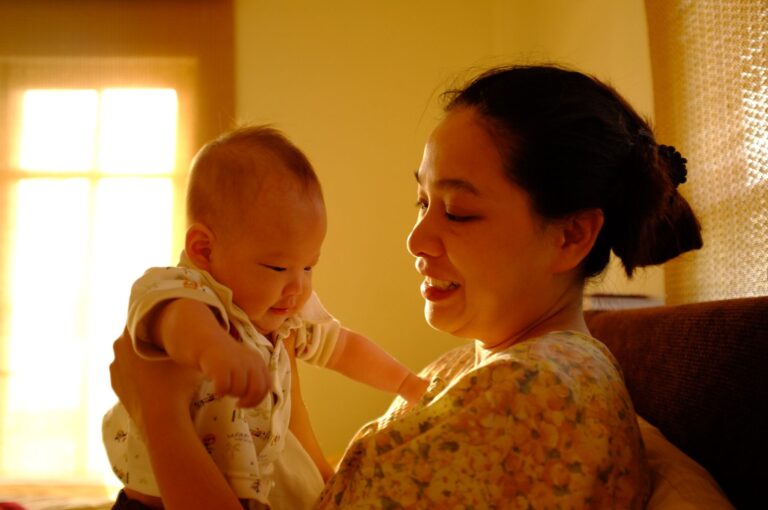
The stove-hood light was the only thing on in the kitchen at half past four, a thin yellow bar over the range that made the rest of the room look like the bottom of a well. I stood barefoot on the tile, and the cold of it came up through me the way it always did that early, before the furnace fully caught. Theo was asleep against my chest, two months old and weightless and heavy at the same time, his fist balled into the front of my shirt like he meant to keep me there. I had been up since two. He fed at two, and I never went back down after, because Dane’s parents ate at six and someone had to have it ready, and a while ago that someone quietly became me.
I had the bacon going low and the coffee cake batter resting and the eggs cracked into a bowl I had not yet touched to heat. I was doing it half in the dark on purpose. The baby slept better in the dark, and by then I could have laid that breakfast out with my eyes closed. Three years of six o’clock breakfasts teaches your hands the route.
Dane came in wearing yesterday’s clothes. I noticed that before I noticed his face. The same shirt from the day before, wrinkled across the back, and his tie still knotted at the collar, just loosened, pulled down an inch and left there. He had slept in his clothes. He had lain down somewhere in that house in his work shirt and his tie rather than come to bed, and I understood later that it was because he already knew what he was going to say and could not stand to say it lying next to me.
He did not look at the baby. He did not ask if I had slept. He stopped a few feet inside the door, near the island, and he said one word.
“Divorce.”
That was all. Not a sentence around it. Not my name in front of it. Just the word, set down on the counter between us like he was telling me the truck was due for an oil change and he would drop it off Thursday.
I want to be honest about the thing that did not happen, because people always expect it to. I did not gasp. The floor did not go out from under me. The marriage ending was not the surprise. I had felt it going for months, the way you feel a change in a house before you can name it, a draft you keep meaning to find the source of. The cracking was old news to me. What stopped me cold was the timing. That he chose that exact minute. Four thirty in the morning, his son asleep on my body, his mother’s breakfast half made in his family’s kitchen, the house I had quietly been keeping upright warm and creaking around all three of us. He chose the one moment when I had my hands most full of his life to hand me back my own.
And he said it the way you mention an errand. That was the part that went into me deepest. No apology. No explanation. He barely looked up from the floor when he said it, and when it was out he reached for his phone on the island like the matter was closed and he was just waiting on the next thing.
My anger did not flare. I have heard women describe rage like a fire, something that leaps up hot and takes the top of your head off. Mine did the opposite. It went cold and it went quiet and it settled in low behind my ribs, in a place I could feel it sit, patient, like it planned to be there a while. I reached over and I turned off the burner under the bacon. I set the spatula down on the spoon rest, squared, the way I set things down when I am being careful not to throw them. And I walked past him toward the hall.
“Don’t make this dramatic,” he said behind me, and I heard the phone screen wake with a small click of light.
I stopped. I did not turn around. Theo shifted against me and settled.
Dramatic. For three years I had done nothing but not be dramatic. I had made a full-time practice of it. I stood in that hallway with my back to my husband and I let myself count, just once, the things I had swallowed so as not to be dramatic.
The morning his mother took the spatula out of my hand at that same stove and said, kindly, always so kindly, that I scrambled the eggs a touch wet and Dane had grown up on them dry, and did I mind, and she’d just finish these. The way she corrected the coffee too, said I made it weak, and started measuring the grounds herself without being asked, in my kitchen, except it was never quite my kitchen. The first family supper after I moved in, when I went to sit at the dining table and she touched my arm and steered me, warm as anything, to a stool at the kitchen island. “You’ll be more comfortable over here, honey.” The table was for family. I understood the arrangement fast. Nobody ever said the rule out loud, which is how I knew it was a real one.
His father and his jokes. How Dane “carried the whole household,” said across that table to nodding company while I stood at the counter I had paid to have redone, refilling their glasses. The roof, he’d say, tapping the ceiling with his eyes when a storm came through, proud as a man can be, “keeps this old place dry, I stay on top of that.” He stayed on top of nothing. I will get to the roof.
And Shanna. Dane’s sister, who had a gift for it. Who could look right through me at a room full of her own people and say, light and laughing, that I was lucky, wasn’t I, lucky to have landed somewhere with a roof over my head and a family around me, some girls don’t get that. Always with a laugh attached. That was the trick of all of it, the family trick, the laugh on the end of every cut so that the cut did not count. It was just honesty. It was just family being family. And if you flinched, if you said the small true thing back, then you were the one with the problem. You were dramatic. You had no sense of humor. You did not understand how close this family was.
So I had learned not to flinch. I had gotten very, very good at not flinching. And standing in that hallway I understood, all at once and very calmly, that keeping the peace in that house had required me to disappear a little more every year, to sand myself down to something that took up no room and made no sound, and that I had agreed to it, one small silence at a time. Peace should never cost a woman her whole self. I had paid that price for three years and told myself it was love.
Here is the thing they did not know about me, the thing Dane had let himself forget. Before I was his wife, before I was the girl at the island who scrambled the eggs wrong, I kept the books. For eleven years I did the books for the grain co-op two towns over, and before that I learned it under Mrs. Vogel at the implement dealer where I started at nineteen. I read money for a living. Ledgers, statements, the honest column and the column that has been made to look honest. I know what money looks like when it is telling the truth and what it looks like when it is being moved around to tell a story. Documentation is not a scheme to me. It is not something I would have to plan or scrape together. It is a reflex. It is the trade I came up in. You show me a household, I can show you where its money actually goes, no matter what anyone at the table says over supper.
They took my quiet for helplessness. Three years of a soft-spoken daughter-in-law who did the early breakfasts and paid what needed paying and never raised her voice, and they built a whole understanding of me on it: poor Delia, sweet Delia, lucky Delia, no people of her own to speak of, nowhere really to go. They needed that to be true. And there is a difference, I would learn to say later, between a woman being helpless and a family needing her to be. They are not the same thing. One is a fact. The other is a plan.
Get a new story in your inbox every morning.
Facebook doesn’t show you every story we post. Our free newsletter does. Join 2,500+ readers.
I went into the bedroom while Dane stood in the kitchen with his phone. I did not slam the door. I pulled the old suitcase out from under the bed, the hard-sided one I had carried in the week of the wedding, when everyone kept telling me that living with his parents was just for now, just till we found our footing, just temporary. I had never gotten it back out. I got it out now, and I packed it the way I do everything, in order, without hurry. Diapers. The wipes. Two changes for Theo and a third to be safe. Bottles, the formula, the little folding pad. One change of clothes for myself and a sweater, because Mrs. Vogel’s house always ran cold and I already knew where I was going. I did not throw things. I placed them. My hands knew this route too.
Then I opened the drawer of the nightstand on my side and I lifted out the folder.
It was a plain manila folder, worn soft at the corners from being handled and then hidden and then handled again. It was heavier than a folder has any business being. I had kept it eighteen months. I set it flat on top of Theo’s things, and I closed the suitcase over it, and I want to tell you what was inside, because everything after turns on it.
The first half was my father. My dad passed three and a half years ago, right after the wedding, and he left me a life-insurance payout, not a fortune but real money, the kind of money that changes what is possible for a person. I never told Dane’s family the size of it. They assumed it was small because they assumed everything about me was small. And I took that money, quietly, over the first year and a half, and I put it into their house. Not into savings. Not into anything of mine. Into the homestead, the old farmhouse on the family’s land that Dane’s grandfather built and that his parents lived in and that the four of us shared, the house that was going to come apart at the seams if somebody did not stop it.
The roof his father bragged about staying on top of. I paid for that roof. A full tear-off and replacement the second winter, when it started letting the weather in over the back bedrooms, and I have the contractor’s invoice and the canceled payment, both in my name. The well went bad the following spring and I paid to have it dug deeper and the pump and the pressure tank replaced, and I have that too. The furnace, the one that was catching slow that cold morning, I paid to have it overhauled so it would catch at all. And the kitchen. The kitchen his mother stood in and corrected my coffee and showed off to company, the new counters and the sink and the cabinet faces, I paid for every foot of it. Eighteen months of receipts and bank statements, sorted by date, every one of them with my name on the paying end. I had not done it to build a case. I had done it because it needed doing and I had the means and I thought, at the time, that I was buying my way into belonging. That a person who kept the family house standing would be counted as family. I was wrong about the return, but I was right to keep the paper.
The second half of the folder was the part I found the way I find things, by keeping the books. Because even after I married in, I could not stop myself from watching the household money, the account Dane and I fed jointly to cover the shared costs, the groceries and the utilities and the taxes on the property. I watched it the way you watch a column that is not adding up. And month after month it did not add up. Money was going out of it that had no matching purpose I could point to. Not much at a time. Enough at a time. So I did what I do. I pulled the thread, quietly, the way a bookkeeper pulls a thread, and it led to a second account. A separate account Dane had opened, that I was never told about, that our household money was being fed into in small steady amounts, building him a private cushion off the top of a pot I kept filling. A man building himself somewhere to land, with money from the account his wife kept refilling.
That alone would have been enough to explain the cold thing behind my ribs. But it was not the part that mattered most. When I finally got a look at who else could touch that account, whose name sat on it beside his as the second signer, it was not a bank officer and it was not some name I did not know. It was his mother. Dane’s mother was the co-signer on the private account her son was quietly filling with the money I poured into their house. It was not just a man building an exit. It was a family building it. An exit fund, assembled patiently, out of me. When I later laid that single fact in front of the one person in the world I trusted with it, I watched even her go still.
The last thing in the folder was thin and official, an envelope from a lawyer’s office in town, and I will come to what was in it, because I had not been standing still those eighteen months either.
I carried the suitcase and the car seat out through the kitchen. Dane was leaning on the island exactly where I had left him, his weight on his forearms, thumbing at his phone. He looked up when he saw the suitcase and something moved across his face that I can only call arithmetic. The face of a man who had run a calculation and was now watching the answer come back wrong.
“You’re really leaving,” he said. Not even angry. Confused, mostly. Like the furniture had stood up and walked.
I stopped and I looked at him. Fully looked at him, straight on, for the first time in that whole gray morning, maybe for the first time in a long time.
“I’m not making a scene,” I said. “I’m making a decision.”
He did not understand it. I could see him not understanding it. He thought I would get to the end of the driveway and fall apart. He thought I would sit and cry in a parking lot somewhere and be back before his mother came down and noticed the coffee cake wasn’t in the oven. He thought the baby made me too frightened to go, that a woman with a two-month-old and, as far as he knew, nothing to her name, does not walk out of the only roof she has. That was the thing. As far as he knew, I had nothing. He had always believed that, and I had never once corrected him, and I understood, buckling my son into his seat, that the not-correcting was about to be the most important thing I had ever done.
My hands shook once, getting the buckle to click, and then they steadied and did not shake again. I shut the car door soft. I did not want to wake him, and I did not want to give the house the sound of a slam to remember me by.
My phone buzzed in my coat as I came around to my side. His mother, already up, texting from her room. “Breakfast at 6. Don’t forget the coffee cake.”
They did not know yet. It was almost tender, how much they did not know. I turned the phone face down on the passenger seat, and I pulled out onto the county road in the dark, the fields still black on both sides, and I drove.
Mrs. Vogel’s house sits at the edge of town where the streetlights give out, a small place with wind chimes on the porch that her late husband hung and she never took down. I had worked under her for six years at the implement dealer, a widow now, the woman who taught me that a clean ledger is a form of self-respect. I had not called ahead. It was not yet five thirty. But her porch light came on before I was out of the car, and she was at the door before I reached the steps, in her robe, and she looked at the suitcase, and she looked at the car seat in my arms with Theo asleep in it, and she looked at whatever my face was doing, and she did not ask me one single question.
“Come in,” she said. That was all. “Come in out of the cold.”
She put me in the back bedroom and she made up a drawer with a folded quilt for Theo because she had no crib, and she put coffee on, and she let me sit at her kitchen table with my hands around a warm cup and say nothing for a long time. Only later, when the light had come up gray in the windows, did I say the thing that had been sitting in me.
“His family thinks I’m helpless.”
Mrs. Vogel did not rush to comfort me. She looked at me over her cup for a moment. “No,” she said. “They need you to be helpless. That’s different.” And she reached over to the counter and slid a yellow legal pad across the table to me, and set a pen on top of it, like she had been waiting three years to do exactly that.
Later, when she saw that I had come with only the one suitcase, she nodded like it was the right answer to a question.
“Good,” she said. “Let him believe that’s all you have.”
The family found their voices around eight. The group chat, the one they had added me to for planning suppers and holidays, started up and did what I knew it would. Where are you. This is not necessary, Delia. Think about your son. You are embarrassing all of us. Come home and we will talk about this like adults. Round after round of it, the tone climbing, each message dressed up as concern and built out of control. I read them over my coffee with Theo asleep in Mrs. Vogel’s borrowed blanket, and I did not answer a single one. Then I set the phone aside and I opened the folder and I read it all the way through, front to back, slow, the way I read things that decide something. Not just the pieces. The shape they made together. And the shape was very clear once you laid it flat.
Mr. Rourke kept an office in town between a tax preparer and a dental clinic, up a narrow stair, a plain room with a plain desk and a window that looked out on the street. I had been to see him once already, months before, which is why the envelope was in the folder, but that first time I had only asked questions and set things in motion quietly. Now I brought him the whole of it. I told him about the one word at four thirty in the morning. I told him about the breakfast plates and the stool at the island and the three years of it. I told him about my father’s money and where it had gone, and I told him how the family had managed, over time, to turn my paying for their house into a thing I owed them rather than a thing I had given, a debt on my side of the ledger instead of a stake. He listened to all of it without once looking impatient, which is its own kind of gift.
Then I slid the folder across the desk.
He read it the way I read things, which is how I knew I had the right man. Level, unhurried, one page at a time. And somewhere in the second half I watched his attention change, sharpen, go from a man doing a favor to a man who has found something. He looked up.
“Does your husband know you kept copies of these?”
“No,” I said.
He nodded slowly and squared the pages back into the folder, careful, the way I would have. “Then we’ll do this carefully, Mrs. Halvorsen,” he said. “When the paperwork is clean, you don’t have to raise your voice at all.”
Something let go in my shoulders that had been holding on so long I had stopped feeling it as holding. Somebody had looked at the evidence of my own life and named it real. He did not tilt his head and gently suggest I might be misreading things, might be overwrought, might be, God help me, dramatic. He looked at the paper and he saw exactly what I saw. That was all I had wanted for three years, and it turned out I had to pay a lawyer to get it.
What he did, in the plain language he used with me afterward, was file a lien against the homestead. A claim, recorded at the county, for the money I had put into that property. It meant the house could not be sold and it could not be refinanced and it could not be quietly signed over to anyone without my contribution being settled first. The house that I was told, in a hundred small ways, was not mine and never would be, now could not move an inch in the world without going through me. He filed it and we waited, and it took a couple of weeks to record, and in that time the family sent one more kind of message.
Come back so we can talk like adults. Come sit down as a family and work this out.
I knew that framing. I had lived inside it for three years. The idea that all of this was a communication problem, a misunderstanding that could be smoothed over if I would just come back into the room where they were comfortable and I was not, and be reasonable, and listen. The dining table as the negotiating table, with the seat rules still in force. I agreed to come. But I told Mr. Rourke, and he said, without any drama at all, that he would come too.
We went on a Sunday afternoon. Rourke came up the porch steps beside me with the legal envelope under his arm, unhurried, in the same plain suit, and I carried Theo against my chest. Through the front window I could already see how they had staged it. The parents were seated at the dining table, waiting, positioned. Shanna was on the couch with the television going on a game nobody was watching, performing the great labor of not caring that I had arrived. There was a casserole cooling on the counter as though this were a normal Sunday. And the family photographs marched along the wall the way they always had, the wedding one included, the whole gallery insisting that nothing had happened and nothing had changed and I was the one making it strange.
Dane’s mother spoke first, before I was fully through the door.
“I hope,” she said, “that you’re done making this harder than it needs to be.”
And then, because she could not help herself, because the reflex ran deeper than the situation, her eyes went to Rourke and to the envelope and to me, and she gestured with two fingers toward the kitchen.
“You can sit over there,” she said. “This table is for family decisions.”
The island. The stool. Three years later and she was still seating me at the island.
I walked to the kitchen. But I did not sit. I set the legal envelope on the counter and I stood next to it with my son in my arms and I waited, and the waiting itself seemed to unsettle her more than any answer would have.
Rourke stepped forward, calm as a man reading a weather report. “Mrs. Halvorsen should sit at the table,” he said. He crossed to the dining room and he laid a single document down in the center of it, turned so they could read it, and then he simply stood back and let the room do what rooms do.
His mother looked down at it. I watched her read the first line and hold. I watched her read the second, and something moved at the corner of her mouth, a small failure of the face she kept so well kept. By the third line her hand, which had been resting on the table edge, came down flat and still.
“What is this?” she said.
“That is the record,” Rourke said, “of Mrs. Halvorsen’s financial investment in this property.”
He laid a second page beside it. “And that is the record of the monthly payments made from her personal account, in the months the household could not cover them.”
Dane’s father leaned in over his wife’s shoulder to read, his jaw working. On the couch, Shanna’s phone went face down against her leg without her seeming to decide to do it. And his mother lifted her eyes off the paper and looked at me, actually looked at me, in a way that in three years she never once had.
“You paid that?” she said. “You paid for the roof?”
“I helped keep this house standing,” I said. “Because I thought I was part of this family.”
Dane had come to the doorway from the hall. He had one hand up over his mouth, and above it his eyes were going back and forth across the pages on the table, and I heard him say, low, more to himself than to me, “I didn’t know you had all of this.”
“I know,” I said.
And that was the whole truth of it, laid out in two words. He did not know because I had made certain he did not know. Being underestimated was the only protection I had ever had in that house. They took my quiet for weakness and in doing so they handed me the one advantage that was available in the whole arrangement, which was to be the only person in the room who could see the entire picture while everyone else saw the slice of it they had built for me.
Rourke was not finished. He laid down a further page, and his voice did not rise a hair.
“There is also this,” he said. “An account opened by Mr. Halvorsen, separate from the household, funded over time out of the shared household money. And a second signer on that account.”
He set his finger, lightly, beside the name.
His mother’s name.
The room understood it in stages. I watched it move across their faces, the slow arrival of what the paper meant, that the household money I had been feeding month after month had been drawn off the top into a private account that Dane had opened and that his mother could reach, that while I was buying their roof and their well and their furnace, the two of them had been quietly assembling a fund to land on, out of the same pot. An exit built out of me, in my own hand, without my knowledge, by the son and the mother together.
Dane’s father reached out and picked up the county-records page, the lien, and read it, and then read it again, top to bottom a second time, and a look came onto his face that I had never seen there in three years of his jokes about carrying the household. He set it down very carefully.
“You dismissed her in public,” Rourke said, to no one and to all of them, gathering the envelope. “The records are answering in public.”
My phone buzzed on the counter where I had set it beside the envelope. One new voicemail. I saw the name on the screen and I understood the timing was better than anything I could have arranged, and I picked it up and I put it on speaker and I set it back down on the counter so the whole room could hear it.
It was the county recorder’s office. A woman’s voice, flat and administrative and utterly without mercy, confirming for me that the lien filed by my attorney two weeks prior had been reviewed and recorded and was valid, entered against the property at their address, and that any future sale or refinance of the parcel would require the recorded matter to be resolved before it could proceed. She thanked me. She wished me a good afternoon. The message ended.
For a moment nobody in that room said anything at all. Then Dane’s mother reached behind herself, feeling for the arm of her chair without looking, and lowered herself down into it, and the composure that she had worn like a good coat for as long as I had known her was simply gone, and under it was an old woman who had just heard a door close.
I want to be careful about what I felt, because it was not what you might think. It was not triumph. I did not stand in that kitchen and feel the hot rush people probably imagine. What I felt was steadier than triumph and it has lasted longer. It was the feeling of a person who spent three years waiting to be believed and finally stopped waiting and brought the proof into the room instead. It was quiet, and it was clean, and it did not need anyone in that house to hand it to me.
I told them, in plain words, what would come next. A proper divorce, with a full and honest accounting of every dollar. Every month, every repair, every shortfall I had covered without being asked and without being thanked. It would take time and some of the months ahead would be hard, I knew that, I was not pretending otherwise to myself even standing there. But there was one thing that could no longer be done, no matter how the rest of it went. This house could never again be arranged as though I had not been in it. As though I had not mattered. The paper made that impossible now, and paper, unlike a family, keeps its word.
Rourke and I went out onto the porch, under the wind of the day and the family’s photographs behind us on the wall. I was getting Theo settled against the cold when I heard the screen door and Dane came out. He looked older than he had that morning. He looked older than I had ever seen him. He said my name, just my name, the way he had failed to say it in front of the word divorce, and then he said, “I should have seen it.”
He did not say what. He did not name the roof, or the account, or the folder, or the woman who kept the books before she ever kept his mother’s kitchen. He just said he should have seen it, and left the it open, because the truth was that the it was everything, and he knew it, and so did I.
“Yes,” I said. “You should have.”
I drove back out to Mrs. Vogel’s with my son in the seat behind me and the fields going gold now in the low afternoon light instead of black. She had the coffee on when I came in, and the wind chimes were going on the porch, and the small back bedroom with the drawer made up into a bed was waiting, and so was the rest of my life, which had been waiting the whole time, it turned out, and did not need anybody’s permission to begin.
Dane had married a woman he thought was the girl at the island. He never once wondered what she was before she came to his family’s table, and he never asked, and that incuriosity felt to him, I am sure, like nothing at all, like the natural order of a house. But a woman is not born at the moment a man notices her. I had a whole life before him, a trade, a set of hands that knew how to read exactly what money is doing when it thinks no one is watching. He forgot that woman was still in there, keeping the books the whole time. It turned out she was the only one in the family who ever really had.
This story is a dramatization. Names, characters, and details are invented, and any resemblance to real people or events is coincidental.