
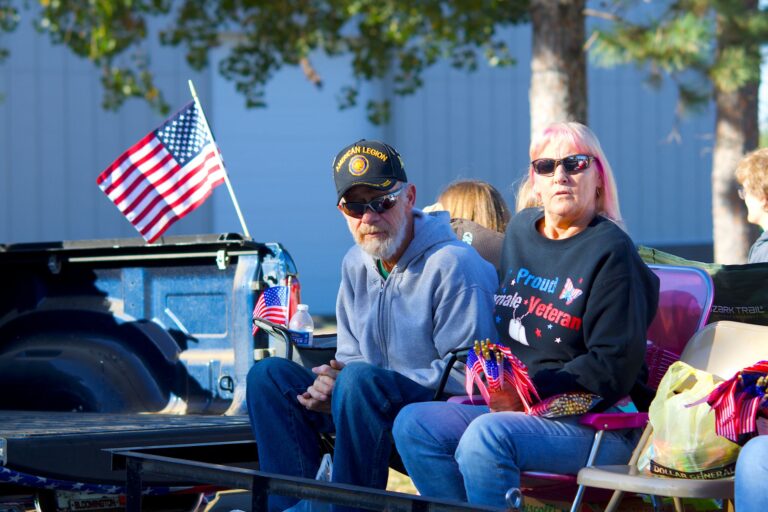
The seat was at the head of the table, and it was empty, and there was a folded card standing on the plate with my name on it in a young soldier’s careful block letters. SFC ELEANOR “DOC” REYES. I stood in the doorway of that hotel ballroom in my church dress with my purse held in front of me like a shield, and I read my own name on that card three times before I let myself believe it was meant for me, because in thirty years of family dinners no one had ever once saved me the good seat. They saved it for the men. They saved it for whoever had the loudest story. They sat me down by the kitchen door where I could get up and help, and they called me, when they bothered to name what I had been at all, just a nurse.
I am seventy-one years old. My name is Eleanor Reyes, and the men who served beside me in the Army called me Doc, and I want to tell you about the afternoon a room full of soldiers I had not seen in half a lifetime set the record straight in front of the people who never bothered to learn it.
Let me go back, because the seat at the head of the table only means what it means because of all the years I spent near the kitchen door.
I was nineteen when I joined the Army in 1972. I came from a town in the valley where the girls who left did it to get married and the girls who stayed did it because they had not left yet, and I did not want either of those to be the whole of me. I had a steadiness in my hands that I did not have anywhere else in my life. My mother used to say I was the only one of her children who could thread a needle in a moving car. So I went where steady hands were wanted, and the Army sent me to medical training at Fort Sam Houston in Texas, and there, in a long cinderblock building that smelled of bleach and floor wax, I learned to be a combat medic.
I want to be careful about that word, because it is the word the rest of this story turns on. I was not a nurse. I have nothing but respect for the nurses, and I worked beside the best of them, but a nurse and a combat medic are not the same job, and the difference is the whole difference. A nurse works in a ward, under a roof, with a doctor down the hall. A combat medic is the one who comes when the roof is gone. We were trained to do the things that keep a person breathing in the first ten minutes, the ten minutes before there is a hospital, the ten minutes that decide everything. We learned to stop bleeding that wanted to kill a man in ninety seconds. We learned to get air into a chest that had quit. We learned to do it on our knees, in the dirt, with our own hands shaking and the worst noise in the world going on around us, and to keep our voice calm anyway because the man on the ground was listening to our voice to decide whether he was going to live.
I made Specialist, and then Sergeant, and over twenty-two years I made Sergeant First Class, which is the rank I retired at, and the chevrons of a Sergeant First Class are not given to a girl who held bandages. They are given to a soldier who led other soldiers and kept them alive. I trained the young medics who came after me. I ran the aid station. When a nineteen-year-old kid arrived terrified and certain he would freeze when the moment came, I was the one who taught him that he would not freeze, because I would be next to him, and I taught him by being next to him until it was true.
I served in places I did not talk about at home. I will not turn this into a war story, because that is not what this is, but I will say that I was there when men I had trained were carried in on litters, and I was there with my hands inside more than one of them, and I was there, more than once, when there was nothing left for my hands to do but hold a boy’s face and tell him his mother loved him while he went. I have washed other people’s blood off my forearms in a metal basin and gone straight back out. I have a steadiness in my hands. It cost something to keep it.
I came home in 1994 with an honorable discharge, a Combat Medical Badge, and a drawer full of things I did not show people. And I married a good man named Tomás who had waited for me, and we raised two children, and I became, in the eyes of the family I married into and the family I came from, a wife and a mother and an aunt, and the medic went quietly into the drawer with the badge.
I let her go in there. I want to be honest about that, because part of this story is mine to own. When you come home from that kind of work, you learn fast that the long version is not welcome at a dinner table. People ask what you did, and you can see in their faces that they want a sentence, not a paragraph, so you give them a sentence. I was a medic in the Army. And the sentence gets shorter every year, because every year it is a little more tiring to watch their eyes slide off it, until one year you find that the sentence has shrunk all the way down to I was a nurse, because that is the word that lets the conversation move on. I said it about myself first. I have to live with that. I handed them the small word so they would not make me carry the big one alone, and then I spent thirty years angry that they used the small one.
The one who used it the worst was my brother-in-law, Gerald.
Gerald is my husband’s older brother, and he is the kind of man who has never been wrong out loud in his life. He never served. He will tell you, if you give him three minutes, that he almost did, that he had a number that was almost called, that he would have gone in a heartbeat, and he says it in a way that somehow makes the men who actually went seem like the ones who got the easy deal. He runs the family gatherings the way a man runs a meeting he appointed himself to chair. He decides who tells the story and who clears the plates. And from the first Thanksgiving I ever spent at that table, Gerald decided that what I had done did not count for very much.
Get a new story in your inbox every morning.
Facebook doesn’t show you every story we post. Our free newsletter does. Join 2,500+ readers.
It started small, the way these things do. The first year, when my mother-in-law mentioned that Eleanor had been in the Army, Gerald said, “Oh, that’s right, you were one of the nurses,” and patted my hand, and I said, “I was a combat medic, actually,” and he said, “Sure, sure, the nurses did good work over there,” and turned to ask his son about football. I let it go. You let the first one go.
But Gerald had found something, and Gerald was a man who pressed on a soft spot once he found it. Every gathering after that, I was the nurse. “Eleanor was a nurse in the service, weren’t you, honey.” “Let the nurse take a look, she’ll have a Band-Aid in that purse.” When his own father, a Korea veteran, was being honored at his funeral, Gerald stood and spoke for twenty minutes about what it meant to serve, about the brotherhood of men who had seen combat, and he looked right past me in the second pew, me who had knelt in more combat than he had read about, and he did not say my name. After, at the reception, he told a cousin, “Eleanor wouldn’t really understand the combat side of it, she was more on the caregiving end, the nursing end.” I was standing close enough to hear it. I had held a man’s severed artery shut with my thumb for nineteen minutes waiting on a dustoff, counting his breaths out loud so he would keep taking them, and Gerald told a room I was on the caregiving end.
The cruelest part was never loud. That is the thing I want people to understand. Gerald never yelled at me, never insulted me to my face in a way I could point to and name. It was always gentle. It was always a pat on the hand and a warm smile and a small word laid down on top of a large life, said so kindly that to object would have made me the difficult one, the woman who could not take a compliment. He called me a nurse the way you would tuck a blanket over someone, as if he were being tender, and every time he did it he made me a little smaller in front of the only family I had, and he did it so softly that for thirty years I could not find the place to stand and fight back without becoming the villain of the dinner.
So I stopped trying. I took the seat by the kitchen door. I got up to refill the iced tea. I let Gerald run the table. And the medic stayed in the drawer with the badge, and I told myself it did not matter, that I knew what I had done and that was enough, and I almost believed it, the way you almost believe a thing you have to believe to get through Thanksgiving.
My children grew up thinking of me as the one who was good in an emergency but never knowing exactly why. My granddaughter, Mia, asked me once, when she was small, “Grandma, were you a nurse in the war?” and I looked at her little face and I was so tired that I said, “Something like that, baby.” I have regretted that sentence more than almost any other I have spoken. I taught the next one the small word too. I handed it down.
What I did not know, in all those years by the kitchen door, was that there were men out in the country who had never once forgotten the big word. Men who said it to their own children at their own dinner tables. Men who, when they told the story of the worst day of their lives, said a woman’s name in the middle of it, and said it the way you say the name of the person who is the reason you are alive to tell the story at all.
The letter came in March.
It was a real letter, in an envelope, with a stamp, which is so rare now that I almost set it aside as something official I did not want to open. The return address was a town in Georgia I did not know. Inside was a single sheet, and a man’s handwriting that had gone shaky with age but pressed hard into the paper, the way men of a certain generation write, and it began, “Doc.”
No one had called me Doc in thirty years. I had to sit down at the kitchen table to read the rest.
The letter was from a man named Raymond Foley. I knew the name the second I saw it, the way you know a name that has lived in the bottom of your own drawer for decades. Ray Foley had been twenty years old. He had come into my aid station on the worst day, the day I do not talk about, with a wound that should have been the end of him, and I had spent the longest hour of my life keeping him on the right side of a line, and I had been so sure I had lost him that when they finally lifted him onto the bird I had let myself cry for the first time in months, because I thought I was crying for a boy who was gone. I had never known he lived. You so rarely know. They go up on the helicopter and out of your hands and you almost never find out the end of the story. I had carried Ray Foley as a boy I had lost. For thirty years.
He had lived. He had gone home and married and raised four children and buried a wife and watched his grandchildren born, and he had spent a good part of those years trying to find me. The unit, what was left of it, held a reunion every five years, and he wrote, the men had decided that this year, the fiftieth, they were not going to hold one more reunion without Doc Reyes in the room. They had tracked me through the VA, through a records office, through, in the end, a great-nephew of mine who answered a phone call without knowing what it would set off. The letter ended, “You are not a guest at this thing, Doc. You are the reason there is a thing. Please come. The men want to thank you to your face, and some of us are running out of time to do it. Yours, Ray Foley, the kid you held together at the river. I lived, Doc. Look what you did. I lived.”
I sat at that table and I cried the way I had not let myself cry in thirty years, the big kind, the kind that comes up from somewhere under the floor.
I almost did not go. I want to admit that. I had become so used to being small that the idea of walking into a room where I was the reason for the room frightened me more than any battlefield ever had. I told Tomás I did not think I should, that it was a long way, that they would not really remember me, that I would just be in the way. He took my hand, my Tomás, and he said, “Ellie, for thirty years you have let them seat you by the door in this family. Let these men seat you wherever they want to seat you.” So I bought a plane ticket, and I bought a church dress, and I flew to Georgia by myself, and I stood in the doorway of that hotel ballroom and read my own name on a card at the head of the table.
There were maybe forty of them, old men now, with canes and oxygen lines and veterans’ caps, and their wives and their grown children, and when I stepped through that door a man across the room saw me and went absolutely still, and then he stood up out of his chair so fast it tipped over behind him, and he said, in a voice that cracked right down the middle, “That’s her. That’s Doc.” And Raymond Foley, seventy years old, crossed that ballroom faster than his body should have let him, and he took both my hands in both of his, and he could not speak, and he did not have to. I looked at his face and underneath seventy I found twenty, the boy at the river, and I said the only thing there was to say. I said, “You lived.” And he said, “You’re damn right I did,” and the whole room was on its feet by then, men who could barely stand, standing.
They sat me at the head of the table. In the seat of honor. Ray Foley pulled out the chair himself and would not let anyone else do it. And one by one, over that dinner, the men got up and told the room what I had been.
I had spent thirty years letting Gerald tell my family I was just a nurse. I sat at that table in Georgia and listened to soldier after soldier tell the truth about me, and I understood that the truth had been alive the whole time, out in the country, in the mouths of the men who had been there. A man named Castellano, who walked with two canes now, stood and told the room about the day I crawled out to him under fire to get a tourniquet on his leg, and he said, “I have got two granddaughters because that woman did not stay behind cover when the manual said she could. I named one of them Eleanor and never told my family why. I’m telling you now, Doc. Her name is Eleanor for you.” And he sat down and wept into his hands, and his wife held him, and I gripped the edge of that table to keep myself upright.
They did not call me a nurse. Not one of them. They called me Doc, and they called me Sergeant Reyes, and one of them, a man who had become a minister, stood and said, “I have been trying for fifty years to find the word for what she was to us, and the closest I can come is that she was the hand that did not let go. The rest of the world has its words for what a medic is. We have one word. Hers.” And he raised his glass, and forty old soldiers raised theirs, and they said my name like it was something holy, and I sat in the seat of honor and let them, because Tomás was right, because for once in thirty years I let someone seat me where they wanted to seat me, and they wanted to seat me at the head.
A man named Whitfield, who had been a radio operator, stood last, and he did not tell a war story. He told a quiet one. He said that the night before the worst day, he had been so frightened he could not eat, and that he had been sitting alone behind the aid station with his hands shaking, certain he was the only coward in the whole company, and that I had come and sat down next to him in the dark without a word. He said I had not told him to be brave. He said I had told him that being scared was the body doing its arithmetic, that fear meant the math was working, and that I would be ten feet from him the whole time, and that if it came to it I would crawl to him. “She didn’t lie to me,” Whitfield said to the room. “She didn’t tell me it would be fine. She told me she’d come. And the next day it came to it, and she came. A person who has been crawled to under fire does not ever again let anybody call that woman just a nurse.” He sat down. His daughter was holding his arm, and I watched her look at her father, and then look at me, and I watched a daughter learn in one second who her father had been carried home by. That is a thing I will keep until I die, that look on that woman’s face.
The wives found me at the dessert table afterward, one and then another and then a small crowd of them, women my age in their good dresses, and they did not say much, but they each took my hand the way you take the hand of someone who gave you something they themselves could never have given. One of them, Castellano’s wife, held my hand in both of hers and said, “I have set a place for you at my table every Thanksgiving for forty years that you never knew about. He makes us put out a glass for Doc. We pour it and we leave it. I have wanted to thank the person that glass was for since 1975.” I did not know what to do with that. I am still not sure I do. Somewhere in Texas there has been a full glass of water with my name on it at a stranger’s holiday table for half a century, poured by a man whose leg I tied off in the dirt, while my own family sat me by the kitchen door.
There is more. There is the part the family back home does not yet know I have, and it is the part that finally set the record straight where it most needed setting.
Ray Foley had done something else, in the months before the reunion. He had written it all down. Not just his own story, all of it, every man’s account he could gather, the dates and the places and the things I had done that I had no idea anyone had even seen, and he had taken it to a Congressman, because Ray Foley had spent thirty years furious that what I did at the river had earned me nothing but a line in a file. And at the end of that dinner, the unit’s old commander, Colonel Hayes, ninety-one years old, was wheeled to the front of the room, and he asked me to stand, and I stood, and he said, “Sergeant First Class Reyes, fifty years ago I wrote a recommendation that got lost in a war. These men would not let it stay lost.” And a serving officer in a dress uniform, a young captain who had flown in for exactly this, stepped forward and read a citation, and at the end of it they pinned a Bronze Star with a V for valor on my church dress, fifty years late, in a hotel ballroom in Georgia, in front of forty men who had known the truth the whole time.
I have to tell you that I did not cry then. I had cried at the river fifty years before and I had cried at my kitchen table in March, but standing there with the colonel’s hand shaking on my shoulder and the medal cold and real on my chest, I did not cry. I came to attention. My back, which has not been straight in years, went straight. My chin came up. And for the length of that citation I was not somebody’s aunt by the kitchen door. I was Sergeant First Class Eleanor Reyes, combat medic, United States Army, and I let myself be her in front of everyone, all the way, for the first time in thirty years.
I flew home with a Bronze Star in my purse and a question I had carried my whole adult life finally answered, which is whether what I did had counted. It had counted. It had been counting the whole time, in the lives of four children named after a day at a river, in a granddaughter named Eleanor in a town I had never seen.
The family gathered for Tomás’s birthday two weeks later, and Gerald ran the table the way Gerald always ran the table, and he seated me, out of habit, by the kitchen door. And at some point, the way he always did, he turned to a new in-law who had not heard it yet and said, warmly, with that pat of the hand, “You know Eleanor was a nurse in the Army, back in the day.”
For thirty years I had let that sentence stand. I had even helped him build it.
I stood up. I am seventy-one and my knees are not what they were and I stood up at that table by the kitchen door, and the room got quiet the way a room gets quiet when something is about to change in it. And I did not yell. I had learned a long time ago, in a place Gerald has never been, that the calm voice is the one that gets listened to, so I kept my voice the way I kept it on my knees in the dirt, level and clear and steady.
“Gerald,” I said. “I was not a nurse. I have let you call me one for thirty years because I was tired and because objecting made me the difficult one, and that was my mistake, and I am correcting it now in front of everyone the way you have made the mistake in front of everyone. I was a combat medic in the United States Army. I retired a Sergeant First Class. I led an aid station. I went out under fire to men you would not have had the stomach to look at, and I brought some of them home, and I held the rest while they died, and two weeks ago a colonel pinned a Bronze Star with valor on me for it, fifty years late, because the men who were actually there have spent their whole lives knowing exactly what I did even while my own family could not be bothered to use the right word.”
I reached into my purse, and I took out the medal, and I set it on the table in front of him, on the white cloth, next to the gravy.
“You almost served,” I said. “I know. You have told me every year. I served. There is a difference, and you have spent thirty years making sure no one at this table learned it. So learn it now. I am not the nurse. I am the medic. And I am done sitting by the door.”
No one laughed. For the first time in thirty years, no one laughed. My granddaughter Mia, grown now, was crying. My son had his hand over his mouth. And Gerald, the man who had never been wrong out loud in his life, looked at that Bronze Star on the white tablecloth and did not have one single word, because for once there was no small soft word in the world that could be laid down on top of what was sitting in front of him.
It was Tomás who moved first. My husband stood up, and he walked the length of that table, past all of them, and he pulled out the chair at the head, his own brother’s chair, the chair Gerald always took, and he held it for me. And he said, loud enough for the whole family, “Sit down, Sergeant. You’ve stood long enough.”
I walked the length of that table and I sat down at the head of it, in my own family, for the first time in thirty years.
I would love to tell you that Gerald apologized, that he stood up a changed man and made it right. He did not. He is not built for it. He muttered something about not having meant anything by it, about how I had never said, about how a person could not be expected to know. And that used to be the kind of thing that would have undone me, that would have sent me back to the kitchen door, because Gerald has always known how to make his cruelty sound like my oversight. But it did not undo me, not this time, because I had sat in the seat of honor in a room full of men who knew exactly what I was, and a thing like that resets you. Once you have heard forty soldiers say your name the right way, you stop needing one frightened man to say it at all.
Here is what I have learned, and it is the only sermon I have. The people who diminish you are very often the ones who were not there. The ones who were there do not need to be told. Ray Foley did not need to be reminded of what I had done. Castellano named his granddaughter without my ever knowing. The truth of what you are does not live in the mouth of the man at the head of the table who never went. It lives, quiet and patient and unkillable, in the lives of the people you actually touched, and it will keep, sometimes for fifty years, until it finds its way back to you in an envelope with a stamp.
I am seventy-one years old, and the men I served beside called me Doc, and they saved me the seat of honor, and they were right to. I am not just a nurse. I never was. I was the hand that did not let go.
And the next time the family gathers, I will be sitting at the head of the table, with a Bronze Star in a frame on my wall at home and a boy named Ray Foley alive in Georgia because of me, and if anyone wants to call me just a nurse, they are welcome to try it. I have learned where to stand. I learned it in the dirt, fifty years ago, on my knees, with my hands inside a dying boy, refusing to let go. Some things you only have to learn once.
This story is a dramatization. Names, characters, and details are invented, and any resemblance to real people or events is coincidental.