
For eleven years I walked past Alistair Bram every single morning and said maybe four words to him.
“Morning.” Sometimes not even that. Sometimes just a nod, the kind you give a coat rack or a water fountain, the kind that doesn’t really land on a person at all. He pushed a wide gray dust mop down the main hall of Cordell Township Elementary in Loomis County, Nebraska, and I taught fifth grade in Room 14, and for more than a decade we lived eight steps apart and I never once asked him a real question.
I am sixty-one years old. I have been teaching since I was twenty-three, almost all of it in this same brick building off Route 9, the one with the flag that snaps so loud in the prairie wind you can hear it through a closed window. I have stood up at retirement dinners and given speeches about how a school is a family. I believed it when I said it. That is the part that still makes my face go hot. I believed I was the kind of woman who saw people.
I did not see Alistair Bram. Not until a Tuesday in November, in our own gymnasium, with the whole town packed onto those pull-out bleachers, when a man in a dress uniform I had never met before walked up to our quiet janitor and stopped the entire assembly cold.
But I am getting ahead of it. Let me back all the way up, because the not-seeing is the real story, and I owe him the whole thing.
Cordell Township is not a big place. We are the kind of town where the grain elevator is the tallest thing for twenty miles, where the diner on Main is called Halverson’s and has been called Halverson’s since before I was born, where the whole community calls itself by the high school mascot even though most of us graduated decades ago. We are Loomis County Badgers, all of us, sixty-year-old women included. Friday nights in the fall, you can find half the town under the lights at the football field even when the team is losing by thirty, because there is nowhere else any of us would rather be.
Our elementary school sits at the edge of all that, a long low building from 1962 with a boiler that groans in January and linoleum floors that have been waxed so many times they hold the light like still water. Keeping those floors was Alistair’s job. He came on as our custodian the year my own daughter started kindergarten, which is how I keep the time. Eleven years.
He was a thin man, tall, with a slight hitch in his left leg that got worse in the cold. He wore gray work pants and a gray work shirt with his first name stitched in red over the pocket, and a Loomis County Co-op ball cap that had faded to almost no color at all. He kept his eyes down. He spoke when spoken to and not much more. He arrived before any of us, at five in the morning, and you would find the building already warm and the floors already shining and the flag already raised, and you would never once see him do any of it. He worked in the seams of the day, in the hours nobody watched.
And we treated him like the building treated him. Like part of the structure. Furniture that moved.
I want to tell you about the children, because they learned it from us, and that is the hardest part to write.
Kids are not born unkind. They copy. They watch the adults in a room to learn who matters, and we taught them, without ever meaning to, that Alistair Bram did not. There was a name some of the older boys used, started a few years back and passed down to each new grade like a hand-me-down coat. They called him “Just the Janitor.” It started, I think, the way these things start, with a boy answering another boy’s question. Who’s that. Oh. That’s just the janitor. And the “just” stuck, because it is a small word and small words do the most damage. By the time it reached my fifth graders it was a thing they said to each other, almost a verb. Quit acting like Just the Janitor. Sit there and be Just the Janitor.
I heard it. God forgive me, I heard it in my own classroom and I let it slide, because I told myself it was harmless, because correcting it would have meant looking at the thing under it, and the thing under it was me.
There was a boy in my room that year named Tobias Renner. Smart boy, quick, a little too quick with his mouth the way bright kids can be when nobody has taught them what to do with it. Tobias’s grandfather had passed the spring before, and Tobias had gone hard and brittle in the way grief makes some children, and he had decided the way to feel big was to make someone else feel small. He picked Alistair.
I remember the morning it tipped over. We had a water fountain in the main hall that had been leaking for a week, and Alistair was down on the floor in front of it, on his bad knee, working a wrench, and a little knot of fifth graders had gathered to watch. Tobias was at the front of them. And Tobias said, loud, performing for the others, “My dad says you only get a job like that if you couldn’t do anything else.”
The hall went quiet. The other kids did that thing kids do, the held-breath laugh, waiting to see what would happen.
Get a new story in your inbox every morning.
Facebook doesn’t show you every story we post. Our free newsletter does. Join 2,500+ readers.
Alistair did not look up. He turned the wrench one more time. The leak stopped. And then he said, in a voice so even it could have been about the weather, “Your dad’s right that I couldn’t do a lot of things. There’s a long list.” He set the wrench in his box. “But I can fix this fountain, and now you’ve got cold water again. Go on to class.”
That was all. He stood up slow, hand on the wall, and he picked up his box and he walked away with that hitch in his leg, and the kids scattered, and I stood in my doorway having watched the whole thing and I did not say one word to Tobias Renner about it. I went back into Room 14 and I taught long division.
I think about that almost every day now. The chances come and the chances go and you do not always know, in the moment, that you are failing a test. But I knew. Some part of me knew, even then.
I want to tell you about one evening, because it is the closest I came, in all those eleven years, to actually seeing him, and I let it pass.
It was a January, two or three winters before the assembly. We had a blizzard come through, the real kind, the kind that shuts down Route 9 and makes the radio man in Hartwell read the school closings in a voice that is trying not to sound delighted. I had stayed late grading, foolishly, and by the time I looked up the parking lot was a white sheet and my old Buick would not turn over. Dead battery, dead cold. I sat there in the dark school feeling sixty years old and stupid, and the only other car in that lot was Alistair’s rusted pickup, because of course it was, because he was always the last one in the building and the last one out.
He came down the hall with his coat already on, saw me standing at the office window looking out at my dead car, and without a word he went and got jumper cables out of his truck and stood out in that screaming wind in his thin gray coat and brought my Buick back to life. Took him twenty minutes in weather that could kill a person. His hands were so cold he could barely work the clamps. And when it was done and the engine was running, I tried to thank him, and he just nodded and said, “Let it run a few minutes before you go. And drive slow, the bridge ices first.” And he turned to go back inside, because he still had floors to do, blizzard or no.
But I stopped him. For once. I asked him in for a cup of the bad office coffee while my car warmed up, mostly because I felt I owed him that much, and to my surprise he came. We sat in the dark front office, the storm howling against the glass, and we drank terrible coffee, and I asked him, finally, a real question. I asked him where he was from before Cordell.
And he got quiet in a particular way, and he said, “Around. Spent some years away when I was young. Came back to the middle of the country on purpose. I like flat land. You can see what’s coming.” And then he looked out at the blizzard and he said something I did not understand at the time. He said, “Out there a storm is just a storm. That’s worth a lot. Some places, you learn to flinch at the sky.” And he finished his coffee and stood up and said the floors weren’t going to wax themselves, and that was the most words I ever got out of Alistair Bram in eleven years, and I did not know what I was looking at. I had a decorated combat veteran sitting across a desk from me telling me, in the only way he could, what the war had done to a young man’s relationship with an open sky, and I heard “I like flat land” and I drove home. That is how completely we miss people. Even when they hand us the key, we do not turn it.
What I did not know, that night and for years after, what none of us knew, was who Alistair Bram had been before he ever picked up a mop.
The reveal, when it came, came in our own gym, and it came because of a woman named Odessa Flynt.
Odessa was new that year, our new principal, brought up from a bigger district downstate after Principal Wexford retired. We were all braced for her. New principals come in with binders and acronyms and a hunger to fix things that are not broken, and we are a stubborn county, slow to warm. But Odessa Flynt was different. The first thing she did, before she changed a single policy, was learn names. Everybody’s. The lunch ladies, the bus drivers, the part-time aide who comes Tuesdays. And Alistair’s.
I found out later that she did something none of the rest of us had ever bothered to do. In her first month, going through the old personnel files in the back office, she found Alistair’s application from eleven years back. And on the line that asked for prior employment, in his small square handwriting, he had written one word. The branch. And a set of years. And nothing else. No explanation. No list of medals. Just the bare fact, stated and left alone, the way he stated and left alone everything.
Odessa Flynt was a Marine’s daughter. Her father had served in the same era. She knew how to read what a man like that leaves off a page. She knew that the men who say the least carry the most. So she did some quiet looking. She made some calls, the way you can when you are a principal with a county’s worth of contacts and a stubborn streak. And what she found made her close her office door and sit for a long while.
She told me later exactly how it went, the whole slow unspooling of it, because she said she needed to tell somebody and I was the one who brought him coffee. She said the first call went nowhere. The second call gave her a name, an old unit association, a phone tree of aging men who keep track of each other the way people do when they have shared the worst day of their lives. The third call was to a man in Oklahoma who went silent for a long moment when she said the name Alistair Bram, and then said, very carefully, “Ma’am, do you know what you’ve got working in that school?” And she said no, that was why she was calling, and the man on the phone took a breath and told her the first piece of it, and then he said, “You should talk to Quist. If anybody’s going to tell it, it should be Quist. He was there.” And he gave her a number in Texas.
She said she sat with that number on a sticky note on her desk for two days before she dialed it, because she had a feeling, the way you do, that the call was going to change something and could not be taken back. When she finally got Bartholomew Quist on the line and told him where Alistair Bram had been for the last eleven years, that he was waxing the floors of an elementary school in Loomis County, Nebraska, and that the children there called him the janitor and did not know any better, there was a silence on the line so long she thought the call had dropped. And then the old sergeant major said, in a thick voice, “He’s alive. We lost track of him in ‘ninety-one. We thought maybe he was gone.” And then he said, “I’ll come. You tell me the date and I will be there. I have been waiting thirty years to put my hand up to that man one more time.”
She told me all of this afterward, at my kitchen table, both of us crying into cold tea. At the time, all any of us knew was that the new principal had decided our Veterans Day assembly that year was going to be a real one, and she was being very stubborn and very secretive about it, and a few of us, God help us, grumbled about the new boss and her big ideas.
We always did something for Veterans Day. A few kids would read poems, somebody’s grandfather in a VFW cap would stand up to be thanked, we would play the recorded anthem and the little ones would put their hands over their hearts in the general direction of their stomachs. Nice. Forgettable. The kind of thing you do because you are supposed to.
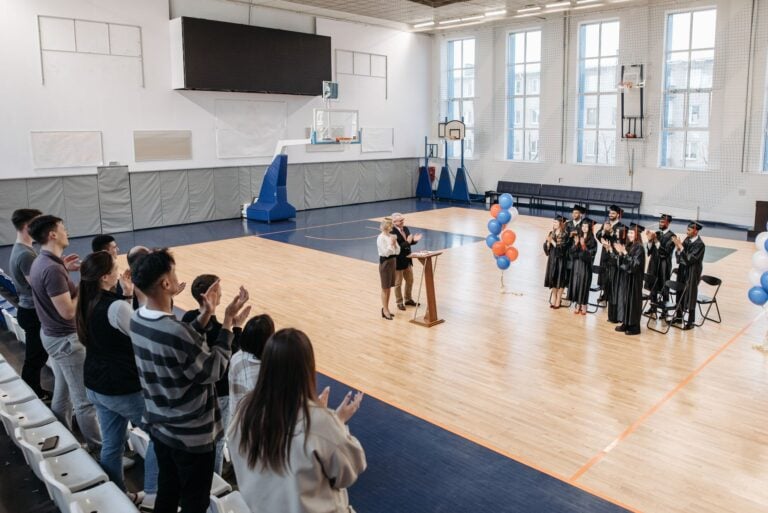
Odessa wanted more. She got the whole town in. She sent flyers home, called the radio station out of Hartwell, got the VFW hall and the Legion and the church ladies all involved. By the morning of, the gymnasium was packed wall to wall, the bleachers groaning, folding chairs three deep on the floor, the whole township pressed in shoulder to shoulder, smelling of coffee and cold air and the gym’s eternal smell of floor wax and old basketball.
That floor wax. I remember thinking, standing there with my class lined up on the bleachers, that the floor had never looked better. It shone like a frozen pond. It shone because Alistair had been in at four that morning to do it. I did not think that thought at the time. I am thinking it now.
Alistair himself was at the back, by the double doors, in his gray uniform with his name over the pocket, standing the way he always stood at assemblies, ready to prop a door or fetch a chair or clean up a spill, invisible, useful, “just” the janitor. I saw him back there and thought nothing of it.
Odessa opened the assembly. The kids did their poems. A color guard from the high school posted the flag, and the old recording of the anthem played, and we all stood. And then, instead of sitting back down, Odessa Flynt stayed at the microphone, and she said she wanted to do something a little different this year.
She said that Veterans Day was about the people who served and then came home and never asked for a single thing back. The ones who fold up their service and put it in a drawer and go to work and never tell you. She said that those were the hardest ones to honor, because they make it their life’s work to not be seen.
“And it turns out,” she said, “that we have one of them right here in this building. Has been, for eleven years. And most of us walk past him every day without knowing.”
I felt the gym go still in a way I had never felt it. Eleven hundred people in a room and nobody breathed.
The double doors at the back opened. And a man walked in that none of us knew. He was older, ramrod straight, in a dress uniform with a chest full of ribbons that even from across the gym you could tell meant something, the kind of order and weight that you do not get for showing up. He walked down the center aisle of that gym, on our frozen-pond floor, and he walked straight back to the doors where Alistair Bram was standing.
And he stopped in front of our janitor and he came to attention and he raised his hand in a salute and he held it.
I will tell you that I have never in my life heard a room get that quiet. Alistair had gone white. He had a stack of folding chairs in his hands and he set them down very carefully, like they might break, and he straightened up, and his bad leg must have been screaming but you would not have known it, and he raised his own hand and returned the salute, and the two of them stood there at the back of our gym holding it while the whole town stared.
The man in the dress uniform was a retired sergeant major named Bartholomew Quist. He had come up from Texas. Odessa had found him through her father’s contacts, one of those threads that runs through the whole community of men who served together. And when he had his moment at the microphone, he told us who Alistair Bram was.
He told us about a place a long way from Loomis County, and a day a long time ago, and a unit pinned down with no good way out, and a young man who went back. Not once. Three times. Across open ground that everyone in that room of veterans understood meant almost certain death, to pull men out one at a time, men who would have died where they lay, and the third time he went back he took the wound that gave him the leg, the hitch, the limp we had watched him drag down our hallway for eleven years and never once asked about.
Bartholomew Quist said Alistair Bram had been awarded the second-highest decoration this country gives for valor in combat. He said the number. He said the citation. He said that there were men alive in that gym’s own county, grown men with grandchildren, who were only alive because a nineteen-year-old named Alistair Bram decided their lives were worth more than his own.
And then Sergeant Major Quist looked out at all of us, the whole packed town, and he said the thing I will carry to my grave.
He said, “I understand you all call him the janitor.” He let it sit. “I have known this man for fifty years. And I want you to know that keeping this school is the proudest work he has ever told me about. He came home and he could not save everyone and it nearly broke him, and he found a place where he could come in before the sun and make a building warm and safe for children, and he decided that was a thing worth doing with the rest of a life. He did not pick this work because he couldn’t do anything else.” His voice cracked, just slightly, this iron old man. “He picked it because after everything he had seen, keeping kids safe and warm was the only thing he wanted left to do.”
I have never heard a gymnasium make the sound that gym made then. It was not applause, not at first. It was a kind of collective intake, the sound of a whole town realizing the same terrible thing at the same time. And then it was applause, and then it was everyone standing, the bleachers thundering, the folding chairs scraping, eleven hundred people on their feet, and Alistair Bram stood at the back of the room he had cared for in the dark for eleven years with tears running down a face he kept perfectly, perfectly still, because that is what men like him do, they hold the line even when the line is their own breaking heart.
And I want to tell you about Tobias Renner, because Tobias was three feet from me on that bleacher.
He had gone absolutely white. This eleven-year-old boy who had told Alistair Bram that he only had that job because he couldn’t do anything else. I watched the whole thing land on him. I watched a child understand, maybe for the first time in his short hard year, that you never, ever know what a quiet person has carried. And Tobias Renner, who I had not been able to reach all fall, who had been all elbows and cruelty since he buried his grandfather, put his face in his hands and cried like the little boy he still was.
When the assembly broke, the whole town wanted to get to Alistair. The old men got to him first, the VFW and the Legion caps, and there is a thing veterans do, a recognition, hands gripping forearms, no words needed. Then the rest of us. And I stood back, because I did not feel I had the right to be at the front of that line.
But Tobias did not stand back. I watched that boy push through a crowd of grown adults, his face a mess, and plant himself in front of Alistair Bram and look up at him. And the whole knot of people went quiet to watch.
Tobias opened his mouth and what came out was, “I said you couldn’t do anything else.” His voice broke on it. “I’m sorry. I’m so sorry. My grandpa died and I’ve been so mean to everybody and I picked you and I’m sorry.”
And Alistair Bram, decorated for valor, who had carried men out of fire and a whole life of silence on top of it, got down. He got down on his bad knee, the wrecked one, right there on his shining floor, so he was level with this boy’s face. I heard him do it. I heard the small grunt it cost him.
And he said, “What was your grandpa’s name?”
Tobias said, “Wendell.”
“Was he a good man?”
“He was the best one.”
“Then you carry him,” Alistair said. “That’s the job now. You carry him by being the kind of man he’d be proud of. You started today. That apology was the hardest kind of brave there is. Harder than anything they gave me a medal for.” He put a hand on the boy’s shoulder. “We’re square, son. We’re square.”
There was not a dry eye in that gymnasium. I am crying right now, writing it, eight months later, at my own kitchen table.
I want to tell you what happened after, because the assembly was not the end of it. The assembly was the beginning.
The town did not forget the next week the way towns do. Something had cracked open in Cordell Township and it stayed open. The diner, Halverson’s, put a plaque on the wall, a real one, with Alistair’s name and the citation, and they told him his coffee was free for life and they meant it and he never could pay for it again no matter how he tried, which embarrassed him terribly, which the whole town found tremendously satisfying. The county Legion post made him a member with full honors. The radio station out of Hartwell did a whole segment.
And the school. Oh, the school changed.
The name “Just the Janitor” died that day and was never spoken again. What replaced it was something I have never seen children do before or since. They started saluting him. Not mocking, not playing. Real. A little girl in the second grade started it, the morning after the assembly, marching up to Alistair in the hall and throwing him a wobbly, fierce, dead-serious salute, and he stopped and set down his mop and returned it to her with total gravity, and after that it was a thing the whole school did. You would see it all day long, in the halls, on the playground. A child would catch sight of Mr. Bram and snap up a hand, and he would stop, every single time, no matter what he was carrying, and give it back. He never once treated it as a game. He understood what those children were doing. They were trying to give him back the eleven years.
I started bringing him coffee in the mornings. Real coffee, in a real cup, the way you do for a person and not a fixture. The first morning I did it he looked at the cup like he did not know what it was for, and I think we both understood everything that cup was apologizing for, and neither of us said it, and that was right. We did not need to say it. I just started doing it, and he started expecting it, and by spring we were friends, the kind of late-arriving friendship that has no business being as good as it is.
I learned things about him. I learned he liked the prairie in winter best, the bare bones of it. I learned he had a sister in Ord he called every Sunday. I learned that the reason he came in at four in the morning was not duty, not really. It was that he did not sleep well, had not since he was nineteen, and the quiet dark building with its honest work was the only place the bad nights eased. He told me that once, simply, the way he said everything. “The floors don’t ask me anything,” he said. “I just take care of them. It’s restful.” I have never heard anyone describe peace better than that.
Tobias Renner became Alistair’s shadow. The boy started showing up early, getting a ride from his mother, just to help. Emptying small bins. Carrying the lighter end of things. And Alistair let him, which I came to understand was its own kind of medicine, for both of them, the grieving old soldier and the grieving boy, working side by side in the quiet morning building, not talking much, taking care of a place together. Wendell Renner would have been proud. I think he was, somewhere. I think he could see it.
I have one more thing to tell you and then I will let this go, because it is the part that matters most.
This past spring, Cordell Township Elementary held a dedication. Odessa Flynt pushed it through the school board, and the board did not even argue, which around here is a miracle on the order of the loaves and fishes. They renamed the gymnasium. Our old 1962 gym, with its frozen-pond floor, is now the Bram Gymnasium, and there is a brass plate by the doors that tells, in a few plain words, who he is and what he did, both kinds of what he did, the valor and the eleven years of floors, because the town understood by then that you could not separate them, that they were the same man being the same brave in two different uniforms.
Alistair did not want the fuss. Of course he didn’t. But he came, and he stood at the front this time instead of the back, and when they pulled the cloth off the brass plate the whole town stood up again, same as that first November day, and this time he let himself look at us. He let himself be seen. After eleven years of working in the seams of the day, he stood in the light of his own gym and let an entire community look right at him and love him, and I think it was the bravest thing I ever watched him do.
He is seventy now. He still comes in at four. He still will not let us buy him coffee at Halverson’s. The children still salute him in the halls and he still stops, every time, and gives it back.
And I still walk past Room 14 every morning. But I do not walk past Alistair Bram anymore. Nobody in Cordell Township does. We learned the lesson the hard way, the way towns mostly do, which is too late and all at once, in a packed gymnasium on a cold November morning, when a stranger in a dress uniform walked down a shining floor to salute the man we had spent eleven years failing to see.
I called him “just the janitor” for eleven years.
I will spend the rest of my life calling him my friend, and saying his name the way it should have been said all along, with the weight it always deserved.
Alistair Bram.
Stand up for that name. The whole town does now.
This story is a dramatization. Names, characters, and details are invented, and any resemblance to real people or events is coincidental.