The Washboard They Left Me
The reading of the will
The lawyer’s office smelled like old coffee and carpet cleaner, and I remember thinking that was about right for the way my family did things. We waited on the important parts and rushed the tender ones. My grandmother had been in the ground eleven days when we gathered in that little office on the square in Delph, Missouri, and my cousins were already checking their phones before the man behind the desk had finished shaking our hands.
I sat in the back. I had learned a long time ago that the back of the room was the safest place to be when my family divided anything. You did not get pointed at from the back. You did not get asked to justify why you deserved a share. You just sat and watched the front of the room fill up with the loud ones, the ones who always found their way to the front of every line, every buffet, every photograph.
There were seven of us that mattered for the reading. My aunt Carol and my uncle Ray, my grandmother’s two living children. My cousins Brandon and Shay, Carol’s kids, both grown now and both convinced the world owed them something for the trouble of showing up to it. My cousin Denise, Ray’s girl, who had a way of crying on cue that I had never learned. My mother’s chair sat empty because my mother had passed six years before Grandma did, and I was what was left of that branch of the family. Just me. Rachel Mae Odell, thirty-eight years old, the granddaughter nobody counted.
And then there was Grandma, not in the room, but in every corner of it. Ada Fenn. Born on a farm outside Delph in nineteen thirty-one, married at nineteen, widowed at fifty-one, and never once in all those years the kind of woman who let a hard day beat her. She raised two children and buried a husband and outlived most of her friends and she did it with her sleeves rolled up. If you had asked anyone in Delph to describe Ada Fenn in one word, they would have said working. That woman worked. It was the truest thing about her.
The lawyer, a soft-spoken man named Mr. Petrie who had done Grandma’s affairs for thirty years, put on his glasses and started to read.
What they wanted
I want to tell you what my family wanted, because you have to understand the wanting before you can understand the rest.
They wanted the house. It was a good house, a two-story white farmhouse on eleven acres at the end of Cutler Road, with a wraparound porch and a barn that still stood straight and a stand of walnut trees Grandpa had planted the year they married. Carol had been circling that house for years, telling anybody who would listen that it should stay in the family, by which she meant it should come to her.
They wanted the land. Eleven acres does not sound like much until you learn that the county had been talking about running a connector road out past Cutler for a decade, and that a developer out of Springfield had been sniffing around the whole stretch. Ray had a friend at the bank, and the friend had a number, and the number had made Ray’s eyes go wide at Thanksgiving two years running.
They wanted the money. Grandma had savings. Not a fortune, but more than anyone expected from a woman who reused aluminum foil and darned socks that should have been thrown out in the Carter administration. There was a little over ninety thousand dollars in a certificate of deposit at the Delph Farmers Bank, money she had built one careful dollar at a time across sixty years, and my family had been quietly dividing that ninety thousand in their heads since the day she stopped recognizing them at the nursing home.
That was the pie. The house, the land, the money. And they had it carved up before Mr. Petrie ever opened his folder. You could see it in the way they sat, leaning forward, hungry, ready.
What I wanted
I did not want the pie.
I know how that sounds. Everybody says they do not want the money right up until the money is on the table. But I need you to believe me when I tell you that I sat in the back of that office wanting one thing, and it was not the house or the land or the ninety thousand dollars.
I wanted her back.
I wanted one more Saturday morning on the back porch with my grandmother, both of us up before the sun, the wringer washer humming and the smell of Fels-Naptha soap on my hands and her voice telling me a story I had heard forty times. I wanted the sound of her wedding ring tapping against a coffee cup. I wanted to feel useful to somebody the way I had felt useful to her.
Because here is the thing my family never understood, or never wanted to. I was the one who took care of her.
When Grandma’s hip went, I was the one who moved into the little back bedroom on Cutler Road so she would not have to go into a home before her time. When her hands got so twisted with arthritis that she could not open a jar or button a blouse, I was the one who buttoned it. When she started forgetting, I was the one who wrote the labels on the kitchen cabinets and set out her pills in the plastic box with the days of the week. For the last four years of her life, I was the one. Not Carol, who lived twenty minutes away and came by on holidays with a store-bought pie and a list of complaints. Not Ray, who called on Sundays and always managed to bring up the connector road. Just me.
And before all of that, before she got old, I was still the one. Because I was the granddaughter who did wash day with her.
Wash day
You have to be a certain age to understand what a washboard is, and I am not sure I am old enough myself, except that Grandma made me old enough by teaching me.
When I was a girl, my mother would drop me at the farm for the whole summer. My mother was not well, in ways I did not have words for then, and the farm was the safest place for me to be. And every Monday and every Thursday, rain or shine, Grandma did the wash.
By the time I came along she had a wringer washer on the back porch, an old Maytag with a tub and two rubber rollers you fed the wet clothes through to squeeze the water out. But Grandma never fully trusted a machine to get a thing clean. Collars, cuffs, the knees of Grandpa’s work pants, anything with a real stain, those went to the washboard first.
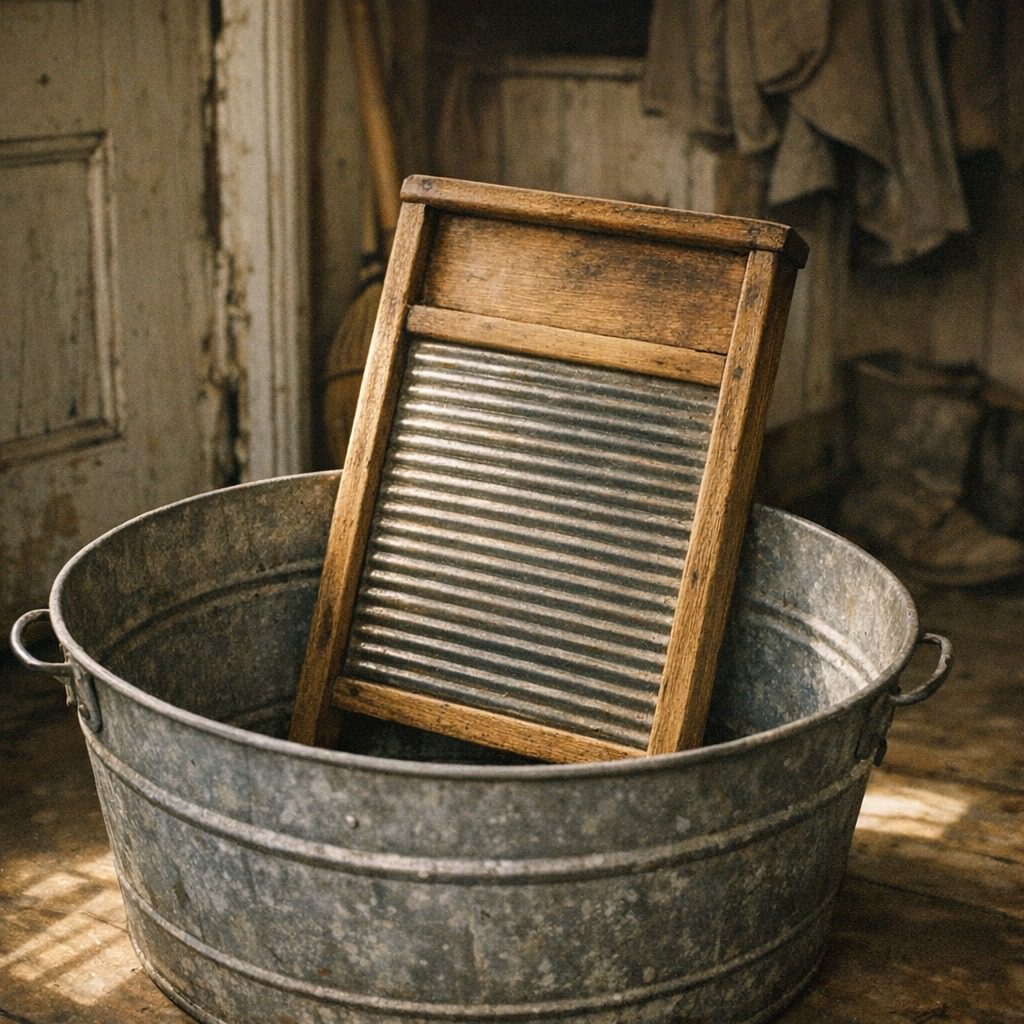
The washboard hung on a nail by the back door for as long as I was alive. It was a wooden frame, gray with age, and a sheet of ribbed metal set into it, the ridges worn smooth in the middle where sixty years of hands had rubbed cloth against them. On the top crosspiece, if you looked close, you could still read a stamped word in faded blue. The maker’s name. I used to trace it with my finger.
Grandma would fill a galvanized tub with water she heated on the stove, and she would set the washboard in at an angle, and she would show me. You wet the cloth. You rub the bar of soap right onto the stain, not into the water, onto the cloth. Then you take the cloth in both hands and you work it up and down the ridges, hard, with your knuckles almost touching the metal, and you feel the dirt come loose. It was not gentle work. By the end of a wash day my knuckles were pink and my back ached and my apron was soaked through.
But she would stand next to me at that tub, her hands next to my hands, and she would talk. She told me about the Depression, about the year the creek flooded and took the chicken house, about the day she met Grandpa at a pie social at the Baptist church, about the war and the letters and the long wait to see if he would come home. She told me who in Delph was kind and who was not, and why, and she never once told me a person was worthless. She said everybody carried a weight I could not see. She told me that work was a kind of prayer. She said, Rachel Mae, a body that is not tired at the end of the day has not lived the day.
And she taught me the difference between the two kinds of clean. There is the clean that a machine gives you, where the thing looks fine and smells fine and you never think about it again. And there is the clean you put your own hands into, where you know every stain that came out because you are the one who worked it loose. She said the second kind was the only kind that lasted, and she was not only talking about laundry, and I knew it even as a child.
I stood at that washboard beside my grandmother more hours than I could count. My cousins never touched it. Brandon and Shay came to the farm for the fishing pond and the four-wheeler. Denise came for Grandma’s fried chicken and to be told she was pretty. Not one of them ever wet a cloth on that board. Not one of them ever heard the stories, because the stories only came out at the tub, in the steam and the ache and the quiet, and you had to earn your place there with your knuckles.
They did not know that. That is the whole thing, right there. They did not know, and I did, and I thought that difference had died with her.
The reading, again
Mr. Petrie read the important parts in order, and it went the way everyone expected, and it broke my heart in a way I had not braced for.
The house on Cutler Road, and the eleven acres it sat on, went to Carol and Ray, jointly, to divide or sell as they saw fit. Carol made a small sound, a satisfied little intake of breath, like a woman settling into a warm bath. Ray nodded slowly, and I could see the connector road behind his eyes, and the number from his friend at the bank.
The savings, the ninety thousand and some in the certificate of deposit at the Delph Farmers Bank, was to be divided into four equal shares among the grandchildren. Brandon. Shay. Denise. And me.
I confess my chest lifted a little at that. Not because of the money, though a fourth of ninety thousand would have changed my life, which was held together at the time with a part-time job at the library and a rented duplex with a furnace that quit every January. It lifted because for one second I thought, she counted me. She put me in with the others. She saw me.
And then Mr. Petrie turned the page and read the next line, and the room went still, and then it did something worse than still. It laughed.
Because the will said, in Grandma’s own words, that the fourth share of the savings meant for me was to be withheld, and in its place I was to receive one item and one item only. The washboard from the back porch. The old scrub board that hung on the nail by the door.
Mr. Petrie read it plainly, without editorializing, the way lawyers do. To my granddaughter Rachel Mae Odell, I leave the washboard that hangs on the back porch, and my confidence that she will know what to do with it.
There was a beat of silence while it landed. And then Shay laughed. It came out of her before she could stop it, a bright ugly bark of a laugh, and once she had done it the rest of them could not help themselves.
The laughing
I want to describe the laughing to you because I have thought about it every day since, and I have come to understand it as the truest picture of my family I will ever have.
Shay laughed first, then Brandon, then Denise, who put a hand over her mouth in a way that was meant to look apologetic but did not stop her shoulders from shaking. Carol did not laugh out loud, but she smiled, a tight satisfied smile, and she looked at me across the room with something like pity and something like triumph, and she said, well, that is fitting, isn’t it, Rachel, you always did like to play in the wash water.
Ray was the one who said the thing I have not been able to shake. Ray leaned back in his chair, and he looked at me, and he said, real friendly, real warm, like he was doing me a kindness: Don’t feel bad, honey. Mama always did have a funny sense of humor. She left you a joke.
A joke.
They thought Grandma had made me the punchline of her own will. They thought she had run out of things to give me and had reached for the nearest piece of junk on the porch and handed it over as a laugh, a little wink from the grave at the granddaughter who never quite measured up. They divided a house and eleven acres and ninety thousand dollars, and they gave me a piece of ribbed metal in a gray wooden frame, and they thought the meanest part was that they were sure I would take it.
And I did take it. That is the part they never understood. I stood up from the back of that room, and I walked past all of them to the front, and I did not cry, though my throat was closed so tight I could not have spoken if I had wanted to. Mr. Petrie had the washboard there, wrapped in brown paper, because Grandma had arranged for it to be brought. She had thought that far ahead. She had known there would be a moment like this one, and she had made sure the board would be in the room to be handed to me.
I took it in both hands, the way you take a cloth to the ridges, and it was heavier than I remembered, and I held it against my chest and I walked out of that office and I did not look back at the laughing.
The nail on the back of the frame
I did not open the paper until I was home.
I sat at my little kitchen table in the duplex with the bad furnace, and I unwrapped my grandmother’s washboard, and I set it in front of me, and I let myself cry then, finally, in private, the way she would have wanted, because Grandma never did hold with crying in front of people who had not earned your tears.
I ran my fingers over the ridges, worn smooth in the center. I turned it over. And on the back of the wooden frame, low in the corner, where the paper had been folded over it, there was something I had never seen in all my years of taking that board off its nail.
A small brass hook, screwed into the wood. Newer than the frame. The brass still bright. And hanging from the hook, on a loop of kitchen twine, a key.
It was a small key, the flat kind, with a number stamped into it. Two-eleven. And wound around the twine, folded into a tight little square the size of a postage stamp, was a piece of paper.
My hands were shaking so hard I nearly tore it. I unfolded it. It was Grandma’s handwriting, the careful cursive she had learned in a one-room school ninety years ago, gone shaky at the end of her life but still hers, still legible, and it said:
Rachel Mae. You were the only one who ever stood at the tub with me. You were the only one who put your hands in the work. The rest of them wanted the machine kind of clean, the kind you do not have to feel. You wanted the real kind, and so did I, and that is why I am giving you the board and not the money. The money would have gone through their hands and yours and been gone. The board is worth more than the money if you take it to a man who knows. But first go to the Delph Farmers Bank and give them this key and tell them Ada Fenn sent her granddaughter. Box two-eleven. What is in it is yours and yours alone, and I did it this way so that not one of them could touch it or laugh you out of it. You will know what to do. You always did. Love, Grandma.
I read it four times before the words would hold still.
Box two-eleven
I did not sleep that night. I sat up with the note and the key and the washboard on my kitchen table, and I thought about the reading of the will, and I understood something that made me laugh out loud alone in my kitchen at three in the morning.
Grandma had known exactly what she was doing. She had not left me a joke. She had left me a test that only I could pass, hidden inside a joke that only they would fall for. She knew my family. She knew that if she had left me anything of visible value, anything with a dollar sign on it, they would have found a way to fight me for it, to wear me down, to make me feel small enough to let it go. So she left me the one thing on that farm they were guaranteed to sneer at. She dressed my whole inheritance up as the family joke, because she knew a joke was the one thing they would never reach for.
And the safe deposit box was in the same bank as the certificate of deposit they had all been dividing in their heads. Right down the street. They had been thinking about that bank for years, and not one of them had ever imagined there was anything in it they did not already know about.
I was at the Delph Farmers Bank when it opened at nine. My knees were shaking. I gave the teller the key and I said the words, Ada Fenn sent her granddaughter, box two-eleven, and I braced for it to be nothing, for it to be a misunderstanding, for a grieving old woman’s confusion.
The bank manager, a woman named Loretta who had known Grandma her whole life, came out from behind her desk and took my hands and said, Rachel Mae, we have been waiting for you. Ada set this up two years ago and she told me herself, she said, one of them will come with the key and it will be the right one, and you are to give her no trouble. She said you would be the one. Come on back.
What was in it
I am going to tell you what was in the box, but first I have to tell you that the money was the smallest part.
There was money. Grandma had kept the certificate of deposit at ninety thousand because she knew that was the number my family would see and want, and she let them have the fight over it because she had already decided it was the least valuable thing she owned. In the box, there was more. Over the years, quietly, a widow who reused foil and darned socks had bought a few things and set them aside, and she had put them where only I would find them.
There were three United States savings bonds, the old paper kind, bought in nineteen seventy-one, matured and long forgotten by anyone but her, worth together a little over nineteen thousand dollars.
There was a coffee can, the actual coffee can, sealed with tape, and inside it was cash, rolled and rubber-banded, seven thousand two hundred dollars, the wash-day money she called it, because for sixty years she had charged the neighbors a little to do their fine washing and their church clothes, and she had never spent a dime of it, she had rolled it up and saved it, one careful dollar at a time, exactly the way she saved everything.
And there was a folder. And the folder is the part that took the money out of it entirely, because the folder held the deed.
Grandma owned more land than anybody knew.
The forty acres
Here is the thing my family never learned, because they never sat at the tub and heard the stories, and the story was right there in the stories if you had ever listened.
When Grandpa died in nineteen eighty-two, he left Grandma the home place, the eleven acres on Cutler Road. But Grandma’s own father, my great-grandfather Elias, had died before I was born, and he had left Grandma a separate piece of ground, forty acres of pasture and timber a mile east, out past the old Hollis place, land that had been in her family since before the county had a courthouse. It was in her maiden name on the old deed, Ada Weeks, and it had never been folded into the Fenn property, and nobody in my generation even knew it existed, because Grandma leased it out to a cattleman for pasture and the checks came to a post office box and she never spoke of it.
Forty acres. And here is the part that turned Ray’s connector road into the smallest joke of all. The forty acres was not out on Cutler Road where the county was thinking about running a connector someday, maybe, if the budget held. The forty acres was the piece the developer out of Springfield actually wanted, because it fronted the highway, and it was the parcel the whole subdivision plan hinged on, and Grandma had known that for two years, because the developer’s man had come to her door with a number, and she had told him to wait, and she had put the deed in a box for me.
There was a second note in the folder, clipped to the deed, and it said:
Rachel Mae, the man will offer you three hundred thousand for the forty acres and you will tell him no and you will wait, because it is worth more and he knows it, and a woman who can stand at a washboard for four hours can surely stand firm for a fair price. Or keep it and lease it like I did and let it feed you the rest of your life. It is yours. You earned it at the tub, one wash day at a time, and you never knew you were earning it, and that is the only way a person ever really earns anything worth having. Do not let them talk you out of it. Do not let them make you feel small. You were never the small one. You were the one who did the work.
The comeuppance
I did not tell my family. Not right away. Grandma had not left me the board so I could rub their noses in it, and I understood that too. I let them have their spring.
Carol and Ray put the house on Cutler Road up for sale, and they fought over it the way I knew they would, over the furniture and the walnut trees and who got Grandpa’s tools, and by summer they were not speaking to each other. The connector road money never came. The county tabled the project in April, the way counties do, and the eleven acres sold for pasture value, and after the realtor and the taxes and the lawyer, Carol and Ray split a good deal less than the number Ray’s friend at the bank had made his eyes go wide, and they each blamed the other for holding out too long.
The ninety thousand in the certificate of deposit got divided four ways, and my cousins each took their share, and Brandon put a down payment on a truck he could not afford the insurance on, and Shay took a cruise and posted pictures of it, and Denise, to her small credit, paid off a hospital bill and cried about Grandma on the internet for a week. My fourth share, the share they had all watched turn into a washboard, I never claimed and never missed.
And then, in July, the man from Springfield closed on the forty acres.
I did not take the three hundred thousand. I waited, the way she told me to, and I stood firm the way she taught me to stand firm at a tub, and in the end the sale closed at four hundred and thirty thousand dollars, because Grandma was right, she was always right, the parcel was the one the whole subdivision hinged on and the developer needed it more than I needed to sell it.
The story got around Delph the way stories do in a town that size. The bank manager did not tell, she was too good a friend of Grandma’s for that, but the sale was public record, and a title company is not a church, and by August my family knew.
I want to tell you there was a big scene, a confrontation, a moment where I stood in Carol’s kitchen and read the note out loud and watched their faces fall. There was not. That is not how Grandma raised me, and it is not how the work makes you.
What happened was quieter and it was better. Carol called me. First time in a year. She was sweet as pie on the phone, sweet the way she was sweet at the reading of the will, and she got around after a while to saying that of course the forty acres had really been family land, hadn’t it, Weeks land, and family land ought to be shared among family, and surely Grandma would have wanted, and I let her talk all the way to the end of it.
And then I said the only hard thing I have ever said to my aunt Carol, and I said it soft, the way Grandma would have. I said, Carol, Grandma left me a joke off the back porch, and every one of you laughed. You laughed so hard you never asked why she’d give the granddaughter who nursed her a piece of junk. Nobody in that room but me knew what that board was worth, because nobody in that room but me ever stood at it. She left me the work, Carol. She left all of you the money, and it went through your hands like she said it would, and she left me the work, and the work is still here. I am not going to argue with you about it. I am just going to hang up now and go do my wash.
And I did.
What the board is worth
I had the washboard appraised, eventually, because Grandma’s note said take it to a man who knows, and I am nothing if not obedient to that woman.
It turned out the faded blue word stamped on the top crosspiece, the one I used to trace with my finger as a child, was the name of a maker whose early boards are sought after by collectors, and the board was older than anyone had guessed, pre-Depression, one of the first run, with a metal that was not tin but a rarer alloy, and the man who knew told me it was worth a few hundred dollars to the right buyer.
A few hundred dollars. After the forty acres and the bonds and the coffee can, a few hundred dollars was nothing, and we both laughed about it, and I thanked him and I brought the board home.
Because I was never going to sell it. He knew that before I said it. The board was never the money. The board was the key and the note and the forty acres and the wash-day cash in the coffee can, yes, but more than any of that, the board was the four years I nursed her and the twenty summers I stood beside her and the ten thousand things she told me at the tub that nobody else in my family will ever know. The board was her telling me, in the only language she trusted, the language of work, that she had seen every hour of it, and that she had valued me the whole time, and that she had built me a soft place to land and dressed it up as a joke so that no one could take it from me.
The money would have gone through their hands and mine and been gone, she wrote, and she was right about that too. The land I leased out, the way she did, and it feeds me the way she said it would, and I did not have to give up the library or the town or the life I had made, I only had to stop being afraid of the January furnace.
The back porch
I bought a little house on the edge of Delph, nothing grand, a one-story with a good back porch, and I hung the washboard on a nail by the back door, in the same spot it hung at the farm for sixty years.
And on Mondays and Thursdays, though I have a perfectly good washing machine, I fill a galvanized tub with water heated on the stove, and I take Grandpa’s old work shirts that I bought back from Ray’s yard sale for a dollar apiece, and I do the collars and the cuffs by hand, on my grandmother’s board, with a bar of Fels-Naptha soap and my knuckles almost touching the ridges worn smooth in the middle by two lifetimes of hands.
My back aches by the end of it. My knuckles go pink. And I talk. I talk to my grandmother, out loud, on the back porch, the way she talked to me, and I tell her who in Delph is kind and who is not, and I tell her that I never once let them make me feel small, and I tell her the forty acres brought a fair price because I stood firm the way she taught me.
And I think about that office on the square, and the brown paper, and the laughing, and I understand now that it was the finest gift anyone ever gave me, precisely because it looked like the meanest. My family divided the money and the land and the house, everything you can measure, and they left me a piece of ribbed metal in a gray wooden frame and thought they had left me nothing.
They left me the one thing that was worth having. They left me the work, and the woman who taught it to me, and the proof that she had counted me all along.
A body that is not tired at the end of the day has not lived the day, she used to say. I go to bed tired. I go to bed with pink knuckles and an aching back and a full heart, in a house that is mine, on land that feeds me, next to a washboard that hangs on a nail by the door.
They got the machine kind of clean, the kind you do not have to feel.
I got the real kind. And it lasted.