
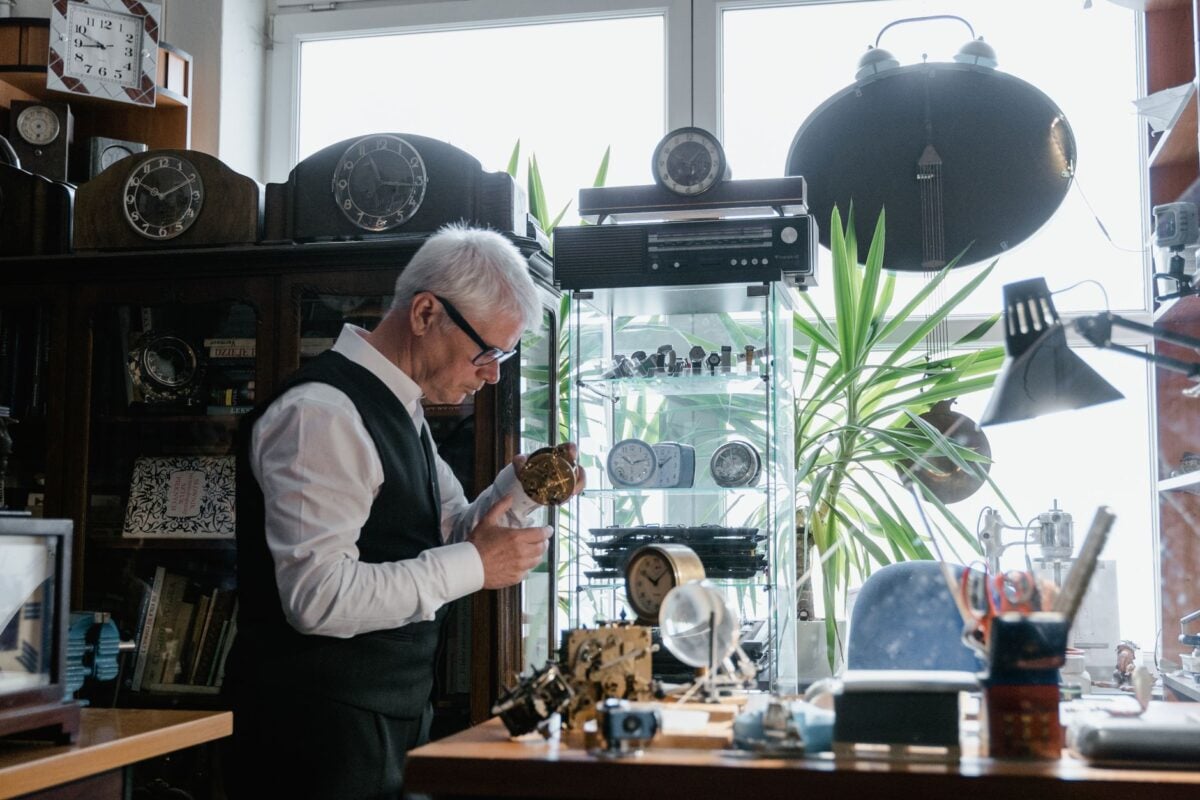
Every Sunday morning for eleven years, before the coffee and before church, I have stood on my hearth rug in Weldon Crossing, Indiana, and wound a clock that belongs to a boy who does not live here anymore.
It is a black Seth Thomas mantel clock, eight-day movement, strikes the hour and the half. My father bought it secondhand in 1961 for four dollars and a repaired barometer.
It sat on his mantel, then on mine, and by the time my son was six years old it had become his. Not in any way a court would recognize. In the way that matters inside a house. He was the one who was allowed to wind it.
You use a crank key that fits two square arbors behind the dial. Left hole for the time, right hole for the strike. Eight slow turns on each side, and you stop when the spring tells you to stop, and you never force the last quarter turn. A clock is not a thing you win an argument with.
I have done it five hundred and seventy-two Sundays now. I know the number because I counted once, on a bad night, the way a more devout man might count beads.
Get a new story in your inbox every morning.
Facebook doesn’t show you every story we post. Our free newsletter does. Join 2,500+ readers.
I am seventy-one years old. I have repaired clocks and watches for a living since I was nineteen.
My shop sits on Main Street between Brandt Feed and Seed and the Farmers Bank, and the sign over the door says Rennick and Son in gold leaf that my father paid a man from Terre Haute to paint in 1974. I never had the Son painted out.
It was not sentiment. It was cowardice, and I will get to that.
I am telling you about the winding first because I was not a man who did not care. I was something worse. I was a man who cared a great deal and had made a rule against showing it.
My wife, Delphia, used to say that Tobin came out of the womb listening.
He did. He was a quiet baby, and then a quiet boy, but he had ears on him.
When he was five, he stood in the middle of my shop, with forty clocks ticking on the walls and the bench, and pointed at a Gilbert regulator on the far wall and said, “That one’s limping.”
A five-year-old had heard what I would have needed a timing machine to confirm.
So I started him young, the way my father started me. At nine he cleaned pivots with pegwood. At twelve he was setting jewels under my loupe.
At fourteen he took a Waltham pocket watch apart on his own and put it back together, and when he wound it and it ran, he looked up at me with a face I can still see. I told him, “Good.” That was all.
I thought a word was plenty.
But Tobin had another thing in him, and I did not take it seriously.
Delphia taught piano out of our front room for thirty-one years, and Tobin grew up under it. Scales, hymns, the Methodist hymnal worked through twice.
At eleven he found my brother’s old Harmony guitar in the church basement, and by thirteen he was playing it on the porch in the evenings, and then songs he made up himself. They were not bad. I did not say they were not bad.
I said, “Don’t leave that where I’ll step on it.”