
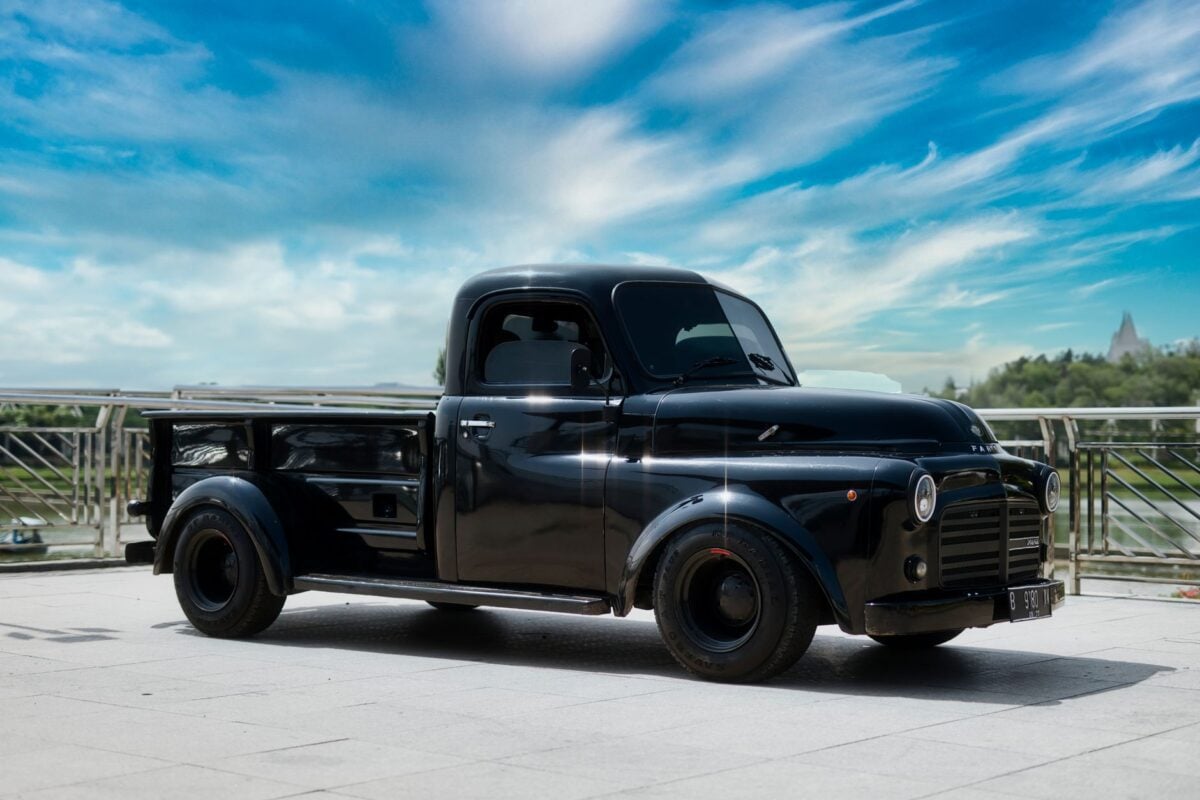
The salesman walked me around the back of the lot, past a row of minivans with their prices soaped on the windshields, and stopped in front of a sky blue and white 1978 Ford.
“That’s the one you called about,” he said. “Dale will be out in a minute.”
I did not answer. I was already walking toward it.
I knew it from forty feet away, down to the way the white roof met the blue at the drip rail, because my son had taped that line four times before he was satisfied.
I laid my hand flat on the hood. It was warm from the sun, and for a second I could not make myself take it off.
“Ma’am?” the salesman said. “You all right?”
Get a new story in your inbox every morning.
Facebook doesn’t show you every story we post. Our free newsletter does. Join 2,500+ readers.
“That fender,” I said. “He sanded it by hand. All one July.”
The salesman had the sense not to ask who he was. I had come to Tulsa with a purse, my checkbook, and a plan that was mostly nerve.
I did not know yet whether the lot would deal. I only knew I could not leave without it.
Let me back up and tell it the way it happened, because the truck was only the end of it.
My name is Margo Hale. I am forty-nine years old, and I work the front counter at a tire shop in Claremore, Oklahoma, where I have been writing up flats and rotations for nineteen years.
My son is Cody. He is twenty-two, a lance corporal in the United States Marine Corps, and at the time of this story he was nearly a year into a deployment that kept him a long way from home.
His father left when Cody was nine. I will not say more about that, because it does not matter here. What matters is who stepped in.
My father, Elwood Schott, drove a feed truck for the co-op for thirty-one years. He had big knuckles, a bad hip, and a steel toolbox of Craftsman wrenches he had carried since before I was born.
Daddy never talked much. He handed Cody a wrench and let the boy figure out what it was for.
The summer Cody turned sixteen, Daddy bought a 1978 Ford F-150 from a widow outside Foyil for eight hundred dollars.
It had a cracked block, no floor on the passenger side, and a family of mice living in the glove box.
“That’s yours if you want it,” Daddy told him. “I’ll show you how. I won’t do it for you.”
Cody wanted it. They worked on it three summers. The first summer they pulled the engine and found out how bad it was.
The second summer, Daddy’s hip put him in a lawn chair, and he sat in the barn and pointed.
The third summer Daddy was gone. He died that February, the winter after the second summer, of his heart. It was quick, the doctor told me, and I have tried to take comfort from that.
At the funeral Cody did not cry. He stood by the casket in a suit that was too short in the sleeves and said, “I’m going to finish it, Mom.”
And he did. He finished it alone, with Daddy’s steel toolbox open on the barn floor and Daddy’s handwriting still on the masking tape stuck to the drawer fronts.