
The first thing I saw that morning was the gulls.
There were dozens of them walking on the sand below Hazel’s house, and gulls do not walk on that beach unless something is lying there for them.
Then I saw the black wire cages, lined up in rows like somebody had parked them.
Our oyster cages, the whole longline of them, sitting high and dry above the waterline.
I stood at the top of the path with my coffee going cold in my hand.
It was a quarter past seven on a Tuesday in September, and the sun was already warm on the back of my neck.
Two hundred cages. That was the whole lease. That was every oyster my mother-in-law had to sell this fall, and every one of them was lying on the sand in the open sun.
I set the coffee mug down on a fence post and went down the path so fast I slid on the pine needles.
Get a new story in your inbox every morning.
Facebook doesn’t show you every story we post. Our free newsletter does. Join 2,500+ readers.
The tide was out. The creek had pulled back almost to the channel.
Out where the line should have been, the two anchor buoys were bobbing by themselves.
Somebody had cut the line loose at both ends, towed the whole thing in on the last of the high water, and dragged it up.
There were tire tracks in the sand. Big lugged tracks, a tractor, coming down the old boat ramp from the next point and swinging back up.
I knew that tractor. Everybody on the creek knew that tractor.
It was Clayton’s. My husband’s uncle. Hazel’s brother-in-law. The man who lived on the next point over with his long gray pier and his skiff and a grudge he had been carrying since before I was married.
The Lease
I should tell you what we had, so you understand what was lying on that sand.
My father-in-law started the cages eleven years ago. Everybody called him Pop, even people who were not family.
He had worked the water his whole life, tonging and crabbing, and when the wild oysters got scarce he went to growing them.
He leased bottom from the state on our side of the creek, put in a longline with an anchor at each end, and clipped on floating cages one at a time as he could afford them.
Each one cost him close to a hundred dollars, floats and all.
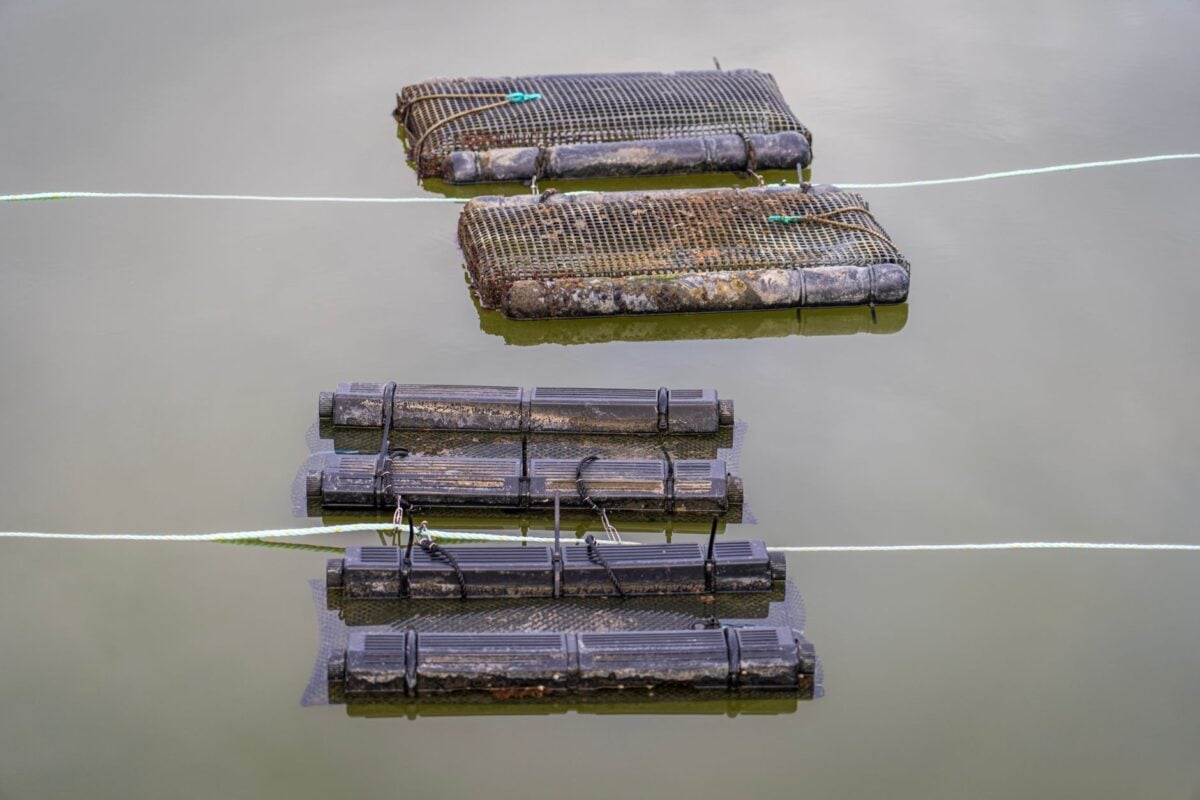
A floating cage is a coated wire mesh box that rides at the surface on its floats. Inside are mesh bags of oysters.
The cage rides low in the water, where the water moves and the oysters feed on whatever the tide brings them.
Once a week or so you flip them so the bags ride up out of the water for a day.
The air and sun kill the barnacles and the slime that grow on the mesh. The oysters close up tight and wait. Then you flip them back down.
That is the trick of it. A day of drying while the cage floats in cool creek water is good for them.
A day lying on hot sand with no water under them is something else entirely. That is an oven.
Pop died two years ago in March. He had a heart attack in the skiff, tied to the end of the line, and Hazel found him when he did not come up for dinner. She had not set foot in the creek since.
Hazel is seventy-one. She has a little bit of Social Security and that lease. That is her living.
The oysters go to a wholesaler in Gloucester and to two raw bars that buy from us every fall.
I married her son twenty-four years ago. He works on a tugboat out of Norfolk, two weeks on and two weeks off, and that Tuesday he was somewhere past the bridge-tunnel with a barge on the hawser and no way off.
So when Pop died, I took the lease over with Hazel.
I do the work and she does the books, and my daughter Kinsey, who is nineteen, runs the skiff for us when she is not at the community college.
That fall we had about four hundred market oysters to a cage, give or take. At sixty cents apiece wholesale, that comes to right around forty-eight thousand dollars.
It sounds like a lot until you know it is a year of living for a widow.