
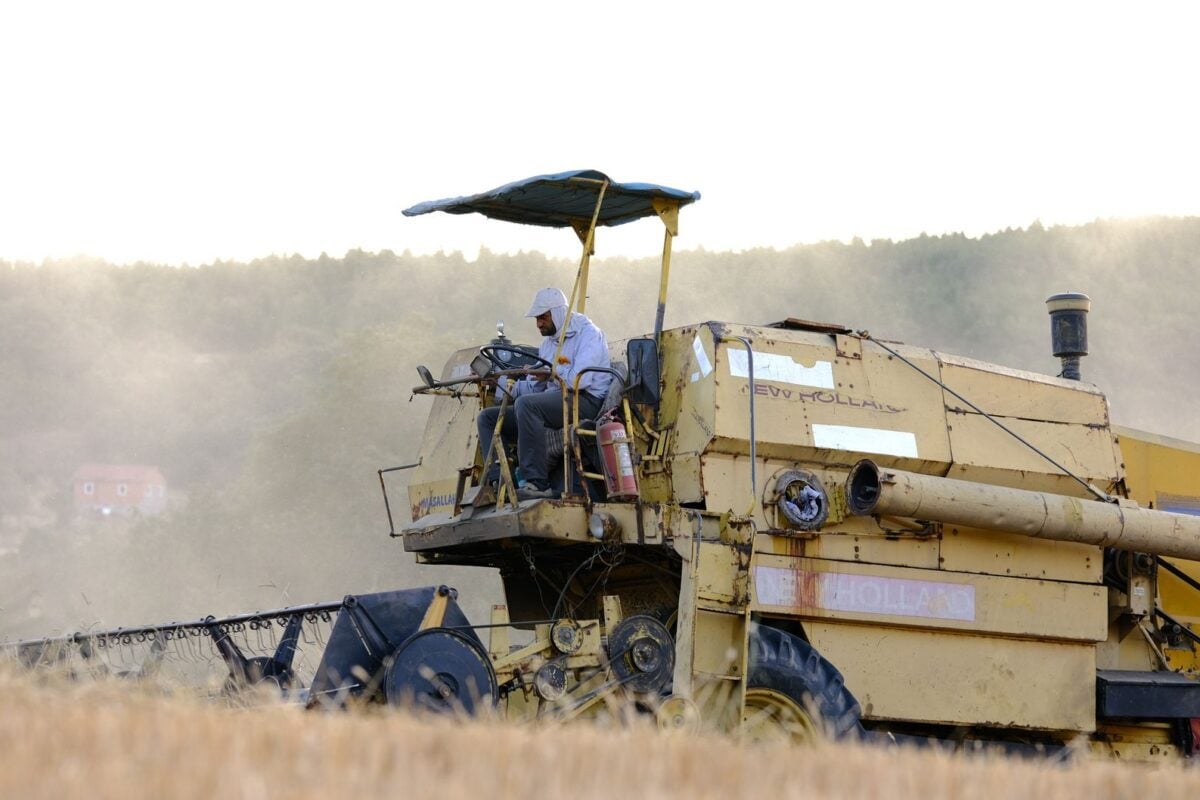
The bidding on my husband’s combine stopped at thirty-one thousand dollars, and the field went so quiet I could hear the flag rope slapping the pole by the clerk’s trailer.
Vance Ostrem had the microphone in one hand and his other hand up in the air, palm out, the way auctioneers hold it when they are begging a crowd without saying so.
“Thirty-one, now thirty-two, who’ll give me thirty-two,” he chanted, and nobody did.
I was standing at the end of the row by the grain cart, holding a cup of coffee that had gone cold an hour before.
I had known that number would be bad. I had not known it would be that bad.
Thirty-one thousand dollars was what a man might pay for a combine with a blown engine and no head.
Get a new story in your inbox every morning.
Facebook doesn’t show you every story we post. Our free newsletter does. Join 2,500+ readers.
This one had a thirty-foot flex head on the front of it, a good engine, and new chain in the feeder house.
And at the edge of the crowd, with his arms crossed over a gray quarter-zip and a black cap pulled low, stood my late husband’s son, Trent, waiting for the hammer to fall on his number.
I should back up, though not very far.
My husband, Orrin Habeck, died the September before, at sixty-one, of a heart attack in the machine shed while he was greasing the very combine they were now trying to give away.
I found him at noon when he did not come in for dinner.
We had farmed four hundred and eighty acres of corn and beans six miles out of Blue Earth, in southern Minnesota, for twenty-six years.
It was his dad’s ground first. Orrin brought me to it when I was twenty-seven and he was thirty-four, with a little boy of his own already.
That little boy was Trent. He was ten when I married his father.
His mother had moved to Mankato and then to Sioux Falls, and Trent spent summers and every other weekend with us until he finished high school.
I will say this plainly before I say anything else. I loved that boy. I packed his lunches. I drove him to wrestling meets in January in a pickup with no heat.
I never once tried to be his mother, because he had one, but I tried hard to be someone.
He never warmed to me, and I stopped expecting him to around the time he turned fifteen. That is not a crime.
Plenty of boys never warm to a stepmother, and plenty of stepmothers learn to live with a polite boy at the supper table.
When Orrin died, the farm came to me. That was how Orrin and I had set it up years before, the way most married couples do, with the understanding that someday the land would pass on down.
Trent had always known it. He had never said a word against it while his father was alive.
But I am fifty-four, and I could not farm four hundred and eighty acres alone. I drove combine. I drove grain cart.
I could run the planter if somebody else filled it. What I could not do was everything, alone, every day, with my back the way it is.
So in the spring I rented the ground to a young couple from over by Frost, who were starting out and needed the acres.