
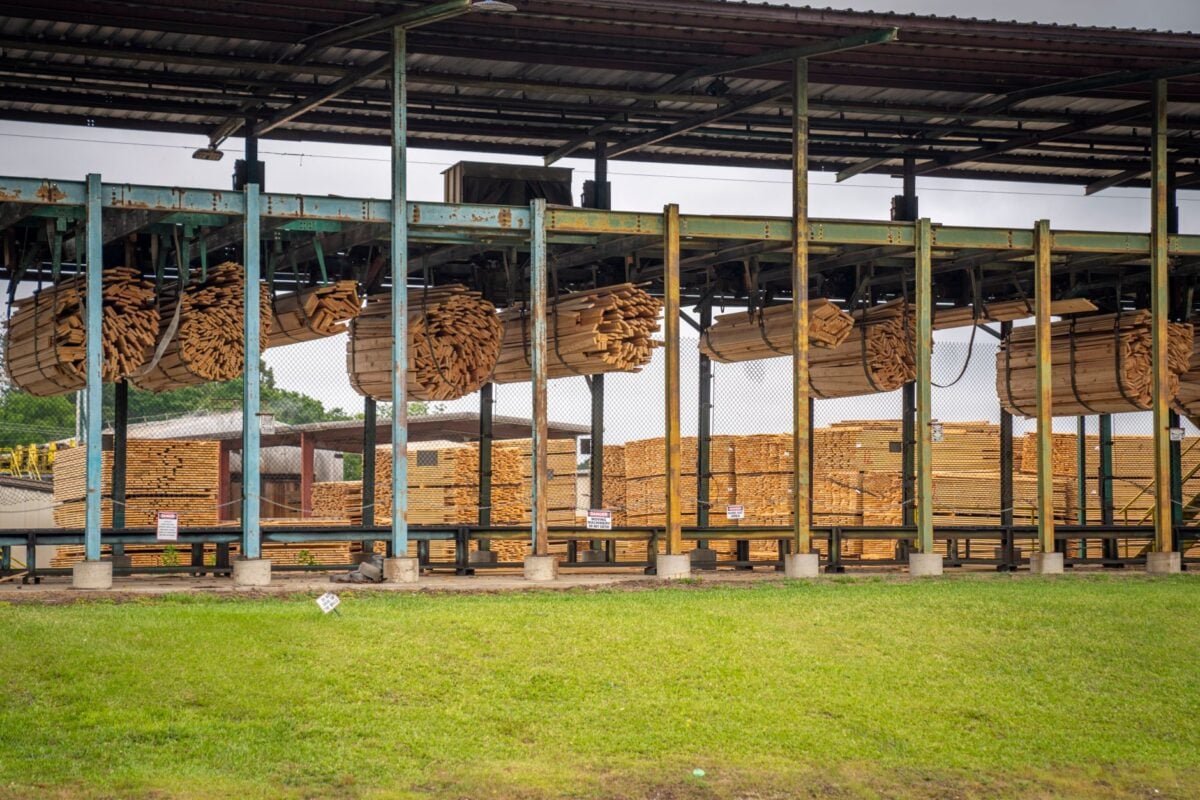
The skid steer had the power unit up on its forks before I got my boots laced.
I came out of the house on a bright cold Saturday morning and there it was, our diesel engine, swinging a foot off the ground in front of the mill shed.
Charla Pike stood beside the trailer with her arms folded. She had a manila envelope tucked under one of them. Her son Asa was on the skid steer, and he did not look at me once.
“Morning, Lacey,” Charla said. “I’m not here to fight. I’m here for my engine.”
It was the first Saturday in November. My husband Tom had been gone four months. His stroke came in June, in the hayfield, and he lived nineteen days after it, most of them not knowing my name.
Get a new story in your inbox every morning.
Facebook doesn’t show you every story we post. Our free newsletter does. Join 2,500+ readers.
I walked down the slope toward the shed. The frost was still white in the shade of the lumber stacks. The empty engine mount sat there with its four bolts lying loose on the planks.
“Charla,” I said. “You took the bolts out before you knocked.”
“I knocked,” she said. “Nobody answered.”
Asa set the power unit on the trailer deck as gently as you would set down a sleeping baby.
He was thirty years old, Tom’s oldest, with his father’s long arms and his father’s way of chewing the inside of his cheek when something was wrong.
“Asa,” I said. “Your dad bolted that down himself.”
He climbed off the machine and went to work with the chains and the binders. He still did not look at me. The ratchet clicked across the yard, loud in the cold.
Charla opened the envelope and held a paper out to me. It was a photocopy of a receipt from 1998, so faded I had to tilt it to the sun.
A four-cylinder diesel power unit, used, six thousand two hundred dollars, paid in cash.
“That was my money,” she said. “I waited tables at the diner on Route 7 for three years, doubles, to put that cash together. Tom put it on his mill, and when he left, he kept the mill and I kept the kids.”
I knew some of that story. Tom never hid it. He and Charla had married young and divorced hard, in 2006, and he had paid his support every month, but there had been years in between when nobody had much.
“You had him fourteen years,” Charla said. “I had him the years that cost something. I’ll take what I paid for.”
I want to tell you that I said something wise. I did not. I stood there in my barn coat with my hands in my pockets and I said, “I have an order on that mill.”
“Then you’d better find another engine,” she said.
The order was the thing.
Noah and Brielle Kittredge were twenty-eight and twenty-seven. They had bought six acres out toward Salisbury and were building their first house themselves, nights and weekends, with Noah’s father helping on the framing.
They had come to the mill in September with a coffee can full of cash and a drawing on graph paper.
They wanted white oak floors. Brielle’s grandmother had white oak floors, and Brielle said they were the only floors she ever remembered sitting on.
We had the logs. Tom had bought a load of white oak off a woodlot in Cornwall the winter before he got sick, good straight butt logs, and they had been sitting on the log deck under a tarp since spring, waiting for someone who would love them.