
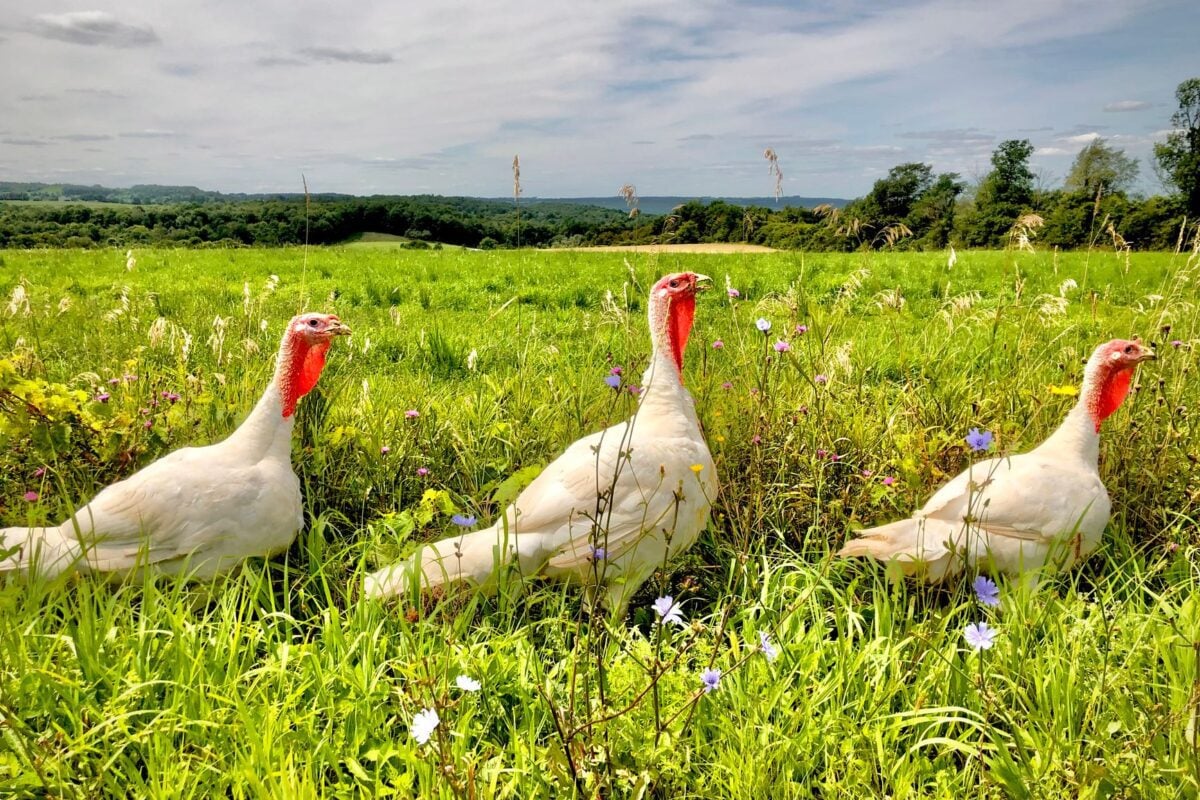
The pasture gate was standing wide open when I came around the corner of the red barn, and for about two seconds my mind would not tell me what was wrong.
Then it did. The pasture was empty. Three hundred big white turkeys had been in there at seven that morning, crowding the feeders, and now there was nothing but trampled grass and a few loose feathers.
I set down the two buckets of grower pellets I was carrying. The low sun was coming across the yard sideways, gold and cold, and I could hear my own breath.
Ellery came up behind me. She is fourteen, my oldest, with her dad’s dark hair and a green hoodie she has worn so long the cuffs are frayed to strings. She had her hands jammed in the front pocket.
Get a new story in your inbox every morning.
Facebook doesn’t show you every story we post. Our free newsletter does. Join 2,500+ readers.
“Mom,” she said. “Brandi opened it.”
I turned and looked at her. She was white around the mouth, the way she gets when she has been holding something in. “She opened the gate?”
“She got out of the car after we did. She walked over and took the chain off and swung it all the way back. I told her not to. I said, Mom needs that shut.”
“What did she say to you, honey?”
Ellery looked at the ground. “She said, Your mom can handle it. She handles everything.” She swallowed. “Then she got back in and drove off. I’m sorry. I should have shut it.”
“You did nothing wrong,” I said, and I put my hand on the back of her neck, the way I did when she was little. “Nothing. You hear me? Go get your brother and sister. Tell them to put their boots on.”
Three Hundred Birds and a Spiral Notebook
I should tell you what was walking around loose that morning, because it was not just birds.
My name is Gretta Solheim. I am thirty-nine years old, and I raise pastured turkeys on eighty acres of my grandparents’ old place outside Fergus Falls, in west central Minnesota. During the school year I also work as a para at the elementary, helping kids who need an extra adult.
Every June, three hundred day-old broad-breasted white poults come to me from a hatchery in boxes with air holes. The post office calls at six in the morning, and I drive in and pick up a peeping box from the back dock.
They spend their first weeks in the brooder under heat lamps. After that they go out on pasture with a woven wire fence, a strand of hot wire on top, and four roost shelters on skids that I pull to fresh grass with the tractor.
By November they are big. The hens dress out somewhere between sixteen and twenty two pounds. The toms go heavier, and some of them top thirty, which is why I tell people with small ovens to order a hen.
Every one of those three hundred birds is sold before it ever hatches. Families call me in the spring and summer, and I write their names in a green spiral notebook that lives on top of my refrigerator.
They pay a twenty dollar deposit. The rest is four dollars and fifty cents a pound at pickup, so a twenty pound hen comes to ninety dollars. All together it is around twenty seven thousand dollars, before feed and the locker plant take their share.
That money is my year. It is the property tax, the propane, the kids’ school shoes, the truck payment, and the feed bill that comes due every three weeks when the truck fills my bin.
But at the gate I was thinking about the names in that notebook. The family out by the lake who has ordered since the first year. The young couple hosting their first Thanksgiving. The widow in town who buys my smallest hen and makes it last a week.
Three hundred families. Every one of them was counting on a bird that, at that moment, I could not see.