
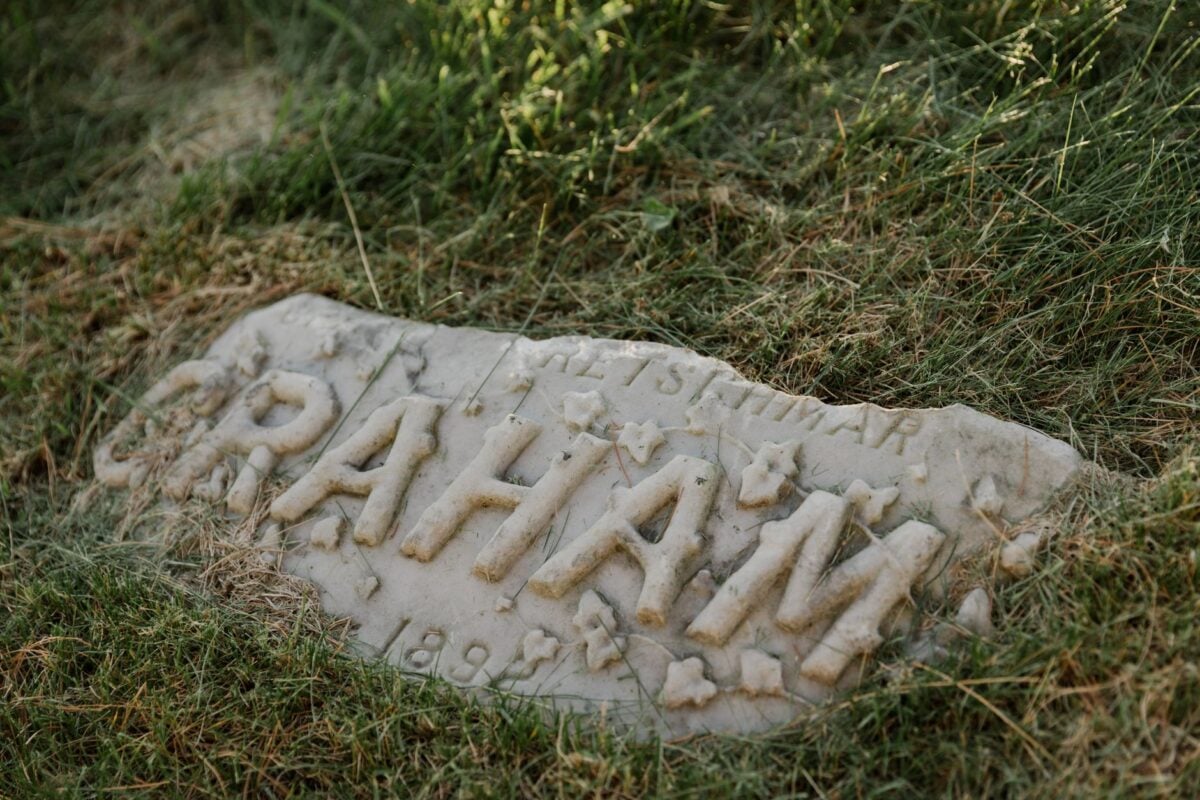
Memorial Day was warm that year, and Mom was on her knees again in the Onawa cemetery, pulling quack grass away from a tin marker the size of a license plate.
The marker said Harlan Vollmer and two dates on a typed card behind a little plastic window. The funeral home stakes them in the ground after a burial. They are meant to stand a few months.
Ours had stood six years. The card had faded so pale you had to bend close to read Dad’s name. The stake leaned toward the cornfield every spring after the frost let go.
“Mom, let me do that,” I said. I was 56 that summer, and my knees were not much better than hers, but she was 83 and I could not stand to watch it.
“I’ve got it, Nadine,” she said. She always said that. She tore the grass loose, laid it in a neat pile, and patted the dirt flat like she was tucking him in.
Get a new story in your inbox every morning.
Facebook doesn’t show you every story we post. Our free newsletter does. Join 2,500+ readers.
Across the cemetery, families were setting out peonies and little flags. The cedars along the west fence threw long shade. Everybody’s people had a stone with a name cut in it. Dad had a card behind plastic.
My brother Kurt had driven up at eleven, stood with us for ten minutes, and left. Before he went, Mom asked him the question she had asked every Memorial Day since Dad died.
“Any word on the stone, Kurtis?”
“They’re still backed up, Mom,” he said, looking at his phone and not at her. “Granite’s hard to get. I’ll call them Monday.”
He kissed her cheek and walked to his truck. Mom watched him go. Then she went back to the grass, and her white hair blew a little in the wind off the fields.
I stood there with a coffee can of peonies in my hands and did arithmetic in my head. Six years. No monument company in Iowa is backed up six years.
I think that was the day I stopped pretending I believed him.
You need to know who my dad was, or none of this makes sense.
Harlan Vollmer ran a motor grader for the Monona County road department for 31 years. He started in a cab with no heater and finished in one with a radio he never turned on.
He knew every gravel road in the north end of the county by the way it washboarded. He could tell you which hill drifted shut in a northwest wind and which culvert would back up in a June rain.
In winter he ran the wing plow before daylight so the milk trucks and school buses could get through. Farm wives used to leave thermoses of coffee on their mailboxes for him. He brought the empty ones back washed.
He was not a talker. He would come home, hang his orange vest on the nail by the back door, wash up to the elbows, and eat whatever Mom set down without one word of complaint.
But if you rode with him, which I did a handful of Saturdays as a girl, he would point at a road and say, “Your mother’s cousin lives down there. I put that crown in it in ’79.” He was proud of his roads.