
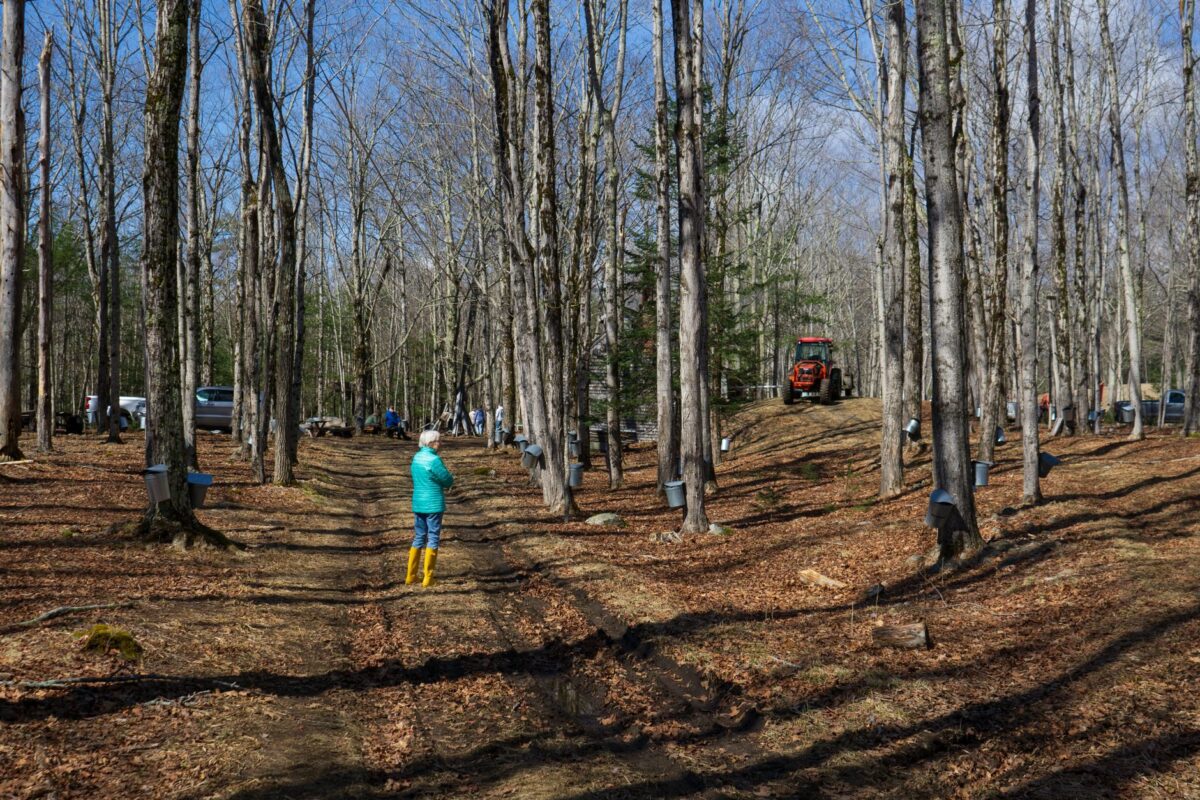
I found the stumps on my mail route on a Tuesday in February, a little after ten in the morning, with the sun on the snow so bright I had to squint to be sure of what I was seeing.
There were fourteen of them along the town road below Dad’s house. Fresh cut, flat and pale as dinner plates, with sawdust sprayed out across the snowbank in a fan the color of oatmeal.
I stopped the car right there in the road. I drive my route from the passenger side of my own car, the way most rural carriers do up here, and I sat with the mail tray in my lap and my hand still on a bundle of seed catalogs.
Those were the oldest maples on the farm. Dad called them the road row. His grandfather tapped them in 1890, when they were already big enough to take two buckets apiece, and there is a photograph of him beside one of them in our front hall.
Now there were stumps, and a pile of tops and limbs pushed back into the woods, and the deep tracks of a loader where somebody had swung the logs up onto a truck.
Get a new story in your inbox every morning.
Facebook doesn’t show you every story we post. Our free newsletter does. Join 2,500+ readers.
I knew whose loader it was. I knew before I let myself think it.
My sister Jana’s husband, Corbin Tatro, had leased Dad’s sugarbush for two seasons. He paid $900 a year for the hill, on a handshake at Dad’s kitchen table, and he ran it on tubing and vacuum for a big commercial syrup outfit over toward the lake.
I finished my route. I want to say that first, because it is the kind of thing people up here notice. I had 412 boxes that day and every one of them got its mail, and I did not cry in front of a single customer.
But I drove the last eleven miles with my jaw so tight my teeth hurt.
My name is Kristen Aldrich. I am 44 years old, and I have carried the mail out of our little post office in Caledonia County for nineteen years. I know every mailbox, every dog, and every frost heave between our house and the county line.
And I know my father. Lyman Aldrich is 88 years old. He sugared that hill for sixty years. He tapped his first tree at nine and he did not stop until his knees gave out three springs ago and he could not get up the slope with a gathering pail anymore.
That was the only reason he leased it. Not for the money. Nine hundred dollars a year does not change much for a man who has lived on a farm since Truman. He leased it because he could not stand the thought of the trees going untapped.
He said once that a maple nobody taps is like a cow nobody milks.
When I pulled into Dad’s dooryard that afternoon the sun was still high and the snow was going soft in the ruts. He was sitting on the porch in his tan barn coat with his gray wool cap pushed back, the way he sits when he is watching the road.
He had seen them. Of course he had. The road row is right below the house. He had watched the whole thing happen from his kitchen window the day before, and he had not called anybody.
“Dad,” I said. I stood at the bottom of the porch steps with my keys still in my hand. “Did Corbin ask you?”